


“Let there be lights in the dome of the sky, to separate day from night. Let them mark the seasons, the days and the years, and serve as lights in the dome of the sky, to illuminate the earth. And so it happened: God made the two great lights, the greater one to govern the day, and the lesser one to govern the night, and the stars” (Gen. 1:14-16).
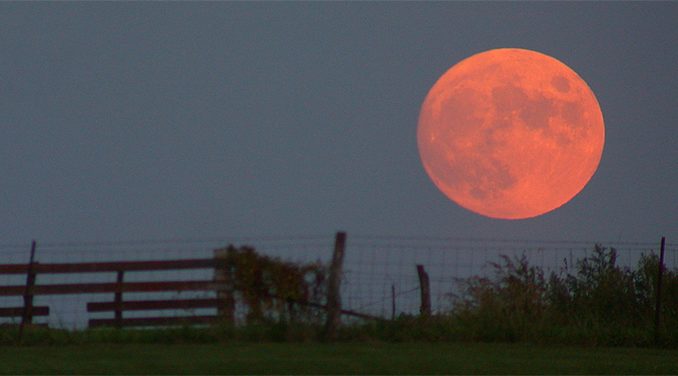
My guess is that most people, in today’s light-switch world, don’t pay too much attention to the sun and moon. This week, however, may afford both celestial bodies a little more attention. The weekend of October 24-25 was the full moon known as “Hunter’s Moon.” The weekend of October 31-November 1 returns most of the United States to standard time and to turning back the clock one hour.
Walking to work even after the weekend, I watched this full, fat moon setting in the morning. Hunter’s Moon (the second full moon of the fall) and Harvest Moon (the first) are somewhat unique phenomena, because they tend to be bright, rise almost at sunset, and shine all night. In a less commercial and industrialized world, their names came from their importance: Harvest Moon prolonged the light so that farmers could finish their harvests, while Hunter’s Moon lighted the forests so men could still bag game ahead of the winter. When human survival depended on the harvest of the fields and the bounty of the forest, Genesis’s reminder that “the lights in the dome of the sky” performed invaluable services in marking “the days and the years.”
It’s just another illustration of the Divine Providence that made the Psalmist exclaim, “What is man that you care for him?” (8:4).
Most folks probably passed by Hunter’s Moon with little notice, other than “it’s a pretty big moon!” The switch back to standard time, however, is likely to garner more attention, some of it negative.
For some time, there have been efforts to abandon the twice-a-year clock change and to install year-round daylight saving time. The House of Representatives adopted the “Sunshine Protection Act” in July by a bipartisan 308-117. It sits in the Senate.
Not since Joshua commanded the sun and moon to stop in their tracks (Joshua 10:12-14) have human beings attempted to “protect” the sun in its course … and, with all due respect, these politicians are no Joshuas. The truth is that, just as we cannot add a moment to our lives, neither can we do so to the day. The length of the average day in early January is almost eleven hours in Florida (many of the “Sunshine Protection Act’s sponsors are from the Sunshine State). However you slice and dice it, Boston is going to get 9.5 hours of daylight in January and New York maybe ten minutes more.
The last time Congress imposed year-round daylight saving time was in 1974, ostensibly to “save energy.” The public rebelled, largely because children across much of America found themselves going to school in the mornings in the dark, and parents considered that dangerous. Were kids safer walking to school in the dark in the morning, when drivers might still be sleepy, or after school (if they stayed, for example, for sports until the sun set)?
What is surprising is that the consideration of children seems considerably more muted in the current debate. Is it because parents don’t care about their children going to school in the dark? I don’t think so. I suggest, rather, its absence reflects the decentralization of child considerations from many public policy debates today.
With our plummeting fertility rates and shrinking families, more and more Americans spend more and more of their adult lives away from children. In such an environment, considerations about children garner less attention.
Consider Washington, DC, where I currently live. Finding an apartment with more than two bedrooms is practically impossible. I’ve listened to young women on the Metro scoping out new apartments; their focus was on the dog walk, not a park for kids. Are we surprised that school schedules are getting less attention in the year-round daylight saving time debate?
“Well,” some might say, “just start school later!” There’s even a push, especially in public schools, arguing that young people don’t get enough rest, and so the opening bell in the morning should be later.
That’s a facile solution because a child’s schedule is rarely autonomous (nor should it be). Are we also ready to give parents flexible morning start times so they can see their child off to school? There are parents who deliver their child to school by walking, driving, or taking them to the bus. When kids’ schedules change, it has an impact on parents–especially when there’s a certain backlash to “get back to the office!” and “start earlier/work later!” We can hardly tamper with children’s schedules while pretending parents have no interest in, or are unaffected by, the change.
Again, no matter how you cut it, for much of America in the depths of winter, there are roughly nine hours (ten at best) of daylight. The time on the clock is arbitrary: we could “schedule” daytime from 2 am to noon! But our “protection” of sunshine remains limited by its amount, whose quota is not open to political giveaway.
Perhaps Americans have decided they prefer daylight at the back end of the day rather than the start. Perhaps Benjamin Franklin’s injunctions about the merits of “early to bed, early to rise” belong to another era. Perhaps–though I doubt we’d admit it–we are no longer that worried about children’s safety on dark winter mornings. Perhaps.
But before we commit ourselves to a policy, one of whose collateral effects may very well be marginalizing the “child calculus” impact of that decision–either on safety or on further separation of parental and child schedules in favor of state and economic orderings–we consciously assess what’s at stake.
After all, Genesis tells the sun and moon to govern man’s earth, not man to govern the sun and moon.
If you value the news and views Catholic World Report provides, please consider donating to support our efforts. Your contribution will help us continue to make CWR available to all readers worldwide for free, without a subscription. Thank you for your generosity!
Click here for more information on donating to CWR. Click here to sign up for our newsletter.




Leave a Reply