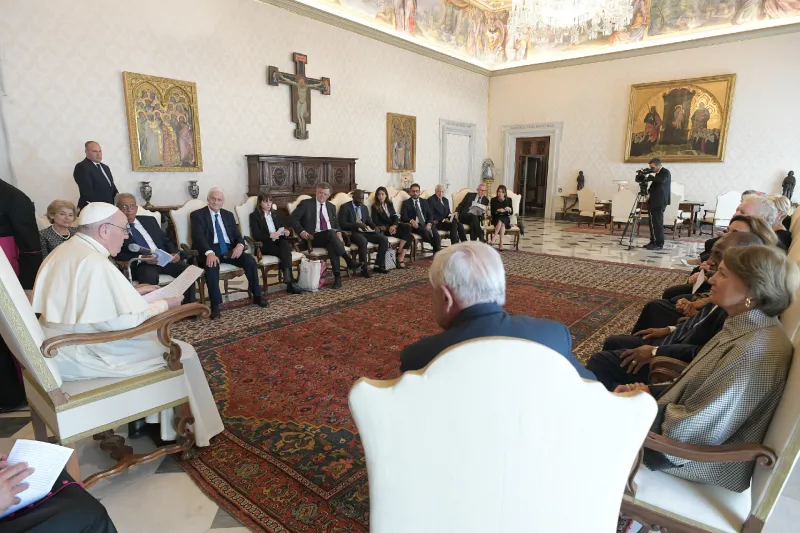
Pope Francis meets with members of Leaders Pour la Paix at the Vatican on Sept. 4, 2021. / Vatican News/CNA
Vatican City, Sep 4, 2021 / 07:05 am (CNA).
Pope Francis said Saturday that politics needs a renewal after the pandemic through the promotion of a culture that prioritizes human dignity.
“The pandemic, with its long aftermath of isolation and ‘social hypertension,’ has inevitably also challenged political action itself, politics as we know it,” Pope Francis said on Sept. 4.
“It is therefore a question of working simultaneously on two levels: cultural and institutional,” he said.
The pope told members of the organization, Leaders Pour la Paix (Leaders for Peace), that helping others to understand the root causes of problems can be considered an “education for peace.”
“It is important to promote a ‘culture of faces,’ which places the dignity of the person at the center, a respect for his or her story, especially if they are wounded and marginalized,” he said in an audience with the group at the Vatican.
“It is also a ‘culture of encounter’ in which we listen to and welcome our brothers and sisters, with trust in the reserves of good that are in the hearts of the people.”
Leaders Pour la Paix is an organization founded by the former French Prime Minister Jean-Pierre Raffarin that brings together high-level government representatives from around the world.
U.S Secretary of State Antony Blinken and Ban Ki-moon, former secretary-general of the United Nations, are among the its board of leaders, along with Kamal Kharazi, the former Iranian foreign minister, and Quan Kong, a member of the Central Committee of the Chinese Communist Party.
The group of 36 world leaders aims to reduce conflicts through prevention by alerting public opinion and decision-makers on risky situations and their consequences, according to its website.
Pope Francis meets with members of Leaders Pour la Paix. Vatican Media/CNA
Pope Francis encouraged the members of the organization to pursue peace through multilateral institutions.
“It is urgent to encourage dialogue and multilateral collaboration, because multilateral agreements better guarantee the protection of a truly universal common good and of the weakest states than bilateral ones,” he said.
The pope underlined that this is “a particularly critical historical moment” in which the pandemic has not yet been overcome and its economic and social consequences are weighing heavily on “the lives of the poorest.”
“Not only has it impoverished the human family of many lives, each one precious and unrepeatable; it has also sown much desolation and increased tensions,” Francis said.
“Faced with the worsening of multiple converging political and environmental crises – hunger, climate, nuclear weapons to name a few – your commitment to peace has never been so necessary and urgent.”
If you value the news and views Catholic World Report provides, please consider donating to support our efforts. Your contribution will help us continue to make CWR available to all readers worldwide for free, without a subscription. Thank you for your generosity!
Click here for more information on donating to CWR. Click here to sign up for our newsletter.
Thomas Sternberg and Bishop Georg Bätzing at the Synodal Way’s second Synodal Assembly in Frankfurt, Germany, Sept. 30, 2021. / Synodaler Weg/Maximilian von Lachner.
Frankfurt, Germany, Oct 1, 2021 / 12:00 pm (CNA).
Participants in the German Ca… […]
Pope Francis prayed before a relic of St. Therese of Lisieux at the beginning of his general audience in St. Peter’s Square, and shortly before going to the hospital for an abdominal surgery, on June 7, 2023. / Daniel Ibanez/CNA
Vatican City, Jun 7, 2023 / 04:37 am (CNA).
One of Pope Francis’ last gestures before undergoing abdominal surgery on Wednesday was to pray before a relic of St. Therese of Lisieux.
A relic of the French Carmelite nun, also known as St. Therese of the Child Jesus, was present on the platform in front of St. Peter’s Basilica during the pope’s weekly general audience June 7.
Before beginning the audience, Francis venerated the relics of St. Therese in a moment of silent prayer. He also placed a single, white rose on the table in front of the reliquary.
Pope Francis was taken to Rome’s Gemelli Hospital for abdominal surgery under general anesthesia at the end of the morning audience, shortly after 11:00 a.m. Rome time, the Vatican said.
Relics of St. Therese’s parents, Sts. Louis and Zélie Guérin Martin, were also present at the meeting with the public June 7. The relics of all three saints will visit different churches in Rome through June 16.
Relics of St. Therese of Lisieux and her parents, Sts. Louis and Zelie Guerin Martin, were on the platform in front of St. Peter’s Basilica during Pope Francis’ general audience June 7, 2023. The relics made a pilgrimage to Rome June 6-16, 2023. Daniel Ibanez/CNA
Pope Francis said Wednesday he intends to publish an apostolic letter on St. Therese of Lisieux, “patroness of the missions,” to mark the 150th anniversary of her birth.
“She was a Carmelite nun who lived her life according to the way of littleness and weakness: she defined herself as ‘a small grain of sand,’” he said in St. Peter’s Square.
“Having poor health, she died at the age of only 24,” he added. “But though her body was sickly, her heart was vibrant, missionary.”
“Here before us are the relics of St. Therese of the Child Jesus, universal patroness of missions,” he said. “It is good that this happens while we are reflecting on the passion for evangelization, on apostolic zeal. Today, then, let us allow the witness of St. Therese to help us. She was born 150 years ago, and I plan to dedicate an apostolic letter to her on this anniversary.”
🎥HIGHLIGHTS | Before commencing the General Audience in St. Peter’s Square, Pope Francis shared a beautiful moment of prayer before the sacred relics of St. Therese of Lisieux, Doctor of the Church and Patroness of the Missions. As a symbol of his devotion, the Holy Father… pic.twitter.com/lRJeWuSx8n
St. Therese of Lisieux was born on Jan. 2, 1873, in Alençon, France. Her mother died when she was four, leaving her father and older sisters to raise her. She received papal permission to enter the Carmelite Monastery at the young age of 15, where she lived until her death from Tuberculosis at the age of 24.
She was proclaimed a Doctor of the Church by St. Pope John Paul II in 1997 and is the patron saint of missions.
Pope Francis reflected on the saint’s life as part of a series of lessons on evangelical zeal.
“She is patroness of the missions, but she was never sent on mission,” Francis explained in his catechesis. “She recounts in her ‘diary’ that her desire was that of being a missionary, and that she wanted to be one not just for a few years, but for the rest of her life, even until the end of the world.”
St. Therese did this, he said, by becoming a spiritual sister to several missionaries, whom she accompanied through her prayers, letters, and sacrifices from within the monastery walls.
“Without being visible, she interceded for the missions, like an engine that, although hidden, gives a vehicle the power to move forward,” the pope said.
“Missionaries, in fact — of whom Therese is patroness — are not only those who travel long distances, learn new languages, do good works, and are good at proclamation,” he added. “No, a missionary is anyone who lives as an instrument of God’s love where they are.”
Pope Francis spoke about St. Therese of Lisieux, the patroness of missions, during his general audience June 7, 2023. Relics of St. Therese and her parents, Sts. Louis and Zelie Guerin Martin, were present on the platform beside the pope for the audience. Daniel Ibanez/CNA
Pope Francis recounted two episodes from St. Therese’s life that help to explain the source of her zeal and missionary strength.
The first happened during Christmas 1886, when Therese was almost 14 years old.
St. Therese was pampered as the youngest child of the family, he explained. But her father was tired after midnight Mass for Christmas and did not feel like being present when his daughter opened her gifts, so he said he was glad it was the last year she would receive gifts.
“Therese, who was very sensitive and easily moved to tears, was hurt, and went up to her room and cried,” the pope said.
“But she quickly suppressed her tears, went downstairs and, full of joy, she was the one who cheered her father,” he said. “What had happened? On that night, when Jesus had made himself weak out of love, her soul became strong: in just a few moments, she had come out of the prison of her selfishness and self-pity; she began to feel that ‘charity entered her heart’ — so she said — ‘with the need to forget herself’ (cf. Manuscript A, 133-134).”
“From then on, she directed her zeal toward others, that they might find God…”
The second event happened after St. Therese became a Carmelite. Pope Francis said the nun became aware of a hardened criminal, Enrico Pranzini, who was sentenced to death by guillotine for having murdered three people.
Therese had a special zeal for saving sinners, and so “she took him into her heart and did all she could: she prayed in every way for his conversion, so that he, whom, with brotherly compassion she called ‘poor wretched Pranzini,’ might demonstrate a small sign of repentance and make room for God’s mercy,” Francis said.
The day after his execution, she read in the newspaper that before laying his head on the chopping block, Pranzini had, “‘all of a sudden, seized by a sudden inspiration, turned around, grabbed a Crucifix that the priest handed to him and kissed three times the sacred wounds’ of Jesus,” he continued.
“Then his soul,” St. Therese wrote, “went to receive the merciful sentence of the One who declared that in Heaven there will be more joy for a single sinner who repents than for the ninety-nine righteous who have no need of repentance!”
Pope Francis said: “With so many means, methods, and structures available, which sometimes distract from what is essential, the Church needs hearts like Therese’s, hearts that draw people to love and bring people closer to God.”
“Let us today ask this saint, whose relics we have here,” he added, “let us ask this saint for the grace to overcome our selfishness and for the passion to intercede that Jesus might be known and loved.”
Our Lady of Lebanon in Harissa, Lebanon. / Kevin Jones/CNA
Washington, D.C. Newsroom, Mar 1, 2022 / 16:00 pm (CNA).
A group of American and European bishops released a statement on Tuesday, March 1 calling for increased protections for the peop… […]
2 Comments
All good points globally, and timely. And yet, within the Church we have thought that the troubling theme was the rupture between the “hermeneutics of continuity” and the “hermeneutics of discontinuity.” Too academic!…
Instead, is the internal ordeal the difference between the Church, itself, and willful ignorance at the mercy (!) of clericalist handlers? Have we been distracted too much by the machinations of McCarrick who simply happened to be a poster-child sexual abuser as well?
What about the well-placed coven of, shall we say “ecclesial abusers,” who apparently have shaped and even determined papal perceptions and commentary for eight long years? This apparently without the interference of any written or broadcast news and analysis, or even computer access by the pope? Who are these alleged whisperers, these news filterers and ghost writers, and what are they saying?
Afterthought:
There are 439 million cell phone users in India. That’s one out of every two persons above the age of 15. Statistical chances are that nearly 100% that the rural family (husband and wife), responsible for only a small crop and some chickens, have a cell phone and greater independent access to internet information than does the pope, the shepherd of 1,400 million followers.
Pope Pius IX once said correctly of incommensurate goods, that “a single human soul is worth more than all the railroads in Italy.” But, considering today’s challenges and the Information Highway, this attitude raises a red flag. or is it rainbow-colored?
No wonder that after eight years, none of the inner circle have even thought to offer Pope Francis a five-minute tutorial on computer use. Can’t risk complicating the agenda.
All good points globally, and timely. And yet, within the Church we have thought that the troubling theme was the rupture between the “hermeneutics of continuity” and the “hermeneutics of discontinuity.” Too academic!…
Instead, is the internal ordeal the difference between the Church, itself, and willful ignorance at the mercy (!) of clericalist handlers? Have we been distracted too much by the machinations of McCarrick who simply happened to be a poster-child sexual abuser as well?
What about the well-placed coven of, shall we say “ecclesial abusers,” who apparently have shaped and even determined papal perceptions and commentary for eight long years? This apparently without the interference of any written or broadcast news and analysis, or even computer access by the pope? Who are these alleged whisperers, these news filterers and ghost writers, and what are they saying?
Check out the “ten takeaways” from Pope Francis’ recent interview, as identified by Fr. Raymond de Souza: https://www.ncregister.com/commentaries/ten-takeaways-from-pope-francis-latest-interview?
Afterthought:
There are 439 million cell phone users in India. That’s one out of every two persons above the age of 15. Statistical chances are that nearly 100% that the rural family (husband and wife), responsible for only a small crop and some chickens, have a cell phone and greater independent access to internet information than does the pope, the shepherd of 1,400 million followers.
Pope Pius IX once said correctly of incommensurate goods, that “a single human soul is worth more than all the railroads in Italy.” But, considering today’s challenges and the Information Highway, this attitude raises a red flag. or is it rainbow-colored?
No wonder that after eight years, none of the inner circle have even thought to offer Pope Francis a five-minute tutorial on computer use. Can’t risk complicating the agenda.
