

During the growing season, visitors driving along country roads on their way to Peoria gaze out on oceans of field corn—the green stalks sporting golden tassels—and the occasional open pasture spotted with cows. Young Fulton Sheen was no stranger to such scenes.
Today, many Catholic pilgrims travel to Peoria, Illinois, visiting Bishop Sheen’s final resting place and a nearby museum dedicated to his legacy. Many more converged on the city in the days leading up to Sheen’s beatification on Thursday, September 24th. The Diocese of Peoria coordinated the Sheen Pilgrimage, which began Sept. 15, included holy hours for nine consecutive days and various other events in both Peoria and St. Louis, Missouri, and concludes with the Sheen Awards Gala the evening of Sept. 25 with Masses of Thanksgiving to be celebrated over the weekend.
Fulton Sheen was born in El Paso, situated roughly thirty miles east of Peoria, in 1895. Receiving the name Peter at Baptism, many people opted to call him Fulton, his mother’s middle name. Ever since he was old enough to go to school, the name stuck. At Confirmation, he took John as his patron and namesake. Hence: Fulton John Sheen.
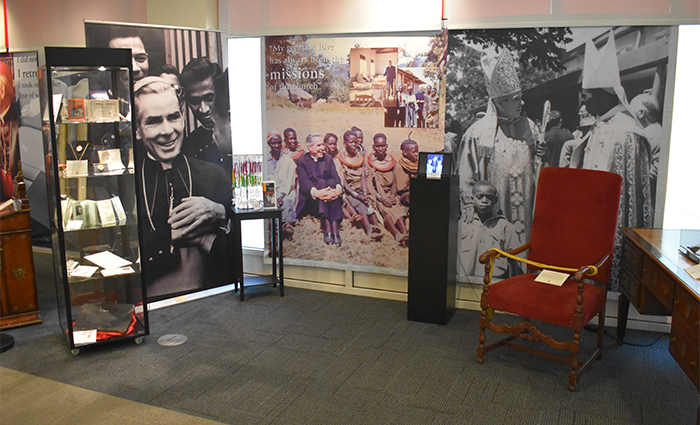
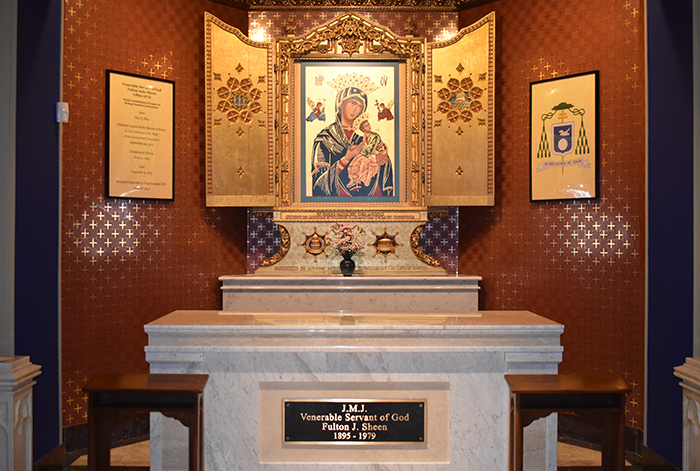
He served as an altar boy at St. Mary’s Cathedral (otherwise known as the Cathedral of St. Mary of the Immaculate Conception) in Peoria, where his remains are interred in a side chapel. In 2021, the street in front of the cathedral was renamed “Bishop Fulton Sheen Ave.” From the cathedral, visitors may walk a few blocks to the Sheen Museum, which is incorporated into the Spalding Pastoral Center. This center houses the Diocese of Peoria’s administrative offices and also includes the building that served as the Spalding Institute, where Sheen attended high school.
Lush, verdant vines scale the facade of the center’s entrance, and a statue of the Blessed Virgin Mary greets all museum-goers. Once inside, visitors encounter a life-size statue of the late archbishop. Exhibits include photos of Sheen, vestments he wore for celebrating Mass, and many other personal items, such as a typewriter. Also on location is the Emmy Award that Sheen took home in 1953 for being an “outstanding personality” on his TV program Life Is Worth Living, beating the stiff competition from figures like newsman Edward R. Murrow and actress Lucille Ball of I Love Lucy fame.
Museum tour coordinator Rhonda Bachman expressed a deep admiration for Sheen. For “such a learned man, he was very relatable,” Bachman told Catholic World Report. “He could really talk to anyone’s level, and I think that really spoke to people, and he won them over.”
A convert to Catholicism, Bachman recalled seeing Sheen on TV in years past but admitted she didn’t know much else about him until after being confirmed. She began hearing more stories about the charismatic bishop and, along with her parish book club, started to read some of his writings.
Upbringing, education, and formation
“Fulton Sheen came from the most humble roots,” Bachman pointed out. “El Paso [is] just a tiny little farm community—kind of in the middle of nowhere.” She explained that “his dad owned a hardware store” in town. However, once the store burned down, the Sheen family moved to a farm that Newton, Fulton’s dad, had inherited from his father. There, they made their living.
Many Illinois boys can claim detasseling as their first job. Young Fulton, the son of farmers, was likewise no stranger to corn. In his autobiography, Treasure in Clay, which was published posthumously, Sheen wrote:
Those who know me now find it hard to realize that there was once a time in my life when I plowed corn, made hay while the sun shone, broke colts to harness, curried horses, cleaned their dirty stalls, milked cows morning and night and in cold, damp weather shucked corn, fed the pigs, dug postholes, applied salve to horses cut by barbed wire, fought potato bugs on the day that a circus came to town, argued with my father every day that farming was not a good life and that you could make a fortune on it only if you struck oil.
As insinuated by that last line, Fulton was no great admirer of the chores on the farm. Onlookers perceived him as a bookish lad. The boy’s natural tenacity and talents would someday take him far from the world of corn and horses and pigs, but that way of life always remained a part of him.
Years later, the archbishop’s niece, Joan Sheen Cunningham, recalled what happened to the farm when Newton passed away. The land was left to the four Sheen brothers, the sons of Newton and Delia, to use as they saw fit. In her memoir My Uncle Fulton Sheen, Cunningham writes:
It was a cluster of small, separate farms, which was left to him and his three brothers when their father died. My uncle Fulton did not want his portion of the land (what would he do with a farm?), so his brothers bought him out. Fulton used the money to buy himself a house in Washington, D.C., which proved to be a savvy decision as he would live there for twenty years.
Some of Sheen’s many living relatives attended his recent beatification. Bachman suggested that close to 300 would attend and sit in a special section.
While he might not have been too keen on farm life, Fulton certainly loved his family—immediate and extended. In the autobiography, he also admitted his debt to his parents for their determination in furnishing him with an education. After the high school years at the Spalding Institute, Fulton enrolled at St. Viator’s College in Bourbonnais, Illinois, and four years later entered St. Paul Seminary in Minnesota.
On Sept. 20, 1919, Fulton Sheen was ordained a priest in the Diocese of Peoria at St. Mary’s Cathedral, the same parish where he had served Mass as a boy and the same church in which pilgrims visit his tomb today.
Even after his ordination, Sheen proved to have a voracious appetite for learning. In 1920, he received bachelor’s degrees in Sacred Theology and Canon Law from the Catholic University of America. Within four years, he had also earned his Ph.D. as well as a Doctor of Divinity degree. He attended classes at celebrated institutions in France and Rome. Soon, he took a short-lived stint teaching dogmatic theology at St. Edmund’s College in England. He then moved back to the U.S. and served for a year at St. Patrick’s Parish, a church with a small congregation in Peoria. Today, the parish no longer exists; the building was sold and became a Protestant church before ceasing to be a house of worship altogether.
Evangelization on radio and television
In 1926, a century before his beatification, Sheen started teaching at the Catholic University of America in Washington, D.C. According to the university’s website, Sheen made his first radio appearance that same year. In 1930, he launched “The Catholic Hour” radio show, which was broadcast to a national audience on close to 400 stations and, at its most popular, to an estimated four million listeners. The subsequent decade witnessed public servants like President Franklin D. Roosevelt, sensational entertainers like Orson Welles, and more contentious figures like Fr. Charles Coughlin become major radio personalities. That this new medium was a powerful means of communication, nobody doubted.
During the golden age of radio, Sheen brought the voice of truth to bear on a tumultuous cultural and political climate. He also conveyed the truths of the faith in the classroom and through printed matter. Sheen’s debut book, God and Intelligence, was first published in 1925 and included an introduction penned by G.K. Chesterton, one of Sheen’s favorite writers. The priest’s writing career took off with more than sixty books published during his lifetime.
Because Sheen embraced the media of his day and age and saw its potential, many Catholics today look to him as a prime example of utilizing the media as a legitimate mode for evangelization.
“Archbishop Fulton Sheen’s approach to media evangelization was that of a natural-born teacher,” Sister Nancy Usselmann, the Director of Pauline Media Studies, told CWR. “He saw an opportunity to catechize people on a wide scale about life, faith, and finding true happiness in God, and utilized the media of his day. He is a true media apostle, just like his contemporary, Blessed James Alberione. Both followed in the footsteps of the Church’s greatest evangelizer, Saint Paul the Apostle. Sheen saw the world as his classroom. His media style was approachable, non-scripted, visually simplistic, and humorous. And that worked at the time he was on television.”
Sheen launched his landmark TV series Life Is Worth Living in 1951, the same year he was ordained a bishop. (His second TV run occurred in the Sixties with The Fulton Sheen Program.) Viewers quickly learned, as radio audiences had years before, about Bishop Sheen’s commanding tone and potent rhetoric. More importantly, they learned the shallowness of the world’s solutions to personal anxieties and social ills. Those who tuned in learned about the reality of morality and the extraordinary mercy God has ready for every penitent sinner.
Writing in the mid-1950s on the nature of television and its audio-only precursor, American essayist E.B. White commented, “The voices of radio and television are the voices of quick-change artists; they move rapidly from selling to telling and back to selling again. They are losing their sharpness because they have divided their allegiance.” Here, White referred to the tendency of performers to also become peddlers through the ubiquitous advertising in their programs.
Contrary to other popular showrunners, Fulton Sheen did not jump at the sponsorship opportunities that came his way. A news blurb from a May 1952 edition of the St. Louis Review stated that, although “the DuMont network has received a number of offers of commercial sponsorship,” the decision rested with Bishop Sheen and the network planned “to continue the present unsponsored status.” The same article quotes Sheen as saying, “I must remember that if the program becomes popular it is not because of the voice that speaks but of the Word of whom I speak.”
Sheen wasn’t trying to sell his audience something; he was offering them the Gospel of Jesus Christ and the salvation it points to—free of charge. (He was not concerned with how much revenue a show might make, and his earnings from his various engagements were donated to charity.) For Sheen, there was no “divided allegiance.” He served God rather than mammon. It took the son of a farmer to invent the technology behind television, and it took another son of another farmer to baptize it and elevate it to its highest potential.
As noted, Sheen went on to win an Emmy for Life Is Worth Living. But that wasn’t the only splash he made in the entertainment world. Ramón Estévez, a Catholic actor better known today as Martin Sheen, adopted the famous bishop’s surname as part of his professional pseudonym. Though Estévez has sometimes regretted changing his name at all, the tribute shows the admiration he has for Fulton Sheen, whom he hails as “the first successful tele-evangelist.”
Sheen’s influence on celebrities and other prominent figures of his day cannot be underestimated. He played a part in the conversion of actress Virginia Mayo, writer and politician Clare Boothe Luce, and many others. Even those who knew Sheen personally and did not become converts still held a deep respect for the man. He managed to touch their lives in an impactful and memorable way. In fact, his original broadcasts and writings continue to influence newer audiences.
An inspiration to others
Decades ago, the Catholic writer Fulton Oursler dedicated a chapter in his book Why I Know There Is a God to a story about Fulton Sheen. It involved a girl named Agatha Retzinek, who claimed she had sold her soul to the devil and had no remorse over it. She spilled some of these facts to the priest, who willingly offered to hear her confession. She flatly refused and left the church. Sheen stayed there praying past midnight when Agatha, who had had a change of heart, returned and tearfully received the sacrament of Penance.
Oursler recounts the story and shares the reaction of one of his contemporaries, Harry Emerson Fosdick, a notable Protestant pastor of an interdenominational church in New York City. Fosdick reportedly exclaimed, “I salute this priest! He is a real servant of Christ, this Monsignor Fulton J. Sheen!”
Billy Graham, the famous evangelical preacher, was a friend of Sheen and greatly admired the bishop. Graham said Sheen could deliver sermons that were as “challenging” as they were “elegant.”
Fulton Sheen’s eloquence and verve have also touched the hearts of many Catholic clergy down to this day, a fact that was on full display at the beatification, with some 1,000 priests, bishops, and cardinals in attendance.
Fr. Donald Calloway, a well-known spiritual writer, has called Sheen “brilliant” in reference to his theological explanations. Fr. Mike Schmitz, who hosted the popular Bible in a Year podcast that took the world by storm, says, “I owe a lot” to Sheen. Many more priests have been molded by Sheen’s words and his example of holiness while in seminary or at various junctures in their spiritual lives.
The spark of faith ignited by Sheen spreads to the laity as well. Many have spoken of this holy bishop’s affinity for being approachable and accessible. Sheen “said early on in Treasure in Clay that part of his goal was to know what the world was thinking and then, secondly, to know how to respond to the world from the teachings of Thomas Aquinas,” Msgr. Gray told CWR. “He was someone who also had the capacity to relate to the common man. Sheen was so successful on television because he could be relatable,” the same sentiment echoed by Bachman.
Msgr. Gray also said he has seen a marked interest among younger generations in Fulton Sheen. “We find that actually a lot of young people are gravitating towards Sheen,” he said. “Part of it is, I think, the boldness of his positions. He was someone who didn’t sugarcoat things. He would be direct. He would say exactly what he was thinking. And I think it’s that directness. Sheen wasn’t trying to please people; he was speaking the truth.”
Catholic artist Timothy Schmalz, known for sculptures like “A Quiet Moment” and “Homeless Jesus,” had something similar to say about the bishop’s outstanding character. “Everything about him was auspicious and almost otherworldly,” Schmalz told CWR.
“Fulton Sheen wasn’t shy about telling it like it was,” he said, referring to the bishop’s unabashed comments denouncing moral depravity. “We need more people like Fulton Sheen. By having more symbols of him out there, he will not be forgotten. That’s what I love about doing a bronze sculpture. Unlike his television shows,” a sculpture is something more permanent.
Schmalz was commissioned to produce a series of sculptures for the Sheen Museum, two of which were presented to the institution in the weeks leading up to the bishop’s beatification, an occasion in which the Catholic Church formally recognizes the heroic virtue, or holiness, of one of its deceased members.

A man of mercy, devoted to the Eucharist
For someone to be a genuine servant leader within the Catholic Church, and not just resemble one, he must truly live the Gospel. Jesus, the archetypal Priest, says that “whoever would be first among you must be your slave” (Mt 20:27). Such a leader must live not for himself but for others. Sheen believed this was inseparable from the vocation of the priest. Thus, when we witness a cleric rising, as it were, through the ranks of the Church, we must assume the Church herself perceives the holiness of such an individual. And when the cause for canonization opens for any deceased person, their life is examined for signs of exemplary holiness. In the case of Sheen, we find this recognition both during and after his earthly life.
Sheen began to serve as an auxiliary bishop of the Archdiocese of New York in 1951, and was installed as the new bishop of Rochester in 1966. He retired three years later, when he was in his seventies. What made him an effective leader was the same thing that made him a good priest and a good Catholic: his love for Jesus Christ, especially in the sacraments.
Dr. Mark J. Zia, a theology professor at Benedictine College and the author of The Enduring Faith and Timeless Truths of Fulton Sheen, draws a connection between the bishop’s inspirational evangelization and his daily holy hour before the Blessed Sacrament, which was truly his “daily bread.”
“The power that Sheen’s daily Eucharistic holy hours had on his effectiveness as a teacher and success as a preacher must not be underestimated,” Dr. Zia told CWR. “Sheen tells us that, on the one hand, he never used notes when preaching or teaching, and yet on the other hand, he always prepared his sermons in the presence of the Blessed Sacrament. Saints like Carlo Acutis would remind us that just as spending time before the rays of the sun gives us sunburn, so too spending time before the Son in the Blessed Sacrament allows us to be transformed by his rays of grace into saints.”
Sheen himself cited the Eucharistic Christ as the source of every good thought and every seed of a great sermon. Said Dr. Zia: “Sheen’s Eucharistic spirituality, coupled with his vast knowledge and wisdom, truly allowed him to develop a methodology for passing on the faith that cannot be rivaled.”
The Eucharist was not the only sacrament that Fulton Sheen had an outspoken passion for. He was also an apostle of the confessional. Fulton Oursler’s story of Sheen encouraging Agatha Retzinek to make a good confession is not a singular event and certainly not rare. Stories abound about Sheen inviting friends and complete strangers to the sacrament of Penance. In his writings and in his broadcasts, he made his audience aware of the infinite mercy of God.
In his book Peace of Soul, in which he goes to pains to defend the realities of sin and the responsibility one must take for committing it, while also delineating the difference between Reconciliation and psychoanalysis, Sheen writes:
Repentance is not self-regarding, but God-regarding. Christianity bids us accept ourselves as we really are, with all our faults and our failings and our sins. In all other religions, one has to be good to come to God—in Christianity, one does not. Christianity might be described as a “come as you are” party. It bids us stop worrying about ourselves, stop concentrating on our faults and our failings, and thrust them upon the Saviour with a firm resolve of amendment.
Sheen practiced what he preached. He also admitted to being human. He was a saint with his own flaws and feelings. In Treasure in Clay, Sheen reveals that he struggled with ambition and with pride, that ancient root of all sins. But there he also says he throws himself upon the mercy of an all-loving God. He writes, “How God will judge I know not, but I trust that He will see me with mercy and compassion.”
Fulton Sheen’s earthly life came to a close quietly on December 9, 1979. His body was found in the private chapel of the apartment he occupied in Manhattan. He had passed away in the presence of Jesus in the Blessed Sacrament. Initially interred at St. Patrick’s Cathedral in New York, Sheen’s remains were later transported to their current resting place in Peoria. What has happened in the years since his death shows the faithful that Sheen’s works of charity are far from over.
Several miracles have been attributed to the late bishop’s intercession. Notably, the miracle that paved the way to his beatification took place in his home Diocese of Peoria. Baby James Fulton Engstrom was stillborn in 2010 and clinically dead for 61 minutes. The child’s family invoked Fulton Sheen repeatedly and, after 61 minutes had passed, the infant inexplicably revived. “Inexplicably,” that is, as far as doctors were concerned. Now a healthy teenager, James Fulton Engstrom carried a reliquary containing Sheen’s jawbone in a procession at the beatification Mass.
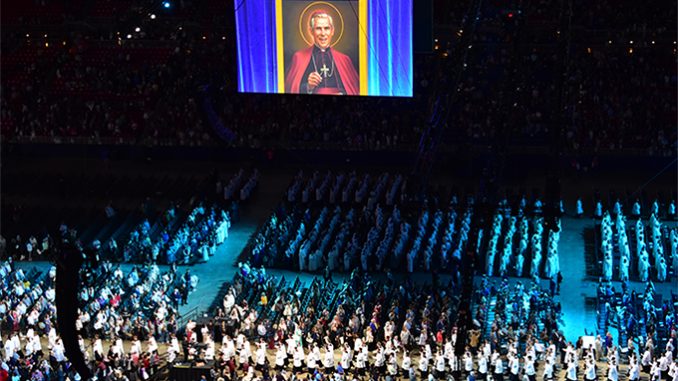
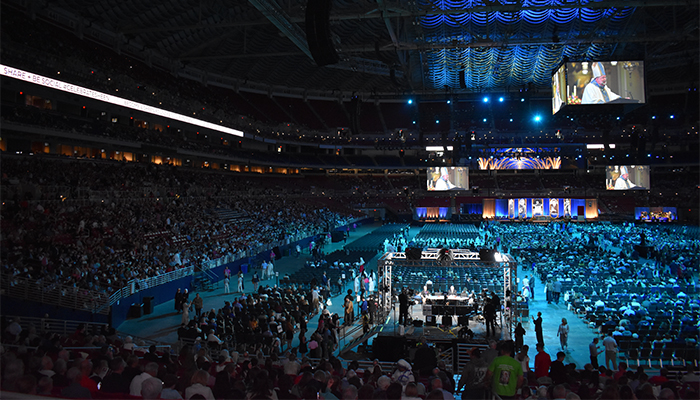
According to the Diocese of Peoria staff, more than 48,000 tickets were sold for the beatification event that took place at the Dome at America’s Center in St. Louis on Thursday, Sept. 24. But since this figure does not account for credentialed attendees, it is assumed more than 50,000 attended in all.
The Beatification: The recognition of “Blessedness”
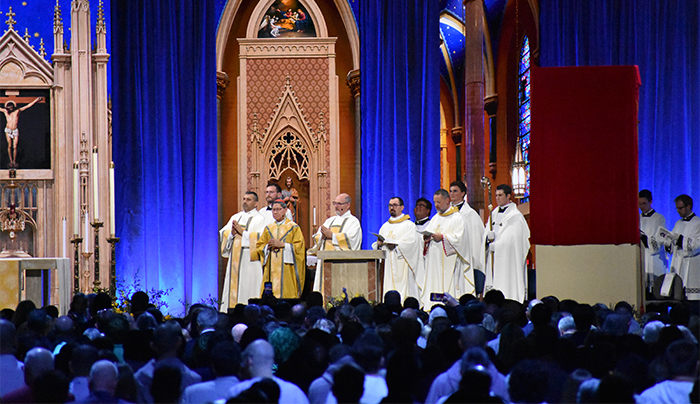
Celebrating the beatification of Sheen, the man so in love with the Eucharistic Lord, took place within the context of the Eucharistic celebration of the Mass. In the hours leading up to Mass, the faithful who gathered at the Dome had the opportunity to peruse the Sheen Expo, which offered a dynamic timeline of his life and accomplishments. In the same exhibition hall, numerous apostolates, including those in the publishing industry, had set up booths to display their offerings. The Daughters of St. Paul, the same religious order to which Sister Nancy Usselmann belongs, were present and sharing the books produced by their ministry. Other similar vendors included Ignatius Press, Our Sunday Visitor, Midwest Theological Forum, and Liguori Publications.
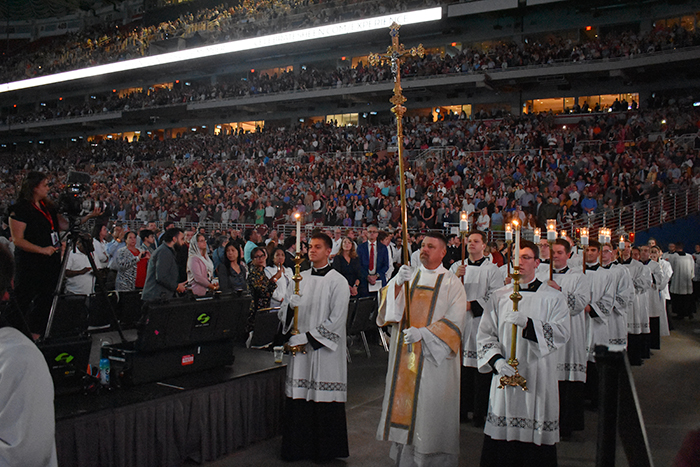
The large center brimmed with Catholics, and many families and friends managed to meet up or unexpectedly reconnect with one another. As time drew closer for Mass, pilgrims took their seats. With so many priests concelebrating, the lengthy procession leading up to the liturgy was accompanied by orchestral music. (In addition, hundreds of religious sisters were in attendance.) Smiles rested on many of the priests’ faces, and more than a few peered around at the thousands gathered around them as they filed into the arena on the main level.
Msgr. Gray was among those concelebrating. Among the princes of the Church in attendance were Cardinal Timothy Dolan and Cardinal Raymond Leo Burke. A cursive JMJ, emblematic of Sheen and standing for “Jesus, Mary, and Joseph,” was stamped in gold letters on the back of the vestments worn by many of the clerics.
Added parts of the beatification Mass included Bishop Louis Tylka of Peoria formally reiterating the request for Fulton Sheen to be declared “blessed” and Cardinal Luis Antonio Tagle’s reading of Pope Leo XIV’s approval for the beatification.
Following the declaration of beatification, a new portrait of Sheen was unveiled. Unlike the icons of the East whose subjects’ lips are seldom parted, Sheen’s grinning mouth stands slightly agape, evoking that aspect of his character he is best known for: communicator of the Good News. In the painting, his right arm is partially raised, just as in life, when he orated and often accompanied it with gestures, understanding body language as much as verbal communication.
In Cardinal Tagle’s homily and comments, he focused on the meaning of “blessedness,” which he closely associated with being “fortunate” and “happy.” He then illustrated how Sheen’s holiness of life displays true blessedness in that this bishop lived the mission Christ had called him to—and not the false mission of a massive ego trip. He said that Sheen learned to be vulnerable and to strive to make his actions accord with his professed beliefs. He thought the same should be applied to all the members of Christ’s Body.
The presiding cardinal recounted how Sheen spoke to the bishops at the Second Vatican Council in 1964 and said:
I beg you most earnestly, venerable fathers, that the notion of poverty be strongly affirmed in this council…As only a wounded Christ could convert a doubting Thomas, so only a Church wounded by poverty can convert a doubting world.
Decades before Pope Francis spoke of his desire for “a church that is poor and for the poor,” Sheen had stated his own desire for a Church that wholeheartedly embraces poverty so as to better relate to those suffering in the world today.
Cardinal Tagle assured those present that Pope Leo rejoices with the Church in the beatification of his “fellow Illinoisan.” The cardinal hailed Sheen as a “son of Illinois, a son of the United States of America,” and indeed a “son of the world.” Blessed Fulton Sheen is for the universal Church. Recalling Sheen’s aptitude for using the media to communicate and to convert, the cardinal proclaimed, “Blessed are you, storyteller of Jesus! Blessed Fulton J. Sheen!”
Throughout Mass, the intermittent cries of babies intermingled with the choral music. The smell of incense rose from the ground level to the sixth story. Thousands of people stood, sat, and knelt in unison. The name “Fulton” was included in the litany of saints listed in the Eucharistic prayer. A myriad of ciboria brought the Lord to all those who wished to receive him in Communion. Following Mass, the faithful had a chance to venerate the relic of Fulton Sheen.
Having celebrated his beatification, the Church now awaits in hope the canonization of Sheen, the final step in the process of declaring him a “saint.” (The prayer asking God for the canonization of Blessed Fulton John Sheen can be found here.) Neither a beatification nor a canonization “places a person in heaven.” It is only an official recognition of their sanctity and closeness to God and presupposes the person’s presence in heaven. Catholic radio host Katie McGrady, who helped present at the ceremony prior to Mass, said there was no doubt that Sheen is in heaven.
In his autobiography, Sheen muses:
I am only certain that there will be three surprises in Heaven. First of all, I will see some people there whom I never expected to see. Second, there will be a number whom I expect to be there who will not be there. And, even relying on [God’s] mercy, the biggest surprise of all may be that I will be there.
If you value the news and views Catholic World Report provides, please consider donating to support our efforts. Your contribution will help us continue to make CWR available to all readers worldwide for free, without a subscription. Thank you for your generosity!
Click here for more information on donating to CWR. Click here to sign up for our newsletter.



Leave a Reply