


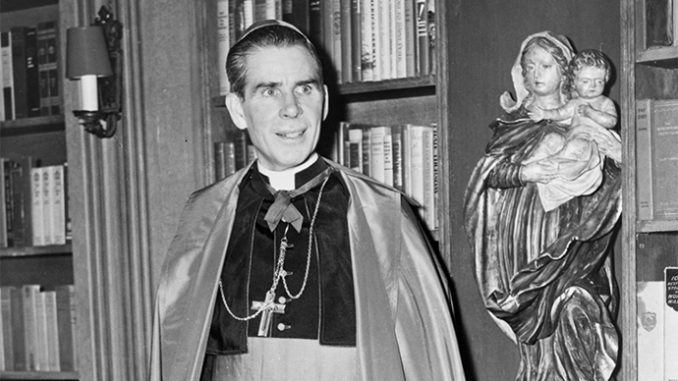
There are moments when history and providence seem to converge.
On Thursday in St. Louis, Archbishop Fulton J. Sheen was beatified, nearly seven years after the Vatican first approved the miracle that cleared the way for the beloved American bishop to be declared blessed. The beatification was originally scheduled for December 2019 but was abruptly postponed while questions surrounding Sheen’s tenure as bishop of Rochester received further examination.
Perhaps the delay itself was providential.
Sheen’s star is shining brightly at this moment in American history because his voice is needed again.
In the mid-20th century, two prominent Americans were relentless in warning the world about communism: Fulton Sheen and Ronald Reagan. They approached the subject from different directions—Sheen as a Catholic philosopher and evangelist, Reagan as an actor, union leader, and eventually president—but both recognized the dangers of an ideology that subordinated the individual to the collective.
Those questions are hardly relics of the Cold War. A Gallup poll released this week found that 43 percent of Americans now view socialism positively, the highest level recorded since Gallup began asking the question in 2010. Among Americans ages 18 to 34, nearly 60 percent have a positive view.
Bishop Robert Barron sees a striking connection between Sheen’s warnings and our present moment. Standing in front of the Gateway Arch in St. Louis on Tuesday, two days before Sheen’s beatification, Barron warned that “communism is making a comeback right now in our country.”
He called on American Catholic leaders to follow Sheen’s example and “speak out strongly on both American and Catholic principles against the re-emergence of this still very dangerous ideology.”
Barron’s point goes to the heart of why Sheen remains so relevant.
Long before his television program Life Is Worth Living made him one of America’s most recognizable personalities in the 1950s, Sheen studied Marxism closely. He understood its attraction, particularly its promises of equality and concern for workers. But he believed its fundamental error went much deeper than economics.
Communism, Sheen said, represented “the final logic of the dehumanization of man.” By denying God and reducing reality to material forces, Marxism inevitably diminished the human person. In Sheen’s analysis, communism promised equality by abolishing private property and ultimately making everyone dependent upon the state.
Pope St. John Paul II would later make the same argument.
The Polish pope knew communism not merely from books but from experience. He lived under both Nazi occupation and a Soviet-backed Communist regime. In his 1991 encyclical Centesimus Annus, John Paul identified what he called socialism’s “fundamental error”: its mistaken understanding of the human person.
Socialism, he wrote, treats the individual as an element or “molecule” within the social organism. Once that happens, the person’s freedom, moral responsibility, and transcendent dignity become subordinate to the economic and political system. The deepest problem, John Paul argued, was atheism. When God is removed, the foundation for the transcendent dignity of the human person is removed with Him.
That connection between Sheen and the pope became beautifully personal near the end of Sheen’s life.
On Oct. 2, 1979, during John Paul’s first papal visit to the United States, the pope spotted the frail 84-year-old archbishop at St. Patrick’s Cathedral in New York. He called Sheen forward and embraced him.
“You have written and spoken well of the Lord Jesus,” John Paul told him. “You are a loyal son of the Church.”
Their exchange did not end there.
Nine days later, John Paul wrote Sheen to congratulate him on the 60th anniversary of his priesthood. “God called you to proclaim in an extraordinary way his dynamic word,” the pope wrote, noting that through Sheen’s six decades of priesthood, “God has touched the lives of millions.”
On Nov. 26, Sheen replied: “I bow in humble gratitude for the Pontifical approval of my ministry of the Word.”
Thirteen days later, Sheen died before the Blessed Sacrament in his private chapel.
Reagan’s confrontation with communism began in another arena: Hollywood.
As president of the Screen Actors Guild in the late 1940s, Reagan encountered Communist organizing and influence within the entertainment industry and labor movement. In 1947, he testified before the House Committee on Un-American Activities about what he described as Communist tactics within Hollywood. Yet Reagan also cautioned against simply outlawing unpopular political beliefs, arguing that American democracy was strong enough to confront dangerous ideologies openly.
That experience helped shape the anti-Communism that later defined his presidency.
Sheen, Reagan, and John Paul II understood something that can easily be forgotten now that the Berlin Wall has fallen and the Soviet Union has disappeared. Ideas do not become harmless simply because history has exposed their failures.
And Sheen’s argument was ultimately deeper than a debate over tax rates, government programs, or economic systems. His concern was the human person.
Christianity begins with a radically different premise from Marxist materialism: man is not merely an economic unit, a member of a class or a component of the state. Every human being is created in the image and likeness of God, endowed with freedom, responsibility, and a destiny beyond this world.
In 2019, the Church was prepared to call Fulton Sheen “blessed.”
Seven years later, as socialism receives its highest favorable rating Gallup has ever recorded among Americans, Sheen is finally raised to the altars. And on the eve of his beatification, one of America’s most prominent bishops stood beneath the Gateway Arch and declared: “We need that voice again today.”
John Paul II famously reminded us that in God’s providence, there are no mere coincidences.
I’m certain this is one of them.
If you value the news and views Catholic World Report provides, please consider donating to support our efforts. Your contribution will help us continue to make CWR available to all readers worldwide for free, without a subscription. Thank you for your generosity!
Click here for more information on donating to CWR. Click here to sign up for our newsletter.


Leave a Reply