


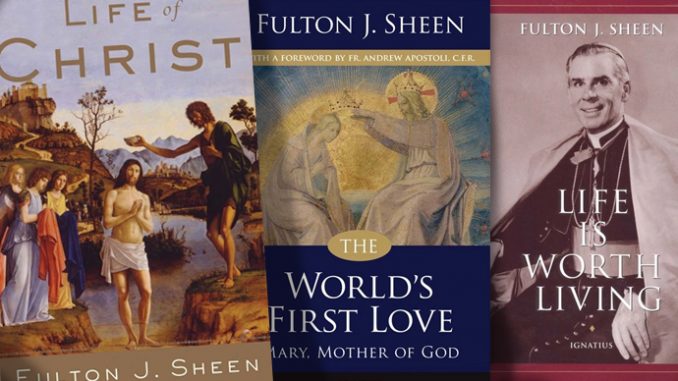
After decades of waiting, the famous and beloved Archbishop Fulton Sheen has finally been declared Blessed Fulton Sheen.
For those who have missed all the online summaries of Sheen’s life, including this one, there are ways to find out more. One could read his autobiography, go to a museum containing his artifacts, watch a documentary about his life, or stream (via three different websites) his award-winning television series.
However, in our justifiable excitement about an American being one step closer to canonization, we should remember that Sheen never primarily thought of himself as a television star but as a Catholic priest.
What set Fulton Sheen apart from other twentieth-century American preachers, both Catholic and non-Catholic? One reason is that he had a way with words.
The brilliant Fulton Sheen
It wasn’t just that he was smart. Yes, he was a brilliant man who earned a doctorate in Belgium, won a coveted prize in philosophy when he was only twenty-eight years old, and was sent to study in Rome. But credentials like those often mean that the recipient is destined to write obscure works intended for a tiny audience of specialists. Sheen, on the other hand, intentionally wrote for the general public, but he didn’t dumb down his message or bore people to tears with technical jargon.
Of course, it is also possible for a talented writer, Catholic or otherwise, to sell a lot of books by telling stories in a fascinating way while playing fast and loose with the facts. Novels featuring an Opus Dei monk leap to mind. Instead, Sheen stuck with the truth.
Yet Sheen didn’t limit himself to writing solely for people who pray the Rosary and attend Mass every day. He wrote sixty-six books on topics ranging from the philosophy of science to the Catholic virtues, from the Way of the Cross to communism. One great mystery of his life is how he found the time to write these books while also serving as a priest, a bishop, and the national director for what was then called the World Mission Society for the Propagation of the Faith.
His Life of Christ
One of Fulton Sheen’s greatest books is his Life of Christ. Writing about the life of Jesus Christ might seem an obvious book topic for a Catholic priest, but this book wasn’t published until he had already been writing for three decades. In the preface of that book, Sheen explains that he wrote it “to find solace in the Cross of Christ, as for about ten years of my life I endured a great trial.”1
Sheen never publicly identified the source of that cross. However, the foreword of the 2008 reprint of Sheen’s autobiography offers a likely explanation: Sheen was persecuted by an American cardinal in a dispute over, of all things, powdered milk.2 Rather than publicly criticizing his persecutor or subtly spreading rumors about him behind his back, Sheen spent a decade reflecting on the life and sufferings of Jesus Christ. And then he wrote a book about what he had learned to help the rest of us face our crosses.
One great trial Christians face today is how to respond to those who ridicule our faith as irrational. In answer to those voices, we can turn to Sheen’s words: “History is full of men who have claimed that they came from God, or that they were gods, or that they bore messages from God—Buddha, Mohammed, Confucius, Christ, Lao-tze, and thousands of others.”3
Sheen reminds us that Jesus Christ, alone among those religious figures, was pre-announced by God centuries before His birth. God provided us with details about “when His messenger was coming, where He would be born, where He would live, the doctrine He would teach, the enemies He would make, the program He would adopt for the future, and the manner of His death”4 long before a baby was born in Bethlehem. It is irrational for unbelievers to ignore these facts about Christ’s existence and predictions that He was coming, and it would be cowardly of us to let them get away with it.
When we try to speak the truth about Jesus Christ, there are many who will twist the meaning of our words beyond recognition, just as Christ’s opponents did to Him. Sheen wrote that, “The opposition and hatred of the Pharisees, Scribes, and temple leaders against Our Lord grew from the inside out, as it does in most human hearts.”5
In this way, Sheen teaches us that rather than fuming over being misunderstood, we should humbly try to understand the motivation behind their opposition. What is in their hearts? Sheen, who had a knack for converting millionaires, prostitutes, communists, and everyone in between, learned how to recognize these modern-day Nicodemuses and led many of them into the Church.6
Of course, when someone actively seeks to do us harm, it is tempting to think of that person as irredeemably wicked, perhaps even as bad as Pontius Pilate. Yet Sheen suggests that Pilate may simply have been something very modern: a practical man. “It is often the fault of practical men, such as Pilate, to regard the search for objective truth as useless theorizing.”7 Are we sometimes too businesslike and savvy about worldly matters to see the Gospel truth, even when it is standing in front of us, just as happened with Pilate?
Then there is the example of Judas, the ultimate betrayer. Once again, Sheen’s analysis of Judas forces us to stop thinking of him as simply a tool of the devil, but to think about all the times we also have betrayed the people we love, usually for selfish reasons. Just like Judas, we hurt our loved ones and hurt Christ Himself for the sake of a “fleeting pleasure or temporary recompense.”8 It is only when we realize that we have “bartered [Christ] away out of all proportion to His due worth”9 and say we’re sorry that we can be reconciled to God and with others.
We are all like Judas, and as Sheen poignantly writes, “The tragedy of the life of Judas is that he might have been St. Judas.”10
A new patron saint for writers
The world recognizes Fulton Sheen for his talents as a public speaker and a bestselling author. The Catholic Church recognizes him as a holy man because of his selfless dedication to his priestly ministry, his personal life of heroic virtue, his devotion to our Lord—particularly his daily Holy Hour before the Blessed Sacrament—and the miracles that occurred due to his intercession after his death.
However, Blessed Fulton Sheen was also an intelligent man and a gifted writer who was willing to devote his writings to uncomfortable truths: truths about the power of the Cross of Christ, about loving the sinner and hating the sin, about defending our faith with humor and intelligence, and about forgiving former friends who persecute you.
“God love you!”—his signature sign-off—was not merely a catchy phrase, but a profound truth. People today still need to hear it, and Catholic writers today still need to say it.
Endnotes:
1 Fulton J. Sheen, Life of Christ (Garden City: Image Books, 1977), 9.
2 Fulton J. Sheen, Treasure in Clay: The Autobiography of Fulton J. Sheen (New York: Image Books/Doubleday, 2008), xi.
3 Life of Christ, 17.
4 Life of Christ, 17.
5 Ibid, 238.
6 See Cheryl C. D. Hughes, Archbishop Fulton J. Sheen: Convert Maker (San Francisco: Ignatius Press, 2024).
7 Life of Christ, 345.
8 Ibid, 350.
9 Ibid, 350.
10 Ibid, 353.
If you value the news and views Catholic World Report provides, please consider donating to support our efforts. Your contribution will help us continue to make CWR available to all readers worldwide for free, without a subscription. Thank you for your generosity!
Click here for more information on donating to CWR. Click here to sign up for our newsletter.


Leave a Reply