


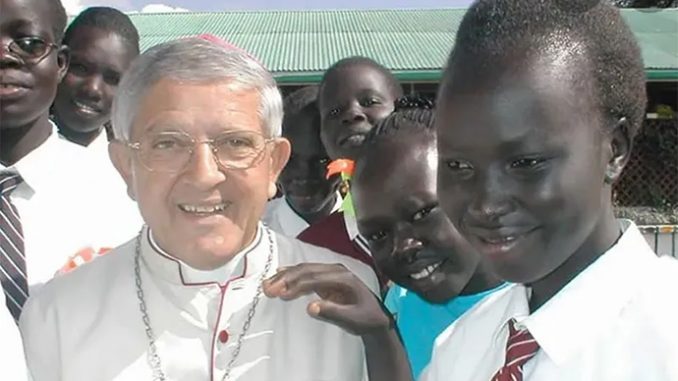
When South Sudan gained its independence in July 2011, Bishop Caesar Mazzolari was there to entrust the new nation to God. He led the opening prayer at Freedom Square in Rumbek, shared in the people’s joy, and went right back to governing his diocese.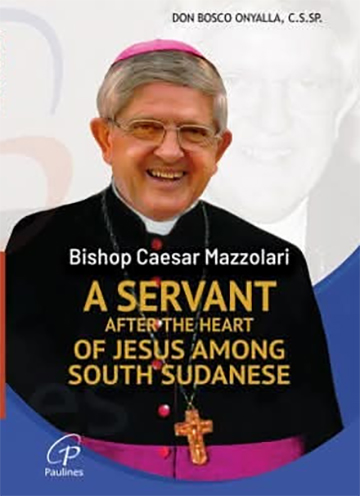
Just days later, on July 16th, the 74-year-old Italian, a Comboni missionary, collapsed and died during Holy Mass.
Now, a leading African priest has chronicled the extraordinary life and final days of the remarkable shepherd in a new book titled Bishop Caesar Mazzolari: A Servant after the Heart of Jesus among South Sudanese.
The author is Fr. Don Bosco Onyalla, C.S.SP., Editor-in-Chief of Africa’s leading Catholic news organization, ACI Africa. Fr. Onyalla says the book is a recollection of the core activities and beliefs of the late bishop, who lived in a modest two-room house, wept before oil executives over the suffering of his people, and rescued Onyalla’s own vocation to the priesthood.
Launching the book on Sunday, September 27, the day of his own Perpetual Profession, Fr. Onyalla spoke with CWR, noting that Bishop Mazzolari’s sudden death left unfinished work,but “it did not leave an empty legacy.”
Here are excerpts of that interview.
CWR: What prompted you to write this book?
Fr. Onyalla: The immediate inspiration was an extensive interview I conducted with Bishop Caesar Mazzolari in January 2009, when he was marking the tenth anniversary of his episcopal ordination. He wanted what he shared about Rumbek Diocese kept in safekeeping as the history of what God had accomplished with His people. After his death in 2011, I became increasingly aware of my responsibility to preserve his recollections and missionary witness. I had received much from him personally, but his story belongs to the Church and the people he served.
CWR: How did his words about putting his recollections “in safekeeping” shape your sense of responsibility?
Fr. Onyalla: I understood that he was entrusting me with more than personal memories. He was recounting the life of Rumbek Diocese and the experiences of the people of Southern Sudan. His words made me attentive both to preserving his testimony and to examining it alongside other records and voices. I wanted readers in South Sudan and beyond to hear what he remembered and to understand the people and circumstances to which he was bearing witness.
CWR: How did you balance personal gratitude with the need for a historically responsible account?
Fr. Onyalla: The starting point was Bishop Mazzolari’s own account in the 2009 interview. Throughout the book, I wanted his voice to take precedence. In that sense, it is principally his story, told as far as possible through his recollections, letters and pastoral decisions. I placed those sources alongside interviews, testimonies, diocesan records and photographs, and tried to distinguish what I witnessed from what other sources established.
Personal gratitude made that work both meaningful and difficult. Writing about his unexpected visit to me on the evening before his death, and my witnessing his collapse during Holy Mass the following day, brought back the grief of losing a spiritual father and shepherd. I had to let that experience remain part of the account without allowing it to stand in for the experiences of everyone else who knew and served with him.
CWR: What does launching the book on the day of your Perpetual Profession mean to you?
Fr. Onyalla: The two events belong together in a deeply personal way. When my Spiritan formation ended in 2002 after nine years, I still believed I was called to the priesthood, but I could not see how that vocation would continue. Bishop Mazzolari welcomed me into Rumbek Diocese and helped preserve that vocation when its future seemed uncertain. My Perpetual Profession marks the definitive offering of the same vocation within the Congregation of the Holy Spirit. Launching his biography on that day allowed me to thank him publicly and honour the Comboni missionary witness that helped shape my own.
CWR: What did his response, “These things happen,” mean to you at the time?
Fr. Onyalla: Bishop Mazzolari said those words in early 2003 after listening to my account of what had happened during my Spiritan formation. The previous year, I had been advised by the leadership of the then East African Province not to submit an application for Perpetual Profession. I received his words as reassurance that this painful turn did not have to end my vocation. What mattered most was that he followed them with action: he welcomed me, gave me room to continue discerning, and entrusted me with responsibilities. His listening and trust helped me regain confidence.
CWR: How do you think he would react to your Perpetual Profession?
Fr. Onyalla: I cannot presume to speak for Bishop Mazzolari. Knowing the confidence he placed in me, however, I believe he would rejoice that the vocation he helped preserve has returned to its original missionary family. He encouraged my priesthood and trusted me with the communication apostolate in Rumbek. I believe he would welcome the possibility of that ministry serving people more widely. I also imagine that he would bring me back to the practical question: how will I live this commitment in community and among the people to whom I am sent? I trust that he continues to intercede for me.
CWR: How did his simple living affect his ability to shepherd the people of Rumbek?
Fr. Onyalla: His residence in Rumbek was a modest two-room house without a private internal bathroom. Near the end of his life, he was considering a cathedral for the people; a new episcopal residence was not among his priorities. His simplicity gave credibility to his pastoral choices. People facing deprivation could see that their bishop did not place his own comfort ahead of their needs. The institutions he helped develop mattered to him for the formation, healthcare, and other services they could provide, rather than for the status they might confer on him.
CWR: Can you give an example of how he stretched himself to relieve others’ suffering?
Fr. Onyalla: John Ashworth’s testimony in the book gives two revealing examples of how personally Bishop Mazzolari carried the suffering and future of the people. At a 2001 meeting with representatives of the Talisman oil company, the company presented high-altitude photographs and claimed that areas where oil was being extracted were uninhabited. Bishop Mazzolari challenged that claim because he had walked among the people living there. Ashworth recalls that he wept. He remembers the bishop weeping on another occasion when a delegation discussed resettling Sudanese “lost boys” in the United States. Bishop Mazzolari knew some of their families and feared what their departure would mean for them and their homeland.
Those tears accompanied advocacy before people with considerable institutional power. They show why his compassion could be so demanding: the people under discussion were never abstractions to him. He knew them, and he was prepared to defend their dignity and future.
CWR: How did prayer fuel his public missionary work?
Fr. Onyalla: We often found Bishop Mazzolari in church, however early we arrived. His devotion to the Eucharist impressed and influenced me. I cannot describe every part of his private prayer, but I witnessed its connection to his public ministry. Prayer sustained his decisions, his continued presence amid danger, and his response to people in distress. For him, service after the Heart of Jesus meant allowing his encounter with Christ to shape daily conduct, relationships and action.
CWR: How does one begin rebuilding a local Church amid a protracted war?
Fr. Onyalla: Bishop Mazzolari inherited a Diocese whose centre, resources and ordinary lines of communication had been badly disrupted. He began with the people: visiting communities, reconnecting those separated by war, supporting clergy, women and men Religious and catechists, and restoring pastoral care wherever people had gathered or been displaced. Buildings and institutions were necessary, but they existed to serve the living Church. The work required collaboration, formation of local leaders, patient organisation and the ability to adapt when conflict disrupted plans yet again.
CWR: How did he balance prophetic witness with protecting the people?
Fr. Onyalla: In our 2009 interview, Bishop Mazzolari recalled that the bishops understood themselves to be a voice for the people. Their question was how openly they could speak without provoking consequences that would leave communities without their shepherds. He knew the risk from the Church’s history: foreign missionaries had been expelled from Sudan in 1964, and their prolonged absence had disrupted the evangelizing mission of the Church. He had also experienced detention and government pressure himself.
His prudence did not mean silence. He supported the bishops’ public teaching on justice and peace and spoke against abuses when he judged that conscience required it. He weighed his words against a pastoral duty to remain with people who could not simply escape the conflict.
CWR: What struck you most about his final days and your last interaction?
Fr. Onyalla: I have spoken of the minutes he brought me on the evening before his death, an ordinary visit I later came to remember as a farewell. Looking beyond that last encounter, what strikes me most is the consistency of his life. Even after independence, and despite his tiredness, he remained among the people and continued attending to the responsibilities of Rumbek Diocese.
The final chapters of the book reflect on what he left in other people’s hands: clergy, catechists and laypeople formed for service; relationships across communities; institutions that supported education, healthcare and evangelisation; and a commitment to dignity and reconciliation. He found it difficult to turn away from people in need. His death left unfinished work, but it did not leave an empty legacy.
CWR: Did the days after independence bring his vocation full circle?
Fr. Onyalla: Chapter 12 follows Bishop Mazzolari through the first seven days of the new nation. On 9 July 2011, he led the opening prayer at Freedom Square in Rumbek, entrusting South Sudan and its people to God. He shared their joy, took photographs of the celebration and later showed them to the Loreto Sisters. He continued his ministry and chaired a meeting about diocesan assignments on 15 July. He died the following morning during Mass.
Viewed through the eyes of faith, those days carry a quiet symbolism. After accompanying the South Sudanese through war and the long journey towards nationhood, he lived to enter the independent nation with them. His earthly ministry ended there, among the people he had served. The work itself continued through the communities he helped build and the people prepared to carry the Church’s mission forward.
CWR: What does becoming a servant after the Heart of Jesus mean to you now?
Fr. Onyalla: The Heart of Jesus is marked by compassion: Jesus saw people in their suffering, drew near to them and acted. Bishop Mazzolari made that compassion tangible for me when he listened to my story, welcomed me and trusted me with responsibilities. His life teaches me that prayer must shape the way I live with others and respond to their needs.
As a Spiritan, I must learn to live generously with my confreres, remain close to people in difficulty, and place my priestly ministry and communication skills at the service of the Church’s evangelizing mission. What does it mean, in my own time and place, to become a servant after the Heart of Jesus? I carry that question into the life I professed on Sunday.
If you value the news and views Catholic World Report provides, please consider donating to support our efforts. Your contribution will help us continue to make CWR available to all readers worldwide for free, without a subscription. Thank you for your generosity!
Click here for more information on donating to CWR. Click here to sign up for our newsletter.



Leave a Reply