

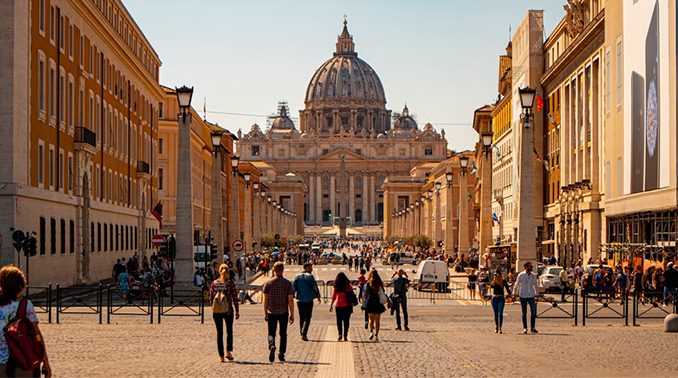
In centuries past, the great missionaries of the Church—many now canonized saints—traveled to the far ends of the earth to bring Christ to those the Church once called pagans. The dangers were not exaggerated. Months crossing open ocean, with a genuine chance of shipwreck, disease, and starvation always possible, if not likely. And, if a missionary made it all the way to his destination, there was more than a passing chance of horrific martyrdom. Survival brought no guarantee of success. First came years spent learning an alien language and adjusting to a foreign culture, and only if trust was won could the work of evangelization begin at all.
The results were mixed. Saint Francis Xavier reportedly baptized hundreds of thousands, but the countries he evangelized remained mostly non-Christian. The North American Martyrs saw almost no immediate fruit, yet their blood proved a seedbed for later converts like Saint Kateri Tekakwitha, important but rare exceptions. In other places, much of Africa, for instance, the faith eventually took root and became the dominant religion of the people. Mexico and South America received it en masse, too, though today we are watching secularization erode what was won.
What moved men and women to give up everything to evangelize a foreign people was the conviction that faith in Christ was not one path among many but the necessary one, worth any cost. The salvation of a single soul justified the sacrifice of temporal comfort, even of life itself. To risk everything for the chance of winning one soul for Christ was, to those missionaries, among the highest vocations a person could have.
The Church today, however, too rarely acts as though it shares that conviction. There is little urgency in bringing non-Christians to Christ, and not much more in catechizing the ones already baptized. Priests with followings in the tens, even hundreds of thousands, increasingly preach that the moral law is negotiable, or that conversion to Christ is a nice ideal but hardly a necessity. No doubt there are others still pursuing evangelization heroically, with real personal risk, even through modern forms of media. The Fr. Walter Ciszeks of our own day are generally not on social media, but they exist, and we would do well to remember them. The Church, whatever the practical habits of her members, remains by nature an evangelizing Church, and she should act like one more consistently.
Technology has changed how everyone, including the Church, engages the world, and some Catholics evangelize online exceedingly well. The Vatican, however, is not among them. Not since John Paul II has the Holy See had a genuinely powerful, global, evangelizing voice. The incoming prefect for communications of the Vatican, Montse Alvarado, has a huge opportunity to bring the Vatican’s media efforts in line with the evangelical mission of the Church. What we need now is a new Vatican media strategy for the 21st century. That will take significant work, but there is a simpler, far more obvious opportunity sitting in plain sight, one the Church has neglected for a very long time.
Rome is consistently one of the most visited cities in the world, and last year proved it emphatically: Vatican and Roman officials estimate some 33.5 million pilgrims and visitors passed through the city during the 2025 Jubilee alone, a record for a single year—that’s over 90,000 people a day. Unlike in centuries past, when the great missionaries went to the far reaches of the earth to find souls at great personal risk, now millions of souls arrive at the Vatican’s front door on their own. Imagine if the Holy See took that seriously: not just as a source of income from Vatican Museum tickets, but as a standing opportunity to teach and to evangelize. It would not be difficult, and it would fulfill her mission perhaps more than almost anything else the Vatican does today.
If I were pope (a creative exercise similar to the hypothetical “if I were Spiderman”), I would make it a top priority to commission a religious community with the mission of forming Church and art historians who would then give free tours of the major churches and historical sites of Rome. It would take several years to equip these guides adequately, but it wouldn’t take decades, as is so often the case with major initiatives.
This isn’t a fantasy. National parks train rangers to give free historical and interpretive tours to visitors who never asked for a lecture and leave grateful for one anyway. Gettysburg, for example, comes to life with the help of a Civil War expert. Volunteer guides already walk visitors through Notre-Dame and Canterbury Cathedral, explaining stained glass and architecture without controversy. After all, it was the Church that invented the idea of religious communities formed for a single purpose: preaching, teaching, or care for the poor. There is no reason a new or existing community couldn’t be formed, or repurposed, to do exactly this, training historians and catechists whose whole vocation is walking pilgrims through Rome. The material is rich in historical and theological significance.
Spend fifteen minutes in Saint Peter’s, or the Lateran, or the Pantheon, or any of the famous tourist stops in Rome, and listen to the conversations. The lack of insight typical for millions of visitors is pathetically sad. They know they are looking at something significant, but they have no idea what or why. They are open to some kind of insight, but are given scraps. More likely, they end up checking a box between pizza and gelato, but their curiosity is an opportunity for so much more! They look but do not see.
I do not blame them. They know Rome is a special place, so they booked an expensive trip to the Eternal City. Sadly, most leave with no genuine idea of what they have seen. Some hire secular tour guides, but those tours are largely void of spiritual insight or any appreciation for the sacrifices made to build Rome into the great Christian shrine, eclipsed only by the Holy Land itself.
Visitors do not learn about the blood of the first, second, and third-century martyrs who were the seedbed of the Church. They do not learn the theological meaning behind the architecture, which speaks of something more sublime than mere beauty. They do not come to know any of the saints, since they’re often told more about the artistic geniuses or the techniques of the masterpieces than the history of those depicted. They do not know the scandal of how some of these buildings and works of art were paid for, a scandal justified by their patrons precisely because the works themselves were meant to communicate the divine, which is an opportunity for an honest assessment of how God works through our human weakness.
Such tourists likely leave Rome with no real sense of the keys of the kingdom given to Peter, or of the unbroken line of his successors down to Pope Leo XIV today. It is not too much to say that Rome cannot be understood apart from the papacy. The only reason the city exists in anything like its current form is Christ’s commission to Peter, and Peter’s martyrdom on the very ground where Saint Peter’s Basilica now stands. How many visitors to Rome understand any of this? If Rome cannot be understood without Peter, why isn’t the Church teaching the people who come to Rome about Peter, and about Peter’s Lord? Why isn’t she using the buildings and the art to evangelize?
We have centuries of blood, sweat, and tears invested in dozens of holy sites, built on the backs of poor, believing Catholics who understood the importance of sacred space and sacred art. That physical and spiritual treasury is being wasted today by what seems to be a sin of omission, the failure to do good. One soul is worth more than all the art of the Vatican combined, and yet there is hardly any urgency about using this treasury for the conversion of souls.
The use of the confessionals is one witness to the sacramental life of the Church, and it is accessible because the infrastructure already exists: nothing needs to be built; it only needs to be staffed. Thankfully, many Rome churches offer confession daily, in the traditional confessionals, open for all to see (something worth imitating whenever new churches are built). The red or green light atop the “box” certainly provokes curiosity in tourists, but there is no catechesis to meet that curiosity. Imagine a simple flyer or a habited monk on hand to explain the sacrament to our modern-day pagans who come as tourists. I suspect the fruit of that would be eternal for some.
Or take Saint Peter’s Square, where tens of thousands of largely uncatechized tourists pass every day. Habited religious could freely offer to explain the meaning of the basilica’s façade and the saints who overlook the square, the history of the site, from Peter’s martyrdom under Rome, to Constantine’s conversion and the building of the original basilica, to the Church’s contribution to art and science through the Middle Ages, to the construction of the new basilica and the controversies around it, to a fair account of the Holy See’s role during the Second World War, and beyond.
All of it is rich material for spiritually curious minds visiting the Vatican. The Vatican Museums themselves are an enormous missed opportunity along the same lines. Elizabeth Lev has spent years showing that a guided tour of Christian Rome can be substantive, engaging, and genuinely evangelistic; her tours are proof that both the appetite and the material are there. But her tours are paid, and reach only those who already know to look for her. Why not take what she has already shown to work, and offer a version of it free, through a religious community formed for exactly this purpose, to the millions who wander into the Vatican?
Similar tours could be offered at the three other major basilicas, at the Chiesa Nuova, at the Gesù, or even sites like the Pantheon and the Colosseum—each would be an opportunity to evangelize the world as it passes through the Eternal City.
None of this requires heavy-handedness. A tourist in Saint Peter’s Square did not come for a sermon, and treating her as a captive audience would backfire. But there is a wide space between silence and a hard sell. A well-trained guide who simply tells the truth about what a building means and why it was built is not proselytizing. She is teaching, and teaching is itself a form of witness.
Some will worry that formalizing this cheapens the sites, turning sacred space into another stop with a script. But the opposite risk is the one we are living with now: these sites already function as consumer products, ticketed and photographed and left uninterpreted, which is its own kind of cheapening. Explaining what a place means does not commodify it; leaving it mute does. Short tracts could be offered as take-homes, with a URL to a well-made website for anyone who wants to go deeper, before or after their trip. The opportunities for creativity here are close to endless, and the cost, measured against what the Church already spends maintaining these buildings, would be small.
Rather than risk life and limb, Church missionaries can let the world come to them. Thirty-three million people did not need to be searched out, chased down, or shipped across an ocean this past year alone. They came on their own, paid their own way, and walked through the door. The least the Church can do is meet them with something more than silence. It would be an effort worth pursuing in honor of those who gave their lives in the past to bring the message of Jesus to all parts of the world.
But, more importantly, it is the right thing to do if we believe in the Creed.
(Editor’s note: This essay was first published at What We Need Now, and is reposted here with kind permission.)
If you value the news and views Catholic World Report provides, please consider donating to support our efforts. Your contribution will help us continue to make CWR available to all readers worldwide for free, without a subscription. Thank you for your generosity!
Click here for more information on donating to CWR. Click here to sign up for our newsletter.



Approximately 4 million persons legally entered the US 2026 (Migration Policy Institute). Approximately 10 thousand illegals crossed into the US 2026 (US Customs and Border). Approximately 18 million illegal residents are now living in the US (Center for Migration).
Whereas Jayd Henricks says “Thirty-three million people did not need to be searched out, chased down, or shipped across an ocean this past year alone”. Is Jayd referring to tourists?
It seems Jayd is making the analogy to tourists visiting Rome and not met with guides who inform on the spiritual meaning of sites, their history, and the prospect of offering a form of evangelization. However, the estimated number of tourists is 70 million (Travel Weekly). Since we have 4 months left for 2026 the 30 million number of tourists could be an estimate.
At any rate rereading his essay Jayd is clearly referring to tourists visiting Rome. 33 million visited during the Jubilee year. An estimated 23 million for 2026. And at any rate Jayd Henrick’s proposal for Rome is in my opinion a good opportunity for evangelization if done well, that is, without imposing on the privacy of the tourists.
Although my initial, mistaken thought of US illegals raises the hot button issue of illegal migrants into the US and the moral responsibility of Catholic clergy to provide at least the sacraments and basic requirements for survival – while they are among us. Some would refuse all and any service to the illegal. Although I’m against illegals entering the US, it is unconscionable not to offer basic charity while the need exists.
I think it’s a legitimate conclusion to reach that the Vatican looks at itself as:
a. A museum
b. A circus with a ring master dressed in white
c. A player in world politics
d. A source of entertainment – almost like Hollywood with a cross
e. A travelling carnival show for youth
I can’t believe that any of these were set out as the mission Christ had for his Church.
There is immense power in the Holy Eucharist and in Rosary. If there were welcoming religious communities in Rome that shared the teachings on the Eucharist and the Rosary while touring the Vatican, I believe there would be a great conversion amongst tourists who visit Rome.