Washington, D.C. Newsroom, Jul 10, 2020 / 04:00 pm (CNA).- The Holy See is facing a perfect storm of a massive income shortfall, months of financial scandal, and a looming international banking inspection. As it prepares to weather the second half of 2020, a range of measures have been taken to shore up its finances and reputation. But will they be enough, or could they end up making matters even more complicated?
According to an apparently leaked internal memo published on Monday, all curial departments of the Vatican have been asked to move all their cash deposits to the Holy See’s central bank. The move signals the depths of the current liquidity crisis facing the Vatican, and raises a number of questions about its ability to mitigate it.
On July 7, Vatican journalist Marco Tosatti published the text of a letter supposedly sent to the heads of all curial dicasteries on May 8. Fr. Juan A. Guerrero, S.J., prefect of the Secretariat for the Economy, said in the letter that the decision was taken after a May 4 meeting, led by Pope Francis, to respond to “this particularly negative economic juncture.”
According to the text of the letter, every Vatican department has been asked to move all their external cash deposits to APSA, which functions as the Holy See treasury, sovereign wealth manager, and administers payroll and operating expenses for Vatican City.
CNA asked the Holy See to confirm or comment on the leaked letter but received no response.
The instruction to move all curial funds to APSA is a dramatic step, exceeding previous attempts at financial centralization under Guerrero’s predecessor, Cardinal George Pell. It points to an acute cash crunch for the Holy See, and raises the possibility that it may already be struggling to meet daily operating expenses, including payroll.
In May, Guerrero said that in the wake of the coronavirus pandemic, the Vatican is forecasting a reduction in income between 30%-80% for the next fiscal year. While dismissing suggestions that this could lead to a default by the Holy See, Guerrero did say “that doesn’t mean that we are not naming the crisis for what it is. We’re certainly facing difficult years.”
Despite the loss of income, some Vatican departments maintain large investment and asset portfolios, most notably the Secretariat of State and the Congregation for the Evangelization of Peoples (Propaganda Fide).
But while moving all cash reserves and deposits held at external banks to APSA could provide a short-term liquidity bridge for the Holy See, it could also create fresh regulatory headaches for the Vatican, and will likely be difficult to achieve.
As CNA has previously reported, the Secretariat of State has maintained large cash balances with several external banks, including in Switzerland. However, transferring the balance of those funds could prove a far from straightforward process.
As reported previously, secretariat funds on deposit were used as security against a $200 million line of credit extended by two banks, Credit Suisse and BSI. The loaned funds were used, in part, to fund the secretariat’s controversial investment in a London building at 60 Sloane Avenue, which has led to the suspension of several curia officials and the arrest of Italian businessman Gianluigi Torzi.
In recent months, Swiss financial authorities have confirmed that several bank accounts, with balances totalling tens of millions of euros, have been frozen as part of an ongoing investigation into the London deal, led by Vatican prosecutors, making them likely hard to transfer.
It is also not clear if the arrangement of using cash deposits as collateral to secure loans to fund investments remains an ongoing practice for the secretariat with other banks. If it does, transferring those deposits to APSA could trigger the banks to call in their loans, adding a credit crunch to a cash shortage for the Vatican.
The text of the leaked letter from Guerrero appears to acknowledge some potential difficulties for different curial departments in complying with his “request,” noting that “where it is necessary to maintain a deposit with IOR or other banks for operational needs, I am kindly asking you to communicate this to this Secretariat [for the Economy] as soon as possible.”
Even if the Secretariat for the Economy is able to have all curial cash moved to APSA without serious financial penalties or complications, and even if this is sufficient to provide for the Holy See’s short-term liquidity needs, the move could still create other unexpected difficulties for the Vatican.
In September, Moneyval, the Council of Europe’s anti-money laundering watchdog, is set to conduct a two-week onsite inspection of the Holy See and Vatican City – the first since 2012.
The president of the Vatican’s Financial Information Authority, Carmelo Barbagallo has described the inspection as “especially important.” “Its outcome may determine how the jurisdiction [of the Vatican] is perceived by the financial community,” he said on July 3.
Moneyval is expected to arrive with its own list of concerns and questions following months of reporting on Vatican financial scandals. A key item on its agenda is likely to be the role of APSA.
Following the last onsite inspection in 2012, APSA agreed to stop providing services to individuals or taking part in commercial transactions, with these functions being transferred to the Institute for Religious Works (IOR), often referred to as the Vatican Bank, which maintains accounts for Vatican employees, individuals and religious groups. APSA was to be limited to administering the sovereign assets of the Holy See, meeting payroll and operational costs, and functioning as the national reserve bank of the Vatican.
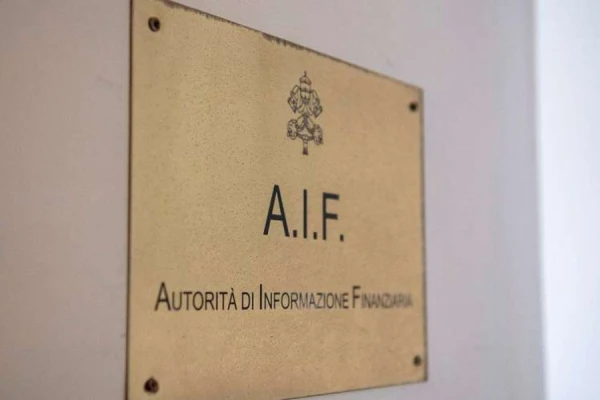
In exchange for agreeing to step back from commercial activity, APSA was exempted from annual inspections by the Vatican’s Financial Intelligence Authority (AIF), whose efforts are in turn assessed by Moneyval.
In 2014, Pope Francis issued new norms, transferring oversight and control of APSA’s remaining investment functions to the Prefecture for the Economy, then headed by Cardinal George Pell.
The AIF’s 2015 annual report concluded that since it is no longer an “entity that carries out financial activities on a professional basis,” “APSA stopped being a part of AIF’s jurisdiction at the end of 2015.”
The 2015 AIF report which exempted APSA from further scrutiny said that “If APSA were to carry out financial activities on a professional basis, it would fall again under the jurisdiction of AIF which… must publish and update the list of subjects who must comply with the requirements set forth in [relevant law].”
But last year, Bishop Nunzio Galantino, head of APSA, acknowledged that it had loaned 50 million euros to finance the purchase of an Italian hospital, the Istituto Dermopatico dell’Immacolata (IDI), in 2015, even though APSA is prohibited from making loans that finance commercial transactions.
APSA was forced to write off 30 million of the 50 million euro loan, wiping out APSA’s profits for the 2018 financial year.
The acknowledgement by Galantino that APSA was in 2015 engaged in prohibited lending activity will likely have attracted the attention of European financial watchdogs, who will want to discuss it in September.
In 2016, Pope Francis partially reversed some of the 2014 reforms, returning control of its investment activity to APSA from the Prefecture for the Economy.
That APSA is engaged in financial activity that requires oversight was underlined when, in June this year, Pope Francis moved the office of the Vatican’s financial records database from APSA back under the management of the Secretariat for the Economy — a move explicitly made to emphasise the need for external oversight.
When Moneyval arrive in September, they are likely to push for a renewed look at the role of APSA and its exemption from AIF and Moneyval’s vigilance – all the more so if it becomes the home for all curial assets.
Some Vatican departments, most notably the Secretariat of State, remain engaged in commercial investments as part of their ongoing financial activities. If, as Guerrero’s May 8 letter indicates, all, or even most, liquid curial assets are now being banked with APSA, it will raise serious questions about how those commercial ventures are being maintained, and if APSA can still credibly claim to play no part in commercial activity.
2020 has become an incredibly high-stakes year for the Vatican, on the line is its ability to continue daily operations and remain a respectable member of the financial community.
Returning to financial health and international credibility are, in many ways, tied together for the Vatican. But after years of regulatory chaos and dubious financial conduct, it remains to be seen if 2020 is a crisis year that makes those efforts come good at last – or finally breaks the bank.
 […]
[…]




Has anyone seen the this Christmas’s Nativity scene in the Vatican?!
That is exactly what I was going to ask. I can think of nobody sane who would think that is art that transmits truth and beauty.
Yup. I was thinking that too.
Artist and teacher ROBERT HENRI: “Art appears in many forms. To some degree EVERY HUMAN BEING is an artist, dependent on the quality of his growth. Art need not be intended. It comes as inevitably as the tree from its roots, the branch from the trunk, the blossom from the twig [….] The whole value of art rests in the artist’s ability to see well into what is before him.”
“Those who have lived and grown at least to some degree in the spirit of freedom are our creative artists [….] They must leave their trace in some way, paint, stone, machinery, whatever [….] I have met masters now and again, some in studios, others ANYWHERE, working on a railroad, running a boat, playing a game, selling things [….] a carpenter or a gardener” (The Art Spirit, 1960).
ST. GREGORY OF NYSSA explains further: “Blessed are the pure of heart, for they shall see God” (Mt 5:8) combines with “the Kingdom of God is within you” (Lk:20-1) to mean that the pure of heart is blessed even now to “see the image of the divine nature in THE BEAUTY OF HIS OWN SOUL.”
Would that Pope Francis knelt at the Vatican Christmas creche and experienced deep remorse. Beauty finds its fountainhead in God’s essence. All that is ordered in truth, physically and spiritually. Visual art all the arts are art when they convey that to the senses. Sensible knowledge of spiritual beauty, God expressing his perfect beauty in the created world. Man creatively filtering it through his unique prism giving a new insight of the same creation. Somewhat like Man expressing to the world Christ through the facets of his rare unique prism. Why the saints are so varied. Art possesses that continuity. Unlike last years and this years creche all since 2013. What’s conveyed are personalistic inventions of what is unknown. The truth of the divinity. Visions of entrapped creatures void of humanness. A something perhaps angel in a space helmet. A moon faced dummy child meant more for the capricious play of children, rather than the infant that inspires love in men. Effrontery at a time of spiritual want. Weep and repair. Recapture the beauty conveyed during 2000 years of magnificent art.
Fully considering Pope St. Paul VI has to say about beauty and truth, we notice the DIVORCE of beauty from truth that occurs when the conjugal principles of Humanae Vitae are violated.
He warns: “Who will stop rulers from favoring, from even imposing upon peoples […] the method of contraception which they judge to be most efficacious” (n. 17). Rulers? How about Shepherds???
When gone viral, the moral tailspin opens the door to the James Martins and Cardinal Paglias of this world, who now ENABLE/IMPOSE unnatural aberrations upon the flock, as by Paglia’s homoerotic and in-your-face wall mural (art!) at the cathedral church of the Diocese of Terni-Narni-Amelia. Said Cardinal Paglia’s mural artist Cinalli: “The one thing that they didn’t permit me to insert [in the catch-all mural] was the [natural] copulation of two people within this net where everything [else !!!] is permitted.” Maybe Cardinal Paglia should clean things up—surely in the interests of Pope St. Paul VI’s truth and beauty?
Oh, but wait, Paglia now is too busy to mess with interior decorating (or the interior life), having been PROMOTED as the President of the Pontifical Academy for Life and the Grand Chancellor of the (renamed, etc.) John Paul II Pontifical Theological Institute for Marriage and Family Sciences. Besides, the mural includes (inclusive!) his own self-referential portrait…
https://www.lifesitenews.com/news/leading-vatican-archbishop-featured-in-homoerotic-painting-he-commissioned
Maureen Mullarkey, artist, writer for the Federalist states it well, “Paglia’s narcissism—the urge to flaunt his liberation from the moral considerations he is pledged to honor—is stunning. It is a finger in the eye of congregants who trust in a priest’s fidelity to his vows. To place it in a public house of worship is treachery. It is also a declaration of Paglia’s own trust in his immunity from reprimand. Let a priest, bound to celibacy, keep his sexuality to himself. Apart from all else, that is elementary manners. It is uncivilized to trumpet what any primitive tribesman understands: that there exists an inviolable boundary between what can be seen and what should be kept hidden. By forcing congregants to peep through a keyhole at his sexual inclinations—and suggested behavior—he mocks the moral sensitivities he is pledged to protect. Abandoning reticence, Paglia disdains his own flock. He is taunting them. There is malice in that”(Maureen Mullarkey in Studio Matters). Cardinal Paglia is one among many who manifest evil within the Church, evil tolerated in measure to adherence. We must be aware. Tolerance is the entree into darkness.
Catholics, indeed all with faith in Christ, all decent men must ask this question, Why would this Roman Pontiff, elected to defend the faith appoint reprobate Cardinal Paglia President of the Pontifical Academy for Life, and Grand Chancellor of the John Paul II Pontifical Theological Institute for Marriage and Family Sciences? Priests, bishops have a duty to their faith in Christ, their ordination in Christ to respond candidly first for their own integrity, and certainly for the faithful.
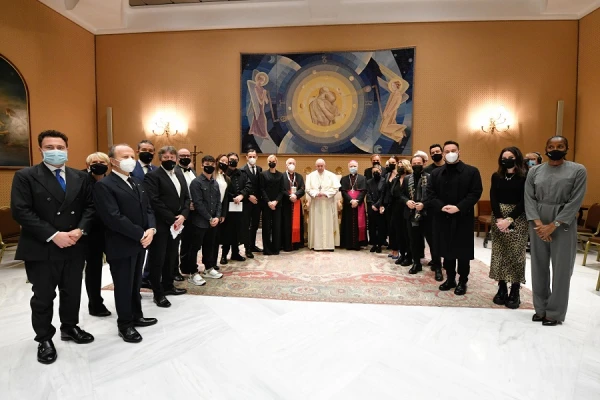
They inspire. They are doing fine but they can do much more. Artists, sportspersons, film stars, and musicians are yet to do justice to their enormous potential in the task of world-rebuilding.
“The bishop of Rome then led his artist visitors to the 2020 creche in St Peter’s Square where Francis then, reportedly, sat in Santa’s lap.”