

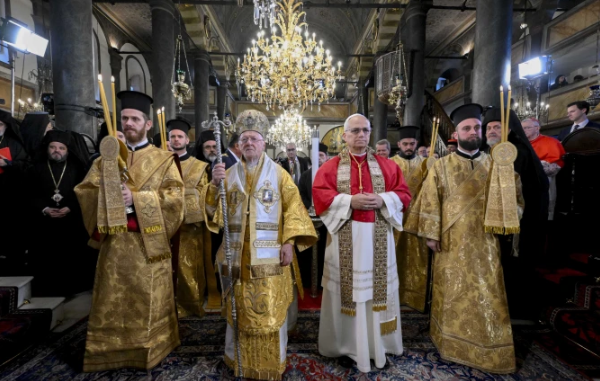
Last month, on July 13 to 15, I attended the 30th annual Orientale Lumen Conference at the Saint John Paul II National Shrine in Washington, D.C. The conference’s theme was urgent: “Ecumenism at a Crossroad: Consensus Achieved—What’s Next?” The scholarly gathering brought together Roman Catholics, Eastern Catholics, and Eastern Orthodox—bishops, clergy, theologians, and laity—which means the conference was not only an academic exchange but also an act of unity in prayer, conversation, and ecclesial friendship.
Archbishop Flavio Pace, Secretary of the Dicastery for Promoting Christian Unity, described the conference as focused on the reception of Catholic-Orthodox dialogue at both international and local levels. The Washington Theological Consortium post captured the spirit of the gathering:
How often do you have the chance to sit down with a cardinal, archbishops, bishops, clergy, theologians, and lay leaders, from the Orthodox and Catholic traditions, not across a formal conference table, but in joint prayer or over coffee, meals, and evening conversations with others who deeply care about the unity of the Church?
That question—“What’s next?”–returned to mind when Pope Leo XIV’s recent revision of the Fundamental Law of Vatican City State was announced on July 31, 2026. The revision may be one of the first concrete answers: not a resolution of all remaining disputes, but a juridical clarification that directly serves Roman Catholic-Eastern Orthodox dialogue.
John Paul II’s 1995 apostolic Letter, Orientale Lumen, made clear that Catholic-Orthodox dialogue has reached a delicate moment. There is consensus on many aspects of first-millennium ecclesiology, synodality, councils, primacy, and the need to read the history of East and West together. Yet the hardest questions remain.
In one Orientale Lumen Conference panel, Bishop Anthony of Synada, speaking from an Orthodox perspective, emphasized that Orthodoxy recognizes the indefectibility of councils: when the Church gathers in council, the Church cannot err. Papal infallibility, however, is different because it is attached to one person, the Pope. The bishop’s point was well taken and not polemical; it stated the difficulty. For many Orthodox, the number one issue is still papal supremacy and infallibility. What would universal jurisdiction mean? What would unity do to the life of the Orthodox Churches? That question—“What would unity do?”—is decisive.
The Joint International Commission for Theological Dialogue between the Roman Catholic Church and the Orthodox Church formed two subcommittees to address two major points of contention: the Filioque and infallibility. The Commission’s September 2025 communiqué states that draft texts on both questions were prepared and that the Coordinating Committee decided to take up infallibility first. This confirms what was evident at Orientale Lumen Conference: the dialogue has moved from courtesy to substance. The question is no longer whether Catholics and Orthodox can meet cordially. The question is whether Rome can clarify how primacy is to be exercised so that it appears as a ministry of unity rather than as a form of Roman Catholic domination.
Pope Leo XIV’s new Fundamental Law offers one such clarification. According to Pope Francis’s 2023 Fundamental Law, the pope was called to exercise sovereign powers also over the Vatican City State “in forza del munus petrino” that is, by virtue of the Petrine office. Leo XIV’s new 2026 Fundamental Law removes that formulation. Instead, it grounds Vatican City State in the Lateran Treaty as the instrument established to guarantee the Holy See’s “absolute and visible independence … for the fulfillment of its high mission in the world” and “its indisputable sovereignty also in the international field” (Article 2).
Article 1 still affirms that the Supreme Pontiff, as sovereign of Vatican City State, has legislative, executive, and judicial power. Article 2 makes an important specification: the State and its legal order are distinct from the Roman Curia and other institutions of the Holy See. This does not diminish papal authority. It clarifies categories. The pope remains sovereign of Vatican City State, but that sovereignty is no longer presented as coming directly from the munus petrinum—by virtue of the Petrine office. Instead, Vatican City State sovereignty is juridical, historical, and diplomatic. It protects the Holy See’s freedom, but it does not define the theology of Peter’s ministry.
Pope Leo XIV’s distinction is important for Catholic-Orthodox dialogue because one of the most persistent Orthodox concerns is that Roman primacy has been fused with juridical centralization, political sovereignty, and a monarchical-pyramidical view of the Church.
The Vatican’s own 2024 study document, The Bishop of Rome, recognized that ecumenical partners have asked for a clearer distinction among the pope’s “special responsibilities for maintaining unity in the truth and ordering things in love.” It specifically calls for a “clearer distinction between his different responsibilities, especially between his patriarchal ministry in the Church of the West and his primatial ministry of unity in the communion of Churches.” The German Lutheran-Catholic dialogue also raised the issue of the pope as “Head of State” and the political-diplomatic implications of his role as “sovereign of Vatican City.” Pope Leo XIV’s decision enacts that differentiation. It says that the Petrine ministry is not “Caesar’s” map: Peter is not a “king,” and Vatican City State exists to protect the freedom of the Holy See; it is not the theological source of Petrine primacy.
This specification comes from a son of St. Augustine, and Augustine helps us see why the distinction is not merely administrative. In The City of God, Augustine teaches that two cities are formed by two loves: the earthly city by love of self (even to contempt of God), and the heavenly city by love of God (even to contempt of self). In the earthly city, rulers are often marked by the lust of ruling; in the heavenly city, rulers and subjects serve one another in love.
Augustine does not deny the usefulness of temporal order. He knows that earthly peace matters. But he refuses to confuse earthly peace with the Church’s final destination. In Book XIX, chapter 17, Augustine explains that the heavenly city, while on pilgrimage, “seeks earthly” peace and obeys civil laws concerning the necessities of mortal life, so long as doing so does not injure “faith and godliness.” Yet the pilgrim Church orders that earthly peace toward the peace of heaven. The Augustinian logic fits Leo’s recent clarification: Vatican City State belongs to the order of earthly peace. It is useful, even necessary, for the Holy See’s mission. In this Augustinian understanding, the Vatican City State is a juridical instrument of earthly peace that protects the Holy See’s freedom; it is not the theological essence of the Petrine ministry.
In his Tractates on the Gospel of John 124.5, Augustine comments that the Church was personified in Peter “on account of the primacy of his apostleship.” In Tractate 50.12, Augustine states that Peter, “in receiving the keys, represented the holy Church.” Peter’s primacy is real, but it is ecclesial and representative. So, Peter is not a person detached from the Church or acting in isolation. Instead, Peter is a sign of confession, communion, forgiveness, and unity.
This Augustinian language is precisely what Catholic-Orthodox dialogue needs. The Chieti Document of 2016 states that, in the first millennium, Rome occupied the first place in the order (taxis) of the five patriarchal sees and exercised a primacy of honor (presbeia tes times) (15). It also notes that the Western interpretation of Roman primacy through Peter’s role was not adopted in the East in the same way (16). Chieti further states (19) that several appeals were made to the bishop of Rome, also from the East, in disciplinary matters. These “appeals to the bishop of Rome from the East expressed the communion of the Church, but the bishop of Rome did not exercise canonical authority over the churches of the East” (19)
The 2023 document Synodality and Primacy in the Second Millenium and Today brings the argument into the present. It warns that the Church is not properly understood either as a pyramid with a primate governing from the top or as a federation of self-sufficient Churches (5.1). It also notes there is now a willingness to distinguish the pope’s patriarchal ministry in the Western or Latin Church from his primatial service in the communion of all the Churches (5.2). That is the road forward: neither papal monarchy nor ecclesial fragmentation, but primacy and synodality together.
This is the ecumenical key for reading the significance of Leo XIV’s recent revision. It does not resolve papal infallibility. It does not answer the Filioque. It does not undo centuries of division. But it does remove one unnecessary ecumenical obstacle: the impression that the pope’s temporal sovereignty over Vatican City State is theologically identical with the Petrine office. Leo’s clarification helps Rome communicate to the East that communion with Peter does not mean confusing the Church with a state, primacy with temporal power, or unity with administrative absorption.
John Paul II opened this path in Ut unum sint, asking Church leaders and theologians to help him find a way of exercising primacy that renounces nothing essential but is open to all the ecclesial values present among other Christians (10) and to a new situation (95). The Orientale Lumen Conference asked, “What’s next?” Pope Leo XIV’s legal clarification may be one answer: not the final answer, but a first “next”.
The way forward requires more than a constitutional revision. It requires reception, authentic synodal practice, theological courage, and above all, humility. But symbols matter, and legal language matters. By removing the link between Vatican sovereignty and the munus petrinum, Leo XIV has helped distinguish the earthly instrument from the ecclesial mystery. Vatican City serves Peter’s freedom, but it is not Peter’s identity.
In Augustinian terms, the Church may use the peace of the earthly city on pilgrimage toward the eternal peace of God. In ecumenical terms, Rome can now say more clearly that Vatican City State serves the freedom of the Holy See, but it does not define the theology of Peter’s ministry. That distinction does not settle every question separating Catholics and Orthodox, but it removes an unnecessary confusion between temporal sovereignty and ecclesial primacy.
This, then, may be Pope Leo XIV’s first “What’s Next?”: clarifying primacy for Catholic-Orthodox dialogue.
If you value the news and views Catholic World Report provides, please consider donating to support our efforts. Your contribution will help us continue to make CWR available to all readers worldwide for free, without a subscription. Thank you for your generosity!
Click here for more information on donating to CWR. Click here to sign up for our newsletter.



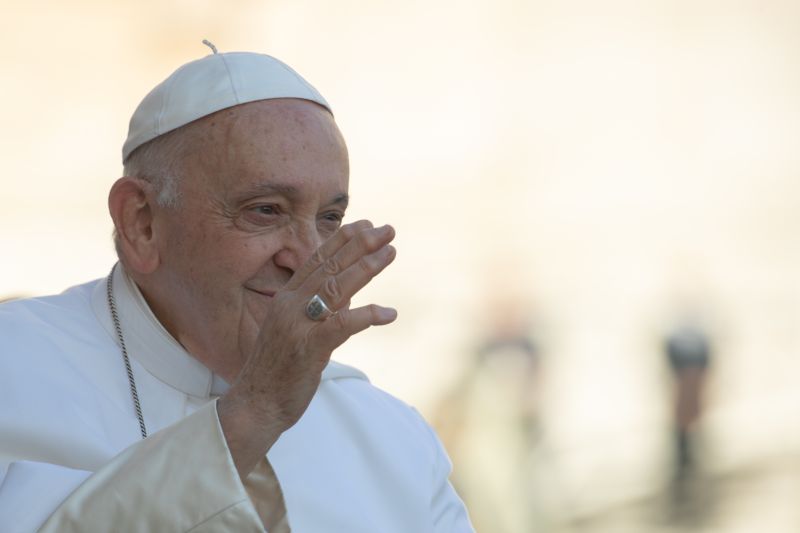
“The pope remains sovereign of Vatican City State, but that sovereignty is no longer presented as coming directly from the munus petrinum—by virtue of the Petrine office. Instead, Vatican City State sovereignty is juridical, historical, and diplomatic. It protects the Holy See’s freedom, but it does not define the theology of Peter’s ministry.”
Presuming that the jihadist invasion of Europe will continue unabated, what would happen to the Vatican City State, should the jihadists fully dominate in Italy, including Rome and Vatican City State?
Suppose the jihadists have no desire to honor any concordat between the “former country of Italy” and the Church. What then happens to the Pope’s role of “sovereign” if that eventuates?
I know these are a host of possible scenarios but, then again, who would have predicted 50 years ago that the European countries would have permitted the invasion of its countries by jihadists?
Returning to the issue at hand of the Petrine Ministry, the Pope as a worldly sovereign of any kind is chimerical at best. The Petrine Ministry would do best if the Pope were to place the importance of his role in the Church as the Protector of Unity, as ‘primus inter pares’, and his authority as deriving from his acting in concert with the other bishops. This notion of “Head of State” compromises the Petrine Ministry.
Imho,
“what would happen”?
The Church has been surrounded and attacked by hoards before.
It will do what it has done best for the last 2,000 years… It will survive.
Jay, you’ve missed the point entirely. The article is about the dual role of the Petrine ministry – one theological/ecclesial and the other statist/governmental. I’m of the opinion that the temporal one harms the Church and occupies way too much of the Pope’s attention to the detriment of the ecclesial. It also has maintained the rift between the Latin Church and the Orthodox Church. The Pope needs to give up this charade that he’s the equivalent of a Prime Minister, President or Sovereign.
You raise an excellent point. The pre-eminent Western scholar of Islam (Bernard Lewis) phrased the third encounter of Europe with Islam possibly only the choice whether the Europe of the future we will be a “Europeanized Islam or an Islamicized Europe.” (The first two encounters were repulsed at Tours in A.D. 722 and at Vienna in A.D. 1683).
Three reflections and a “contact point”:
FIRST, against Islam, how resilient (or not) is the nation-state system as an artifact of the religious wars within the West (Augsburg in A.D. 1555, and then the Treaty of Westphalia in A.D. 1648 after the Thirty Years War)? And, what will be the place of the Catholic Church under either Islamic scenario confronting sleepwalker Europe? As either a second-class dhimmi, or maybe a quarantined millet under the later Ottoman Empire? And, with the pope in exile as under Napoleon?
SECOND, deeper than power politics: the two divergent and alternative universes—Western agnostic rationalism and Islamic fideism—were addressed in a balanced way by Pope Benedict in his “Regensburg Lecture” (2006). A discourse violently rejected in the Islamic universe and ignored (of course) in the West.
My mind returns to Charles de Foucauld (1858-1916): Of missionary peoples, he said, “Neither does our role as Little Brothers include working for their adaptation to the Western materialistic, technological form of civilization, which, moreover, comes far from representing the only conceivable idea of a really human civilization.” His own conversion from a dissolute, comfortable and bored existence continued in Morocco where “through the faith of an entire people of Moslems, he had glimpsed something of the greatness of God” (In Rene Voillaume, “Seeds of the Desert” (Notre Dame, Indiana: Fides Publishers, Inc., 1964).
THIRD, “the greatness of God”…as with Christian Wisdom as “fear of the Lord.” (Something more than “project church” under the influence of Freemason Bugnini or any roundtable consensus too much like Islamic Ijtihad.) From Rome, then, which is prior to both Western culture and a resurgent 7th-century Islam—in terms of both chronology and substance—what is the clear vision of both the transcendent greatness of God and the “transcendent dignity of the human person”—as gratuitously revealed in Christ? A perennial Catholic Church at once Eucharistic and communal.
CONTACT POINT: Prior to Vatican II, one Muslim thinker pondered the two alternative universes:
“It all comes down to knowing whether one should hold strictly to the fundamental religious values which were those of Abraham and Moses, on pain of falling into blasphemy as the Muslims believe; or whether God has called men to approach him more closely, revealing to them little by little their fundamental condition as sinful men, and the forgiveness that transforms them and prepares them for the beatific vision—as Christian dogma teaches.” (al Akkad in 1956, as cited by Jean Guitton, “The Great Heresies and Church Councils,” 1965).
What is interreligious “fraternity”?
Thanks for a wonderfully articulate article on a topic that seems rather remote and obscure to at least this reader.
Unity is an ideal ( neither necessary or possible); but we must never give up trying.
If something isn’t necessary or possible, why expend any effort?
There are things that are necessary and possible and they require unceasing effort.
Pitchfork : Extend effort because many blessings are gained in trying to get together even if human weaknesses makes unity highly unlikely. Greater respect and cooperation would be a great blessing however and is far more likely and possible.
We are not required to engage in Quixotic Quests.
If there is no necessity or possibility of reunification, then there’s an opportunity cost to such pursuits-and one seeking a peaceful co-existence.
Given how aggressively parts of Orthodoxy is courting disaffected Catholics (especially young men, hence the “orthobros”), I suspect that reunification is highly unlikely, as there’s active animus and fundamental theological disagreements.
First, resolve the riff with the SSPX. I realize meeting with celebrities is a top Papal priority, but surely they could have been given the accompaniment the Queen of Punk received.
The Pope has given SSPX an on ramp, but they seem unwilling to take it. They are very welcome to come back and we would all profit by it. Perhaps more freedom will be given to those who want the Latin mass in the church, I hope so. This is a very delicate issue and not everyone will be pleased whatever the outcome.
The Catholic church is one, holy and apostolic. Unity is not a numbers games or to be determined by compromising with error. During the Protestant deformation, the Unity and oneness of the Catholic church remained. Those who left the church are outside of it, until they repent and seek forgiveness.
By abandoning the concept of heresy and error, the church has opened the doors to compromise.
I agree.
Also…the Catholic Church has already bent over backward to accommodate the Orthodox. Nothing will satisfy them except our complete compitulation. But that ain’t gonna happen. We’re not going to give away the farm.
There will never be unity on the basis of this post because it doesn’t even represent Catholic belief. On whose behalf does it address the Orthodox Churches, which left communion with the Church?
The “Chieti” document is heretical. It claims that the “West” only recognised a “primacy of honour” to Rome “after” the fourth century, and that the “East” never accepted even that. Both these claims are false. The Church teaches that the Popes have immediate jurisdiction over every Christian, but there is no mention of it in the post.
If the intention behind this newspeak is to make Catholics forget such truths, it won’t work. The Orthodox national churches won’t let them.
Amen.
We read: “Pope Leo XIV’s distinction is important for Catholic-Orthodox dialogue because one of the most persistent Orthodox concerns is that Roman primacy has been fused with juridical centralization, political sovereignty, and a monarchical-pyramidical view of the Church.”
Neither monarchical nor sociological, but rather institutional and charismatic, as re-emphasized by the 1985 Extraordinary Synod of Bishops which sought to protect the Second Vatican Council from “divergent interpretations.” And, as reaffirmed in the cited 2023 document “Synodality and Primacy in the Second Millenium and Today.”
Further, papal infallibility does not enable (positive) monarchy, but (only negatively) protects the papacy from error in proclaiming what has been revealed (from “extravagant” inventions as worded by Cardinal Newman). Universal jurisdiction protects the universal Church—indwelled by the indivisible Holy Spirit—from being dismembered by geographically scattered nation-states (like Russia). Recent synodality falters because it extravagantly reduced diocesan bishops to function “primarily as facilitators.” The rest is recent history.
All of this fiddling about whilst Our Lady’s request to consecrate Russia to her Immaculate Heart goes unheeded.
“It will be late.”
But perhaps, by affirming The Filioque , it will be soon, for certainly the affirmation of The Unity Of The Holy Ghost, The Spirit Of Perfect Divine Eternal Infinite Love Between The Father And His Only Begotten Son, Jesus The Christ, Who Proceeds From The Father Filioque. Peace🙏✝️
The Filioque, while Catholic dogma, is often omitted in many Eastern Catholic liturgies in keeping with their original heritage and the original Greek translation. They don’t deny it, but it’s not part of their tradition to recite it.
I believe that Papal infalliblility and authority, the Immaculate Conception, and divorce/remarriage are the biggest roadblocks to full communion with the Orthodox. It’s been 972 years since the Schism, and reunion would be a wonderful thing.
If we threw those “roadblocks” of the Catholic faith overboard, we wouldn’t be uniting with the Orthodox national Churches, we’d be joining them.
Exactly. No thanks.
To deny The Unity Of The Holy Ghost, The Spirit Of Perfect Divine Eternal Infinite Love Between The Father And His Only Begotten Son, Jesus The Christ, Proceeds From Both The Father And His Only Begotten Son, Jesus The Christ, And
Thus deny that Christ Is Consubstantial With The Father, is to deny The Divinity of Christ, and thus The Divinity of The Most Holy Blessed Trinity, Father, Son, And Holy Ghost, which is apostasy.
I should also add (Miguel, Nick, and everyone) that it is the Orthodox Churches that have to overcome the roadblocks. The Filioque, Papal authority, and the Immaculate Conception are all things that the Orthodox MUST accept, no matter what. Same with divorce/remarriage.
Though a Roman Catholic, I have been a member of a Byzantine Catholic parish for nearly 30 years. I can assure you that many, well educated Eastern Rite Catholics do indeed deny the Filioque, including some priests with whom I have spoken. I have no opinion on the issue, or the various definitions given to the the dogma in the various traditions, but I saw many Eastern Rite parishes in the 1980s where the words “and the Son” were crossed out in missals, long before the omission was authorized in North America.
The distinction around primacy matters because dialogue can stall when participants use one word while assuming different theological and historical meanings. Placing the discussion alongside a Divine Liturgy and an academic conference usefully shows that this is not merely an institutional question; it concerns worship, memory, and how churches recognize one another. Clarification is therefore valuable when it makes room for precise disagreement as well as genuine convergence, rather than asking either tradition to flatten its own understanding.
To deny The Unity Of The Holy Ghost, The Spirit Of Perfect Divine Eternal Infinite Love Between The Father And His Only Begotten Son, Jesus The Christ, Who Proceeds From Both The Father And His Only Begotten Son, Jesus The Christ, And thus deny that Christ Is Consubstantial With The Father, is to deny The Divinity of Christ, and thus deny The Divinity of The Most Holy Blessed Trinity, which is, in essence, an act of apostasy, because it denies that God Exists, In Essence, In A Communion Of Perfect Divine Eternal Infinite Love.
Eastern Orthodox Church (EOC) Ecclesiology doesn’t really accommodate a singular group of clergy, hierarchs, or scholars to decide on particular issues and speak on behalf of the One Holy, Catholic and Apostolic Church. Despite many friendly encounters between Rome and Constantinople in the previous century and ongoing, history has gathered SO MANY points of divergence in terms of theology and praxis that any official, joint, contemporary proclamation by the Vatican and the Phanar would almost immediately be rejected by a sizable portion of Orthodox Hierarchs simply because each Bishop in the EOC is gifted with the same grace of the Holy Spirit at elevation, and therefore maintains the prerogative to “rightly divide the Word of Truth.” This is perhaps not ideal when it comes to hashing out a framework for unity (witness Russia vs. Ukraine – a monumental stain on our claims of communion/unity in the Holy Spirit), but it does allow each bishop an authoritative voice on behalf of their respective flocks, rightly or wrongly. Historically, theological errors and adjustments (if they truly matter) are resolved in the EOC somewhat organically over time. We do not view the Ecumenical Patriarch in the same manner as Roman Catholics view the Papal Chair. Our deference to rank and experience within the EOC is one based on “honoring those to whom honor is due” and recognizing the voice of the Holy Spirit (which, as mentioned can take MANY years), not a strict view of authority that demands subordination. Any deference to the Bishop of Rome would be based on such. I think the question would be “will the Bishop of Rome (and not just Leo but the See itself) and the EOC Bishops/hierarchs find a way to submit to each other in humility and love regarding major points of disagreement that divide the Church?” And can this be done in committee? Sadly, I think not. Perhaps a committee(s) of ever-changing personnel over decades could finally hammer out a somewhat interesting set of suppositions for an 8th Ecumenical Council to consider, but short of The Holy Spirit’s voice and call being heard throughout the Church, additional schism is the likely result. I’ve attended an Eastern Rite Catholic Divine Liturgy (no Filioque and I did not commune, but it was VERY familiar) and I’m a huge fan of Robert Taft, SJ (of blessed memory) so I do very much appreciate the work going on in the POI in Rome, and I have sincere respect for the Christians “at Rome,” but alas this a rather tiny piece of the puzzle. I’m afraid that Rome and the EOC may have to endure until the eschaton to attain to the “unity of the faith and the knowledge of Thine unapproachable Glory.” May our conduct towards one another approach the example of our Lord Jesus Christ and His Saints.
Thank you for your perspective and insights. I thought the following questions were particularly well-framed: “I think the question would be “will the Bishop of Rome (and not just Leo but the See itself) and the EOC Bishops/hierarchs find a way to submit to each other in humility and love regarding major points of disagreement that divide the Church?” And can this be done in committee? Sadly, I think not.”
I agree. There are non-negotiables on both sides that can’t be papered over by reaching a consensus on a few minor points, such as whatever was agreed to in this recent meeting, which I still don’t understand after several readings of the article . What does it mean, in real terms, to say that the Pope can serve as a minister of unity for all of the Churches without exercising any substantive administrative authority?. Unity is not merely a attitude or a state of mind. The Roman Catholic Church remains hierarchical in nature, and that essential structure can’t be wished away.
Perhaps the distinctions being made in the article are too subtle for me to understand, but in that case, they’re probably too subtle for many lay Catholics (or lay Orthodox Christians) to understand.
Hi Mary – thanks for your kind reply. I think the issue at hand is that of temporal vs. ecclesial authority. The Tradition of the Church is that a Bishop cannot be both the head of State – King or Emperor, ect. – and a serving Patriarch at the same time. And since the gifting and role of Bishop cannot be rescinded apart from a synod vote for deposition, so once a Pope, always a Pope. The Vatican is considered it’s own political state – therefore, the problem. To allow it would be akin to King Henry the 8th taking the role of head of the Church of England and king at the same time. Kind of a no-no conflict of interest with respect to the Church. I’d have to review some history to see if this situation ever existed in the EOC – it might have – but probably not for long. Anyway, this is one of the main points of discussion this time around, I believe. I invite a correction on this from someone should I have missed the point. Be well.
Thank you, the context you provided helps me better understand the issue. I’ll admit that I haven’t spent much time thinking about the Vatican City State.
Don’t worry. It won’t take till the end of the world. The Orthodox national Churches will choose unity when it makes sense from the perspective of civil society and politics, as always. That time is arriving soon.
“I’m afraid that Rome and the EOC may have to endure until the eschaton to attain to the ‘unity of the faith and the knowledge of Thine unapproachable Glory’” (William Gould (Rdr. Basil).
The Apostle writes in Ephesians 1:10 that God plans to bring unity to all things in heaven and on earth under Christ. It’s not a direct reference of that occurring during the eschaton, as it clearly would be after the eschaton. Although it would be expected during an extreme crisis that Christians will put aside differences and unite in Christ. In any event that unity will be the work of our God who is infinitely good.
Talk to the Orthodox in the pews, or their priests and deacons, and you will get a very different impression of the “state of ecumenism” between the Churches. They are appalled by the treatment of Catholics devoted to the TLM as compared to Catholics who promote the LGBT agenda, and they want nothing to do with an imperial pope who claims the authority to abolish Tradition and ignore the Ten Commandments.
What “imperial pope” are you alluding to? And what commandments are being ignored and what traditions were abolished. Please be specific and stop generalizing.
Obtuse!
“Talk to the Orthodox in the pews, or their priests and deacons, and you will get a very different impression of the “state of ecumenism” between the Churches.”
Agreed. The Orthodox do not take the perspective that the differences between East and West are minimal. Some are actively and aggressively engaged in Proselytizing and winning converts, especially among young men who are disgusted by the effete and toxically effeminate nature of entirely too many Bishops who deem to want to be in charge of a libertine soup kitchen, not a Diocese of the Church-hence the “Ortho bros”.
I have a friend whose young adult son was increasingly disgusted by Francine inversion of the prudential and the imperative and converted to Orthodoxy after being engaged online. Interestingly, they attested to their belief in a doctrinal chasm by having him undergo a full immersion Baptism, which I was told was rather “unique”, involving not only the Orthodox cleric, but women with water vessels.
Women do not engage in any liturgical/sacramental activity in the Eastern Orthodox Church (including being altar servers or readers). Often, an aged religious sister/old lay women take case of the Sanctuary.
It is worthy of mentioning that different local Orthodox Churches have different procedures for a reception of Catholics and Protestants into the Orthodox Church. This reflects an attitude to the Roman Catholics; for example, most Greeks call Catholics “heretics” while for Russians they are more often just “schismatics”.
Thus the practice: Greeks or Russian Orthodox Church Outside of Russia insist on re-baptism while others like Antiochian or Russian Orthodox Church (Moscow Patriarchate) accept Catholics and Protestants via Chrismation and Profession of Faith.
A useful quote:
“The Orthodox Church in America (the former “American Metropolia”), founded by Russian missionaries and later forming a diocese of the Russian Orthodox Church with its centre first in San Francisco and then in New York, and which for a time had as her diocesan bishop the future [Saint] Patriarch Tikhon, inherited the traditions of the Russian Church with respect to the rite for the reception of the non-Orthodox converting to the Orthodox Church. The Orthodox Church in America receives non-Orthodox by three rites:
1. Those converting from Judaism, paganism, and Islam, as well as those who distort or do not accept the dogma of the Holy Trinity, or where the baptism is performed by a single immersion, by means of baptism.
2. Those whose baptism was valid but who either do not have sacrament of chrismation or who lack a hierarchy with apostolic succession (or if it is questionable), by means of chrismation. This group includes Lutherans, Calvinists and Episcopalians (Anglicans).
3. Those whose hierarchy has apostolic succession and whose baptism and chrismation (or confirmation) was performed in their church, by means of repentance and repudiation of heresy, following instruction in Orthodoxy. This group includes persons of the Roman Catholic and Armenian confessions. If it happens that they were not chrismated or confirmed in their churches or if there is any question about this, they are anointed with the Holy Chrism.”
And also:
“Following the Second Vatican Council an agreement was worked out between the Russian Orthodox Church and the Roman Church that, in the case of extreme need and in the complete absence of their clergy, members of the Roman Church could receive the Holy Mysteries in Russian Churches and likewise, the Orthodox in Roman Catholic Churches. We have no knowledge whether this agreement was realized in practice or whether it only remains on paper. Not a single Orthodox Church, with the exception of the Russian Church Abroad, reproached the Patriarch of Moscow for this decision which was called forth by the terrible times and persecutions of Christians under godless regimes. Nonetheless this decision has not been rescinded even now, and the recently printed catechism of the Roman Church published with the blessing of Pope John Paul II speaks of the full recognition of the sacraments of the Orthodox Church.”
‘On the Question of the Order of Reception of Persons into the Orthodox Church, Coming to Her from Other Christian Churches’, Archimandrite Ambrosius (Pogodin)
The distinction between what belongs to a universal ministry and what concerns the internal life of particular churches seems central to any serious discussion of primacy. It gives the dialogue a more precise question than simply asking whether authority exists. The setting of a Divine Liturgy and the continuing scholarly conversation also underline that theological clarification is inseparable from patient encounter, historical awareness, and careful language.
When the “love of God” becomes greater than the “love of power” and is expressed in our lives, daily acts of love towards all of our brothers and sisters in Christ so that God, Father, Son and Holy Spirit are recognized in all of our brothers and sisters, throughout the Mystical Body of Christ, of which all are a part, all of Christianity may, by the grace, mercy and love of God, be united.
The necessary next step may be “lived humility” as exampled by Jesus Christ himself when he, for our sake and our salvation and in total obedience to the Father and in union with the Holy Spirit, became “man”, lived amongst us and died for forgiveness of our sins.
In this humility, we must all recognize that “the greatest will be the least”, the “servant of all”…by which those seen as servants may lovingly teach those who proclaim themselves “masters”.
When we greet everyone as Christ, truly seeing Christ within them so as to welcome Christ with the Father and the Holy Spirit, then and only then will there be unity. Then and only then will we be living our faith.
Yours in Christ.
Greeting everyone in Christ does also mean telling them when they are in error about the faith, especially if one represents the Church, as a priest or bishop or Pope. Doing this in a charitable way goes without saying, but if this action is omitted by those whose duty of state requires it, or the true faith obscured (even denied, as in the Chieti declaration, above), there is no charity.
The distinction around primacy matters because dialogue can stall when participants assume the same word carries the same historical and ecclesial implications for both traditions. Framing the issue with precision leaves room to examine how service, communion, and authority relate without reducing Orthodox concerns to a procedural disagreement. The conference context also suggests that sustained encounter remains essential alongside formal theological statements.