


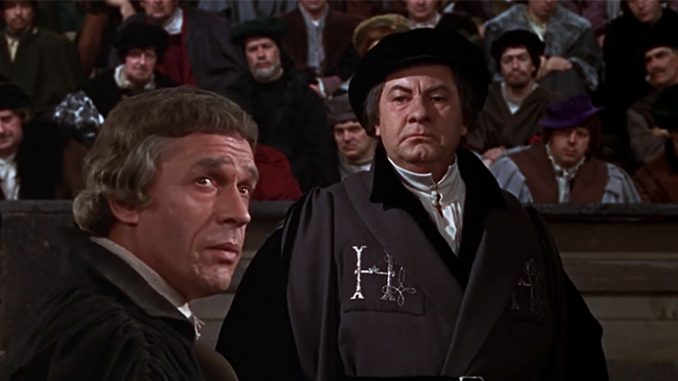
1966 was a great year for movies, and six decades later, the five nominated for “Best Picture” at the 39th Academy Awards the following year are all still worth watching: Alfie; A Man for All Seasons; The Russians Are Coming, the Russians Are Coming; The Sand Pebbles; and Who’s Afraid of Virginia Wolfe?
That 1967 Oscar ceremony seems to have taken place on a distant and different planet, though, light-years removed from the vulgar wokery that dominates Oscar night these days. Then, the show was elegant, well-paced, and wonderfully emceed by Bob Hope, dressed in a white tie. The most memorable moment came during Audrey Hepburn’s presentation of the “Best Picture” Oscar, the dramatic finale of Hollywood’s annual celebration of cinema as art. After a brief exchange of compliments with Hope, Miss Hepburn recited the names and producers of the nominated films, took the envelope, read the card therein, looked briefly up to heaven—and then, with a smile of satisfaction, as if her prayers had been answered, announced that the winner was A Man for All Seasons.
I recently rewatched Fred Zinnemann’s riveting cinematic adaptation of Robert Bolt’s play for at least the sixth time, and the thought occurred: Is A Man for All Seasons the most perfect film ever made? Everything about it seems exactly right.
Bolt’s screenplay keeps the action moving, highlighting the story’s pivotal moments while losing nothing of consequence from the play’s script. Everyone in the cast is terrific, beginning with Paul Scofield’s Thomas More and continuing through Wendy Hiller’s Alice More, Robert Shaw’s Henry VIII (the young Renaissance hero, not the porcine lecher of later years), Orson Welles’s Cardinal Wolsey (embodiment of a Church crippled by its alliance with state power), Nigel Davenport’s rough-and-tumble Duke of Norfolk, Leo McKern’s cynically amoral Thomas Cromwell, and John Hurt’s Richard Rich, corrupted by intellectual arrogance and overweening ambition. Vanessa Redgrave’s lascivious, 80-second cameo as Anne Boleyn hints at the sorry end awaiting the woman for whom King Henry broke with the Church of Rome.
Ted Moore’s cinematography is both gorgeous and true to history; I once looked out the window in More’s cell in the Tower of London and was struck by how cannily Zinnemann and his cinematographer used that view of the Thames embankment to convey the changing seasons during Sir Thomas’ lengthy imprisonment. Georges Delerue’s score is well-matched to the flow of the film and gives it an authentic Renaissance flavor.
If there is anything awry in A Man for All Seasons, I didn’t notice it.
I’ve often taken exception to Bolt’s attempt, in the preface he wrote for the 1962 paperback edition of his play, to justify to his secularist peers his esteem for More, an ardent Catholic. In that apologia, the agnostic-bordering-on-atheist playwright positioned Thomas More as a proto-existentialist hero: one who died in defense of “an adamantine sense of his own self,” King Henry’s threat to which caused “this supple, humorous, unassuming, and sophisticated person [to] set like metal, [and be] overtaken by an absolutely primitive rigor”—a man “who could no more be budged than a cliff.”
Yet in his screenplay, Bolt could not escape some decidedly Catholic facts: that the More family prayed together; that More, as a theologically knowledgeable consultant, helped Henry VIII win the title “Defender of the Faith” for a book defending the seven sacraments against Martin Luther; and that More, at his trial, insisted that the papacy was a divinely mandated institution. Then, at the end, Bolt’s More confesses that he dies “the King’s good servant, but God’s first” — the God “who will not refuse one who is so blithe to go to him.”
In that preface, Robert Bolt admits an admiration for Albert Camus that I share in some respects. But it is impossible to imagine Camus’ last words mirroring More’s, had the French existentialist writer died in similar circumstances. In giving his 16th-century hero those lines on the scaffold, Bolt thus tacitly conceded that More thought he was dying for the truth of Christ and the Gospel, not because, as a good existentialist with an “adamantine sense of self,” he could do no other.
Thomas More was a highly effective, conscientious public official. That aspect of his life is muted in A Man for All Seasons, where we see More invested as Lord Chancellor of England but not acting in that high office. Nonetheless, More’s example is important to lift up today, when public office is too often an invitation to performance art (or performance sludge).
Which suggests that A Man for All Seasons, sixty years old in December, should be required viewing for those in public service in 2026.
If you value the news and views Catholic World Report provides, please consider donating to support our efforts. Your contribution will help us continue to make CWR available to all readers worldwide for free, without a subscription. Thank you for your generosity!
Click here for more information on donating to CWR. Click here to sign up for our newsletter.

Leave a Reply