


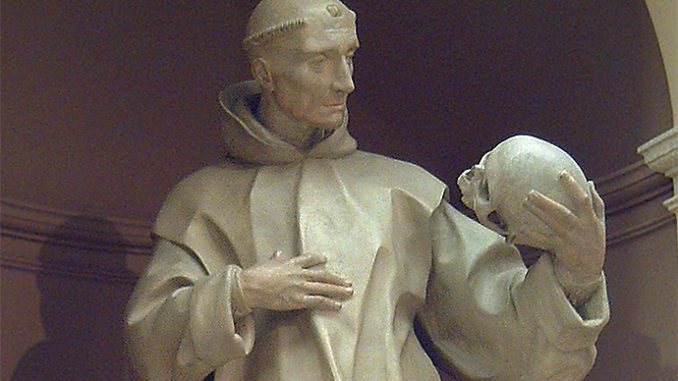
Every religious order has its own unique charism. While Saint Teresa of Calcutta’s Missionaries of Charity serve the poorest of the poor, Saint Dominic’s Order of Preachers preach God’s word. Like every flower in God’s Creation, every religious order gives Him glory in a different way.
Saint Bruno, however, never intended to establish a religious order. He only wanted to live alone with God as a hermit. But God had other plans.
Bruno’s early life
While many details about Bruno’s life are disputed—such as his family’s name—everyone seems to agree that he was born in the German city of Cologne around the year 1030 and was sent to the French city of Reims to be educated. Afterward, he was made a canon at the city’s cathedral. As a canon, he followed a rule of life that was both like that of a monk and like that of a secular priest. He had a home outside the cathedral cloister, received an income, and had servants. As a canon, he also joined the other seventy-two canons to pray the Divine Office at set times each day.
Bruno was probably only about twenty-six years old when he was given the office of director of studies in Reims. Bruno held this office for two decades and taught many men who later became bishops, priors, and abbots, as well as pope. Those men praised Bruno’s wisdom and his linguistic abilities, and one admirer wrote: “Those who drank of his spring became philosophers.”1
In 1068, the archbishop of Reims died, and a man named Manasses succeeded him. Bruno was appointed diocesan chancellor, and his star seemed to be rising.
However, Manassas had not become archbishop for the sake of furthering the kingdom of God but for his own sake. It’s not clear when Bruno became aware that his bishop was a hot-tempered, unprincipled, greedy autocrat who purchased his bishopric through simony and who was willing to lie, threaten, and use violence to get his way. But by 1077, Bruno had had enough, either of Manassas’ temper or because he seemed to be complicit in Manassas’ schemes by serving as his chancellor. Bruno resigned his position and traveled to a Church council, where he described Manassas’ behavior in detail to a papal legate. The irate archbishop retaliated by confiscating Bruno’s goods and making false accusations against Bruno and others.
At first, Manassas managed to hoodwink the pope into believing he was innocent. But in a few years, Manassas—compelled by a papal condemnation and a riot—was forced to run away to Germany to hide with Holy Roman emperor Henry IV.
Founding the Carthusian order
If Bruno had ever entertained hopes of becoming a bishop, this bitter episode changed his mind. Years later, Bruno reminisced to a friend about a conversation he had with two friends during this period. The friends were talking, fittingly enough, in a garden.
We talked for some time, I think, about the false attractions and the perishable riches of this world and about the joys of eternal glory. With fervent love for God we then promised, we vowed, we decided soon to leave the fleeting shadows of the world to go in search of the good that is everlasting and receive the monastic habit.2
Although they were initially delayed, Bruno and his friends traveled to a new monastery directed by Saint Robert of Molesme. This community eventually became the motherhouse of the Cistercian order. After spending some time there, Bruno and his companions went to confer with Hugh, the bishop of Grenoble, also a future saint. Hugh was sympathetic to Bruno’s goal of living a more solitary, contemplative life. He granted Bruno a plot of land in the nearby mountains, which was called Chartreuse.
Bruno and his companions built separate cells in the mountains and lived in poverty, silence, and simplicity. But one of Bruno’s students had become Pope (now Blessed) Urban II. Urban was an intelligent and pious man, and he was locked in a power struggle with Emperor Henry IV. Urban needed advisors who cared more about the Church than about power, and he ordered Bruno to come help him.
Although it cost him dearly, Bruno obeyed the pope and went to Rome. At first, his community decided not to continue without him, so Bruno ceded his property to the abbot of a nearby monastery.
Soon afterward, some of the brothers followed Bruno to Rome. At this point, Bruno was able to convince them to return to Chartreuse, although he had to humbly ask the abbot to give him back their mountain property. While a few brothers remained with Bruno, the rest went back to France and continued what is now known as the Grande Chartreuse.
Until his death around the year 1101, Bruno repeatedly asked to return to Chartreuse, but Pope Urban always refused. Bruno, with the help of a supportive nobleman, established a similar community in nearby Reggio Calabria, although he turned down the pope’s offer to be named the archbishop of that diocese. Bruno did his best to live a life of solitude and contemplation, even though he had to spend many hours in the worldly Roman court.
The life of a Carthusian
What was so unique about Bruno’s community that it evolved to become one of the greatest religious orders in the Church? As shown in the 2005 film Into Great Silence, the rule of life practiced by Carthusians balances the life of a hermit with the life of a monk. They primarily spend their days in solitude, but they also come together to pray the Carthusian Offices, offer Mass, and enjoy periods of recreation. This balance of prayer and sacramental life with long hours of silence helps Carthusians to foster a profound, constant, and wordless communication with God.
On a practical level, there are many differences between the Carthusians and other orders. For example, the hermits’ cells are typically connected to one another by hallways, but the windows of each cell face away from one another to create a sense of solitude for each hermit. The monks’ daily schedule involves rising at midnight to pray for about two hours. “[T]he Carthusian Father spends some fourteen hours a day in prayer, lectio divina and study, six of these hours in church and eight alone in his cell.”3 While the rest of us sleep, Carthusians somewhere are praying.
Both Carthusian Fathers and Brothers devote themselves to hours of prayer and study, along with some manual labor. But the Brothers proportionately spend more time performing services for the monastery, such as cooking, gardening, and cutting down trees for firewood.
There are communities of Carthusian nuns as well, although there have always been fewer nuns than monks. It is not surprising that fewer women are attracted to a religious life, which involves almost perpetual silence.
A century after Bruno died, there were thirty-three Carthusian Charterhouses. The Carthusians prospered particularly during the period of 1350-1550 and spread from France into what is now England, Germany, Italy, the Netherlands, and Spain.4 Over the centuries, some Carthusian monasteries have been destroyed or closed due to avalanches, fires, and anti-Catholic governments. But there are currently Charterhouses in Argentina, Brazil, Korea, Slovenia, and the United States, as well as Germany, Italy, Portugal, Spain, Switzerland, and the United Kingdom.
Unlike some of the greatest religious orders that have split, ceased to exist, been censured, or required serious reform, Carthusians can boast that their order has never needed reform. Perhaps the long novitiate required before profession weeds out those who might want to wear more comfortable clothing, eat meat regularly, have casual conversations, or get more sleep.
Saintly Carthusians
Out of humility, the leader of a Carthusian monastery is called prior or prioress, not abbot or abbess. Similarly, Carthusians have resolutely refused to try to draw the attention of the Church toward their holiest members, not even their founder. As they put it, “The Charterhouse makes saints, but it does not make them known.”5 Despite the many miracles that have reportedly occurred through his intercession over the centuries, Bruno was not formally declared Saint Bruno until a seventeenth-century pope added Bruno to the Church’s liturgical calendar.
However, other people have worked toward the canonization of Carthusians. Bruno’s friend and successor, Lanuinus of Calabria, has been named a Blessed. Seven Carthusian monks who became bishops have been recognized for their holiness by the Church,6 and two monks who were also widely known for their holiness during their lifetimes have been beatified.7
Blessed John the Spaniard was a Carthusian monk who wrote the constitutions for Carthusian nuns, and two of those nuns have been recognized by the Church: Blessed Beatrice of Ornacieux and Saint Roseline of Villeneuve.
Nineteen Carthusians have been recognized as martyrs, including seventeen who were executed during King Henry VIII’s battle with the Catholic Church.8 During the French Revolution, 126 Charterhouses in France were closed. Two Carthusian priests from that period who died in prison have also been beatified.9
Only a few of Bruno’s writings still survive. One of them is a letter that he wrote to the hermits of Chartreuse, perhaps a year before he died. In that letter, Bruno wrote:
Rejoice, my dear brothers, over your blessed vocation and the generous gift of divine grace you have received. Rejoice over having escaped the turbulent waters of this world, where there are so many perils and shipwrecks. Rejoice over having reached the peaceful quiet of a sheltered cove.10
Bruno’s modern biographer, Jesuit André Ravier, points to one phrase in that letter to describe the greatest gift of Carthusian contemplative life: the security of a sheltered cove.
By God’s grace, Saint Bruno and those who have followed him have discovered the life of a Carthusian to be like spending your life in a sheltered cove. The Carthusian’s search for a contemplative life of self-effacement, a life hidden in the wilderness like that of our Lord, a life of silence and all-embracing love, is a great gift to the Church and for the glory of God.11
Endnotes:
1 E. I. Watkin, Neglected Saints (Providence: Cluny, 2021), 28.
2 André Ravier, S.J., trans. Bruno Becker, O.S.B., Saint Bruno the Carthusian (Leominster: Gracewing, 2017), 61.
3 Robin Bruce Lockhart, Halfway to Heaven: The Hidden Life of the Carthusians (Kalamazoo: Cistercian Publications, 1999), 61.
4 Ibid., 41.
5 The Latin expression is: Cartusia sanctos facit, sed non patefacit.
6 Their names are: Saints Airaldus of Maurienne, Anthelm of Belley, Hugh of Lincoln, Artaldus of Belley, Stephen of Châtillon, and Blesseds Boniface of Savoy and Niccolò Albergati.
7 Their names are: Blesseds Odo of Novara and William of Fenoli.
8 The following Carthusian monks were condemned to death in 1535: Saints John Houghton, Robert Lawrence, and Augustine Webster; and Blesseds Sebastian Newdigate, Humphrey Middlemore, and William Exmew. The following Carthusian monks were condemned to death in 1537: Blesseds John Rochester, James Walworth, William Greenwood, John Davey, Robert Salt, Thomas Green, Thomas Scryven, Thomas Redding, Richard Bere, and Thomas Johnson. Blessed William Horne died a martyr in 1540.
9 Blesseds Claude Beguinot and Lazare Tiersot died in 1794 while in prison.
10 Ravier, 154.
11 See Ravier, 14.
If you value the news and views Catholic World Report provides, please consider donating to support our efforts. Your contribution will help us continue to make CWR available to all readers worldwide for free, without a subscription. Thank you for your generosity!
Click here for more information on donating to CWR. Click here to sign up for our newsletter.


Leave a Reply