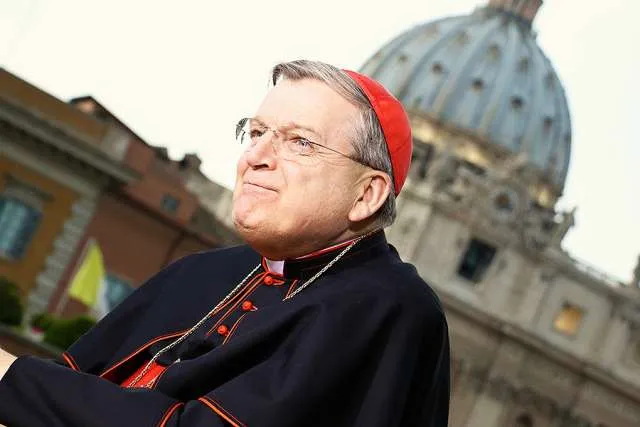
Vatican City, Apr 6, 2018 / 11:05 am (CNA).- Before he died, the late Cardinal Carlo Caffarra, emeritus Archbishop of Bologna, told friends that he wished for a conference that would gather bishops and other Catholics to reflect on the state of the Church.
The conference “Church, where do you go?,” scheduled for April 7 in Rome, can be considered the fulfillment of Cardinal Caffarra’s wish.
Not by chance, the conference is dedicated to his memory. Not by chance, the subtitle of the conference is “only the blind would deny there is confusion in the Church,” a passage of one of his latest interviews.
A number of significant topics that have arisen during Pope Francis’ pontificate will be discussed: the 50th anniversary of the Humanae Vitae; questions about the Church’s doctrine on matters of sexual morality; the issue of conscience, which was crucial during the 2015 synod on family, and the concept of “discernment,” which is sometimes used in arguments justifying more open access to communion for divorced and remarried Catholics.
The topics of discussion will also include the limits of the papal authority and infallibility.
There are all the ingredients of a rich food for thought.
Relators of the conference are Cardinals Raymond Leo Burke, Walter Brandmueller and Joseph Zen Zekiun; Bishop Athanasius Schneider; philosopher Marcello Pera; professors Renzo Puccetti and Valerio Gigliotti; and journalist Francesca Romana Poleggi.
The titles of the lectures touch critical issues, and also explore the possibility of correcting the pope, if his statements seem to contradict Catholic doctrine. This demonstrates the increasing preoccupation in some circles with the protection of the deposit of faith.
Though some presentation titles might seem harsh, the topics are real, and they are intended to be part of an attempt to respond to open issues, such as those put forth by the 2016 dubia of four cardinals, that asked the pope certain questions about the doctrine of the Church, in light of the different ways Amoris Laetitia was being interpreted.
The late Cardinal Caffarra was one of the signatories of those dubia, and his approach to the issue provides a good way to glimpse into the conference, beyond any possible vis polemica.
Cardinal Caffarra always underscored he was not against the Pope, but he was merely seeking clarity on issues of faith. His signature at the end of the dubia, and the following letter he sent to the Pope to solicit a response, was intended as a search for the guidance of Peter on questions on faith and doctrine.
The Apr. 7 conference will be concluded by a short video interview Cardinal Caffarra granted on the issue of Humanae Vitae, one of the increasingly controversial topics of the moment.
Presenting a book on the contribution of Cardinal Karol Wojtytla (then Pope John Paul II) to the preparatory commission of Humanae Vitae, Cardinal Gerhard Ludwig Mueller, emeritus prefect of the Congregation for the Doctrine of the Faith, stressed that overturning the teaching of the Bl. Paul VI encyclical would be “a crime against the Church,” and denounced the work of a “secret commission” to re-write Humanae Vitae.
The commission is a study group led by professor Gilfredo Marengo, that is said to be looking back to the genesis of the encyclical.
The genesis of Humanae Vitae is one of main topics of discussion, and Renzo Puccetti, one of the lecturers, described it very well in the book “I veleni della contraccezione” (“The poisons of contraception”) that explains how the contraceptive pill was invented, developed and spread, describes the work of the lobbies of demographic control and how Catholics responded with natural family planning, and describes the struggle between bishops, theologians, doctors, and association of lay people over contraception.
This struggle poisoned the years before and after the Second Vatican Council, but Paul VI resolved to staying faithful to the doctrine.
The rebellion that followed provides a lot of clues about what is going on now. The encyclical was strongly resisted by a group of theologians that grabbed the headlines, and the pope was subjected to strong pressures.
The first step was to question the authoritativeness of the encyclical, saying that norms of contraception were not mandatory, as the document did not present a solemn declaration of infallibility.
This is the reason why Cardinal Wojtyla, who took part the in the preparatory committee, recommended that Paul VI clearly express the infallibility, not of the encyclical, but of the teaching expressed in the encyclical, a part of deposit of faith that needed to be preserved to stay faithful to the Gospel.
If the story behind Humanae Vitae says a lot about how campaigns against Catholic teaching is carried on even nowadays, the issue of pope’s infallibility is another interesting topic.
Is Amoris Laetitia or any other Papal document beyond the possibility of any mistake? To this extent, it is worthy to note that Cardinal Walter Brandmueller, another of the speakers, wrote in 1992 a book titled “The Church and the right to be wrong” about the Galileo case.
Cardinal Brandmueller took the example of Galileo to stress that the Church does not claim any infallibility except in some, well defined cases. Things can be discussed, in the end. Noting this is also an indirect response to those who blame any critic of Amoris Laetitia as a critic of papal authority itself.
Cardinal Burke is a very well known personality, and on numerous occasions he has addressed the problems of confusion over Catholic teaching. and the need to tackle that issue for the sake of the faithful.
Cardinal Zen has become the loudest voice in the defense of the Church’s freedom in China. While a discussion on the China-Vatican deal on the appointment of bishops is underway, Cardinal Zen has expressed the concern of many Catholics of China, and decried a return to Ostpolitik, the label given to Holy See’s policy with Eastern bloc countries on the other side of the Iron Curtain.
Ostpolitik was a diplomacy of dialogue and concessions, developed in the 60s by Msgr. Agostino Casaroli, later St. John Paul II’s Secretary of State.
Ostpolitik was also strongly criticized from the Cardinals of the Church of Silence, i.e., Cardinal Stefan Wyszynski, Primate of Poland, and above all Cardinal Jozef Mindszenty, Archbishop of Budapest-Esztergom, that both considered the Holy See’s approach as amounting to too much dialoguing with the countries of the Soviet bloc.
Bishop Schneider of Astana, Kazakhstan, has been one of the strongest defenders of Catholic teaching and a promoter of the Kazakhstani profession of truths on marriage.
Is the current approach on issues of doctrine and morality a replica of the Ostpolitik approach? Is the Church dialoguing too much with the world, giving up the primary task of evangelization?
Those are issues that will be explored during the April 7 discussion.
The conference will end with a declaration, which will likely restate the truth of faith regarding doctrine on marriage and sexuality.
According to the veteran Vatican watcher Sandro Magister, “this ‘declaratio’ will be the polar opposite of that ‘Kölner Erklärung’ – the declaration signed in Cologne in 1989 by German theologians now in the good graces of Francis – which concerned the principles later reaffirmed by John Paul II in the 1993 encyclical “Veritatis Splendor.”
It remains to be seen how much the conference will garner attention and make an impact. It is likely it will be labeled as an “anti-Francis” conference, but it is also likely that there will be a poor response to the hard-hitting questions raised during the lectures.

 […]
[…]



 By
By 

Just dont send in the homosexualists at the Vatican to have a discussion with SPXX about these episcopal ordinations.
The Orthodox Church (Greek, Russian, Rumanian, Serbian, Antiochian, etc.) have basically kept the same liturgical practices since the eighth century and the Nicean II ecumenical council (the last one recognized by the Orthodox Church). It is still hard to grasp why the Catholic Church changed the liturgy that was so good for the likes of Dante, St. Francis of Assisi, St Thomas Aquinas, St Dominic, St John Newman, and so many other Catholic saints and thinkers, until 1962.
DR, that problem has been around for a very long time. If not out in the open, then undercover.
I knew an SSPX family who had a tragic outcome because of that. We certainly shouldn’t ” celebrate ” confusion and vice but we need to also be cautious. Especially with our children. That kind of deviancy can be found in traditional communities too.
mrscracker: agreed…unfortunately its endemic in the clerical Church
Having read a recent interview of SSPX Superior General Father Davide Pagliarani by Diane Montagna, Fr Pagliarini indeed makes a strong argument for his belief the Church is on the wrong track in following the secularist momentum left as Pope Francis’ legacy, and arguably being pursued by Leo XIV.
That Leo XIV will send the one man that epitomizes that legacy, Cdl Victor Fernández to meet with him can either be an indication of Pagliarini’s contention, or a test for Fernández’ continued tenure.
During Pagliarini’s interview with Montagna the SSPX Superior general lamented that the reconciliation over the TLM achieved by Benedict XVI has been apparently reinforced under Leo.
Nevertheless, Leo XIV has shown movement toward a more precise treatment of moral doctrine and a strengthening of the marriage contract. The bottom line issue is remaining true to the Church instituted by Christ. This is where the battle must be fought. Not from without.
Having read a recent interview of SSPX Superior General Father Davide Pagliarani by Diane Montagna, Fr Pagliarini indeed makes a strong argument for his belief the Church is on the wrong track in following the secularist momentum left as Pope Francis’ legacy, and arguably being pursued by Leo XIV.
That Leo XIV will send the one man that epitomizes that legacy, Cdl Victor Fernández to meet with him can either be an indication of Pagliarini’s contention, or a test for Fernández’ continued tenure.
During Pagliarini’s interview with Montagna the SSPX Superior general lamented that the reconciliation over the TLM, achieved by Benedict XVI and abrogated by Pope Francis, that abrogation has apparently been reinforced under Leo.
Nevertheless, Leo XIV has shown movement toward a more precise treatment of moral doctrine and a strengthening of the marriage contract. The bottom line issue is remaining true to the Church instituted by Christ. This is where the battle must be fought. Not from without.
It comes down to holiness. Do the members/leaders of the SSPX manifest true sanctity– which includes dispositions of humility, patient suffering, love of the Church and zeal for souls. The latter it seems is in their favor. While their good fruits of evangelizing are clear, the plan to consecrate on July 1, outside Rome’s directive, indicates obstinacy and pride.
Other positive signs are what we don’t see- the dozen or so post-synodal Study Groups on “hot button issues” seem to have lost their steam. And, in November, it was reported that two of their reports (rescheduled from June until December of 2025) had demoted the homosexual lifestyle from “controversial” to only an “emerging concern,” and that deaconesses of any sort are off the table.
Also, we notice nothing in the wind about a proposed new round of “synods” (Cardinal Grech) at the local, regional and continental levels, all to crescendo into a Rome event in 2028 rebranded as an “ecclesial assembly.”
Might it be that when Pope Leo XIV speaks positively of being “synodal” he is simply referring to a needed culture of greater interpersonal rapport—rather than to the earlier drift to restructure the apostolic succession and the unified “hierarchical communion” (Lumen Gentium) of the Church into polyglot Congregationalism (with, say, der Synodal Weg Germania insulated safely within the European faction?).
In considering the impending dialogue between the Vatican and the SSPX, one must revisit the fundamental duty of the laity: when a shepherd veers toward the abyss, are the sheep bound to follow him over the precipice? I contend that while we owe a filial respect to the Petrine Office, our ultimate allegiance is to the Eternal Shepherd. We follow the path of authority to the edge of the cliff, but we must stop where that path diverges from Sacred Tradition.
The SSPX has maintained a singular, unvarying witness to the Faith, remaining largely insulated from the corrosive influence of modernism and its attendant heresies. In stark contrast, the institutional Church currently grapples with a series of profound scandals: the presence of an identifiable ‘lavender mafia’ that attacks the family, marriage, and moral standards, the horrific scourge of sexual abuse and its subsequent cover-ups, and the baffling, continued promotion of an artist whose work and lives are an affront to the priesthood and the entire concept of holiness.
What, then, is our priority? It must begin and end with Jesus Christ. I find it untenable to prioritize ‘canonical regularity’ or liturgical ‘acceptability’ over the 1,800-year liturgical and theological legacy of the Church. We must build our foundation upon Christ alone, remaining steadfast even as the winds of abuse and heterodoxy howl through the cloisters. If we are to discuss the ‘validity’ of bishops, let us first discuss the ‘validity’ of a witness that protects the flock from the cliff’s edge.
Jesus Christ founded the Catholic Church. The pope is the vicar of Christ on earth. If the SSPX excommunicates themselves once again, they are not followers of Christ nor upholding the faith. And no, that doesn’t mean you embrace the evils that occur in various parishes or among people who claim to be Catholics, but it does mean you stay faithful and not follow some group who constantly tout how “Catholic” they are.
Why is that SO hard for these brainwashed folks to understand?
Brainwashed? Hmm. The pope, any pope, is not Jesus. In these difficult times we had one monumental example of a pope in a state of heresy – Francis. Among a mountain of errors, he chose to directly contradict the clear teachings of Pope Benedict and Pope Saint John Paul II, which also was a conflict with 2,000 years of Tradition.
I have never attended an SSPX mass, but I do have deep appreciation for the TLM. I strive to focus solely on Jesus Christ and his teachings. I reject anyone who attempts to change Tradition, Doctrine, and/or the teachings of the Church. I support unity, but not at any cost.
Something I think about is if Vatican II was so wonderful or true, why did we lose over 50% of the Body of Christ? How was that same failure reflected among the priesthood and the Religious? Do not confuse my questions with attacking, but honest questions. As a convert, I am still baffled by how Vatican II was implemented and its detrimental impact on the Church.
Michael B, as a convert, you must understand that we as individuals don’t need to keep searching and trying to figure things out. The Church does that for us, through the pope, councils, documents, and the Magesterium. Jesus himself designed it to be this way. There have been no changes in doctrine or teachings. A core tenet of the faith is that the Church is indefectible; it will last until the end of time and cannot fall into error. The TLM is not the only way of expressing the Church’s Liturgy. Vatican II occurred during great social upheaval, but was not the cause for people abandoning the Church. We all have free will and can make mistakes, including the pope, but he cannot fall onto error in an official capacity, and his personal holiness, or lack thereof, does not disqualify him from being pope. The Church also reserves the right to change its Liturgical practices and instruct us on how we are to worship at Mass.
The SSPX is no authority on these matters as they have proven themselves time and again to be disobedient, and are apparently ready to be so again. They hide behind the beauty of the TLM to manipulate people into thinking that Rome has lost its way. And unfortunately a lot of this thinking has permeated other TLM groups that are still united to Rome.
It is good that you focus on Christ and His teachings; continue to do that as you attend Mass, whether TLM or otherwise. I speak as someone who was exclusively involved with the SSPX for nineteen years. They are operating an agenda parallel to the Church which creates confusion, division, and doubt among the faithful.
“Vatican II occurred during great social upheaval, but was not the cause for people abandoning the Church.” When has there not been social upheaval? The Church and her liturgy used to be a haven from such upheaval, instead of being submerged by it and a contributor to the chaos. Vatican II was a complete and utter disaster, and the mass of Paul VI a tragic perversion of Catholic prayer.
Faithful to what or whom? Pope’s are meant to defend and uphold tradition, not undermine it.
It is you who appear to be brainwashed, just in the way Protestants think of certain Catholics. Your papolatry is not Catholic.
No Timothy, it is you who sound like a protestant, by attacking a Catholic for engaging in “papolitry.”
+Leo isn’t sending his best in +Tucho.
It appears to me that the only sacrosanct element in the perennial Magisterium is the authority of the bishop…from top to bottom…but the rest is quite expendable if it is convenient to relativize it.
Recall well this from Pastor Aeternus of Vatican I in its definition of papal infallibility: “The Holy Spirit was not given to the Roman Pontiffs so that they might disclose new doctrine, but so that they might guard and set forth the Deposit of Faith handed down from the Apostles.”
Bishop Melchior Cano, O.P., at the Council of Trent stated: “Peter has no need of our lies or flattery. Those who blindly and indiscriminately defend every decision of the Supreme Pontiff are the very ones who do most to undermine the authority of the Holy See – they destroy instead of strengthening its foundations.”
What we observe over the last sixty-four years is quite scandalous. It undermines the faith of millions. The episcopate renders itself incredible. Their absence from the defense of the faith, while aggrandizing themselves and their own notions is abhorrent and an offense against the Gospel. Theological abuse renders sexual abuse pale.
We are all obliged to provide assent to the perennial Magisterium — the episcopate is no exception. It is not theirs to tinker with. When are they going to provide their “wisdom” to German synodalists, same-sex advocates in collars, bold liturgical aberrations never conceived of by the mid-century council?
One may simply ask which group is conforming the world to God and which is conforming God to the world. We must chose wisely given that pur eternal souls depend upon that choice.
Every Catholic needs to ask him or herself one very basic question which should be answered in the fullness of truth. It is this: “Why did Archbishop Lefevre institute the Society of St. Pius X in the first place?” Was it because he rose one morning and decided to be disobedient and prideful? Or, was he reacting to some very serious liturgical and magisterial challenges to the Catholic faith?
In this regard, I remind myself that I graduated from a Catholic college in 1970 after 16 years of Catholic education. As we approached graduation, my five roommates and I decided to host a thanksgiving Mass (?) for our parents. The college chaplain agreed to celebrate Sunday Mass in our dormitory apartment. For sacred vessels we used glasses to hold the wine – glasses used previously to hold beer. We used store-bought bread that was leavened. For the Mass readings, we chose selections from Erick Fromm’s The Art of Loving and from Kahil Gibran’s The Prophet. We condescended to read a Gospel from one of the four Gospel writers. Such was the state of liturgy and Church teachings only 5 or so years after the closing of the Council.
Again I ask: “What might Archbishop Lefevre have been reacting to? A lost patrimony, perhaps?
In the late 1980s and early 1990s, at Mass at the Paulist Center in Boston, home-baked whole wheat bread was consecrated, then broken and distributed in straw baskets (similar to those used as collection plates). Wine followed, consecrated in a vase-like porcelain pitcher, later passed in as jovial a manner (with parishioners remaining seated in the pews), not dissimilar to persons taking a ‘toke’ and handing it down the line at a college frat party.
Has anything much changed? See what appear to be liturgical dancers in the sanctuary (together with the choir and piano) at last year’s Pentecost.
https://www.paulistcenter.org/mass-schedule/
DeaconEdwardPeitler, Mons. Lefebvre established SSPX in 1970 with Vatican’s approval. Only after he had disagreements with Popes Paul VI and John Paul II was the approval withdrawn in 1975. So, the initial establishment of SSPX was not a reaction to a lost patrimony.
I listened to some of the priest’s homily for the Feast of the Baptism of the Lord (2025). It’s on YouTube. The president’s name was not mentioned, but he certainly was talked about with more than a mite of asperity, obvious dislike, and allusions to immoral tyranny.
Oscar, It is indeed hard to understand, from the west’s point of view, why Pope Paul VI chose to promulgate a new order of the Mass following Vatican II.
I came from a third world country in Southeast Asia that has been Catholic for 400 years. Before Vatican II, most people in my small town loved the Church for its devotions to the Blessed Mother and the saints, but hardly understood the Mass in Latin; although they dutifully went to church on Sundays and holydays. They were very poor, but good people. think they were given permission to silently recite the rosary during Mass then; so that was what they did.
In order to follow the Mass in Latin, one needed a Latin-English hand missal, which was unavailable in town and expensive to buy in the city. At any rate, most townspeople at that time could hardly read in English, let alone understand Latin. That was just after WWII, which devastated our town.
My father, a poor carpenter, was a cantor at the Mass. He spent his life savings for a copy of the Liber Usualis. It was the only copy in town outside of what the priest used.
When, in the 1970s, the Mass in Latin was replaced with the Novus Ordo in the vernacular, my father was heartbroken, to say the least. He has been dead for many years, and I hope and pray he’s at peace with the Lord.
The village people now appreciate the Mass in the language they understand. They don’t need to buy a missal. They’ve memorized the prayers and the songs. The last time I went to visit my hometown, the church was bursting at the seams. Groups of old people still prayed the rosary before and after the Mass, but not during the Mass. The people seemed very happy with the Novus Ordo.
Even with the best will in the world on both sides, it seems humanly impossible for everything to be worked out canonically and doctrinally before July 1. But if this leads to an open and frank discussion about Vatican II (including a discussion of its actual authority, based on the Nota praevia), then that can only be good for the entire Church and not only the SSPX.
It seem very unlikely that Rome could in good conscience provide an apostolic mandate to a bishop (Fellay or de Gallaretta) who is technically suspended. But why could not Rome send a prelate in good standing (a cardinal like Mueller or Sarah) to perform the consecrations? Even though the ceremony would be in the old rite, it would be performed by a prelate who himself had been consecrated in the new rite of 1968, and would thus be a concrete way for the Society to show that they accept the validity of the new rites, even if they can still have reservations about aspects of the reform (they would not be asked to perform or participate in the new rites themselves).
Still, the fact remains that the Society itself technically does not even exist right now and certainly has no canonical mission, but could even that not be resolved fairly easily on an interim basis? The SSPX was in fact founded with canonical approval in 1970, and thus it did “exist” in the eyes of the Church for several years until it was suppressed in 1975 (even if one disputes the SSPX claim that the suppression was illegal and was of no effect, it is true that it was a cloudy situation). Could the Holy See not simply overturn the 1975 suppression and then, voila, without having to *create* a status for the SSPX, they would just go back automatically to being what they were? Admittedly such a status (basically an entity under the immediate jurisdiction of a Swiss diocese) would be totally inadequate to the needs of an international community with 800 priests, but it would just be a starting point that would allow them all to receive a canonical mission. Eventually — when the doctrinal issues are ironed out — the Society could receive a more stable canonical status, for example as a personal prelature. But offering an episcopal consecration under the auspices of Rome would be an important litmus test for both sides: how serious Rome is for reconciliation that is not simply complete surrender and how serious the SSPX is about wanted a normal relationship with Rome. If the SSPX leadership would refuse such consecrations because of pandering to their more extreme crypto-sedevacantist wing and thus proceed to do consecrations on their own anyway, then the putative schism would be more clear and an excommunication Rome would declare would be much “cleaner” in the eyes of everyone of good will.