

 By
By As one of the leading international experts on Lefebvrism sees it, reconciliation is impossible as long as the Societyʼs rejection of certain parts of the Second Vatican Council persists.
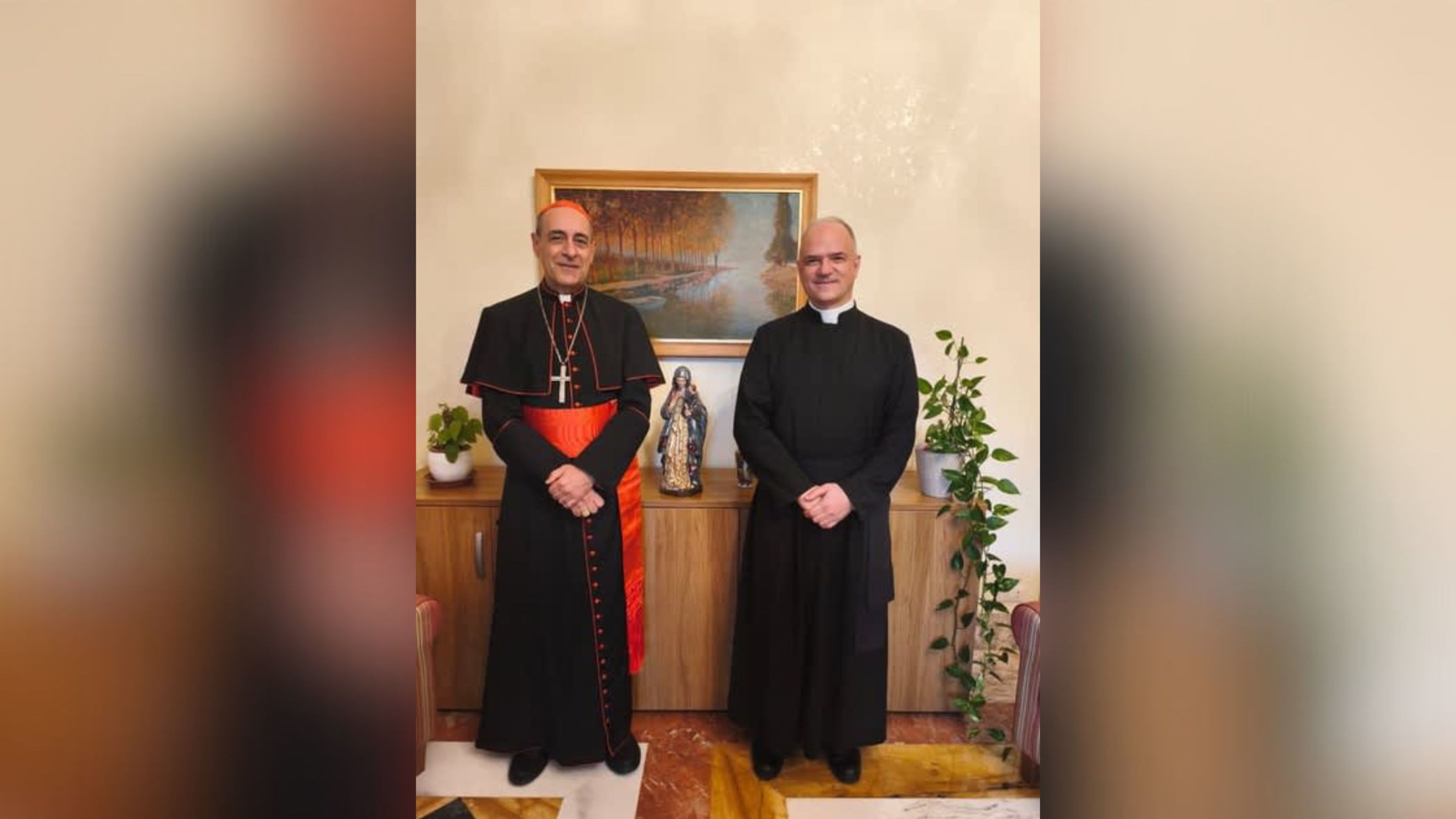
The Society of St. Pius X (SSPX) went from full communion with Rome to formal rupture in less than two decades, a break that has never been fully healed.
On May 13, Cardinal Víctor Manuel Fernández, prefect of the Dicastery for the Doctrine of the Faith, warned that the episcopal consecrations without a papal mandate — which the society has announced will take place July 1st — will constitute a schismatic act entailing automatic excommunication, the very same scenario the SSPX bishops experienced in 1988.
Origins
The SSPX fraternity was founded in Switzerland as a priestly society of diocesan right by Archbishop Marcel Lefebvre and canonically erected in 1970 within the Diocese of Fribourg, with the approval of the Ordinary; that is, in full communion with Rome. The SSPX celebrates exclusively the Traditional Latin Mass and maintains doctrinal differences regarding certain teachings and reforms of the Second Vatican Council.
The first cracks in the relationship with the Catholic Church emerged just four years after its founding. In 1974, following an apostolic visitation to the seminary he had established in the Swiss town of Écône, Lefebvre publicly expressed his rejection of various teachings of the Second Vatican Council, not only regarding liturgical matters but also concerning broader doctrinal issues.
In a statement to ACI Prensa, the Spanish-language sister service of EWTN News, Italian sociologist Massimo Introvigne, one of the leading international experts on Lefebvrism, the “truly insurmountable” stumbling block for the Lefebvrists was the document Dignitatis Humanae. Promulgated in 1965, this document represented one of the most audacious theological and pastoral shifts of the Second Vatican Council, in which the Church affirmed the principle of religious freedom for the first time.
Dispute over religious freedom
“According to Lefebvre, only the Catholic Church should be guaranteed the right to religious freedom; other religions may, at most, be tolerated,” summarized the sociologist, who also explains that this entails a rejection by the Lefebvrists of any openness toward ecumenical and interreligious dialogue.
The core of the disagreement regarding Dignitatis Humanae was the subject of intense correspondence with the then-prefect of the Congregation for the Doctrine of the Faith, Cardinal Joseph Ratzinger, who held that position between 1981 and 2005 before being elected pope as Benedict XVI.
In a letter titled “Liberté religieuse. Réponse aux ‘dubia’ présentés par S.E. Mgr. Lefebvre,” (Religious Freedom. Response to the ‘dubia’ presented by H.E. Archbishop Lefebvre) dated March 9, 1987 — one year prior to Lefebvreʼs excommunication — Ratzinger attempted to persuade Lefebvre that there was no rupture regarding religious liberty between the Magisterium preceding the Second Vatican Council and Dignitatis Humanae, and that the concept could be upheld on theological and philosophical grounds that exclude relativism.
“We have preserved the correspondence exchanged between the two, which reveals how, in the end, Cardinal Ratzinger concluded that Archbishop Lefebvre’s positions were diverging from orthodoxy and from communion with Rome,” Introvigne explained.
Introvigne, who interviewed Lefebvre on several occasions before his death in 1991, noted a little-known fact: the archbishop participated in all four sessions of the Second Vatican Council as superior general of the Fathers of the Holy Spirit and even signed all the conciliar documents.
However, Lefebvreʼs views became more radicalized after the council when he “began to be concerned about what he considered to be progressive drifts within the Church — drifts which, in his view, were moving away from tradition,” the expert explained.
In that context, in 1970, he founded a seminary in Switzerland with the aim of offering a traditional priestly formation. “Gradually, throughout the 1970s, he also began to formulate responses that led him toward positions of rupture,” Introvigne noted.
The first rupture
These responses led, in 1975, to the canonical suppression of the fraternity by the bishop of Fribourg, a decision that Lefebvre challenged unsuccessfully.
A year later, the situation escalated with his suspension ab ordinum collatione (from the conferring of orders) and, subsequently, a divinis, which prohibited him from performing any sacred act, including the celebration of Mass.
Although these categories belong to the 1917 Code of Canon Law then in force, their legal effect today is unequivocal: Lefebvre was deprived of the lawful exercise of his ministry.
Despite this, he continued to ordain priests, and the fraternity continued to expand its activities, “all under objective conditions of canonical illegality;” that is, outside of ecclesial norms, as explained to ACI Prensa by professor of Roman Law, Father Pierpaolo Dal Corso.
1988: Episcopal consecrations and schism
The definitive breaking point occurred on June 30, 1988, when Lefebvre consecrated four bishops without the required pontifical mandate, openly defying the authority of the Roman pontiff, John Paul II. According to Dal Corso, that act constituted “a wound of extreme gravity to the hierarchical communion of the Church” and had a clear schismatic dimension.
In the face of this new and grave act of insubordination, the then-Congregation for Bishops declared the Society of St. Pius X to be schismatic on July 1, 1988.
Dal Corso rejects the thesis of the supposed “state of necessity” invoked by the fraternity to justify the consecrations of 1988. Although the Code of Canon Law recognizes this concept as an exempting or mitigating circumstance, the Vatican clarified in 1994 that it was not applicable in this case, given the pope’s explicit warning and the extreme gravity of the act.
“A state of necessity cannot be used to legitimize opposition to the authority of the Successor of Peter, nor to cast doubt upon the infallibility of the pope and the indefectibility of the Church,” Dal Corso said.
The following day, John Paul II promulgated the motu proprio Ecclesia Dei, in which he affirmed that Lefebvre, the bishop who consecrated with him, and the four men consecrated as bishops had incurred latae sententiae (automatically upon the commission of the offense) excommunication in accordance with Canon 1364 of the 1983 Code for the crime of schism.
Lefebvre died in 1991 without having shown public signs of repentance, an indispensable condition for an eventual canonical reconciliation.
Gestures of rapprochement without full regularization
In subsequent pontificates, there were significant attempts at rapprochement.
In 2007, Benedict XVI promulgated the motu proprio Summorum Pontificum, which recognized the legitimacy of using the 1962 Missal, otherwise known as the extraordinary form of the Roman Rite, an act which the fraternity highly values.
“It was an important step toward rapprochement, as it legitimized from a merely liturgical standpoint celebrations according to the 1962 Missal of John XXIII; they never accepted the missal resulting from the liturgical reform of the Second Vatican Council,” Dal Corso explained.
Two years later, in 2009, Pope Benedict XVI lifted the excommunication incurred for the specific offense of episcopal ordination without a pontifical mandate.
However, as Dal Corso emphasized, this remission “did not affect the excommunication for schism,” which remained legally in force. The canonical status of the fraternity therefore remained irregular.
Pope Francis took further pastoral steps, granting SSPX priests the faculty to hear confessions and granting diocesan bishops or other local ordinaries the authority to give SSPX priests the ability to celebrate licitly and validly the marriages of the faithful who follow the Societyʼs pastoral activity. These measures, however, did not entail full juridical regularization.
Now, under the leadership of the Italian priest Davide Pagliarani, the fraternity has announced new episcopal consecrations for July 1, 2026, a date chosen with seemingly deliberate intent. “It is the very same day as the consecrations of 1988. Beyond being a provocation, it symbolically signifies a reaffirmation of that stance,” the expert explained.
Meanwhile, the prefect of the Vatican’s Dicastery for the Doctrine of the Faith, Cardinal Víctor Manuel Fernández, has reiterated that lacking the requisite pontifical mandate, should they take place, these episcopal ordinations will constitute a schismatic act.
Introvigne said the current scenario brings the situation back to the one that existed before the papacy of Benedict XVI. As long as the doctrinal rejection of certain parts of the Second Vatican Council persists, he said, “reconciliation is impossible. The future, as the saying goes, is in the hands of God.”
Canonical status of the faithful
Regarding the faithful who adhere to the SSPX, Dal Corso said that the Pontifical Council for Legislative Texts clarified in 1996 that excommunication for schism does not automatically apply to those who attend or participate in worship celebrated by the SSPX.
In this regard, Monsignor William King, JCD, professor of canon law at The Catholic University of America, told ACI Prensa that “if a person attends a Mass celebrated by a priest in schism, that individual is not excommunicated, unless he attends that Mass deliberately because he does not accept the authority of the pope or the authenticity of the Catholic Church.” That is to say, for formal schism, it is necessary that the person freely and consciously embrace the essential core of schism: the denial of the pope’s authority, outwardly manifested.
This story was first published by ACI Prensa, the Spanish-language sister service of EWTN News. It has been translated and adapted by EWTN News English.
If you value the news and views Catholic World Report provides, please consider donating to support our efforts. Your contribution will help us continue to make CWR available to all readers worldwide for free, without a subscription. Thank you for your generosity!
Click here for more information on donating to CWR. Click here to sign up for our newsletter.

Monsignor William King, JCD, professor of canon law acknowledges that “if a person attends a Mass celebrated by a priest in schism, that individual is not excommunicated, unless he attends that Mass deliberately because he does not accept the authority of the pope or the authenticity of the Catholic Church.” All fair and square. Although their’s a larger picture.
Granted the excommunication for schism is legal, is it necessary to retain the sentence against Archbishop Marcel Lefebvre? In other words, can a legally just sentence be subject to a reevaluation based on moral justice. Vat II was primarily a pastoral council, most of the documents are not dogmatic constitutions except for Verbum Dei and Lumen Gentium. Looking back at events at the time the Church was going off the rails regarding sexual freedom as well as liturgical freedom to improvise what is sacred to the point of blasphemy. From that perspective a faithful, compliant prelate decided whether canonically legal or not, that it was more vital to retain the true faith than to join what was occurring particularly with the ban on the TLM.
If we wish to be one Church, a unity of believers is it necessary to uphold the sentence of excommunication? Could Leo XIV make a healing gesture for sake of unity and diversification reinstating Summorum Pontificum and lift the sentence on Lefebvre?
The Holy Father is the shepherd of the “true faith”. It is on those who reject his authority to compromise their errors.
“in the face of the destruction of the Church, in the face of the destruction of our Faith, in the face of the ruins piling up before our eyes… I felt it was my duty to train priests — to train true priests, whom the Church needs.”
Archbishop Marcel Lefebvre, 1976.
All decry the state of the Church on this website: one man took action to preserve the expression and teaching of the Faith as bequeathed by Sacred Tradition through 20 milennia.
How can that Faith no longer be the “true faith”? Either +Lefebvre changed the Faith, or it was changed in Rome. And Yet the deposit of faith cannot change. So if something has changed in Rome since 1962 it is not normal. There should be no rupture between 1962 and 1970. And yet there is. And all decry it here. Rome – constant as the Northern Star – has changed.
“Something in the Church has changed.”
The duty of an Archbishop is to saveguard the Faith unto death.
+Lefebvre did no less.
If AT THIS TIME there is an underlying skewed idea of the primacy of Peter at work, the Holy Spirit will uncover it.
Lefebvre’s calculated action BACK THEN still has to be weighed in context if it was “too much” or proportionate and if the Holy Spirit had moved it.
I believe we have to exercise more care not running everything into everything. Eg., the answer to skewed primacy is not another skewed primacy.
I also believe an investigation into Lefebvre with a view to possible reconciling likely will not develop at this time in the synodalism fixation.
Primary concern I would have is SSPX acting out “manifesto” – I think invalid.
although nothing has changed doctrinally.. something has changed pastorally (everyone sees this!)… and an SSPX pastor or one who believes in what the Church has always Taught.. is preferred from a pastoral perspective.
I don’t think that’s right David. They have to locate a relation to/with the wisdom in JPII into which the investigation into Lefebvre and the SSPX would be seeking to find the reconciliation if it exists.
Seconding the proposal for consideration indicated here by Fr. Morello.
Investigation of Lefebvre apart from the strained circumstances that prevailed at the time of his excommunication, could reveal the true inspiration and regulations for the SSPX “in full communion with Rome” with their founder.
It would also be a forum for wider traditionalist dialogue. It would not be a challenge to JPII but a look at his mission of mercy in a viable context.
Without that the SSPX as I have said is at large and in constant variability most likely to end up getting dissolved and reformatted in parts.
“In a letter titled “Liberté religieuse. Réponse aux ‘dubia’ présentés par S.E. Mgr. Lefebvre,” (Religious Freedom. Response to the ‘dubia’ presented by H.E. Archbishop Lefebvre) dated March 9, 1987 — one year prior to Lefebvreʼs excommunication — Ratzinger attempted to persuade Lefebvre that there was no rupture regarding religious liberty between the Magisterium preceding the Second Vatican Council and Dignitatis Humanae, and that the concept could be upheld on theological and philosophical grounds that exclude relativism.”
In fairness, it should be pointed out that the treatment sent to Archbishop Lefebvre was not, in fact, an actual response to Lefebvre’s dubia; rather, it was an unsigned opinion by a noteworthy theologian. It was, in short, not an official Church document of any kind. And in fairness to Massimo Introvigno, he has pointed this out in other treatments on this subject.