


 By
By 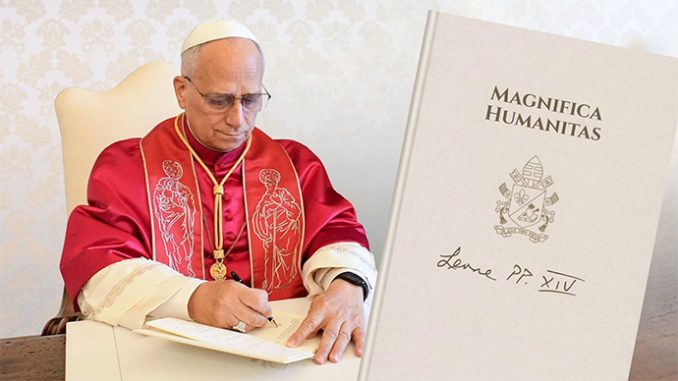
The Vatican announced Monday that Pope Leo XIV’s first encyclical will be published on May 25, with the title Magnifica Humanitas.
Pope Leo will speak at a presentation for the release of the social encyclical — a papal letter to the Church — at 11:30 a.m. Rome time on May 25, in the Vaticanʼs Synod Hall.
The Vatican also confirmed that the full title of the encyclical is Magnifica Humanitas: On the Protection of Human Dignity in the Age of Artificial Intelligence. Magnifica Humanitas is Latin for “Magnificent Humanity.”
Leo signed the letter, which is expected to provide moral guidance on the digital revolution and emerging technologies such as AI, on May 15.
The speakers at the encyclicalʼs presentation will be: Cardinal Víctor Manuel Fernández, prefect of the Dicastery for the Doctrine of the Faith; Cardinal Michael Czerny, SJ, prefect of the Dicastery for Integral Human Development; Anna Rowlands, professor of ethics and political theology at the University of Durham in the United Kingdom; Christopher Olah, co-founder of Anthropic USA; and Léocadie Lushombo, it, professor of theological ethics at the Jesuit School of Theology at Santa Clara University in Berkeley, California.
Secretary of State Cardinal Pietro Parolin will offer concluding remarks.
May 15 marked the 135th anniversary of the publication of Pope Leo XIII’s 1891 encyclical on capital and labor, Rerum Novarum, “Of New Things” — the first in a long line of social encyclicals produced in the modern era of the Catholic Church.
Pope Leo XIV indicated at the beginning of his pontificate that he intended to follow in the footsteps of his predecessor Leo XIII by responding to todayʼs Industrial Revolution: “developments in the field of artificial intelligence.”
Addressing the College of Cardinals on May 10, 2025, the new pope said he chose to take the name Leo XIV for various reasons, “but mainly because Pope Leo XIII in his historic Encyclical Rerum Novarum addressed the social question in the context of the first great industrial revolution.”
“In our own day,” he continued, “the Church offers to everyone the treasury of her social teaching in response to another industrial revolution and to developments in the field of artificial intelligence that pose new challenges for the defense of human dignity, justice and labor.”
If you value the news and views Catholic World Report provides, please consider donating to support our efforts. Your contribution will help us continue to make CWR available to all readers worldwide for free, without a subscription. Thank you for your generosity!
Click here for more information on donating to CWR. Click here to sign up for our newsletter.



I wonder why the founder of Anthropic is one of the speakers. That is the comnpany that Trump banned as a vendor to the military because of a disagreement over safeguards.
The disagreement was over weaponizing/in-built weaponization/pre-weaponized.
Thank you, I know that, but that doesn’t answer my question about why the company’s founder is a speaker at the encyclical’s presentation.
Could be he had a lucky day stroke of luck and still didn’t figure it out by now poor lad? Me, I was at a JPII Mass in St. Peter’s Square and I never got anywhere close to the Pope but at the time it felt like I was right up there assisting at his side trying to get through to tell him about this, that and the other on which he had no clue. But praise God it went like that and I was under him, in Rome.
Where is the truth? Claude wasn’t already “weaponized” to some extent? It would appear that Amazon accounts are all in jeopardy as well?
‘ Anthropic hasn’t released the model publicly and is instead granting access to a tightly controlled consortium of companies through its Project Glasswing. The company is working closely with federal, state, and local representatives. OpenAI is also granting businesses and governments special early access to its latest AI models to shore up their cyber defenses. ‘
https://edition.cnn.com/2026/05/20/tech/ai-executive-order-trump-white-house
* * * * *
‘ Threat actors are actively leveraging the recent Claude Code leak as a social engineering lure to distribute malicious payloads with GitHub serving as a delivery channel. Threat actors move quickly to take advantage of a publicized incident. That kind of rapid movement increases the chance of opportunistic compromise, especially through trojanized repositories. ‘
https://www.zscaler.com/blogs/security-research/anthropic-claude-code-leak
* * * * *
‘ This is the second time that Anthropic has had a data leak in recent weeks. Fortune previously reported on a separate breach and noted that the company was storing thousands of internal files on publicly accessible systems. That included a draft of a blog post that referred to an upcoming model known as “Mythos” and “Capybara”.
Some experts worry the leaks suggest internal security vulnerabilities within Anthropic. That could be particularly troubling for a company focused on AI safety.
The leaks could also help competitors, like OpenAI and Google, better understand how Claude Code’s AI system works. The Wall Street Journal reported that the most recent leak included commercially sensitive information, such as tools and instructions for getting its AI models to work as coding agents. ‘
https://www.theguardian.com/technology/2026/apr/01/anthropic-claudes-code-leaks-ai
* * * * *
‘ Developers also discovered code designed to scrub references to Anthropic-specific names—even the phrase “Claude Code”—when the tool is used to create code in public software repositories, making the latter code appear as though it was entirely written by a human. Alex Kim, an independent developer, posted a technical analysis of the leaked code in which he called it “a one-way door”—a feature that can be forced on but not off. “Hiding internal codenames is reasonable,” he wrote. “Having the AI actively pretend to be human is a different thing.” Anthropic did not respond to a request for comment from Scientific American. ‘
https://www.scientificamerican.com/article/anthropic-leak-reveals-claude-code-tracking-user-frustration-and-raises-new/
* * * * *
‘ In November 2024, Anthropic partnered with Palantir and Amazon Web Services to provide the Claude model to U.S. intelligence and defense agencies. In June 2025, Anthropic announced a “Claude Gov” model. Ars Technica reported that as of June 2025 it was in use at multiple U.S. national security agencies. As of February 2026, Anthropic’s partnership with Palantir makes Claude the only AI model used in classified missions. According to The Wall Street Journal, the U.S. military used Claude in its 2026 raid on Venezuela. ‘
https://en.wikipedia.org/wiki/Claude_(language_model)
‘ Mythos, announced on April 7, is being deployed as part of Anthropic’s “Project Glasswing,” a controlled initiative under which select organizations, including major tech firms such as Amazon (AMZN.O), opens new tab, Microsoft (MSFT.O), opens new tab, Nvidia (NVDA.O), opens new tab and Apple (AAPL.O), opens new tab, are permitted to use the unreleased Claude Mythos Preview model for defensive cybersecurity purposes. ‘
https://www.reuters.com/technology/anthropic-let-partners-share-mythos-cybersecurity-findings-with-others-2026-05-18/
Silence when faced with stark reality of idolatrous ideology:
https://m.youtube.com/watch?v=SIHm-pOb7zk&ra=m
I’ve already heard enough of Pope Leo. Will his words produce more disunity?
Ai can be seen as nothing more than a particular area in communication and electronics tech monopoly, the situation in that industry already at the point of needing trust dismantling or trust busting. Weaponizing of the tech is therefore going in the wrong direction. One of the novel features for trust busting here is algorithm which is at the center of weaponization and everything else: particular figures can impact the algorithm at the touch of a button or by mere verbal announcement, that the algorithm is trained to recognize; the algorithm itself already programmed how to receive and apply the instruction for adaptation that it had been informing all the while. Another novel area of trust busting, at least for the US, is the Trump Admin “partnering” with Israel as a “national security” tenet called “policy”. Israel is at the nub and core of all the tech and the Trump Admin has effectively subsumed the US into co-management with a foreign power which in many respects allows the foreign power to take lead roles and unilateral action including adapting tech without notice and/or adapting with deceptions.
In view of which I have to say I find the discussion that the AI “dangers” are about “deep fake” and “human contact” is rather sloppy – off the mark and truly lazy. The positioning of the discussion is bordering on the naive if it isn’t deceptive itself.
‘ Explaining his choice of papal name in an address to the College of Cardinals on May 10, 2025, Leo said: “In our own day, the Church offers to everyone the treasury of her social teaching in response to another industrial revolution and to developments in the field of artificial intelligence that pose new challenges for the defense of human dignity, justice and labor.” ‘
https://www.catholicworldreport.com/2026/05/17/vatican-sets-up-commission-on-artificial-intelligence/
https://www.catholicworldreport.com/2026/05/21/vatican-warns-that-ai-deepfakes-threaten-the-human-experience/