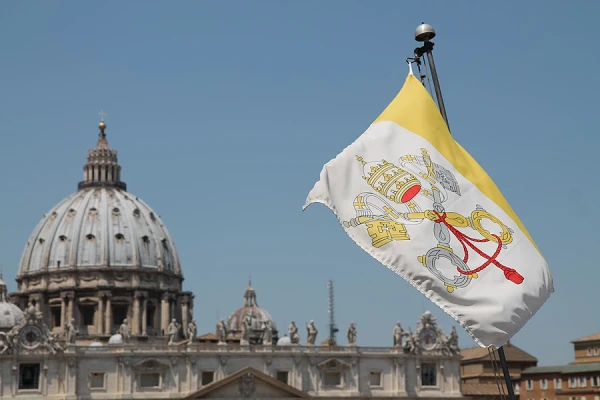
Vatican City, Dec 16, 2019 / 03:40 pm (CNA).- On Oct. 1, Vatican police raided the usually quiet offices of the Vatican’s Secretariat of State. They packed up documents, computers, and files, and banned employees from entering the premises. Since then, security and financial officials have resigned their positions, the Vatican has been excised from an international intelligence organization, and the details of a series of investments involving shady figures and banks, violations of canon law, and myriad holding companies and investment funds have emerged.
Still, the Vatican’s unfolding financial scandal has not yet led to action at the Vatican. To understand why, it’s important to understand something about the scandal itself.
In fact, there are a few scandals.
The first involves the Vatican Secretariat of State’s 2015 role in the purchase of a bankrupt Italian hospital. That scandal includes Vatican funds borrowed illicitly and transferred from religious orders to holding companies, obtaining a $25 million grant under false or misleading pretenses, and a scheme to “repay” a portion of the grant by “crediting” the grantees against requests for money in the future.
The second scandal involves a London real estate development into which the Vatican’s Secretariat of State invested hundreds of millions of dollars. The affair involves borrowing money from a discredited Swiss bank, concealing loans on internal balance sheets, violating the canonical status of a London parish, and giving 60 million in management fees to a man who sold the property to the Vatican through several of his own companies.
That man, Italian Rafeal Mincione, is a long-time figure in Vatican finances. He previously had a “beneficial ownership” in a company specializing in high-risk options trading, which was sanctioned and fined by the SEC in 2015.
Other figures connected to the project have been investigated for financial corruption and money laundering, and seen their companies suspended by financial officials.
The third scandal involves a fund, Centurion Global, by which the Secretariat of State has invested tens of million of dollars into Hollywood films, energy projects, and European startups. That investment, which has lost money while its managers have recouped millions in fees, involves fund managers connected to a Swiss bank that ran afoul of regulators and was shuttered – the same bank that partially financed the London deal. The fund does its business with an unlikely pair of banks: both linked to a billion-dollar Venezuelan money laundering and bribery scandal.
As those details emerged, one U.S. Church official asked CNA, “Haven’t these guys heard of Goldman Sachs or JP Morgan? Why are they doing business with these shady characters?”
The question is a fair one. The Vatican’s financial partners are unusual choices for a sovereign state.
The scandals are serious, and the issues they raise are proven, not speculated. They represent more than a bad deal: They represent hundreds of millions in lost investments, and a story of Vatican officials willing to bend or ignore rules in financial dealings. In the aggregate, they also represent a pattern that several popes have tried to address, with little success.
Still, while causing major repercussions in the international financial security community, the scandals have not seemed to lead to any serious consequences for Vatican officials.
Investigations are underway, and Pope Francis has said the Oct. 1 raid is a sign that accountability protocols are having an effect. He’s asked for patience as that work continues. There could indeed be indictments in Vatican City courts, though they’re expected only to impact low-level Church bureaucrats.
Seasoned experts say they’re skeptical about accountability for high-ranking officials, because the scandals point to serious structural and systemic problems at the Vatican. Pope Francis, at the time of his election, recognized in the Vatican’s dicasteries a culture lacking policy compliance, mission integration, internal controls, accessible information, and external accountability.
The pope set Cardinal George Pell to the task of reforming some elements of that culture, but well before Pell returned to Australia in 2017 to face abuse charges, the cardinal’s efforts had begun to seem Sisyphean. Cabinet-level officials in the Vatican created workarounds and carve-outs to avoid Pell’s oversight, one had cancelled Pell’s planned PriceWaterhouseCoopers audit of Vatican finances, and the cardinal reportedly found papal support for his efforts to be inconsistent.
Since Pell’s departure, the financial management office he oversaw has wielded ever less influence over financial affairs, and is no longer considered likely to effectively change operational practices at the Vatican.
But to many observers, those structural and systemic problems are the scandal. Officials acting unilaterally are seemingly able to borrow and invest hundreds of millions without oversight or internal checks. Spending caps and thresholds are an ordinary part of financial control, and are even established by canon law for dioceses and religious orders, but seem to be functionally non-existent at the Vatican.
Those familiar with financial administration say that the Secretary of State arranging for a loan that runs contrary to international convention, or a second-tier official in his office establishing the mechanisms of large-scale investment and development, with no controls to subject his action to review, illustrate precisely the problem. Especially, experts say, when the Vatican’s business partners seem consistently disreputable, and themselves mired in scandal.
An American financial expert speculated to CNA that anywhere but the Vatican, “people would be in prison by now.” In the world of the Vatican, that is unlikely.
While some observers seem nonplussed by the financial scandals, characterizing coverage of them as conspiratorial and “lurid,” Pope Francis himself has emphasized their significance. Last month, the pope admitted corruption in the Vatican, called the London development issue a “scandal,” and said that officials “have done things that do not seem ‘clean.’”
The pope’s view, expressed frequently, has been that the problem of corruption, wherever it’s found, is not principally a problem of politics or economics, but of morality, and requires the will to do things differently than they’ve been done before.
The pope has also recognized what financial criminals, grifters, and regulatory agencies have already recognized: that the Vatican, absent internal controls, transparency, and accountability, and run by well-meaning figures trained in theology, not international business, is easily taken advantage of, and has, in fact, been frequently taken advantage of.
The long history of financial scandals involving the Vatican does not make for easy reading; even the Vatileaks cables, and the bond and bank scandals of the 1970 and 1980s are a sufficiently discouraging picture of the problems caused by the culture of internal fiefdoms and the lack of internal controls at the Apostolic See.
Commentators, even those without practical Vatican experience, need only review the history of recent decades to understand why Pope Francis has repeatedly called for transparency and accountability, and why there seems to be so much difficulty getting there.
The pope also seems to recognize the effect that ongoing financial scandals have on the faith of Catholics, and on the morale of those practicing Catholics already discouraged by the 2018 sexual abuse scandal.
The reformers who have tried to clean up Vatican finances have mostly resigned or been defeated. They’ve been thwarted by cultural sclerosis, but also by a cultural tolerance for financial mismanagement that enables bad decisions to become worse ones. The Church’s teaching is clear: the stewardship of ecclesiastical goods is a sacred trust; the Church’s money is not hers, but the Lord’s.
Still, the moral obligations of financial stewards seem not to deter some Vatican officials, and some, including high-level officials, have made the excuse that as long as money is serving good purposes, how it is managed hardly matters.
The pope may yet be able to accomplish some policy changes that lead to greater financial accountability. It seems unlikely that lay Catholics will effectively call the Church to account for financial mismanagement, or effectively insist on the importance of acting with integrity with God’s resources. This means that change, regrettably, is only likely to come through European banking regulators, financial crimes investigators, and lawsuits. It will be a pity if that is the only way things move forward, but it will not be a surprise.
While the recent past has been characterized as “opaque,” the Church seems unlikely to learn about transparency, until she learns the hard way.
 […]
[…]



 By
By 

Just dont send in the homosexualists at the Vatican to have a discussion with SPXX about these episcopal ordinations.
The Orthodox Church (Greek, Russian, Rumanian, Serbian, Antiochian, etc.) have basically kept the same liturgical practices since the eighth century and the Nicean II ecumenical council (the last one recognized by the Orthodox Church). It is still hard to grasp why the Catholic Church changed the liturgy that was so good for the likes of Dante, St. Francis of Assisi, St Thomas Aquinas, St Dominic, St John Newman, and so many other Catholic saints and thinkers, until 1962.
DR, that problem has been around for a very long time. If not out in the open, then undercover.
I knew an SSPX family who had a tragic outcome because of that. We certainly shouldn’t ” celebrate ” confusion and vice but we need to also be cautious. Especially with our children. That kind of deviancy can be found in traditional communities too.
mrscracker: agreed…unfortunately its endemic in the clerical Church
Having read a recent interview of SSPX Superior General Father Davide Pagliarani by Diane Montagna, Fr Pagliarini indeed makes a strong argument for his belief the Church is on the wrong track in following the secularist momentum left as Pope Francis’ legacy, and arguably being pursued by Leo XIV.
That Leo XIV will send the one man that epitomizes that legacy, Cdl Victor Fernández to meet with him can either be an indication of Pagliarini’s contention, or a test for Fernández’ continued tenure.
During Pagliarini’s interview with Montagna the SSPX Superior general lamented that the reconciliation over the TLM achieved by Benedict XVI has been apparently reinforced under Leo.
Nevertheless, Leo XIV has shown movement toward a more precise treatment of moral doctrine and a strengthening of the marriage contract. The bottom line issue is remaining true to the Church instituted by Christ. This is where the battle must be fought. Not from without.
Having read a recent interview of SSPX Superior General Father Davide Pagliarani by Diane Montagna, Fr Pagliarini indeed makes a strong argument for his belief the Church is on the wrong track in following the secularist momentum left as Pope Francis’ legacy, and arguably being pursued by Leo XIV.
That Leo XIV will send the one man that epitomizes that legacy, Cdl Victor Fernández to meet with him can either be an indication of Pagliarini’s contention, or a test for Fernández’ continued tenure.
During Pagliarini’s interview with Montagna the SSPX Superior general lamented that the reconciliation over the TLM, achieved by Benedict XVI and abrogated by Pope Francis, that abrogation has apparently been reinforced under Leo.
Nevertheless, Leo XIV has shown movement toward a more precise treatment of moral doctrine and a strengthening of the marriage contract. The bottom line issue is remaining true to the Church instituted by Christ. This is where the battle must be fought. Not from without.
It comes down to holiness. Do the members/leaders of the SSPX manifest true sanctity– which includes dispositions of humility, patient suffering, love of the Church and zeal for souls. The latter it seems is in their favor. While their good fruits of evangelizing are clear, the plan to consecrate on July 1, outside Rome’s directive, indicates obstinacy and pride.
Other positive signs are what we don’t see- the dozen or so post-synodal Study Groups on “hot button issues” seem to have lost their steam. And, in November, it was reported that two of their reports (rescheduled from June until December of 2025) had demoted the homosexual lifestyle from “controversial” to only an “emerging concern,” and that deaconesses of any sort are off the table.
Also, we notice nothing in the wind about a proposed new round of “synods” (Cardinal Grech) at the local, regional and continental levels, all to crescendo into a Rome event in 2028 rebranded as an “ecclesial assembly.”
Might it be that when Pope Leo XIV speaks positively of being “synodal” he is simply referring to a needed culture of greater interpersonal rapport—rather than to the earlier drift to restructure the apostolic succession and the unified “hierarchical communion” (Lumen Gentium) of the Church into polyglot Congregationalism (with, say, der Synodal Weg Germania insulated safely within the European faction?).
In considering the impending dialogue between the Vatican and the SSPX, one must revisit the fundamental duty of the laity: when a shepherd veers toward the abyss, are the sheep bound to follow him over the precipice? I contend that while we owe a filial respect to the Petrine Office, our ultimate allegiance is to the Eternal Shepherd. We follow the path of authority to the edge of the cliff, but we must stop where that path diverges from Sacred Tradition.
The SSPX has maintained a singular, unvarying witness to the Faith, remaining largely insulated from the corrosive influence of modernism and its attendant heresies. In stark contrast, the institutional Church currently grapples with a series of profound scandals: the presence of an identifiable ‘lavender mafia’ that attacks the family, marriage, and moral standards, the horrific scourge of sexual abuse and its subsequent cover-ups, and the baffling, continued promotion of an artist whose work and lives are an affront to the priesthood and the entire concept of holiness.
What, then, is our priority? It must begin and end with Jesus Christ. I find it untenable to prioritize ‘canonical regularity’ or liturgical ‘acceptability’ over the 1,800-year liturgical and theological legacy of the Church. We must build our foundation upon Christ alone, remaining steadfast even as the winds of abuse and heterodoxy howl through the cloisters. If we are to discuss the ‘validity’ of bishops, let us first discuss the ‘validity’ of a witness that protects the flock from the cliff’s edge.
Jesus Christ founded the Catholic Church. The pope is the vicar of Christ on earth. If the SSPX excommunicates themselves once again, they are not followers of Christ nor upholding the faith. And no, that doesn’t mean you embrace the evils that occur in various parishes or among people who claim to be Catholics, but it does mean you stay faithful and not follow some group who constantly tout how “Catholic” they are.
Why is that SO hard for these brainwashed folks to understand?
Brainwashed? Hmm. The pope, any pope, is not Jesus. In these difficult times we had one monumental example of a pope in a state of heresy – Francis. Among a mountain of errors, he chose to directly contradict the clear teachings of Pope Benedict and Pope Saint John Paul II, which also was a conflict with 2,000 years of Tradition.
I have never attended an SSPX mass, but I do have deep appreciation for the TLM. I strive to focus solely on Jesus Christ and his teachings. I reject anyone who attempts to change Tradition, Doctrine, and/or the teachings of the Church. I support unity, but not at any cost.
Something I think about is if Vatican II was so wonderful or true, why did we lose over 50% of the Body of Christ? How was that same failure reflected among the priesthood and the Religious? Do not confuse my questions with attacking, but honest questions. As a convert, I am still baffled by how Vatican II was implemented and its detrimental impact on the Church.
Michael B, as a convert, you must understand that we as individuals don’t need to keep searching and trying to figure things out. The Church does that for us, through the pope, councils, documents, and the Magesterium. Jesus himself designed it to be this way. There have been no changes in doctrine or teachings. A core tenet of the faith is that the Church is indefectible; it will last until the end of time and cannot fall into error. The TLM is not the only way of expressing the Church’s Liturgy. Vatican II occurred during great social upheaval, but was not the cause for people abandoning the Church. We all have free will and can make mistakes, including the pope, but he cannot fall onto error in an official capacity, and his personal holiness, or lack thereof, does not disqualify him from being pope. The Church also reserves the right to change its Liturgical practices and instruct us on how we are to worship at Mass.
The SSPX is no authority on these matters as they have proven themselves time and again to be disobedient, and are apparently ready to be so again. They hide behind the beauty of the TLM to manipulate people into thinking that Rome has lost its way. And unfortunately a lot of this thinking has permeated other TLM groups that are still united to Rome.
It is good that you focus on Christ and His teachings; continue to do that as you attend Mass, whether TLM or otherwise. I speak as someone who was exclusively involved with the SSPX for nineteen years. They are operating an agenda parallel to the Church which creates confusion, division, and doubt among the faithful.
“Vatican II occurred during great social upheaval, but was not the cause for people abandoning the Church.” When has there not been social upheaval? The Church and her liturgy used to be a haven from such upheaval, instead of being submerged by it and a contributor to the chaos. Vatican II was a complete and utter disaster, and the mass of Paul VI a tragic perversion of Catholic prayer.
Faithful to what or whom? Pope’s are meant to defend and uphold tradition, not undermine it.
It is you who appear to be brainwashed, just in the way Protestants think of certain Catholics. Your papolatry is not Catholic.
No Timothy, it is you who sound like a protestant, by attacking a Catholic for engaging in “papolitry.”
+Leo isn’t sending his best in +Tucho.
It appears to me that the only sacrosanct element in the perennial Magisterium is the authority of the bishop…from top to bottom…but the rest is quite expendable if it is convenient to relativize it.
Recall well this from Pastor Aeternus of Vatican I in its definition of papal infallibility: “The Holy Spirit was not given to the Roman Pontiffs so that they might disclose new doctrine, but so that they might guard and set forth the Deposit of Faith handed down from the Apostles.”
Bishop Melchior Cano, O.P., at the Council of Trent stated: “Peter has no need of our lies or flattery. Those who blindly and indiscriminately defend every decision of the Supreme Pontiff are the very ones who do most to undermine the authority of the Holy See – they destroy instead of strengthening its foundations.”
What we observe over the last sixty-four years is quite scandalous. It undermines the faith of millions. The episcopate renders itself incredible. Their absence from the defense of the faith, while aggrandizing themselves and their own notions is abhorrent and an offense against the Gospel. Theological abuse renders sexual abuse pale.
We are all obliged to provide assent to the perennial Magisterium — the episcopate is no exception. It is not theirs to tinker with. When are they going to provide their “wisdom” to German synodalists, same-sex advocates in collars, bold liturgical aberrations never conceived of by the mid-century council?
One may simply ask which group is conforming the world to God and which is conforming God to the world. We must chose wisely given that pur eternal souls depend upon that choice.
Every Catholic needs to ask him or herself one very basic question which should be answered in the fullness of truth. It is this: “Why did Archbishop Lefevre institute the Society of St. Pius X in the first place?” Was it because he rose one morning and decided to be disobedient and prideful? Or, was he reacting to some very serious liturgical and magisterial challenges to the Catholic faith?
In this regard, I remind myself that I graduated from a Catholic college in 1970 after 16 years of Catholic education. As we approached graduation, my five roommates and I decided to host a thanksgiving Mass (?) for our parents. The college chaplain agreed to celebrate Sunday Mass in our dormitory apartment. For sacred vessels we used glasses to hold the wine – glasses used previously to hold beer. We used store-bought bread that was leavened. For the Mass readings, we chose selections from Erick Fromm’s The Art of Loving and from Kahil Gibran’s The Prophet. We condescended to read a Gospel from one of the four Gospel writers. Such was the state of liturgy and Church teachings only 5 or so years after the closing of the Council.
Again I ask: “What might Archbishop Lefevre have been reacting to? A lost patrimony, perhaps?
In the late 1980s and early 1990s, at Mass at the Paulist Center in Boston, home-baked whole wheat bread was consecrated, then broken and distributed in straw baskets (similar to those used as collection plates). Wine followed, consecrated in a vase-like porcelain pitcher, later passed in as jovial a manner (with parishioners remaining seated in the pews), not dissimilar to persons taking a ‘toke’ and handing it down the line at a college frat party.
Has anything much changed? See what appear to be liturgical dancers in the sanctuary (together with the choir and piano) at last year’s Pentecost.
https://www.paulistcenter.org/mass-schedule/
DeaconEdwardPeitler, Mons. Lefebvre established SSPX in 1970 with Vatican’s approval. Only after he had disagreements with Popes Paul VI and John Paul II was the approval withdrawn in 1975. So, the initial establishment of SSPX was not a reaction to a lost patrimony.
I listened to some of the priest’s homily for the Feast of the Baptism of the Lord (2025). It’s on YouTube. The president’s name was not mentioned, but he certainly was talked about with more than a mite of asperity, obvious dislike, and allusions to immoral tyranny.
Oscar, It is indeed hard to understand, from the west’s point of view, why Pope Paul VI chose to promulgate a new order of the Mass following Vatican II.
I came from a third world country in Southeast Asia that has been Catholic for 400 years. Before Vatican II, most people in my small town loved the Church for its devotions to the Blessed Mother and the saints, but hardly understood the Mass in Latin; although they dutifully went to church on Sundays and holydays. They were very poor, but good people. think they were given permission to silently recite the rosary during Mass then; so that was what they did.
In order to follow the Mass in Latin, one needed a Latin-English hand missal, which was unavailable in town and expensive to buy in the city. At any rate, most townspeople at that time could hardly read in English, let alone understand Latin. That was just after WWII, which devastated our town.
My father, a poor carpenter, was a cantor at the Mass. He spent his life savings for a copy of the Liber Usualis. It was the only copy in town outside of what the priest used.
When, in the 1970s, the Mass in Latin was replaced with the Novus Ordo in the vernacular, my father was heartbroken, to say the least. He has been dead for many years, and I hope and pray he’s at peace with the Lord.
The village people now appreciate the Mass in the language they understand. They don’t need to buy a missal. They’ve memorized the prayers and the songs. The last time I went to visit my hometown, the church was bursting at the seams. Groups of old people still prayed the rosary before and after the Mass, but not during the Mass. The people seemed very happy with the Novus Ordo.
Even with the best will in the world on both sides, it seems humanly impossible for everything to be worked out canonically and doctrinally before July 1. But if this leads to an open and frank discussion about Vatican II (including a discussion of its actual authority, based on the Nota praevia), then that can only be good for the entire Church and not only the SSPX.
It seem very unlikely that Rome could in good conscience provide an apostolic mandate to a bishop (Fellay or de Gallaretta) who is technically suspended. But why could not Rome send a prelate in good standing (a cardinal like Mueller or Sarah) to perform the consecrations? Even though the ceremony would be in the old rite, it would be performed by a prelate who himself had been consecrated in the new rite of 1968, and would thus be a concrete way for the Society to show that they accept the validity of the new rites, even if they can still have reservations about aspects of the reform (they would not be asked to perform or participate in the new rites themselves).
Still, the fact remains that the Society itself technically does not even exist right now and certainly has no canonical mission, but could even that not be resolved fairly easily on an interim basis? The SSPX was in fact founded with canonical approval in 1970, and thus it did “exist” in the eyes of the Church for several years until it was suppressed in 1975 (even if one disputes the SSPX claim that the suppression was illegal and was of no effect, it is true that it was a cloudy situation). Could the Holy See not simply overturn the 1975 suppression and then, voila, without having to *create* a status for the SSPX, they would just go back automatically to being what they were? Admittedly such a status (basically an entity under the immediate jurisdiction of a Swiss diocese) would be totally inadequate to the needs of an international community with 800 priests, but it would just be a starting point that would allow them all to receive a canonical mission. Eventually — when the doctrinal issues are ironed out — the Society could receive a more stable canonical status, for example as a personal prelature. But offering an episcopal consecration under the auspices of Rome would be an important litmus test for both sides: how serious Rome is for reconciliation that is not simply complete surrender and how serious the SSPX is about wanted a normal relationship with Rome. If the SSPX leadership would refuse such consecrations because of pandering to their more extreme crypto-sedevacantist wing and thus proceed to do consecrations on their own anyway, then the putative schism would be more clear and an excommunication Rome would declare would be much “cleaner” in the eyes of everyone of good will.