

 By
By CatholicPOST seeks to restore Catholic social doctrine to its rightful place in intellectual life and academic discussion.
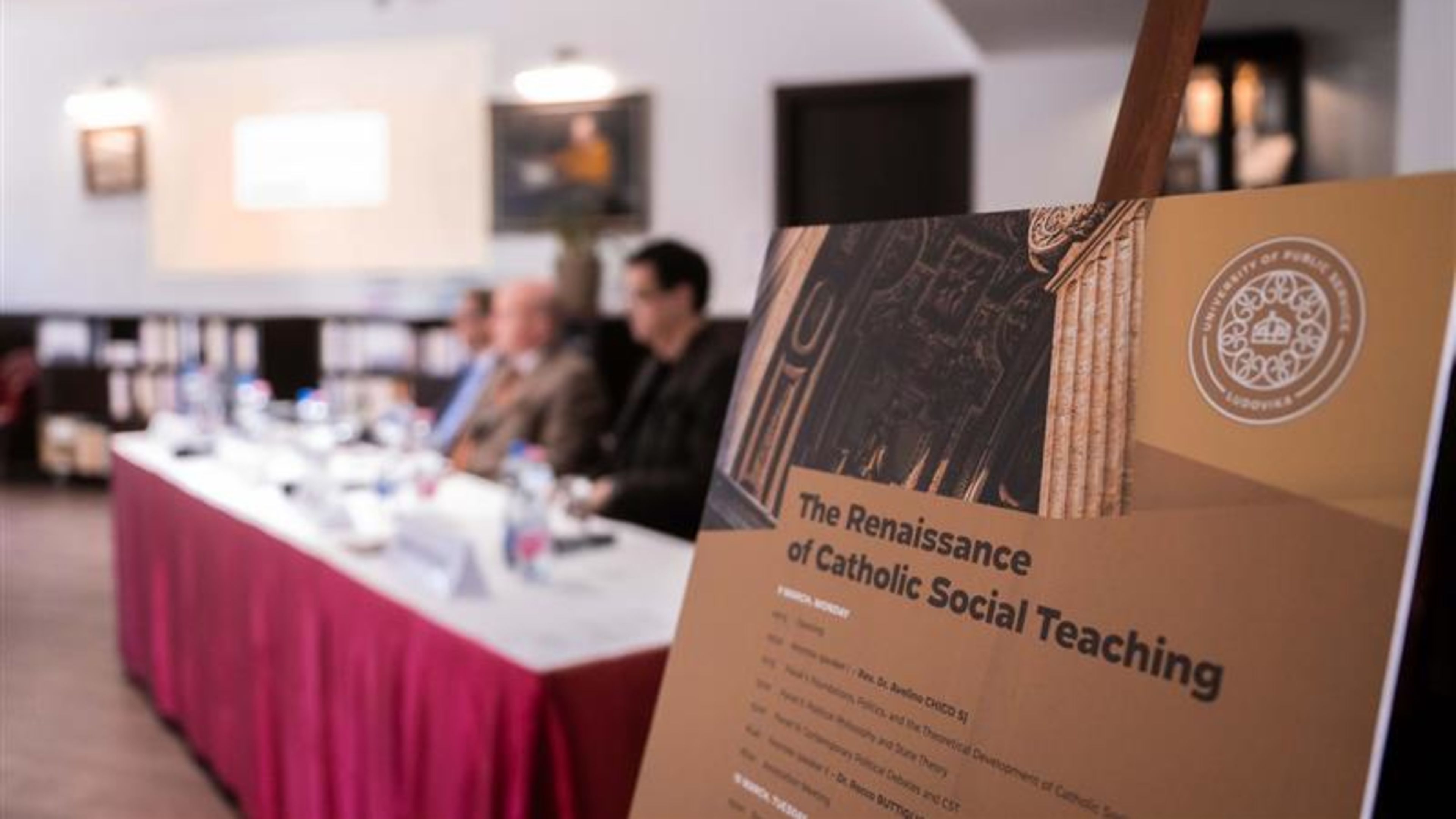
Catholic political and social thought, one of the foundational intellectual traditions of Western civilization, is poised for renewal as a new international initiative seeks to bring it back into conversation with new generations and decision-makers of tomorrow.
CatholicPOST, the Association for the Renewal of Catholic Political and Social Thought, was born from the conviction — shared by a group of European scholars during the COVID-19 lockdowns — that the health crisis had exposed not only the fragility of modern Western societies but also a deeper anthropological confusion threatening their social foundations.
That vision took concrete form at the inaugural conference of the association, titled “The Renaissance of Catholic Social Teaching,” held March 9–10 at the Ludovika University of Public Service in Budapest and attended by international academics and Vatican and Hungarian Catholic Church officials.
“COVID was a tragic moment in contemporary history, and it required thinking back again on the basics of social life,” Professor Ferenc Hörcher — a Hungarian professor of political philosophy, historian of ideas, and the association’s president — told EWTN News. “And that is something you can do best on the grounds of the Catholic tradition, pointing back to Aristotle and forward to the social teaching of the Church.”
For Hörcher — also director of the Research Institute for Politics and Government at Ludovika — the timing has only gained relevance with the election of Pope Leo XIV, whose choice of name evokes Pope Leo XIII, author of the landmark 1891 encyclical Rerum Novarum, widely regarded as the founding text of modern Catholic social teaching.
Neglected intellectual inheritance
One of CatholicPOST’s most urgent tasks is to restore Catholic social doctrine to its rightful place in intellectual life and academic discussion — a place it has progressively lost over the past century.
Secularization, according to the association’s founders, has pushed Catholic intellectual traditions to the margins of public discourse. Even conservative academic circles, in their view, have often drawn more from Anglo-Saxon traditions with Protestant roots than from Catholic social thought.
“Catholicism finds itself in the second row,” Hörcher said, “despite the fact that our modern and postmodern civilization is essentially built on it.”
The association presents itself as a scholarly, nonpartisan platform, open not only to Catholics but also to thinkers willing to engage seriously with the tradition.
“The Church cannot enter directly into political debate — that is not its mission,” Hörcher said. “But we, as Catholic intellectuals and practitioners in our own professions, can take that on.”
Deeper stakes
The initiative of the group, consisting of, among others, American, Swedish, Maltese, and Hungarian scholars, emerges at a moment of mounting polarization across Western societies, as clashes over gender identity, family, bioethics, and the very understanding of the human person grow increasingly confrontational — and, at times, violent.
For Hörcher, this is precisely why a recovery of serious Catholic political and social thought matters. CatholicPOST, he said, aims to reconnect contemporary debates with an intellectual tradition capable of addressing questions of philosophical anthropology that go far beyond basic politics.
That ambition also helps explain the caliber of thinkers already orbiting the initiative, from French political philosopher Pierre Manent, a leading contemporary thinker on natural law and the moral foundations of political life, to scholars at the University of Notre Dame, home to the natural law tradition developed by John Finnis, and Princeton’s James Madison Program, led by natural law theorist Robert George — a circle Hörcher is set to join for a year as a visiting scholar to Princeton’s Department of Politics.
The initiative has also attracted attention in Rome. In his keynote speech at the Budapest conference, Father Avelino Chico, head of office at the Dicastery for Promoting Integral Human Development, presented Catholic social teaching as a living intellectual tradition still evolving in response to the “new things” of each age — from industrial modernity in the time of Rerum Novarum to contemporary social challenges such as artificial intelligence, migration, ecological crisis, and widening inequality.
Chico portrayed Pope Leo XIV as continuing that trajectory, seeking to integrate the legacy of Leo XIII and Pope Francis through the lens of integral human development — an approach that takes seriously not only economic realities but also the spiritual, cultural, and political dimensions of human life.
Supporting new generations
The association is already planning a second conference in Kraków, a deliberate choice honoring Poland’s enduring Catholic intellectual tradition and the legacy of St. John Paul II.
Registration in the U.S. is also underway, as CatholicPOST has roots in American educational institutions like Christendom College, as a result of its aim to strengthen its international footprint and deepen transatlantic academic ties.
For Hörcher, however, the deeper hope is not merely institutional growth but helping provide intellectual substance to what he sees as a broader spiritual movement among younger Westerners rediscovering Christianity. “We hope to give munition,” he said, “intellectual support for those young people.”
He sees CatholicPOST as part of a recurring pattern in Catholic history. “Each century brought a revival of Catholic political thought,” he said, citing the neo-scholastic revival of 16th- to 17th-century Spain, the Holy Alliance of the post-Napoleonic Age, the social teaching inaugurated by Leo XIII, and the contribution of Catholic thinkers such as Jacques Maritain to the postwar rise of the human rights framework.
“These historical precedents help us envision what a new renaissance might look like — and why it is needed now.”
If you value the news and views Catholic World Report provides, please consider donating to support our efforts. Your contribution will help us continue to make CWR available to all readers worldwide for free, without a subscription. Thank you for your generosity!
Click here for more information on donating to CWR. Click here to sign up for our newsletter.

Secularism is the halfway house to post-societal angst. Beyond scholarship and Aristotle, Who is the source of our Hope?