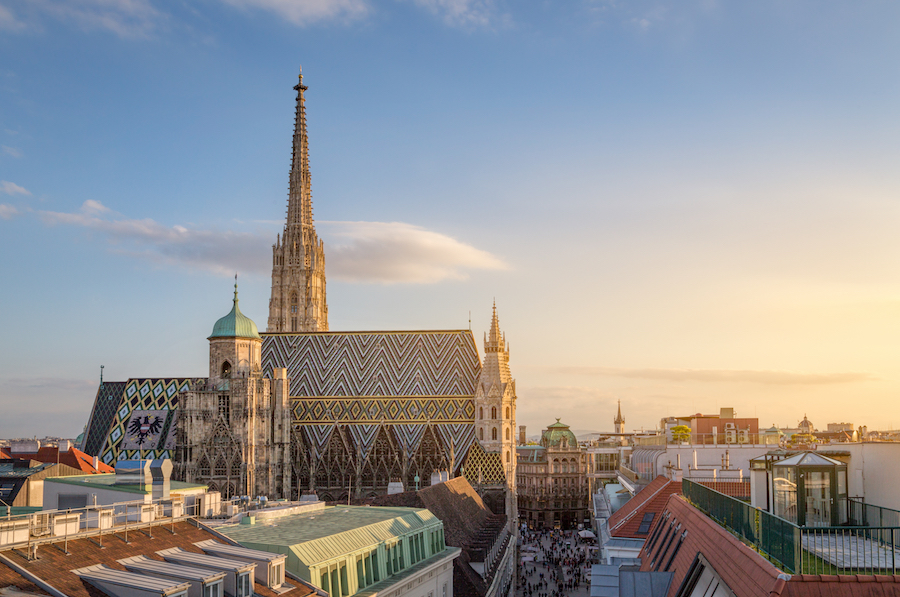
Vienna Skyline with St. Stephen’s Cathedral, Vienna, Austria. | Credit: mrgb/shutterstock
Jan 8, 2026 / 07:00 am (CNA).
The Catholic Church in Austria has launched a new formation program to promote late vocations, aimed at men between 45 and 60 years old who are currently employed and can complete the process without having to leave their jobs.
The initiative, promoted by the Conference of Rectors of Austrian Seminaries, breaks with the traditional model of formation and preparation for priestly ordination and opts for a more flexible model as a response to the shortage of vocations.
Under the name “ Zweiten Weg für Spätberufene” (“Second Path for Late Vocations”), the program is specifically aimed at men with professional experience and offers the possibility of pursuing theological studies remotely, without requiring community life in the seminary or exclusively in-person formation, adapting to the professional demands of each candidate.
This new program also allows them to continue practicing their profession after being ordained priests — with the exception of political positions — albeit in a limited capacity, with the express authorization of their diocese and provided that their profession is compatible with the priestly ethos.
With this new proposal, the Church in Austria is committed to integrating the path to the priesthood with the daily lives of the candidates, who must be single or widowed and commit to a life of celibacy.
The fundamental pillar of the initiative is the document Ratio Fundamentalis Institutionis Sacerdotalis, from the Dicastery for the Clergy, on the gift of the priestly vocation and the importance of formation.
According to the latest data provided by the Austrian Bishops’ Conference for the year 2024, there are currently 3,269 priests in the country, a number that has experienced a slight but steady decline in recent years.
This story was first published by ACI Prensa, CNA’s Spanish-language news partner. It has been translated and adapted by CNA.
If you value the news and views Catholic World Report provides, please consider donating to support our efforts. Your contribution will help us continue to make CWR available to all readers worldwide for free, without a subscription. Thank you for your generosity!
Click here for more information on donating to CWR. Click here to sign up for our newsletter.
This photograph taken on March 18, 2022 shows smoke rising after an explosion in Kyiv. – Authorities in Kyiv said one person was killed early on March 18, 2022 when a downed Russian rocket struck a residential building in the capital’s northern suburbs. They said a school and playground were also hit. / Fadel Senna/AFP via Getty Images
Washington, D.C. Newsroom, Mar 18, 2022 / 12:21 pm (CNA).
While it is logistically feasible for Pope Francis to travel to Kyiv, as the city’s mayor has invited him to do, the danger associated with holding any gatherings with him once he got there makes such a visit unlikely, according to the Vatican’s apostolic nuncio to Ukraine, Archbishop Visvaldas Kulbokas.
“Yesterday, three prime ministers arrived to Kyiv — the prime ministers of Poland, Czech Republic, and Slovenia. So, logistically speaking, yes, it is possible to come to Kyiv,” Kulbokas, the pope’s representative in Ukraine, told Raymond Arroyo, host of EWTN’s “The World Over,” on March 17.
“I know that Pope Francis wants to do all that is possible for him in order to contribute for peace, so I know for sure that he is evaluating, he is thinking about all the possibilities,” he added.
However, Kulbokas explained, the hope is that a papal visit could involve more than simply a discussion, as can happen readily enough through conventional or online means. Catholics and church leaders would want to pray with him, as would members of the Orthodox Church and other faiths.
While it is certainly something to hope for, he said, the situation is “too dangerous in Kyiv.”
KYIV, UKRAINE – MARCH 18: A woman sheltering in a metro station brushes her daughter’s hair on March 18, 2022 in Kyiv, Ukraine. Russian forces remain on the outskirts of the Ukrainian capital, but their advance has stalled in recent days, even while Russian strikes – and pieces of intercepted missiles – have hit residential areas in the north of Kyiv. An estimated half of Kyiv’s population has fled to other parts of the country, or abroad, since Russia invaded on February 24. Chris McGrath/Getty Images
Unable to leave nunciature
Kulbokas, 47, who is from Lithuania, is currently bunkering in the nunciature in a residential area of the Ukraine capital.
He told Arroyo that because of the danger of missiles, the upper levels of the building cannot be used. Authorities have asked residents to reduce their movements to only essential ones, he said.
Sleep, prayer, and the celebration of Mass are all held in the same rooms with no windows, he said, adding that the situation is “dramatic.” The government has ordered some of the local shops to stay open, he said, in order that food and other necessities may be available to the people. He said that he has assistants who make the trip to the shops to buy food and other supplies.
Kulbokas also revealed to Arroyo that he has not left his residence for 21 days, because of the frequent attacks on the city. You can watch the full interview in the video below.
‘I will try to get them out’
In the interview, Kulbokas spoke about the solidarity he feels with the pope and the wider Church during this ordeal.
He shared a conversation he had with Polish Cardinal Konrad Krajewski about the difficulties authorities were having evacuating children from an orphanage in the city, Kulbokas said. Such an undertaking is extremely complicated and risky because of ongoing Russian missile and artillery attacks and the damage that these have done to the city’s infrastructure.
Cardinal Konrad Krajewski and Major Archbishop Sviatoslav Shevchuk greet children in Lviv, Ukraine. Screenshot from zhyve.tv YouTube channel.
Moved by the dire predicament, Krajewski pledged to take action himself, if necessary.
“Look, Visvalda, if you will see that the situation remains as difficult as it is now for some more hours, then I will come. I will take a car and I will try. I will try to get them out,” the nuncio said the Polish prelate told him. “Even under bombing. Even under shelling. If I die, I die. But at least I will try.”
The exchange made an enormous impression on the nuncio.
Even though he was speaking with a special envoy of Pope Francis, not the pope himself, “I felt his presence,” Kulbokas said.
“He was some 500 or 600 kilometers away from Kyiv, but I was feeling his presence so strongly that it [gave me] courage also.”
Krajewski, who is in charge of the pope’s charitable efforts as papal almoner, will play a prominent role in Pope Francis’ upcoming consecration of Russia and Ukraine to the Immaculate Heart of Mary on March 25.
That day, while the pope leads the act of consecration at St. Peter’s Basilica at the Vatican, Krajewski will do the same in Fatima, Portugal, where the Blessed Virgin Mary first requested Russia’s consecration during her appearances to three children in 1917.
Asked for his thoughts on the consecration, Kulbokas told Arroyo that the war does not just have political and military aspects, but spiritual ones, as well.
The nuncio said he believes that “God wants to tell us something” by allowing this war to occur.
The Blessed Virgin Mary “is the one able to face these satanic deeds,” he said.
Kulbokas added that it is not enough for the pope to consecrate Russia and Ukraine; “all the believers” should join him in consecrating themselves to the Immaculate Heart of Mary, he said.
London, England, Feb 8, 2017 / 04:35 pm (CNA/EWTN News).- When the fetal ultrasound gained popularity in the 1970s, it was hailed as a “window to the womb.” But now, new technology could offer a much more in-depth view of babies before birth.
Courtesy of a new multimillion dollar project based out of London, some parents are able to see clear scans of every movement and organ of their babies in the womb starting as early as 20 weeks, using advanced MRI technology.
“There is nothing quite as emotional as seeing your unborn child moving inside you, and these MRI scans are taking images to the next level,” stated Cathy Ranson, the editor of ChannelMum.com, a website that is distributing videos of the MRI scans.
“They are truly breathtaking,” Ranson continued.
Traditionally, ultrasounds are used during pregnancy to check in on growing babies in the womb using high frequency sound waves. Although useful, ultrasounds usually produce limited visual scopes of the womb and can vary in quality depending on various factors, such as age, weight, and position.
However, a curious team of medics pushed the limits of the ultrasound to find out if there was a better way to get in-utero scans.
Top minds from Kings College London, St. Thomas’ Hospital, Imperial College London, University of Firenze, the Hospital for Sick Children in Toronto and Philips Health were given £10 million from the Wellcome Trust and Engineering and Physical Sciences Research Council to see if they could advance antenatal scans.
This team of medics composed a new series of algorithms and magnetic fields to go beyond the limits of the ultrasound. This new technology is allowing clear pictures of the entire womb, making details like a 20-week heart valve crystal clear.
A video, produced by the iFIND project, shows just how detailed the scans are: the baby is stretching, turning, and even playing with the umbilical cord. They also recorded the reverberations of the baby’s movements, which could be seen rippling through the mother’s belly.
In addition to creating the optimal scan, the MRI technology also has a mechanism that auto corrects any small movements to produce an overall smooth image.
Dr. David Lloyd, a Clinical Research Fellow at King’s College London, said the new MRI scans “can see the structures inside the body, regardless of whether there’s bone, muscle or fat in the way.”
“It is also one of the few imaging techniques that is safe to use in pregnancy,” Dr. Lloyd continued.
This new technology is more than just a great picture for excited parents to see. The MRI scans could also reveal complications or growth deficiencies earlier in the pregnancy, which could allow for advanced treatment even before the baby is born.
The MRI scans have already kicked up some debate, especially in the UK where abortion is legal up to 24 weeks. These new scans, showing how babies actively move around at 20 weeks, is making the current abortion limit even more questionable.
Moving forward, the iFIND project wants the MRI scans to become available for all pregnant women around the world.
Rome Newsroom, May 13, 2020 / 10:00 am (CNA).- For the first time in its history, the Shrine of Our Lady of Fatima celebrated the May 13 anniversary of the 1917 Marian apparitions without the presence of the public.
“Yes, the sanctuary is empty, but not deserted. We are physically separated, but spiritually united as a Church with Mary, in an intense way, with a heart full of faith and trust,” Cardinal António Marto said as he led the rosary on the eve of the anniversary.
“Holy Mary, teach us to believe, hope, and love you. Star of the Sea, shine on us and guide us on our way in the sea of history,” the cardinal prayed.
Marto, the bishop of Leiria-Fátima, offered Mass May 13 via livestream at the Fatima shrine, calling for conversion and dedication to the rosary in response to the coronavirus pandemic.
“A pandemic is a call to a deep spiritual conversion,” Cardinal Marto said in his homily May 13.
“A short time ago we were living with enormous trust in the technical-scientific power, in the economical-financial power, thinking that we were perhaps immune to any epidemic or, if it came, a quick solution would be found. But, unexpectedly, an unpredictable, invisible, silent virus, able to contaminate everything and all, staggering the world. We felt the ground falter under our feet,” he said.
Marto said that the current “dramatic and tragic situation” reveals humanity’s vulnerability and frailty, and invites one to reflect on what is essential in life.
In Portugal, the celebrations of Our Lady of Fatima began on the eve of the feast. Fr. Carlos Cabecinhas, the rector of the Marian shrine, invited families to place candles in the windows of their houses as a way to participate in the traditional procession of candles at Fatima from home.
The rector said that while people cannot make a pilgrimage with their feet, they can make an interior pilgrimage with their hearts.
Public Masses are expected to resume in Portugal May 30 with some restrictions laid out by Portugal’s bishops’ conference to help prevent the spread of COVID-19.
At Fatima’s Chapel of the Apparitions, Cardinal Marto led the rosary May 12 with meditations on the sorrowful mysteries for the intention of ending the coronavirus pandemic.
“To the virus pandemic we want to respond with unity and prayer, with compassion and tenderness,” he said.
“Today we respond with the rosary, a prayer for difficult times,” Marto said. “By meditating on the painful mysteries, we unite all the suffering humanity. We entrust our pain to Mary’s maternal heart.”
The cardinal then quoted the Virgin Mary’s request when she appeared to three shepherd children Lucia, Jacinta and Francisco on May 13, 1917: “Pray the rosary every day to bring peace to the world and an end to the war.”
Jacinta and Francisco Marto were canonized on May 13, 2017, by Pope Francis in Portugal. Both of the young saints died of the Spanish flu pandemic that killed between 50 and 100 million people in the early 20th century.
Pope Francis encouraged devotion to Our Lady of Fatima during his general audience offered via livestream from the Vatican’s Apostolic Palace May 13.
“Today we celebrate the liturgical memorial of Our Lady of Fatima,” he said. “We turn our thoughts to the apparitions and its message transmitted throughout the world.”
“In our prayer we ask God, through the intercession of the Immaculate Heart of Mary, for peace for the world, the end of the pandemic, the spirit of penance and our conversion,” Pope Francis said.
Fix the Mass and you just might find you can fix the priesthood. Continue to remain indignant about the “Masterpiece of self-destruction” being “performed” today at the Cramner Table and simply extend and advance the crisis. It’s that simple and that obvious.
Austria is showing the way. Training and ordaining those called to serve right in the midst of their work and work-milieu is constructive thinking. When at work they with their presence will edify colleagues. When they retire, the faithful will go in search of them for enlightenment and spiritual solace.
Fix the Mass and you just might find you can fix the priesthood. Continue to remain indignant about the “Masterpiece of self-destruction” being “performed” today at the Cramner Table and simply extend and advance the crisis. It’s that simple and that obvious.
Austria is showing the way. Training and ordaining those called to serve right in the midst of their work and work-milieu is constructive thinking. When at work they with their presence will edify colleagues. When they retire, the faithful will go in search of them for enlightenment and spiritual solace.