



Washington, D.C. Newsroom, Dec 18, 2025 / 17:48 pm
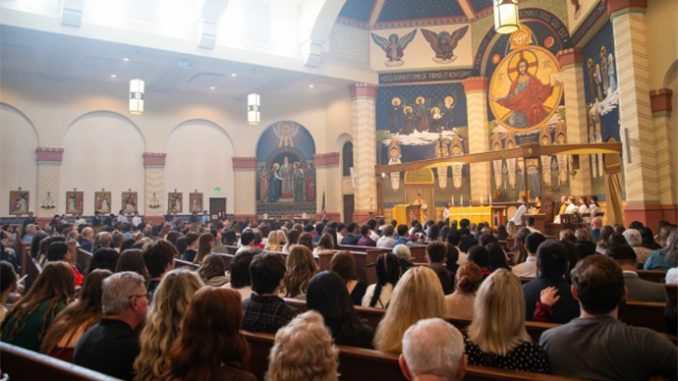
Encouraging participation in Mass and making the sacraments more accessible can deepen fulfillment among Catholics and therefore help to keep Catholics in the faith, experts say.
A recent Pew Research Center report, “Why Do Some Americans Leave Their Religion While Others Stay?”, examined the religious switching of U.S. adults. It looked into the reasons why people stay or leave their childhood faith.
The report revealed many U.S. adults (35%) have left the religion they grew up in, but the majority of Americans (56%) still identify with their childhood religion. The survey reported that Catholics specifically continue to identify with the faith because “their religion fulfills their spiritual needs” (54%) and “they believe in the religion’s teachings” (53%).
To better understand why Catholicism fulfills spiritual needs and which teachings are most important in that process, “it’s crucial that we pay attention to what’s working,” Tom Nash, a contributing apologist for Catholic Answers, told CNA.
He highlighted a June Pew study that found practicing Catholics believe “having a personal relationship with Jesus Christ” (90%) and “receiving the Eucharist” (83%) are the most essential aspects of their faith.
The study “tracks with the Church’s teaching that the sacrifice of the Mass is ‘the source and summit of the Christian life’ (Catechism of the Catholic Church, 1324), and provides insight regarding how the Church best fulfills someone’s spiritual needs and, relatedly, which teachings are most important,” Nash said.
“Through his one paschal sacrifice of Calvary — which encompasses his passion, death, resurrection, and ascension into heaven — Jesus has redeemed the world. In addition, Jesus enables us to offer anew sacramentally and partake of his one sacrifice in the Mass, which is the New Covenant Passover Communion sacrifice,” Nash said.
Receiving the sacraments
Since the majority of Catholics say the faith fulfills their spiritual needs and they believe in the religion’s teachings, it’s “best” to highlight what meets those aspects, Nash said. Specifically, he suggested making the sacraments accessible to Catholics.
“When we make sacramental encounters more available with Our Lord Jesus Christ, an increase in Sunday Mass participation will follow accordingly,” Nash said.
Not only is receiving the Eucharist at Mass “fundamental,” but so is “communing with our Eucharist Lord Jesus spiritually through Eucharistic adoration,” Nash said. This allows Catholics to have “a deep relationship with Our Lord; and they thus form the bedrock of Catholic belief, because they enable us to have increasing divine intimacy with Jesus, and through him with the Father and the Holy Spirit.”
“For practicing Catholics, those who are not participating in weekly Mass, and people in general to whom Christ’s Great Commission is also addressed, we need to ‘Open the doors wide to Christ. To his saving power,’” as St. John Paul II said in his inauguration Mass.
The best and most convenient way to “open the doors” is “to give Catholics and non-Catholics alike the opportunity to draw near to our Eucharistic Lord Jesus in Eucharistic adoration,” Nash said. “With the help of parish deacons and laymen, every parish in the country can open its doors for adoration several nights a week for two to three hours.”
This will allow people to “draw near to the Lord in intimate spiritual communion, whether with our Eucharistic Lord exposed in a monstrance or reposed in the tabernacle. And also open the doors on a morning or two to accommodate those who work evenings.”
“A lot of people — inactive Catholics and non-Catholics alike — are not likely to come to Mass. But if you give them an opportunity to quietly spend time with Jesus in the Blessed Sacrament when it’s more convenient for them, they will draw near,” he said.
The sacrament of confession is also necessary. Nash suggests making confession “available five to 10 hours every week at every parish.”
“It’s not by accident that two of the most demonically oppressed priests in the last two centuries are renowned priest confessors: St. John Vianney and St. Padre Pio,” Nash said. “The devil knows the power of this great sacrament and acts accordingly in opposing it. In this way, we can ironically take a lesson from Lucifer, who despite his being ‘the father of lies’ (Jn 8:44) can’t help but tell the true in expressing his unvarnished hatred of Our Lord Jesus Christ and his Catholic Church.”
Catholics must be ‘equipped’ and ‘formed’
Among all former Catholics whom the new study looked at, it found “the most commonly cited reasons for leaving include no longer believing in the religion’s teachings, scandals involving clergy or religious leaders, or being unhappy about the religion’s teachings about social and political issues,” said Becka Alper, senior researcher at Pew Research Center, in a Dec. 17 interview with “EWTN News Nightly.”
The study reported that most former Catholics are now Protestants. They reported they switched because they stopped believing in the Church’s teachings (46%), “assuming they understand them well to begin with, and because they now believe in the distinctive teachings of Protestantism of one type or another,” Nash said.
If Catholics are equipped “to explain the faith well in a joyful manner, we can stanch the hemorrhaging from the Church,” Nash said. This will also help “remove stumbling blocks for former Catholics and never-Catholic Christians regarding the nature of the Mass, Christ’s real presence in the Eucharist, and that he also provides us to encounter him in his merciful love through the sacrament of confession.”
If you value the news and views Catholic World Report provides, please consider donating to support our efforts. Your contribution will help us continue to make CWR available to all readers worldwide for free, without a subscription. Thank you for your generosity!
Click here for more information on donating to CWR. Click here to sign up for our newsletter.

The wording as “the source and summit of the Christian life (Catechism of the Catholic Church, 1324)” is accurate, but falls too far short of CCC 1374 on the sacramental Real Presence:
“The mode of Christ’s presence under the Eucharistic species is unique. It raises the Eucharist above all the sacraments as ‘the perfection of the spiritual life and the end to which all the sacraments tend.’ In the most blessed sacrament of the Eucharist ‘the body and blood, together with the soul and divinity, of our Lord Jesus Christ and, therefore, THE WHOLE CHRIST IS TRULY, REALLY, AND SUBSTANTIALLY CONTAINED [italics].’ ‘This presence is called ‘real’ – by which is not intended to exclude the other types of presence as if they could not be ‘real’ too, but because it is presence in the fullest sense: that is to say, it is a SUBSTANTIAL presence by which Christ, God and man, makes himself wholly and entirely present’.”
Why, it’s almost as if the Church, itself, is Eucharistic rather than, say, sorta congregational with some sacramental symbolism added in the mix. So, yes, to the Sacrament of Penance and to Eucharistic Adoration…
It’s almost as if in receiving the consecrated host of the Eucharist we become literally and personally incorporated into the “Mystical Body of Christ.” A stunning reality ever ancient—and forever new until fully face to face with the unveiled Glory of God (say what!) in the Beatific Vision—well above and beyond any lesser spiritual need.
St. Augustine was onto something when he remarked of the Real Presence: “I am the food of grown men. Grow, and you shall feed upon me. You will not change me into yourself, as you change food into your flesh, but you will be changed into me” (Confessions, Book 7, Ch. 2:16).
I like this and would only add: increase the available time for liturgical prayer outside Mass, eg parish lauds and vespers. By scheduling the Divine Office for ordinary Catholics and Christians in general to pray with the clergy, we are likely to see increased church attendance. Yes, some are going to come for vespers only and not Mass, but that’s a start and it’s truly a liturgy, so the person who has failed his Sunday Mass obligation by attending Mass is at least darkening the doorway of a parish and encountering the Eucharistic Lord and praying a liturgy. It’s a start! Then, if we believe that the liturgy is real, we can hope that grace will move the believer to return to regular Mass attendance and for the uninitiated to enter full communion with the Church. Of course we used to hear: if a priest leaves ministry, ask him when he stopped praying his breviary. By adding sung vespers and other offices, the laity is renewed and priests will see that laypeople love the Church. And ordinary Catholics who otherwise have never heard of this prayer will rejoice that Catholics have more than only the Mass for prayer. Especially sung vespers invites the people to a deeper Eucharistic faith because of the incensation and a deeper Marian piety because the incensation is during the Magnificat. As this article rightly points out, we already have all the tools necessary for renewal. Just be Catholic.
If you don’t mind, I would highly recommend this book by Charles Cardinal Journet.https://www.staugustine.net/9781587314995/the-mass/
It is a very good theological work on the Mass.
YES! Compelled to spend the rest of my life in prison or on a deserted island, I’d take this book as one of a handful to go with me.
One cannot fail to note the charism and the uniquely clear understanding Cardinal Journet has been given by God. I’ve randomly chosen a few selections of his writing:
The Mass is the “unbloody presence of the one unique bloody sacrifice of the Cross.”
“The office proper to the priest is to give people to God and God to the people.”
“One of the more revolutionary traits of Christianity is the fact that it has freed cultures from their necessary bonds to determined places, holy mountains or sacred woods, or even their ties with the Temple in Jerusalem. The faithful people are themselves the Temple of God. Wherever it has spread, from the rising of the sun to its setting, a new sacrifice is offered. The true sanctuary is no longer on Mount Garazim or in Jerusalem, but wherever true adorers adore in spirit and in truth.” THEN: “Still more than the house of the Christian people, the church is the house of Christ. A mystery, a presence, fills even the poorest of the Catholic churches. A church is inhabited. It does not live primarily by the motion of the comings-and-goings, which the crowds bring to it. A church is, rather, the very source of life and purity for those who enter within its walls. It possesses a real presence, the corporal presence of Christ, where Love Supreme touched our human nature in order to contract an eternal wedding with it, the hearth of a radiance capable of illuminating the entire drama of time and human affairs.”
I could well re-type or re-read the entire book. The book will give a gentle and peaceful astonishment at its well-written and well-loved truths.
“Encouraging participation in Mass and making the sacraments more accessible can deepen fulfillment among Catholics and therefore help to keep Catholics in the faith, experts say.”
So, how does suppressing TLM encourage participation in the Mass? Seems to me that participation is being discouraged. (Spoiler alert: I have not attended TLM since 1965).
For every church in every diocese, we need a report card on how many total hours priests hear confessions. That, along with WEEKLY Mass attendance needs to be reported.
After more than 45 years as a convert, I’m still struggling to comprehend what happens in the sacrifice in the mass. It’s not that I don’t believe, but more that I’m unable to . I truly believe that valid orders are necessary for a true consecration to happen, and that only through Apostolic succession is this possible. It was when I was seeking holy orders in the Anglican communion that I became aware of the difference. The validity of my priesthood would have depended completely on the validity of the ordaining my bishop’s holy orders. As a priest I would say the very same words at the consecration as a Catholic priest, but the elements would remain unchanged. Why? Why was succession so important? How would I know the difference between receiving communion in the Catholic Church and the Anglican Church? Exactly what was I receiving as an Anglican? How much of the benefit or blessing depended on what I believed , or did I receive grace or blessings just by receiving? In the end I found peace when I came upon a saying sometimes attributed to Queen Elizabeth I of England when she was trying to bring unity into the much Divided English Church at the time. She said -referring to the consecration- “His were the words that spake it, His were the hands that break it (the bread) , what His words doth make it, I accept and take it”. In other words, it is not absolutely necessary to KNOW in order to accept the sacrament for what it is. In a sense belief and knowledge are not necessary for worthy, however preferable, reception. I pray that one day I can truly say “I believe” when I receive. Now I neither know or believe, but accept the darkness of trust.
James Connor: Perhaps it might help you to consider the Eucharist as a gift. We need only to be open to the truth that the One who gives Himself as a gift to you, does so with a perfectly loving heart. There’s no more to understand than that.
Jesus is the sacrificial lamb, pure and innocent?
James if I may. The continuity of laying of hands is essential because it ensures the work of the Holy Spirit’s guidance and efficacy of doctrine of the one true Church instituted by Christ by his laying of hands, and the admonition that any claim of validity from a body that breaks its bond with the universal Church no longer represents the original foundation.
It’s reasonable to assume that evidence of that has been in the direction Anglicanism has taken regarding divorce, female clergy, the acceptance of same sex behavior including clergy. Rather than trust, although indeed a form of faith, proactively open your mind and heart to the real presence in your hands and within you when consumed in order to fully realize the gift received.
“For practicing Catholics, those who are not participating in weekly Mass, and people in general to whom Christ’s Great Commission is also addressed, we need to Open the doors wide to Christ. To his saving power”.
John Paul II’s homily is a two edged sword. He would add Veritatis Splendor. Unlike a future successor, Francis I, who offered the charming idea of an open embrace to all comers sins and all that they might, as Francis’ consigliere Msgr Antonio Spadaro said that they receive what they really need, the Eucharist. It’s true.That has merit.
Although does itm means retention of sins or remission? As Robert Royal and others including myself queried, is this a first step? That was not the apparent case with the Rome Gay Parade led by Fr James Martin SJ ending in the Sanctuary with Mass and communion, open door policy parishioners received the Holy Eucharist with signs indicating their disposition to remission of sins with F… Rules signs.
Leo XIV has a tough balancing act if he seriously intends to unify a divided Church with opposite positions from liturgy to morality. So far he’s walking the tightrope with effort and wavering. To date open door policy which is largely the case has had as much success as open border policy. While the latter has succeeded in droves of illegals invading the sovereignty of nations, the former has failed to decrease the permanent flow of parishioners out the doors [statistics that show increase is based on births not practice except in rare moments as in the Church of martyrs Nigeria].
Someone said elsewhere in an article here that while response to libertine democracy, offering financial safety nets and freedoms was tepid, Hitler, who offered Germans struggle, blood, and death had his countrymen throwing themselves at his feet.
Admission must be given to the truth of human nature. Men need challenge. For a vital practice of the faith, as during our early centuries, that challenge incurs what Paul admonished his disciples, that they had not yet shed blood.
About Pope Leo’s “walking a tightrope” walk in a divided Church, at least three steps:
First, RE-ESTABLISH the irreducible difference between an “ecclesial assembly” (recently mutated as an involuted “synod on synodality”), and a distinct and divinely accountable “synod of bishops”—rooted in Tradition and the scriptural Apostolic Succession (Note 1 below);
Second, RECONNECT amputated “pastoral” accommodation with sound Christian anthropology and moral theology (not ideology)—and the universal and inborn moral absolutes (Note 2 below);
Third, WITNESS credibly in related matters of often great complexity—and governed by the moral virtues of courage, temperance, justice…and especially prudential judgement (Note 3 below).
__________________________________
Note 1: Is the consistory of ALL of cardinals, announced for January 2026, a needed reset from the mongrelized Synod on Synodality, or not?
About “ecclesial assemblies” (and Cardinal Grech’s earlier mentioned and rebranded Synod of 2028), already decades ago Benedict XVI used this term when he reflected on the loss of communio in recent centuries. At Trent the restoration of the sacramentally ordained priest as more than a seeming “cult-minister” (Protestant congregationalism), but as a bearer of sacramentality through Holy Orders, also led to widened separation of the laity from the clergy—the loss of communio—”the problem of the laity, which arose at this time and still haunts us today.” The “original meaning of the word ‘ecclesia’—that is, a ‘coming together’.” (“Successio Apostolica,” as Chapter 2 in Ratzinger, “Principles of Catholic Theology,” 1982/Ignatius 1987).
Note 2: Is St. John Paul II’s encyclical (more than a Vaticanese photo op!), Veritatis Splendor, (VS) still part our real future, or not?
“…. A separation, or even an opposition, is thus established in some cases between the teaching of the precept, which is valid and general, and the norm of the individual conscience, which would in fact make the final ‘decision’ [no longer a ‘moral judgment’!] about what is good and what is evil. On this basis, an attempt is made to legitimize so-called ‘pastoral’ solutions contrary to [!] the teaching of the Magisterium, and to justify a ‘creative’ hermeneutic according to which the moral conscience is in no way obliged, in every case, by a particular negative precept [thou shalt not…]”(VS, n. 56). And…”This is the first time, in fact, that the Magisterium of the Church [!] has set forth in detail the fundamental elements of this [‘moral’] teaching…” (VS, n. 115). And, “The Church is no way the author or the arbiter of this [‘moral’] norm” (VS, n. 95).
Note 3: In addition to the intact moral absolutes, how will authentic witnessing in a fallen world reflect the Catholic Social Thought (CST), now that the unevangelized but accountable laity have too-often defaulted (e.g., the long shadow of the Land O’ Lakes Declaration) to well-positioned and politicized clericalists?
About the riddles of CST, which is centered above all on the “transcendent dignity of each human person,” we have: (1) the fully human Person AND the Family, always together, (2) wider Solidarity AND concrete Subsidiarity, always together, (3) Rights AND Responsibilities, always together, (4) informed Conscience AND faithful Citizenship, always together, (5) the option for the Poor AND the dignity of Work, always together, and (6) Solidarity with the current and future generations AND sustainable care for God’s Creation, always together.
Agreed entirely on restoration of Veritatis Splendor and the legacy of John Paul II. As the Body of Christ we cannot justify the demolition of the Academy and institute he founded with the claim of a new revelation, which is precisely what a new paradigm is.
Nor might we justifiably suppress the outstanding legacy of Benedict XVI and Jesus of Nazareth. Most of us do not recognize this previous shepherd’s voice. This is neither brotherly love nor Fatherly love. It is rapine.
Of course the shedding of blood was not intended to refer exclusively to actual martyrdom, rather figuratively the sufferings that we endure as participants within the mystical body.
Plus Baltimore Catechism.