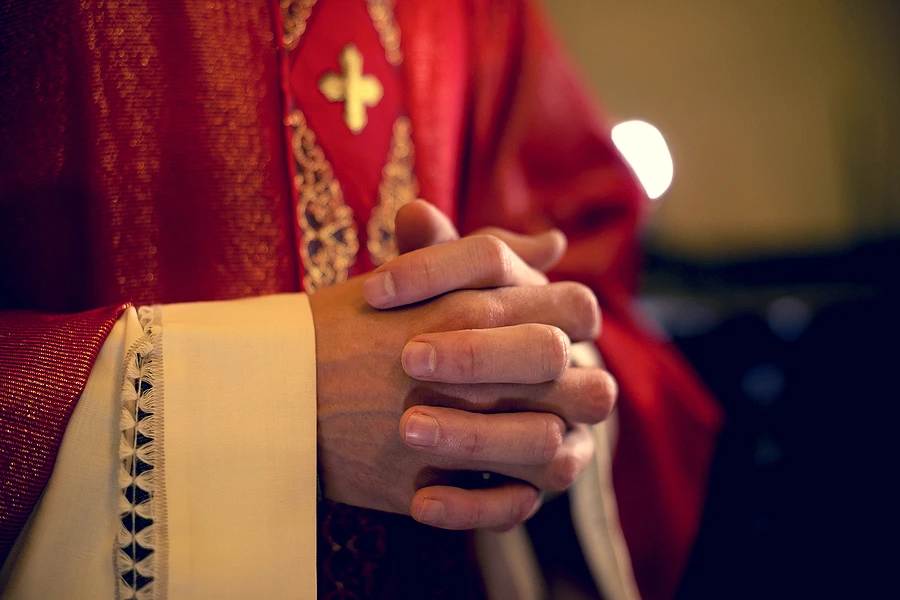
Rome, Italy, Mar 15, 2017 / 02:50 am (CNA/EWTN News).- When reports came out recently about Pope Francis’ decision to modify the penalties for several priests found guilty of abusing minors, the question arose as to whether the Pope was being too merciful in his decision.
Another concern was whether priests found guilty of abuse of minors would continue to be dismissed from the clerical state, or “laicized.”
To address these issues and clear up some of the grey area on this topic, CNA spoke with a canonist, Fr. Damián Astigueta, SJ.
A professor at the Pontifical Gregorian University with a specialty in criminal proceedings, Fr. Astigueta offered insights on what dismissal from the clerical state is, why the Church doesn’t always choose to dismiss from the clerical state priests who are guilty of abuse, what those condemned to a life of prayer and penance actually do, the role of bishops in abuse cases, the lessening of sentences, and more.
What is dismissal from the clerical state?
While frequently used in the media, the term “laicization” doesn’t really exist anymore among canonists, Fr. Astigueta said, and has been widely replaced by the term “loss of the clerical state.”
When a priest loses his clerical state, either because he requested it or because it was taken from him, he is “‘dismissed from the clerical state,’ because this is a juridical status,” Fr. Astigueta explained.
“He remains in a situation judicially as if they were a layperson. This is where the term ‘laicization’ comes from.”
He clarified that when this happens, it doesn’t mean that a priest is no longer a priest: “the sacrament of Holy Orders isn’t lost; it imprints an ontological sign on the being of the priest that can never be lost.”
What happens instead is that exercising the rights proper to the clerical state are prohibited, such as saying Mass, hearing confessions, and administering the sacraments; as are the obligations, such as that of reciting the Liturgy of the Hours and obedience to their bishop.
However, since a man dismissed from the clerical state remains a priest, there are times at which the Church continues to oblige him to act as a priest.
For example, if he finds someone in danger of death who asks for the sacraments, even though he is no longer in a clerical state, he “must hear (the person’s) confession because the most important thing is the salvation of that person.”
Fr. Astigueta also emphasized the importance of not misinterpreting the process to mean a “reduction to the lay state.” This phrase is not correct, he stressed, since it inaccurately treats laity “in a derogatory way, as if they were lesser.”
Why not all priests guilty of abuse lose the clerical state
For Fr. Astigueta, the answer to the question of why not all priests found guilty of abuse are dismissed from the clerical state has two primary components: not all acts of abuse are the same in terms of severity, and the situation of the priest himself varies.
“Why doesn’t the Church dismiss from the clerical state all abusers? Because not all abuses are the same entity,” he said. Even civil law recognizes a difference in severity between pedophilia – which involves prepubescent children – and ephebophilia – which involves mid-to-late adolescents. In other cases, there may be the appearance of consent with an older teen, he said, which can further complicate the matter. The penalty assessed to the priest takes these factors into account, he added.
When it comes to priests who are found guilty of abuse, there are different types of punishments, including dismissal from the clerical state, or a life of “prayer and penance,” depending on the situation.
“There are certain cases in which dismissal would be the just punishment,” Fr. Astigueta said.
But there are also cases – even with several instances of serious abuse that have caused a lot of damage – when the Church decides against this dismissal, he said, pointing to Legion of Christ founder Fr. Marcial Maciel as an example.
Fr. Maciel was a person “who was proven to have committed a series of very serious crimes, a person who when one knows what he did truly realizes they are in front of a very disturbed person,” the priest said. “Can a disturbed person be punished with the maximum penalty?”
At times the Church prefers to use a different system, prohibiting the person from ministry, particularly in public. Instead, the person is isolated at home, dedicated to prayer “and nothing more.” This means no visits from people, at times not even friends or their congregation.
In the case of Fr. Maciel, even his funeral, for which he had saved enormous funds, was closed to the public.
“Is it a gilded prison? In a certain way, yes,” Fr. Astigueta said. However, he said the Church at times chooses this punishment, which is less strong, because at a certain point, “when I give a person a sanction that destroys them, it’s not a sanction, but revenge.”
Fr. Astigueta also spoke of the importance of mercy in the process, particularly when it comes to elderly priests and the Church’s own responsibility toward her members.
Even in a tragic case when a child has been abused, “the Church is still a mother, and mercy is used for the victims and the priest,” he said, noting that abusers often have serious psychological problems that require treatment.
If a priest chooses to renounce his clerical state, he is often inserted into society without a problem; but when it comes to those who have been dismissed, it can be a lot harder, Fr. Astigueta said, explaining that there is a canon (c. 1350 §2) establishing “that there exists a duty of charity toward them.”
This means “helping them and taking care of them in the measure that the person lets themselves be helped,” he said.
If an 80-year-old priest is dismissed from the clerical state, “where do we send him? Can he find work? He’ll end up living on the street as a homeless man. How long will he last? He won’t last anything,” he observed.
To put a man on the street in this circumstance, unless he has relatives ready to take him on, “is practically to kill him.”
Often, despite the harm done, something good in the person remains, he said, explaining that because of this, sometimes a more just penance is to let him “live with his conscience.” While a life of prayer and reflection might sound comfortable, Fr. Astigueta asked: “reflecting with whom? With your memories before God, with your regrets.”
He noted that in order to avoid pressure from the media in these cases, the Church “is obliged at times to punish, in my view, more seriously than it should.”
Offering help to victims and bringing about justice is always the Church’s top priority when it comes to clerical abuse, but concern must also be shown to the sinner, he said, explaining that if the Church were to immediately dismiss from the clerical state every abusive priest, it could cause more harm.
“Sometimes we find ourselves in situations that if these people are thrown out on the street, I am leaving a possible serial killer,” Fr. Astigueta said, referring to pedophiles. The Church, he said, must also take this into account.
Fr. Astigueta stressed that when it comes to mercy in abuse cases, it “never goes against justice,” and that the first act of mercy is “to tell the truth.”
Once the truth is known, the measure in which the offender can be sanctioned must be taken into account “in order to avoid that the penalty is a revenge,” because this helps no one.
“The pain of the victim is never cured with revenge; the only way to heal the victim’s pain is forgiveness offered freely,” he said, noting that “this can never be forced on anyone; but certainly neither can the spirit of revenge be forced.”
What a life of prayer and penance actually means
Many priests found guilty of abuse, instead of being dismissed from the clerical state, are instead sentenced to a life of “prayer and penance.”
But while the sentence is fairly common, among elderly priests in particular, what it actually involves is at times a bit obscure to the public eye, and it can seem like the priest is getting off easy despite committing heinous crimes.
Fr. Astigueta explained that on a practical level, “the person is isolated, sometimes more, sometimes less.”
Often “the person is isolated, possibly without having direct access to the telephone or the TV, and must dedicate himself to reading, praying and walking around inside the house.”
At times the person might even be barred from leaving the house without permission, under pain of incurring further punishments.
He pointed to the recent case of Luis Fernando Figari, a layman and founder of the Sodalitium Christianae Vitae, who was found guilty of an extreme, authoritarian style of leadership as well as several accounts of sexual, physical, and psychological abuse.
As a punishment, the Vatican didn’t expel Figari from the community, but ordered that he live alone, and barred him from any contact with the community’s members and from receiving people.
If a priest who receives this sentence doesn’t want to follow the rules, the Church in this case “can impose the full dismissal” from their clerical status, Fr. Astigueta said, noting that the majority of priests who choose to this life are people who “want to be helped and recognize that this penalty is a table of salvation for them.”
“It’s strong, yes, but at least I have something to eat and I can live my final years in peace,” Fr. Astigueta said, noting that in general it is elderly priests who end up in this situation, whereas younger ones with some sort of major mental health disorder are typically sent to a therapeutic communities.
At times they are able to celebrate Mass with others, but “always with the very clear ban that ‘from here, you cannot go away without permission.’”
The Church, Fr. Astigueta said, “is not a prison … it doesn’t have penitential system like a state, but someone must keep watch over those removed from ministry.”
And this implies “a very heavy duty for the Church, because who is the one that supervises? Who is responsible for him? It’s not so easy, it implies a lot of obligations.”
Fr. Astigueta also noted that there’s a different canonical process for lay founders such as Figari, versus priests who abuse.
“Technically speaking, the case of a layman doesn’t enter into the canon on abuses like the priests,” he said.
Clerics who commit sexual abuse are charged under a canon (c. 1395 §2) which criminalizes those offenses against the sixth commandment which are committed by force or threats or publicly or with a minor below the age of 16.
But when it comes to the laity specifically, “this lack in the code must be thought of,” because unfortunately “the times are those in which we can’t only think about priest founders, but of many laity who have a position in the Church … who can abuse minors,” such as school directors or professors.
In these cases, he said, the Church applies a canon (c. 1399) which covers the situation in which the criminal “goes against a divine or ecclesiastical law with harm or danger of grave scandal.”
Cases in which the victims are mentally disabled must also be taken into consideration, he said, as well as many other forms of abuse “that should be considered crimes,” and are in many states.
The role of the bishop in cases of abuse
When it comes to the responsibility of bishops in abuse cases, Fr. Astigueta said that while expectations might have been murky in the past, they are clear now, and require the bishop to act immediately.
“When the bishop is informed, when he receives the news that an abuse has been committed, he has the obligation, a serious obligation, to intervene.”
A bishop must first intervene on a judicial level, alerting civil authorities, but also on the pastoral level, he said, explaining that the process looks different for every nation.
On a pastoral level, bishops must from the start turn their immediate attention to the victims “in order to welcome them and to help them understand that we are not against them and we are looking for the truth,” he said.
After the initial investigation has begun, the bishop may, but is not obliged to, apply a “precautionary measure,” which is a type of disciplinary measure enforced in order to avoid “the process from being polluted.”
Giving a theoretical example, Fr. Astigueta said a priest might try to pressure a victim into retracting their statement, so the bishop could decide to “distance” the priest from the process. This choice might also be made in situations where there is risk of a serious scandal, he said.
Once a priest is found guilty, the bishop will have to carry out the sentence, and it may even be the bishop himself to enforce the decree of dismissal from the clerical state with the authority of the Congregation for the Doctrine of the Faith, Fr. Astigueta explained.
Victims must be helped to live a “process of reconciliation, of accompaniment” and one in which they are made to feel that “they are part of the Church,” he said, but stressed that this is at a pastoral level, which must always remain separate from the judicial level.
Fr. Astigueta also spoke on cases of negligence on the part of a bishop, which Pope Francis in his 2016 motu proprio Come una madre amorevole established as grounds for removal from office.
The canon behind the rule (c. 1389 §2), the priest said, states that “A person who through culpable negligence illegitimately places or omits an act of ecclesiastical power, ministry, or function with harm to another is to be punished with a just penalty.”
The issue is also dealt with in a canon (c. 193 §1) which speaks of removal from office “for grave causes.” Removal from office, he explained, is “the act through which a person loses a series of rights which are part of an office.”
“So this person who was the bishop had rights and duties regarding the community. As he has not fulfilled them, this office is removed,” Fr. Astigueta said.
Removal in this sense can either be for disciplinary or penal reasons, Fr. Astigueta said, explaining that in the case of penal removal for negligence, the bishop is dismissed because “he didn’t act as he should have.”
While in the past bishops moved abusive priests around in part because they didn’t understand the severity of the problem, “today no one can say that they don’t know what abuse is and the magnitude of the problem.”
In cases of abuse, then, “it’s already so severe that there is no need for another cause, negligence is enough.” Part of this negligence, Fr. Astigueta explained, could be moving priests, not acting immediately, or letting time pass until more accusations arise: “Here we would have a case of negligence.”
Another instance, he said, would be failing to take precautionary measures against a priest accused of abuse, and it is later discovered that the priest had committed other abuses during that time. Other reasons for removal of office due to negligence could be that the bishop didn’t follow the protocol requested by the state.
He noted that there are a variety of situations, but “the Pope wanted to say that this negligence in itself so important because the damage to the other produced due to negligence, which is almost – even if it can’t be said in a clear way – an act of complicity due to negligence.”
Stronger punishment isn’t always the best way to prevent abuse
No matter the situation of the priest or the bishop, Fr. Astigueta stressed the importance of pursuing the just punishment given the particular situation, and warned against the temptation to immediately impose the maximum punishment – dismissal from the clerical state – on all cases.
To do so, he said, “would be an injustice, it would be a type of witch hunt, and this produces fugitives. If everyone is punished with the maximum, with this you resolve nothing.”
It’s a fact, he said, that all states which have attempted to toughen the penalties in order to prevent further crimes “have failed to do so.”
The only thing that actually makes the crimes diminish, he said, are preventative measures and “the consciousness of the people, the intervention of the people,” specifically through education.
“If the people within the Church were all to work so that there were a healthy environment, not one of suspicion, but healthy and prudent,” these delinquent act would diminish. “Not because the maximum penalty is applied.”
 […]
[…]






By illuminating the fact that The Office Of The MUNUS is “forever”, Pope Benedict illuminated the fact that “The Holy Spirit was not promised to the successors of Peter that by His revelation they might make known new doctrine, but that by His assistance they might inviolably keep and faithfully expound the Revelation, the Deposit of Faith, delivered through the Apostles”.
Pope Benedict, by maintaining The Office Of The MUNUS, The Gift Of The Holy Ghost, The Gift Of Infallibility in regards to Faith And Morals, exposed the fact that there existed within the hierarchy of The Catholic Church a counterfeit magisterium that, in denying The Unity Of The Holy Ghost, The Spirit Of Perfect Divine Eternal Love Between The Father And His Only Begotten Son, Jesus The Christ, Who Must Proceed From Both The Father And His Only Begotten Son, Jesus The Christ, In The Ordered Communion Of Perfect Divine Eternal Complementary Love, The Most Holy Blessed Trinity, Pope Benedict exposed the fact that this counterfeit magisterium, which, in denying The Divinity of The Most Holy Blessed Trinity, was attempting to subsist within The One Body Of Christ, while denying The Most Holy Blessed Trinity, In The Unity Of The Holy Ghost, Is The Author Of Love, Of Life, And Of Marriage, and thus Pope Benedict exposed the fact that this counterfeit magisterium, in essence, existed in a state of apostasy, in complete contradiction to The Deposit Of Faith.
Dear Blessed Mother Mary, Mediatrix Of All Graces, Mirror of Justice And Destroyer Of All Heresy, Who Through Your Fiat, Affirmed The Filioque, and thus the fact that There Is Only One Son Of God, One Word Of God Made Flesh, One Lamb Of God Who Can Taketh Away The Sins Of The World, Our Only Savior, Jesus The Christ, thus there can only be, One Spirit Of Perfect Divine Eternal Complementary Love Between The Father And His Only Begotten Son, Jesus The Christ, Who Must Proceed From Both The Father And His Only Begotten Son, Jesus The Christ, In The Ordered Communion Of Perfect Divine Eternal Complementary Love, The Most Holy And Undivided Blessed Trinity (Filioque), hear our Prayer that your Immaculate Heart Will Triumph soon for the sake of Christ, His Church, all who will come to believe, and all our beloved prodigal sons and daughters, who, hopefully, will return to The One Body Of Christ, which exists From The Father, Through, With, And In His Only Son, Jesus The Christ, In The Unity Of The Holy Ghost (Filioque) Amen.
Cleverly (!) maybe not quite a “counterfeit magisterium,” but rather a deceptive rupture between intact and formal teachings which are never denied outright (the Magisterium), and actual practice–a schizophrenic ploy of indirect signaling, photo-ops and insinuation–and, as wisely anticipated by St. John Paul II in his encyclical Veritatis Splendor (1993):
“A separation, or even an opposition [!], is thus established in some cases between the teaching of the precept, which is valid and general, and the norm of the individual conscience, which would in fact make the final decision [no longer a ‘moral judgment’!] about what is good and what is evil. On this basis, an attempt is made to legitimize so-called ‘pastoral’ solutions contrary to the teaching of the Magisterium, and to justify a ‘creative’ hermeneutic according to which the moral conscience is in no way obliged, in every case, by a particular negative precept [thou shalt not!]”(n. 56).
And…
“This is the first time, in fact, that the Magisterium of the Church [!] has set forth in detail the fundamental elements of this [‘moral’] teaching, and presented the principles for the pastoral discernment necessary in practical and cultural situations which are complex and even crucial” (n. 115).
And,
“The Church is no way the author or the arbiter of this [‘moral’] norm” (n. 95).
ND: there is only ONE , HOLY, CATHOLIC & APOSTOLIC CHURCH. No parallel magisterium!
Powerful words ND.
“God’s Revolution” is not over yet?
God bless,
CN
Benedict XVI was a good and holy man. He was an inspired teacher whose
sermons, books and reflections touch even ordinary non-theologians. His resignation
was a much lamented setback for the Church.
We were blessed to have two great popes in my lifetime: John Paul II and
Benedict. John Paul II has reached sainthood; hopefully, Benedict will join him.
May I live to see that. !!
In his later years as Pope I became very fond of Benedict XVI- his teaching, graciousness and gentle spirit. I would very much like the Church to begin the long process in examining his cause, and if he measures up, his eventual canonization. In the mean time I will continue to evoke his intercession. I thank God for Benedict XVI!
Please!!! I love BXVI! But enough of the “spirit of Vat II” (note the lower case “s”) led rush to canonize every Pope nowadays! It’s downright scary who is in the batters box after BXVI!!!
Here we go again. Yet another Vatican II Pope canonized. Despite the moral wreckage which they helped–by their negligence–to bring about.
Heroic Sanctity? In someone who delivered us into the hands of Bergoglio?
I’m a huge fan of Ratzinger-Benedict and when I met him in 2003, he was humble and other oriented—not selfish. He might be a future doctor. But let’s hold off. Wisdom says don’t rush, no? Saint Therese took longer. Francis Xavier took far longer. Joan of Arc far longer. The Church thinks and acts in centuries, we used to hear. In my private prayer for nearly 3 years I’ve both prayed for his repose and beseeched his intercession. Give it the required time and trust with hope. Full investigation into his life, transparency. Abandonment.
I am convinced of Joseph Ratzinger/Pope Benedict XIV’s personal sanctity. His entire life will be carefully scrutinized, in order to ascertain heroic virtue. This man was a holy genius. Holy geniuses are few and far between.
Before he became pope, I was a so-so Catholic. As soon as he stepped out on the balcony of St.Peter’s Basilica on the day of his election, I was infused with a love for Jesus Christ and for the papacy. That’s the moment I delved into my Catholic faith with a sincere commitment. Not only did I read as much as I could of his writings, but I read the entire Bible, and entire Catechism of the Catholic Church, in order to be informed and educated about my own faith. This was the “Benedict effect” for me.
I was privileged to scratch the the surface of his opus: thirty-two books of his, and counting. His “Introduction to Christianity” is a recognized masterpiece. He leaves behind him a treasury of Catholic teaching, for generations of theologians to dissect, including all of his homilies and speeches. In fact, his musings on Good Friday, 2005, just before John Paul II’s death, clearly demonstrate that Ratzinger was nothing short of a prophet (reminiscent of St.Pope Paul VI’s prophetic voice in Humanae Vitae), discussing the filth that was in the Church and his comments about the “Dictatorship of Relativism” in his pre-conclave homily before his election as pope.
His quiet and humble demeanor was just one of his personal traits. When my beloved mother, who truly loved and respected him, died, I wrote him a five-page letter, in French (his mastery of French was exquisite, by the way). He wrote me back; I still have his letter (what a gift for me!). His sweet words and compassionate understanding touched me deeply.
I thank God for giving us this Holy Pope. I have no doubt that he will be declared a Doctor of the Church eventually.
Marie Brousseau: Catholic author, essayist, biologist and teacher
Author of “Defending Human Dignity: Catholic Answers to Gender, Abortion and Relativism
mariebrousseau.com
This business with Francis declaring that Benedict supported him and the “legalizing of homosexuality because it is not a heresy” -has to come to a reckoning, it seems to me.
Also to re-emphasize, it is bearing down on Pope Leo.
See references in my comments in the CWR news report on the removal of Bishop Strickland.
https://www.catholicworldreport.com/2023/11/11/breaking-pope-francis-relieves-strickland-of-his-duties-as-bishop-of-tyler/
Marie Brosseau above (5:09 p.m.) – Ditto. During JPII’s time, I swallowed the MSM’s slanderous portrayal of Ratzinger/Benedict. How could I have been such a sucker?
Eight days left on the Catechism in a Year!
Cleo above (4:21 am) – I understand exactly what you’re talking about. Secular media set the tone by their subjective narrative. They negatively, and falsely, influenced a lot of people.
They did the same thing with Pope Pius XII. It is essential to get informed through proper sources. For Pius XII, the Jewish community has exonerated him, thanks to numerous documentation of his heroic actions, such as hiding thousands of Rome’s Jewish men, women and children, in convents around the eternal city, and at Castel Gandolfo.
For Benedict, the whole episode of his being enrolled in the “Hitler Youth” was a pernicious attempt to smear his good name. I discuss this very aspect of the subjectivity of MSM, in my essay called “The insidiousness of subjectivity”. I also devote space about Ratzinger’s views on the dictatorship of relativism in my book (Defending Human Dignity).
I have reviewed two of Ratzinger’s works, “The Spirit of the Liturgy” and his timeless “Introduction to Christianity”, on Goodreads (I am also a Goodreads author). I will soon be reviewing another of his masterpieces, “Jesus of Nazareth”, the first in his trilogy on Jesus, which he wrote as Pope Benedict XVI.
I highly recommend all of his writings to everyone: if you want to know this man’s mind, heart and soul, read his books. His autobiography, “Milestone”, was published in 1998:he recounts the first fifty years of his life, covering his childhood in Nazi Germany, forced service in Hitler Youth and the army, his calling to the priesthood, his theological studies, experiences at Vatican II, professorship, and rise in the Church up to 1977, offering deep personal insights into his formation and faith. Another gem is “The Ratzinger Report” (1985), in which he frankly discussed the state of the Church. His interviews with journalist Peter Sewald are also very insightful, especially “Salt of the Earth” (1997).
For insights into the bias of secular media,and other topics, such as “Lying by Omission” and the use of language to distort the truth (“Truth and Language”), you can read my essays which are posted on my Blog page, on my website (mariebrousseau.com), anytime.