

A Syrian artist says restoration work on icons brings together history, chemistry, and art — and that protecting an icon is protecting history.
In the Syrian conscience, April is not limited to World Heritage Day celebrated on April 18. Rather, the month unfolds as a full season of cultural rebirth, stretching from the ancient roots of Akitu to the solemnity of Easter and the feast of St. George, as well as the memory of the massacres of 1915 and Syria’s Independence Day.
Within this time crowded with memory, the restoration of Syrian icons emerges as an act of safeguarding identity. It repairs the fractures of time and restores to sacred figures the radiance of a history that runs deep, declaring that protecting this heritage is not a cultural luxury but a struggle for survival carried out quietly by Syrian hands.
In this context, visual artist and restorer Lia Snayej shared with ACI MENA, the Arabic-language sister service of EWTN News, the path that led her into this delicate field. She said that seeing icons burned, damaged by gunfire, or covered with layers of black residue while participating in an exhibition was a shocking experience. That moment pushed her to explore restoration more deeply, before she later specialized in the field academically through a master’s degree in Russia.
Snayej said restoration brings together history, chemistry, and art, adding that protecting an icon is, at its core, protecting history.

Regarding the restoration process, she emphasized that documentation is the most important step and accompanies every stage of the work. Every detail is recorded in a special file that remains with the icon, almost like its “personal identity card.”
She explained that the work begins with studying the history of the piece and its artistic background before preparing a precise restoration plan. Not every icon, she noted, needs restoration; some require only preservation and measures to stop further deterioration. Each icon has its own condition, making restoration similar to medical treatment, with each case requiring a different diagnosis.
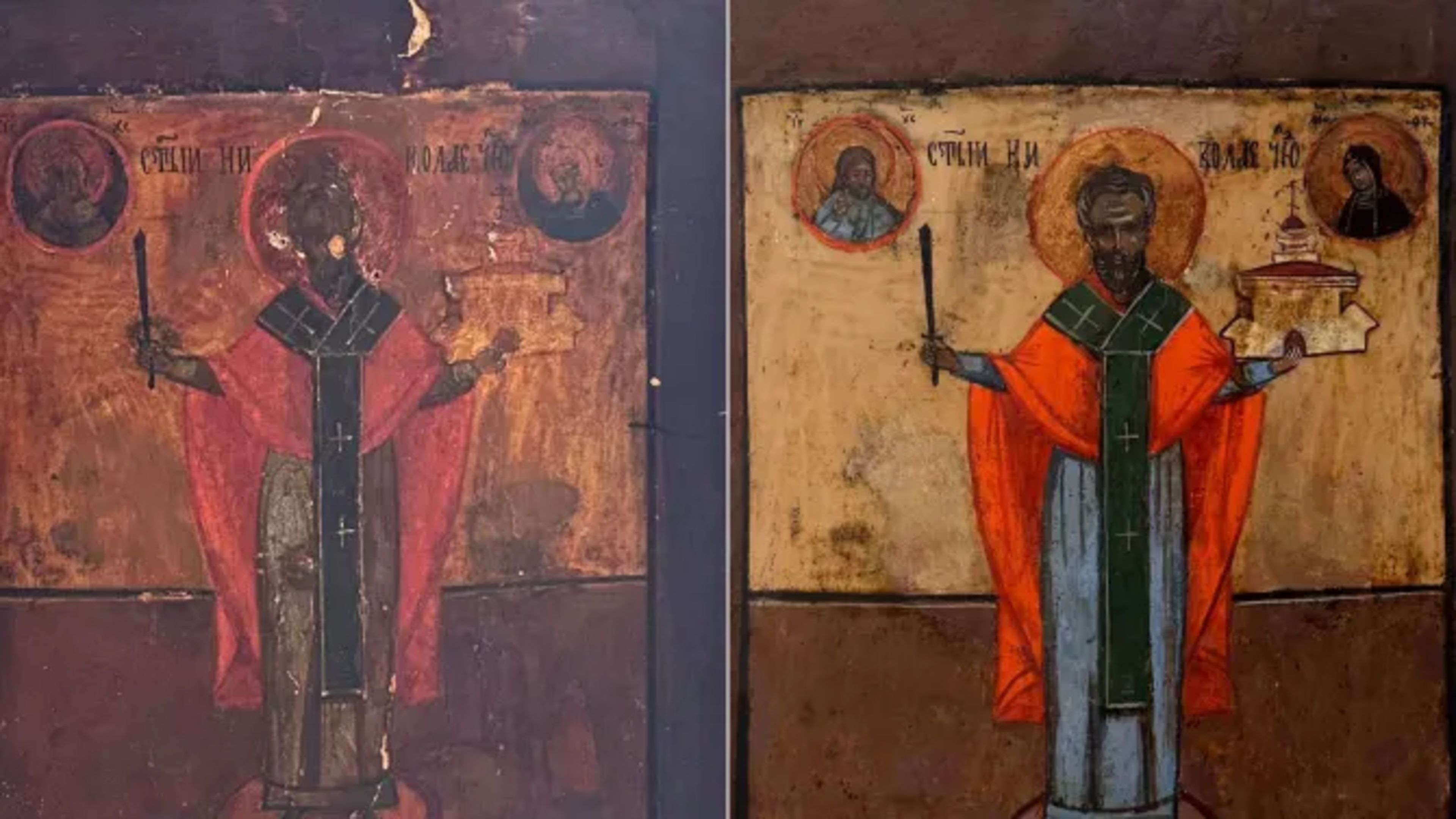
Snayej said the main stages of restoration include stabilizing the paint layer using special materials such as “Japanese paper,” followed by cleaning and sterilization. She described this as a very delicate stage, since a mistake could lead to the loss of color. The process then continues with retouching and the addition of a new protective layer.
Assessing the current state of icons, Snayej said the greatest danger is the lack of attention they receive. Many historic icons, she said, are sold outside Syria for very low prices, while original icons are rarely found in homes, where printed reproductions are more common.
She also criticized the neglect of some churches when it comes to restoring their icons. She recalled an incident in Lebanon, where she found two historic icons stored in poor conditions inside a damp warehouse before she took on their restoration.
Snayej also warned against daily practices that damage icons, such as placing candles directly beneath them or cleaning them with materials not intended for that purpose.

Despite the challenges — including the difficulty of obtaining restoration materials and their high cost — Snayej said she remains committed to this path. Her passion, she explained, sometimes leads her to work free of charge in order to preserve a threatened work of art.
Last month, she participated in an exhibition organized by the Greek Orthodox Church in Damascus, where she displayed two historic icons she had restored. One was a Russian icon of St. Nicholas, while the other consisted of four parts depicting the Virgin Mary, with the crucified Jesus at the center.
Snayej said what surprised her most at the event was not the exhibition itself but the level of interest shown by visitors and the number of questions they asked about the history of icons and restoration techniques. For her, this reflected a striking and genuine desire among people to rediscover this heritage.
She concluded by saying that the icon has taught her to respect artistic work and serious research, and that it has transformed her specialization into a personal commitment that goes beyond the limits of a profession.
This story was first published by ACI MENA, the Arabic-language sister service of EWTN News. It has been translated and adapted by EWTN News English.
If you value the news and views Catholic World Report provides, please consider donating to support our efforts. Your contribution will help us continue to make CWR available to all readers worldwide for free, without a subscription. Thank you for your generosity!
Click here for more information on donating to CWR. Click here to sign up for our newsletter.


Art is a treasure of cultural riches, evident in the iconography of the Russian Rublev and the Greek Angelos Akotantos. It shouldn’t be a wonder that Pope Gregory III formally condemned iconoclasm at a Synod he convened for that purpose, Rome 731, excommunicating anyone who defaced the sacred images.
French impressionists capture a sense of a culture’s spiritual interface with reality. As does other great art Italy, Flanders, China. The Icon differs in that it captures the divinity’s spiritual signature on his creation. It preserves the ineffable.
The most important aspect of icon is that it is a result of a prayer and is made for a prayer, communal and private. Hence, it is literally a prayer (and the knowledge of God) of the whole Church expressed in colours and lines; when a restorer works on an icon, she literally saves that spiritual experience from the oblivion.