


Vatican City, Oct 30, 2025 / 16:20 pm
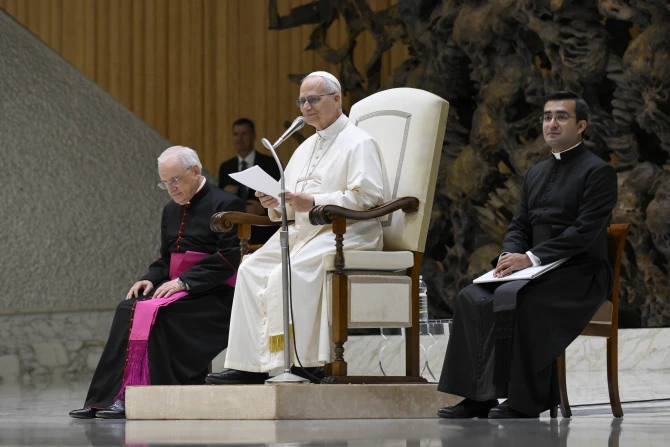
Pope Leo XIV on Thursday urged young people to cultivate their “interior life” and to listen to their restlessness without “fleeing from it” or “filling it” with things that don’t satisfy, lest they fall into existential emptiness.
“Having a great deal of knowledge is not enough if we do not know who we are or what the meaning of life is,” the pope told the hundreds of university students he received Oct. 30 in the Paul VI Audience Hall at the Vatican for an event held as part of the Jubilee of the World of Education.
In his message, he invited the students to rediscover the inner dimension of life and pointed out that “without silence, without listening, without prayer, even the light of the stars goes out.”
“We can know a great deal about the world and still ignore our own hearts,” he noted, while encouraging the students to constantly strive “toward the heights,” being “the beacon of hope in the dark hours of history.”
Leo XIV acknowledged that many young people experience a sense of emptiness or inner restlessness and emphasized that this disorientation is not solely due to personal reasons.
“In the most serious cases, we see episodes of distress, violence, bullying, and oppression — even young people who isolate themselves and no longer want to relate to others,” the pope observed. In his view, these deep wounds are “the reflection of “a void created by a society that has forgotten how to form the spiritual dimension of the human person, focusing only on the technical, social, or moral aspects of life.”
The pope was especially approachable and relaxed with the young people, with whom he shared several spontaneous moments. He introduced himself to them twice as a “former math and physics teacher,” recalling his teaching past, and even joked with them: “Perhaps you have a math exam soon?” he asked, going off script and eliciting laughter and applause.
The pope affirmed that a life that remains “stifled by fleeting pleasures will never satisfy us.” Instead, he asked each person to say in his or her heart: “I dream of more, Lord, I long for something greater, inspire me!”
“This desire is your strength and expresses well the commitment of young people who envision a better society and refuse to be mere spectators,” he emphasized after noting that the “desire for the infinite” is the compass they should use.
Instead of looking at your phone, ‘look to the sky, to the heights’
He urged the university students to not be satisfied “with appearances or fads” and instead of “being fixated on your smartphones, to look to the sky, to the heights.”
“How wonderful it would be if one day your generation were remembered as the ‘generation plus,’ remembered for the extra drive you brought to the Church and the world,” he exclaimed.
During his address, Pope Leo cited as role models St. Pier Giorgio Frassati, who had “the courage to live life to the fullest” and “to the heights,” and St. Carlo Acutis, “who did not become a slave to the internet but rather used it skillfully for good.” The pontiff canonized these two young saints together on Sept. 7.
The pope also cited St. Augustine as an example, describing him as “brilliant but deeply unsatisfied” because he found “neither truth nor peace until he discovered God in his own heart.”
The Holy Father focused much of his address on the challenges posed by the digital world and the development of artificial intelligence, urging that these areas not become “a cage where you lock yourselves in” nor “an addiction or an escape.”
“You live in [digital education] and that’s not a bad thing; there are enormous opportunities for study and communication. But don’t let the algorithm write your story! Be the authors: Use technology wisely, but don’t let technology use you,” he urged.
‘It is not enough to silence weapons, we must disarm hearts’
Leo XIV emphasized the urgency of a “disarmed and disarming education” that forms new generations in respect, justice, and equality.
“You can see how much our future is threatened by war and hatred, which divide people. Can this future be changed? Certainly! How? With an education for peace that is disarmed and disarming,” the pope said. Furthermore, he warned that it is not enough to “silence the weapons,” but rather “we must disarm hearts, renouncing all violence and vulgarity.”
As in his recent document on education, “Drawing New Maps of Hope,” Leo XIV called for avoiding all forms of exclusion or privilege in education, “recognizing the equal dignity of every young person, without ever dividing young people between the privileged few who have access to expensive schools and the many who do not have access to education.”
This story was first published by ACI Prensa, CNA’s Spanish-language news partner. It has been translated and adapted by CNA.
If you value the news and views Catholic World Report provides, please consider donating to support our efforts. Your contribution will help us continue to make CWR available to all readers worldwide for free, without a subscription. Thank you for your generosity!
Click here for more information on donating to CWR. Click here to sign up for our newsletter.

From what comes through, Pope Leo is emphasizing a “humility” of “absolute togetherness” that shuns “divisions” because we “are responsible” for making things keep cohering; while he is warning against some things like “unethical” AI, getting existentially marooned and being too knowledgeable. As a manifest Gospel and evangelism building bridges which is open to the skies and the stars.
There has to be a breakaway from our life being inexorably sucked into a technological vortex; in which the soul becomes a reflexion of a manufactured database rather than the creative living God.
Return to nature is a welcome start. But then there’s the challenge of redirection. Pope Leo commends role models for the modern man Frassati and Acutis. A prime value of Church pronouncement of sainthood is precisely that.
“We must disarm hearts”.
Here we must tread carefully as to not surrender our ability to discern, to deliberate, to retain a sense of fortitude in pursuit of the truth, determining good from evil. Destruction of division has two meanings, because not all division is evil. In the end our best model other than the witness of the saints and martyrs is Christ.
About the “interior life,” this from St. Augustine:
“Men go abroad to wonder at the heights of mountains, at the huge waves of the sea, at the long courses of the rivers, at the vast compass of the ocean, at the circular motions of the stars, and they pass by themselves without wondering.”
Too bad that so many synodallers “walking together” forgot to set up a Study Group to on the interior life, alongside those other ten or fifteen other constellations of “experts”.
Students – they are blessed with opportunities galore. They will reshape the world and make it a better place for them and for generations yet to come. Forerunners Saint Pier Giorgio Frassati and Saint Carlo Acutis are fresh and dynamic sources of inspiration for the young and the young at heart.