Washington, D.C. Newsroom, Jul 24, 2020 / 06:00 am (CNA).- Part 3 of a three part series examining the situation of the Church in China. Part 1 examined the Church on the mainland, Part 2 examined the situation in Hong Kong.
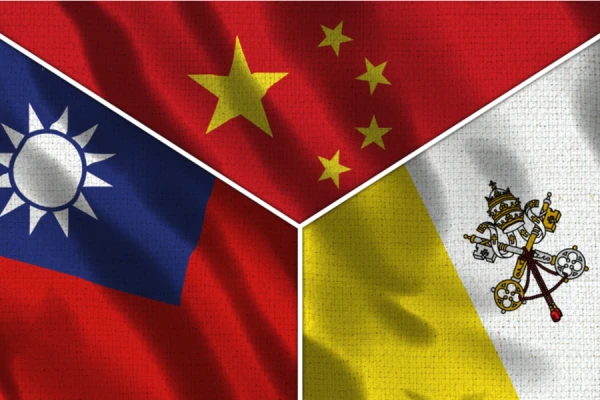
With negotiations ongoing for an extension of the 2018 Vatican-China deal, the fate of Vatican-Taiwan relations may prove inextricable from the future of the deal – and of the Church in China.
When the 2018 deal was signed, ceding some control over episcopal appointments to the Communist Party, the Holy See stressed that it was a “pastoral” not “political” agreement, aimed at bringing together the underground Church loyal to Rome and the communist-controlled, schismatic Chinese Patriotic Catholic Association (CPCA).
But the “pastoral” split among China’s Catholics is rooted in the diplomatic split between Communist China and the Holy See. While the Vatican may insist its goals are purely ecclesiastical, the Chinese government is unlikely to make such a distinction. And with an extension of the deal under discussion, many are now asking if the Holy See is preparing to accept recognizing “one China” as the price of a unified Church.
The Holy See has recognized the government of Taiwan, officially the Republic of China, since 1942, while the Communist People’s Republic of China has had control of the mainland since the conclusion of the Chinese civil war in 1949. While the Church has maintained an embassy in Taiwan since then, it has had no official diplomatic presence on the mainland since 1951, when it was officially expelled – creating the split between the CPCA and the underground Church.
The communist government has always made claim to Taiwan as a rebel province, insisting that there is only one China, and one Chinese government. Isolating Taiwan and curtailing international recognition of it as a sovereign democratic nation was, and remains, a central foreign policy priority.
China succeeded in getting the United Nations to cease recognition of the Taiwanese government in 1971, and since that time the vast majority of member states have severed official ties, often as a condition of increased aid from or trade with China. Taiwan has lost five diplomatic allies since 2016, with developing nations such as El Salvador, Panama, and the Dominican Republic cutting ties under pressure from Beijing.
Although its embassy in Taipei has been led by a chargé d’affairs, not a full ambassador, since 1971, today the Holy See remains the last European government, and the most prominent international body, to recognize Taiwan.
Ever since the 2018 agreement was signed, China and Vatican watchers have waited to see if there would be a further shift in the Vatican’s China diplomacy, and the signs, while subtle, have been there to be seen.
In March 2018, the Vatican-China deal was under negotiations and widely discussed in the media. Taiwan’s Archbishop John Hung Shan-chuan of Taipei voiced his own opinion, saying Taiwan did not anticipate that the Holy See and mainland China would establish diplomatic relations, because to do so requires sharing “common values with each other.”
“The values the Vatican holds are different from those of the Chinese Communist Party. Building ties with the Vatican requires values including freedom and democracy,” he said at the time.
Yet, since then, overt support for these values from Rome has been scant regarding China. The Vatican has not commented on the more than 1 million Uyghurs interned in concentration camps, subject to forced sterilizations, torture, and anti-religious indoctrination. Nor has it spoken publicly on the continued persecution of Christians across the mainland, including the harassment, arrest, and detention of faithful Catholic bishops.
Instead, Cardinal Pietro Parolin has praised Chinese president Xi Jinping’s campaign of “sinicization” of religion and culture in the country, saying it relates to the Catholic concept of inculturation “without confusion and without opposition.”
At the same time, the Chinese government has launched a crackdown on civil liberties in Hong Kong, first in response to protests against a 2019 law to authorize extradition to the mainland, and more recently following the imposition of sweeping new “national security” measures on the supposedly self-governing territory.
At the beginning of the year, Taiwan’s president, Tsai Ing-wen, wrote to Pope Francis in response to his message for the 2020 World Day of Peace. The president used her letter to explain the parallels between Chinese attitude to, and actions against Hong Kong and Taiwan.
“I am in complete accord with your statement that walking the path of peace requires us to set aside every act of violence in thought, word and deed, whether against our neighbors or against God’s creation,” Tsai wrote to Francis in January, as she detailed a list of China’s actions that she said constitute “abuses of power” in Hong Kong, the persecution of religious believers on the mainland, and its aggression toward Taiwan.
“The crux of the issue is that China refuses to relinquish its desire to dominate Taiwan. It continues to undermine Taiwan’s democracy, freedom, and human rights with threats of military force and the implementation of disinformation campaigns, cyberattacks, and diplomatic maneuvers.”
Yet, as negotiations with the Communist government continue, the diplomatic discourse between the Holy See and Taiwan appears distinctly one-sided.
Amid the COVID-19 pandemic, the Holy See was the only diplomatic ally of Taiwan which did not make an appeal to allow Taiwan to participate in the World Health Organization’s assembly meetings. Taiwan’s Ministry of Foreign Affairs said in May that the Vatican would voice its support for Taiwan through other channels.
Earlier this month, the Hong Kong newspaper South China Morning Post quoted a Vatican source saying that the Holy See could even move its embassy from Taiwan to the mainland.
“Taiwan should not be offended if the embassy in Taipei is moved back to its original address in Beijing,” the Vatican source was quoted saying.
While such a move would be seen by many observers as a dramatic diplomatic coup for Beijing, Taiwan’s newly installed Archbishop Thomas An-Zu Chung downplayed the significance of the possibility, telling the Morning Post that the Taiwan mission “should be maintained” even if the official Vatican embassy is moved to Beijing.
Such a move “could happen soon if the mainland Chinese government is more open-minded and receptive towards the Roman Catholic Church,” Chung said, adding that “in reality, the Sino-Vatican agreement has not had an actual impact on Taiwan’s relationship with the Vatican.”
The Vatican has been vocal in its desire to see a unified Catholic Church in China, presumably encompassing the official and underground Churches on the mainland, as well as the for-now independent dioceses of Hong Kong and Taiwan. If the mainland government hopes to press the Holy See into accepting a “one China” policy as a price of a “one Church in China,” the signs suggest it may work.
In 2018, some in Rome might have hoped to see the freedoms of Taiwanese and Hong Kong Catholics protected as it moved towards uniting the Church on the mainland. Yet in the two years since the Vatican-China agreement was signed, the Communist government has made it abundantly clear that they – not Rome – will be the supreme authority over Catholics in the country.
While it remains, in the eyes of many Chinese Catholics, a deeply unpleasant offer, the Holy See is still at the table.
 […]
[…]




We read: “Earlier in the week, McElroy underscored the Church’s stance, reiterating Pope Francis’ categorical rejection of atomic weapons and warning that deterrence ‘is not a step on the road to nuclear disarmament but a morass’.”
Thinking about the “morass,” but also thinking how exactly to unwind a world with now seven nuclear powers—a few big ones and the rest at least capable of nuclear blackmail. Mostly Russia and then the United States, but also China, France, United Kingdom, India, Pakistan, Israel and North Korea (but no longer Iran, yet).
In 1965 and in a not entirely different context, right after the 1963 Cuban Missile Crisis and speaking for the Church as a whole, the Second Vatican Council stated that the Church has “admiration” for those who individually forego violence—without harm to others, but also asserted the right and duty for defense, and accepted “deterrence” if (!) this was a step toward nuclear disarmament, and therefore in the end stopped short of demanding a “freeze” in ownership of weapon arsenals (Gaudium et Spes, nn. 78-82).
Later in 1982, Pope John Paul II sent a compatible address to the Second Special Session of the United Nations dedicated to disarmament (Negotiation: The Only Realistic Solution to the Continuing Threat of War [Boston: St. Paul Editions, 1982]): “In current conditions ‘deterrence’ based on balance, certainly not as an end in itself (!) but as a step on the way toward a progressive disarmament, may still be judged morally acceptable” (p. 10). We’re still stepping through the morass, maybe, of the technocratic/military 20th Century—where two thirds of all deaths in both World War I and II were civilians. Yes, an “unthinkable” situation all around.
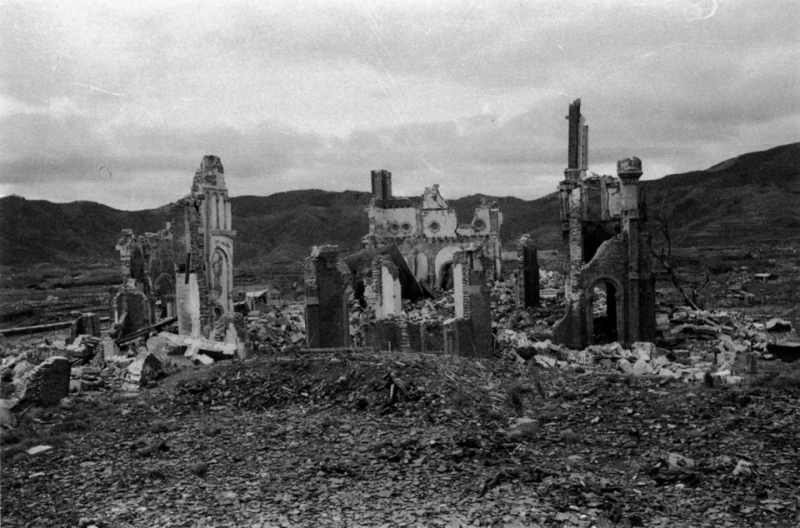
Here’s an uplifting link for the reported Nagasaki Bell Project which reached its financial donor goal on July 15 of this year, just in time for the second bell’s installation.
Yes.
Suppose you were hiking in, say, Cyprus, and you discovered you were deep inside a minefield. You phone your bishop, and condescendingly explains to you that, according to the last several Popes and articles he has read in America magazine, land mines are Bad Things and you should not linger next to them; therefore he advises you to leave by the fastest route, which is of course a straight line.
His conclusion that land mines are Bad Things was not exactly in question, and his advice to just leave in a straight line is on par with what you might expect from a 4-year-old, though not as cute. Sometimes there is no easy way out of a bad situation, and there is no substitute for dangerous work carried out by thoughtful people who have been trained for precisely this kind of situation.
Where was the article commemorating the bombing of Dresden? Oh, yeah, only nukes are sexy. More died in the firebombing of Tokyo on March 9-10, 1945, but those were only conventional bombs, and those are passé. And let’s not get into the siege of Leningrad at all, nor the sack of Jerusalem in A.D. 70. If it ain’t atomic, it’s not worth thinking about!
My point is that there is no MORAL difference between isolated atomic bombing and other ways militaries have destroyed cities — conventional bombings, sieges, or even “putting the city to the sword”.
There is at minimum a practical difference with nuclear weapons as they have existed since about 1950. What is unprecedented is the ability — and the temptation — to destroy many cities quickly. Also new is the ability to create EMPs that would eliminate power grids and most civilian equipment with an electronic component (including cars and trucks). Also, there is a real risk of nuclear winter. https://www.sciencealert.com/a-nuclear-winter-could-destroy-much-of-the-worlds-food-supply https://climate.envsci.rutgers.edu/pdf/IndiaPakistanBullAtomSci.pdf
But these considerations are for TODAY and for the future; they really have nothing to do with 1945. The only actual, historical uses of atomic weapons were not morally different from other forms of terror bombing.
Thank you for this: “My point is that there is no MORAL difference between isolated atomic bombing and other ways militaries have destroyed cities — conventional bombings, sieges, or even ‘putting the city to the sword’.”
Elsewhere I use the atomic bombings to make the case that “momentum” explains lots of seemingly complex outcomes, often more so than singling out one high-profile and even willing person (President Truman). The conveyor belt too often makes the “decision.”
Three other examples:
FIRST, of the fatal Apollo I launchpad fire (1967) and after many orange flags in the final days, the head of Mission Control (Gene Kranz) later debriefed his team by explaining: “none of us said ‘stop’. This will never happen again.” But the same thing applies to the fatal Challenger Space Shuttle Disaster in 1986…a back-room technical engineer did warn that the low ambient temperature on launch day would fracture key parts of the spacecraft outer surface (the “O-rings”) and cause the explosion. But, hey, front-room people who are really good at making the tough decisions and moving things along (momentum?) couldn’t hear. Why should managers even listen to technicians?
SECOND, take the financial collapse of 2008. For his part in the neglect (momentum?) that triggered the global meltdown beginning in the United States, the economist Alan Greenspan (chairman of the Federal Reserve, 1987-2006) explained at a Senate investigative hearing that he would have done something if someone else (!) on the board had raised an issue. Further, “I couldn’t imagine [elementary imagination!] that the banks [more business as usual] wouldn’t look out for their own self-interest.”
THIRD, about your reference to the firebombing of one-fourth of Tokyo, the death count was probably 100,000. Still less than half of the combined Hiroshima and Nagasaki. General Curtis Le May had authorized the deliberate saturation bombings. Yes, Dresden is a similar story. Overall, two thirds of all deaths in World Wars I and II were civilians.
SUMMARY: Most surely agree with your overall “point.”. So, no wonder that St. John Paul II penned the encyclical “Veritatis Splendor” (1993)—too often on the back shelf—affirming the universal natural law and, therefore, the primacy of inviolable moral absolutes over any kind of mathematics like head counts, or “proportionalism,” or “consequentialism,” or the evasive Fundamental Option. https://www.vatican.va/content/john-paul-ii/en/encyclicals/documents/hf_jp-ii_enc_06081993_veritatis-splendor.html
Bishops raising their voice against bombing is a good sign. Sensitizing and conscientizing fellow mortals from refraining from mischief is a long felt need. Long live peace and harmony.
Atom bombs have caused catastrophic damage to lives and the environment. But in the USA alone, over 60 million lives have been lost by abortion. In the entire world who can surmise the loss of lives by abortion…maybe 200 million? maybe 309 million. And yet, I dont see any of our Catholic bishops hopping around the globe protesting all these deaths. But, then again, being vocal about abortion killing isn’t fashionable for our bishops. If they did, they wouldn’t be invited to hob knob with the elitist anti-nuclear weapons crowd who love to do their safe moral posturing.
“And they were like sheep without a shepherd.”