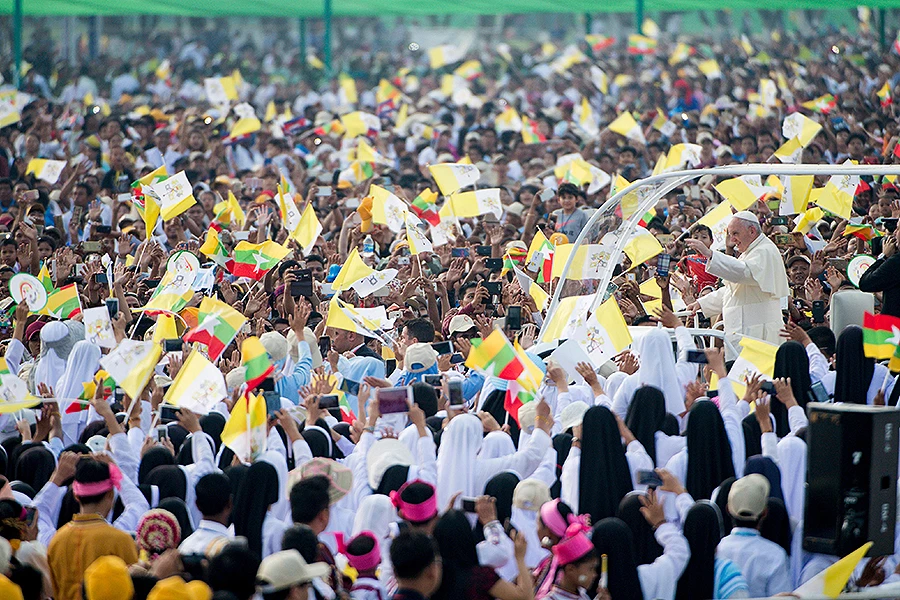
Yangon, Burma, Nov 29, 2017 / 09:46 pm (CNA/EWTN News).- The Catholic young people of Burma are “a welcome sound” of encouragement, Pope Francis told them Thursday at a Mass said at St. Mary’s Cathedral in Yangon.
“Dear young people of Myanmar … you are a beautiful and encouraging sight, for you bring us ‘good news’, the good news of your youth, your faith and your enthusiasm. Indeed, you are good news, because you are concrete signs of the Church’s faith in Jesus Christ, who brings us a joy and a hope that will never die,” Francis said Nov. 30 in the largest city of Burma (also known as Myanmar).
The Pope’s Mass with Burmese youth comes at the conclusion of his visit to the country, where he arrived Nov. 27. He also met with government officials, religious leaders, Buddhist monks, and the country’s bishops. The previous day, he said Mass in Yangon’s Kyaikkasan Ground, attended by much of the country’s Catholic population. From Burma, he will continue on to Bangladesh before returning to Rome.
“As my visit to your beautiful country draws to a close, I join you in thanking God for the many graces we have received in these days,” he stated.
“Some people ask how it is possible to speak of good news when so many people around us are suffering? Where is the good news when so much injustice, poverty and misery cast a shadow over us and our world?”
In the face of this suffering, he said it is important that the Burmese youth “are not afraid to believe in the good news of God’s mercy, because it has a name and a face: Jesus Christ. As messengers of this good news, you are ready to bring a word of hope to the Church, to your own country, and to the wider world.”
“You are ready to bring good news for your suffering brothers and sisters who need your prayers and your solidarity, but also your enthusiasm for human rights, for justice,” and for Christ’s love and peace.
The Pope’s words about solidarity, human rights, and justice come as international attention on Burma is focused on the Rohingya, a predominantly Muslim ethnic minority who have been denied citizenship and who face general persecution in the Buddhist-majority country. In recent months, more than 600,000 Rohingya have fled the country for Bangladesh amid state-sponsored violence against them.
At the same time, Pope Francis challenged his listeners with three conditions of salvation given in St. Paul’s Epistle to the Romans which was proclaimed at the Mass, and which ask us “to think about our place in God’s plan.”
“In effect, Paul asks three questions, and I want to put them to each of you personally,” he said. “First, how are people to believe in the Lord unless they have heard about him? Second, how are people to hear about the Lord unless they have a messenger, someone to bring the good news? And third, how can they have a messenger unless one is sent?”
While wanting all of his listeners “to think deeply about these questions,” the Pope offered guidance to “help you to discern what it is that the Lord is asking of you.”
First, he said, it is important to listen for God’s voice: “Our world is full of many sounds, so many distractions, that can drown out God’s voice. If others are to hear and believe in him, they need to find him in people who are authentic. People who know how to listen … But only the Lord can help you to be genuine, so talk to him in prayer. Learn to hear his voice, quietly speaking in the depths of your heart.”
“But talk also to the saints,” he added, pointing to Saint Andrew, whose feast was celebrated at the Mass. “Andrew was a humble fisherman who became a great martyr … But before he became a martyr, he made his share of mistakes, and he needed to be patient, and to learn gradually how to be a true disciple of Christ. So do not be afraid to learn from your own mistakes!”
Pope Francis urged Burma’s youth to “let the saints lead you to Jesus and teach you to put your lives in his hands. You know that Jesus is full of mercy. So share with him all that you hold in your hearts: your fears and your worries, as well as your dreams and your hopes. Cultivate your interior life, as you would tend a garden or a field. This takes time; it takes patience. But like a farmer who waits for the crops to grow, if you wait the Lord will make you bear much fruit, a fruit you can then share with others.”
The Pope then turned to young people’s need to be “messengers of the good news of Jesus, above all to your contemporaries and friends. Do not be afraid to make a ruckus, to ask questions that make people think!”
“Don’t worry if sometimes you feel that you are few and far between,” he told them, in consideration of the fact that Catholics make up only about one percent of Burma’s population. “The Gospel always grows from small beginnings. So make yourselves heard.”
<blockquote class=”twitter-tweet” data-lang=”en”><p lang=”en” dir=”ltr”><a href=”https://twitter.com/hashtag/Pope?src=hash&ref_src=twsrc%5Etfw”>#Pope</a> to young people in Yangon: “Do not be afraid to make a ruckus, to ask questions that make people think!… Make yourselves heard. I want you to shout! But not with your voices. No! I want you to shout with your lives, with your hearts, & in this way to be signs of hope…” <a href=”https://t.co/XvufBjwyhR”>pic.twitter.com/XvufBjwyhR</a></p>— Edward Pentin (@EdwardPentin) <a href=”https://twitter.com/EdwardPentin/status/936088670423019520?ref_src=twsrc%5Etfw”>November 30, 2017</a></blockquote>
<script async src=”https://platform.twitter.com/widgets.js” charset=”utf-8″></script>
“I want you to shout … with your lives, with your hearts, and in this way to be signs of hope to those who need encouragement, a helping hand to the sick, a welcome smile to the stranger, a kindly support to the lonely.”
Finally, Pope Francis discussed being sent forth at the conclusion of Mass “to take with us the gifts we have received and to share them with others. This can be a little daunting, since we don’t always know where Jesus may be sending us. But he never sends us out without also walking at our side, and always just a little in front, leading us into new and wonderful parts of his kingdom.”
To be sent by Christ is to follow him, the Pope added. “The Lord will invite some of you to follow him as priests … Others he will call to become religious or consecrated men and women. And yet others he will call to the married life, to be loving fathers and mothers. Whatever your vocation, I urge you: be brave, be generous and, above all, be joyful!”
Francis concluded by given Burma’s young people the example of Mary, who though young, “had the courage to trust in the ‘good news’ she had heard, and to express it in a life of faithful dedication to her vocation, total self-giving, and complete trust in God’s loving care. Like Mary, may all of you be gentle but courageous in bringing Jesus and his love to others.”
“Dear young people, with great affection I commend all of you, and your families, to her maternal intercession. And I ask you, please, to remember to pray for me. God bless Myanmar!”
 […]
[…]


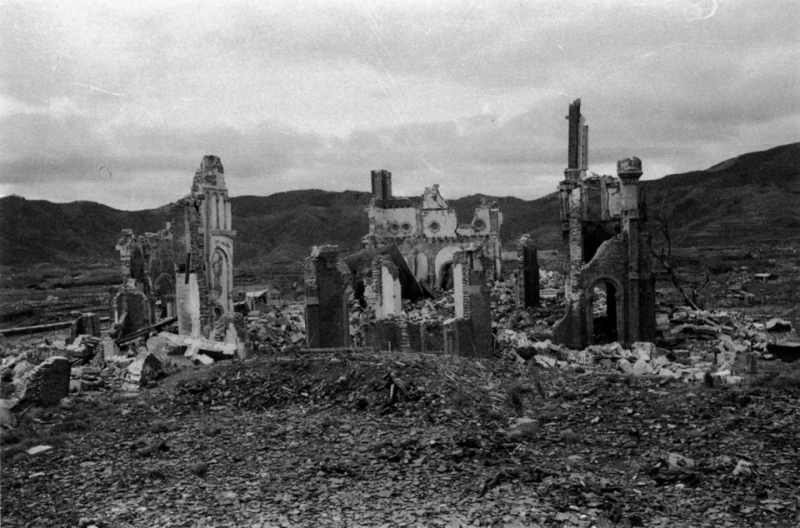


We read: “Earlier in the week, McElroy underscored the Church’s stance, reiterating Pope Francis’ categorical rejection of atomic weapons and warning that deterrence ‘is not a step on the road to nuclear disarmament but a morass’.”
Thinking about the “morass,” but also thinking how exactly to unwind a world with now seven nuclear powers—a few big ones and the rest at least capable of nuclear blackmail. Mostly Russia and then the United States, but also China, France, United Kingdom, India, Pakistan, Israel and North Korea (but no longer Iran, yet).
In 1965 and in a not entirely different context, right after the 1963 Cuban Missile Crisis and speaking for the Church as a whole, the Second Vatican Council stated that the Church has “admiration” for those who individually forego violence—without harm to others, but also asserted the right and duty for defense, and accepted “deterrence” if (!) this was a step toward nuclear disarmament, and therefore in the end stopped short of demanding a “freeze” in ownership of weapon arsenals (Gaudium et Spes, nn. 78-82).
Later in 1982, Pope John Paul II sent a compatible address to the Second Special Session of the United Nations dedicated to disarmament (Negotiation: The Only Realistic Solution to the Continuing Threat of War [Boston: St. Paul Editions, 1982]): “In current conditions ‘deterrence’ based on balance, certainly not as an end in itself (!) but as a step on the way toward a progressive disarmament, may still be judged morally acceptable” (p. 10). We’re still stepping through the morass, maybe, of the technocratic/military 20th Century—where two thirds of all deaths in both World War I and II were civilians. Yes, an “unthinkable” situation all around.
Here’s an uplifting link for the reported Nagasaki Bell Project which reached its financial donor goal on July 15 of this year, just in time for the second bell’s installation.
Yes.
Suppose you were hiking in, say, Cyprus, and you discovered you were deep inside a minefield. You phone your bishop, and condescendingly explains to you that, according to the last several Popes and articles he has read in America magazine, land mines are Bad Things and you should not linger next to them; therefore he advises you to leave by the fastest route, which is of course a straight line.
His conclusion that land mines are Bad Things was not exactly in question, and his advice to just leave in a straight line is on par with what you might expect from a 4-year-old, though not as cute. Sometimes there is no easy way out of a bad situation, and there is no substitute for dangerous work carried out by thoughtful people who have been trained for precisely this kind of situation.
Where was the article commemorating the bombing of Dresden? Oh, yeah, only nukes are sexy. More died in the firebombing of Tokyo on March 9-10, 1945, but those were only conventional bombs, and those are passé. And let’s not get into the siege of Leningrad at all, nor the sack of Jerusalem in A.D. 70. If it ain’t atomic, it’s not worth thinking about!
My point is that there is no MORAL difference between isolated atomic bombing and other ways militaries have destroyed cities — conventional bombings, sieges, or even “putting the city to the sword”.
There is at minimum a practical difference with nuclear weapons as they have existed since about 1950. What is unprecedented is the ability — and the temptation — to destroy many cities quickly. Also new is the ability to create EMPs that would eliminate power grids and most civilian equipment with an electronic component (including cars and trucks). Also, there is a real risk of nuclear winter. https://www.sciencealert.com/a-nuclear-winter-could-destroy-much-of-the-worlds-food-supply https://climate.envsci.rutgers.edu/pdf/IndiaPakistanBullAtomSci.pdf
But these considerations are for TODAY and for the future; they really have nothing to do with 1945. The only actual, historical uses of atomic weapons were not morally different from other forms of terror bombing.
Thank you for this: “My point is that there is no MORAL difference between isolated atomic bombing and other ways militaries have destroyed cities — conventional bombings, sieges, or even ‘putting the city to the sword’.”
Elsewhere I use the atomic bombings to make the case that “momentum” explains lots of seemingly complex outcomes, often more so than singling out one high-profile and even willing person (President Truman). The conveyor belt too often makes the “decision.”
Three other examples:
FIRST, of the fatal Apollo I launchpad fire (1967) and after many orange flags in the final days, the head of Mission Control (Gene Kranz) later debriefed his team by explaining: “none of us said ‘stop’. This will never happen again.” But the same thing applies to the fatal Challenger Space Shuttle Disaster in 1986…a back-room technical engineer did warn that the low ambient temperature on launch day would fracture key parts of the spacecraft outer surface (the “O-rings”) and cause the explosion. But, hey, front-room people who are really good at making the tough decisions and moving things along (momentum?) couldn’t hear. Why should managers even listen to technicians?
SECOND, take the financial collapse of 2008. For his part in the neglect (momentum?) that triggered the global meltdown beginning in the United States, the economist Alan Greenspan (chairman of the Federal Reserve, 1987-2006) explained at a Senate investigative hearing that he would have done something if someone else (!) on the board had raised an issue. Further, “I couldn’t imagine [elementary imagination!] that the banks [more business as usual] wouldn’t look out for their own self-interest.”
THIRD, about your reference to the firebombing of one-fourth of Tokyo, the death count was probably 100,000. Still less than half of the combined Hiroshima and Nagasaki. General Curtis Le May had authorized the deliberate saturation bombings. Yes, Dresden is a similar story. Overall, two thirds of all deaths in World Wars I and II were civilians.
SUMMARY: Most surely agree with your overall “point.”. So, no wonder that St. John Paul II penned the encyclical “Veritatis Splendor” (1993)—too often on the back shelf—affirming the universal natural law and, therefore, the primacy of inviolable moral absolutes over any kind of mathematics like head counts, or “proportionalism,” or “consequentialism,” or the evasive Fundamental Option. https://www.vatican.va/content/john-paul-ii/en/encyclicals/documents/hf_jp-ii_enc_06081993_veritatis-splendor.html
Bishops raising their voice against bombing is a good sign. Sensitizing and conscientizing fellow mortals from refraining from mischief is a long felt need. Long live peace and harmony.
Atom bombs have caused catastrophic damage to lives and the environment. But in the USA alone, over 60 million lives have been lost by abortion. In the entire world who can surmise the loss of lives by abortion…maybe 200 million? maybe 309 million. And yet, I dont see any of our Catholic bishops hopping around the globe protesting all these deaths. But, then again, being vocal about abortion killing isn’t fashionable for our bishops. If they did, they wouldn’t be invited to hob knob with the elitist anti-nuclear weapons crowd who love to do their safe moral posturing.
“And they were like sheep without a shepherd.”