
Rome, Italy, Feb 14, 2018 / 11:06 am (CNA).- A missionary priest and expert on the Church in China has expressed caution, and a limited optimism, about a rumored agreement between China and the Vatican on the appointment of bishops.
Fr. Bernard Cervellera is the editor-in-chief of Asia News, a media project of the Pontifical Institute for Foreign Missions, PIME.
In an interview with CNA, he said that an accord could lead to greater freedom for Catholics in the Communist country, though he questioned the Chinese communist party’s intentions, asking whether true religious freedom is possible under a regime that so far has sought to eradicate religion.
The priest stressed that if an agreement is reached, the Vatican will need to push “for more religious freedom.”
“You can’t simply deliver the Church, but there must also be more religious freedom,” he said.
Asia News covers the Church in China closely, and reported the news that in October 2017 a Holy See delegation went to China asking two bishops – Peter Zhuang Jianjian of Shantou in and Bishop Joseph Guo Xijin of Mindong– to step down in favor of government-appointed bishops.
In 1951 Beijing broke official diplomatic ties with the Vatican. Since the 1980s they have loosely cooperated in episcopal appointments, however, the government has also named bishops without Vatican approval.
The result has been an increasingly complicated and tense relationship between the government-supported Chinese Patriotic Catholic Association and the so-called “underground Church,” which includes priests and bishops who are not recognized by the government.
Many Catholics parishioners, priests and bishops who have rejected government control have been imprisoned, harassed and otherwise persecuted. Churches have also been destroyed by the Chinese government.
Currently every bishop recognized by Beijing must be a member of the patriotic association, and many bishops appointed by the Vatican who are not recognized or approved by the Chinese government have faced government persecution.
However, as part of a proposed agreement, which sources close the situation have said is “imminent” and could come to fruition as early as this spring, the Vatican is expected to officially recognize seven bishops who are out of communion with Rome, including 2-3 whose excommunications have been explicitly declared by the Vatican.
Most notably, the new deal would also apparently outline government and Vatican roles in future episcopal selection. Reportedly, the details of the deal would be similar to the Vatican’s accord with Vietnam, in which the Holy See would propose three names, and the Chinese government would choose the one to be appointed bishop.
Cervellera told CNA that the Chinese government has tended to view religions as dangerous sources of terrorism and division, which threaten societal coexistence.
For that reason, he said, making a concession for the sake of a deal is “likely the step that’s needed to show that the Church isn’t interested in overthrowing the Chinese government.”
Referring to recent statements made by Cardinal Joseph Zen, Archbishop Emeritus of Hong Kong and a leading opponent of the deal, Fr. Cervellera told CNA that “this agreement is an agreement that doesn’t ‘sell’ the Church,” but depending on how much the Vatican is willing to concede, could place the Church’s fate “completely in the hands of the government.”
Cervellera pointed to a government crackdown on religion, involving a stricter enforcement of rules which, as of Feb. 1, ban anyone under 18 from attending religious services. It’s also now forbidden to hold any sort of youth group activity, even if it’s not held at a church, he said.
Cervellera said that a fellow priest had observed that the government “has turned churches into a special type of ‘nightclub’ only for adults.”
If young people are removed from religion, he said, “you are practically condemning religions to death,” and this “was always the project of the Chinese Communist Party, always. Because the Patriotic Association was born to control religions so that little by little…they die from suffocation.”
On the other hand, he said, a deal Vatican deal with the government on appointing bishops could “facilitate the Vatican in deciding the candidates without problems, and help (with) the daily management of the Church,” he said.
But if the Vatican doesn’t insist on more breathing room, “both the official and the underground, the Church will continue being suffocated. Because what is lacking is religious freedom.”
On Monday a group of 15 influential Chinese Catholics, most of whom are from Hong Kong, wrote an open letter to bishops’ conferences around the world voicing their opposition to the deal, saying the government should have no role in choosing bishops and warned of schism should an accord be reached.
The signatories, which include Hong Kong politicians, university professors, lecturers, researchers, lawyers and human rights activists, specifically referenced the seven “illicit” bishops in question, saying “they do not have the trust of the faithful, and have never repented publicly.”
“If they were to be recognized as legitimate, the faithful in Greater China would be plunged into confusion and pain, and schism would be created in the Church in China.”
However, on Sunday, Feb. 11, Bishop Joseph Guo Xijin of the Mindong Diocese – one of the bishops asked to step down by the Vatican delegation in 2017 – said he would be willing to step aside in favor of government-backed Bishop Zhan Silu, who was formerly excommunicated by Rome.
According to the New York Times, Bishop Guo – who has placed in detention multiple times and is currently living under police surveillance – said he would respect any agreement that is reached, and that if he were presented with an official, verifiable Vatican document asking for his resignation, “then we must obey Rome’s decision.”
“Our consistent stand is to respect the deal made between the Vatican and the Chinese government,” he said, explaining that “the Chinese Catholic Church must have a connection with the Vatican; the connection cannot be severed.”
Though he would respect any deal that is reached, Guo also cautioned that there is still hesitancy on the part of Chinese authorities to let the Vatican have a final say over Catholic spiritual life, and that while they might not explicitly say the local Church has to “disconnect” from Rome, this has at times been implied.
What the Chinese authorities don’t realize, he said, is that by having the local Church cut ties with the universal Church would make Chinese Catholics “second-class believers,” because Catholics in other countries get to have a say in the rules that govern the global Church, whereas Chinese faithful don’t.
Guo said he at one point told the Chinese government that “when you restrict churches in China to contact Rome, in fact you are slapping your own face…We need to participate so that the Chinese voice” is not lost, but is heard within the universal Church.
However, despite recent crackdowns and a lingering reluctance on the part of the government, Guo said he believes restrictions on Catholics have loosened, and “the government is gradually opening up to it.”
In his comments to CNA, Fr. Cervellera said a deal would certainly make the process of choosing bishops easier, and it could open wider channels of communication with between the Vatican and the government.
“Now it’s truly complicated for the Vatican to make their needs heard to the Chinese Church,” so an agreement could make things easier, but “this doesn’t mean more free.”
Referring to rumors that the proposed deal would follow the Vietnam model, he said in this case “at least there is great assurance that the criteria in which the candidates are chosen is based on faith,” because with the patriotic association, the criteria are mainly in their own interests.
However, he voiced doubt that a deal might be as close as this spring, as authorities in the past have said multiple times that an agreement was near, but it never happened.
“I say this not because it’s pessimistic, but there are many, many problems inside the (Chinese community),” including an attitude on the part of some who don’t want an agreement.
Concerns have also been raised that should an agreement be made, it would potentially harm the Holy See’s relationship with Taiwan, as they are the island nation’s only European ally and one of only 20 countries who recognize their authority over Beijing.
On this point, Fr. Cervellera stressed that the agreement, “if it happens, is an agreement on the appointment of bishops, it’s not an agreement on diplomatic relations.”
In his view, “more time is needed” before discussing diplomatic ties between the Vatican and China.
Taiwan, he said, while having few allies, still has commercial offices all over the world, “and they are able to manage commercial relations throughout the world even without having this legal recognition from European countries. I think there will always be the possibility.”
If the Holy See lands this deal with China, “I don’t think it will be a big problem [for Taiwan],” he said, because “it’s not that the Vatican can forget about Taiwan, because it’s always a lively Church, so the Vatican must have relations with the community of Taiwan.
Overall, though skeptical, Fr. Cervellera said he hopes that if an accord is reached, it would help lead “to a greater influence of religions on Chinese society.”
A big problem Chinese society has, he said, is that it is very materialistic and lacks values, so beyond the “so-called national consciousness” that seeks to control and subordinate citizens, “there is nothing.”
“So to find a way to give spiritual values, to inflate spiritual values to give dignity to the people, this is an important task,” he said.
“I don’t know if this will happen through an agreement on the nomination of bishops. I hope, but this is certainly the mission of the Church, the entire global Church and the universal Church regarding China: to do it in such a way that Chinese development is a development inside the dignity of the human person…I hope that the Church is able to make [China] more human.”
 […]
[…]


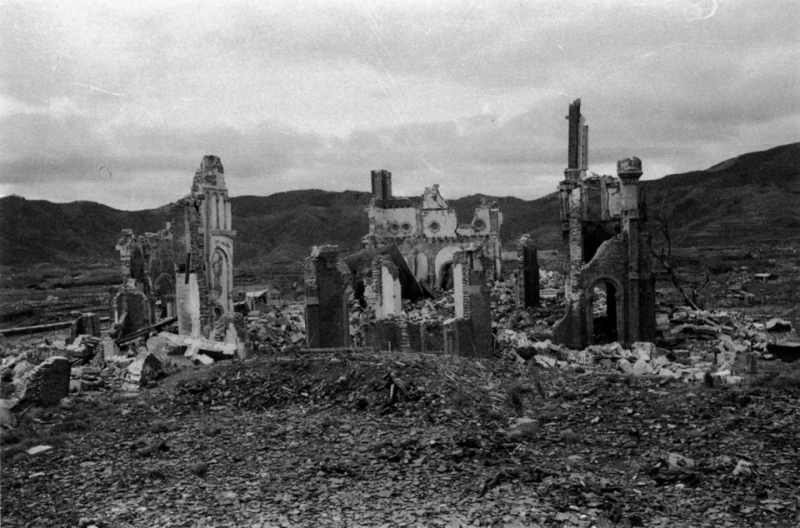


We read: “Earlier in the week, McElroy underscored the Church’s stance, reiterating Pope Francis’ categorical rejection of atomic weapons and warning that deterrence ‘is not a step on the road to nuclear disarmament but a morass’.”
Thinking about the “morass,” but also thinking how exactly to unwind a world with now seven nuclear powers—a few big ones and the rest at least capable of nuclear blackmail. Mostly Russia and then the United States, but also China, France, United Kingdom, India, Pakistan, Israel and North Korea (but no longer Iran, yet).
In 1965 and in a not entirely different context, right after the 1963 Cuban Missile Crisis and speaking for the Church as a whole, the Second Vatican Council stated that the Church has “admiration” for those who individually forego violence—without harm to others, but also asserted the right and duty for defense, and accepted “deterrence” if (!) this was a step toward nuclear disarmament, and therefore in the end stopped short of demanding a “freeze” in ownership of weapon arsenals (Gaudium et Spes, nn. 78-82).
Later in 1982, Pope John Paul II sent a compatible address to the Second Special Session of the United Nations dedicated to disarmament (Negotiation: The Only Realistic Solution to the Continuing Threat of War [Boston: St. Paul Editions, 1982]): “In current conditions ‘deterrence’ based on balance, certainly not as an end in itself (!) but as a step on the way toward a progressive disarmament, may still be judged morally acceptable” (p. 10). We’re still stepping through the morass, maybe, of the technocratic/military 20th Century—where two thirds of all deaths in both World War I and II were civilians. Yes, an “unthinkable” situation all around.
Here’s an uplifting link for the reported Nagasaki Bell Project which reached its financial donor goal on July 15 of this year, just in time for the second bell’s installation.
Yes.
Suppose you were hiking in, say, Cyprus, and you discovered you were deep inside a minefield. You phone your bishop, and condescendingly explains to you that, according to the last several Popes and articles he has read in America magazine, land mines are Bad Things and you should not linger next to them; therefore he advises you to leave by the fastest route, which is of course a straight line.
His conclusion that land mines are Bad Things was not exactly in question, and his advice to just leave in a straight line is on par with what you might expect from a 4-year-old, though not as cute. Sometimes there is no easy way out of a bad situation, and there is no substitute for dangerous work carried out by thoughtful people who have been trained for precisely this kind of situation.
Where was the article commemorating the bombing of Dresden? Oh, yeah, only nukes are sexy. More died in the firebombing of Tokyo on March 9-10, 1945, but those were only conventional bombs, and those are passé. And let’s not get into the siege of Leningrad at all, nor the sack of Jerusalem in A.D. 70. If it ain’t atomic, it’s not worth thinking about!
My point is that there is no MORAL difference between isolated atomic bombing and other ways militaries have destroyed cities — conventional bombings, sieges, or even “putting the city to the sword”.
There is at minimum a practical difference with nuclear weapons as they have existed since about 1950. What is unprecedented is the ability — and the temptation — to destroy many cities quickly. Also new is the ability to create EMPs that would eliminate power grids and most civilian equipment with an electronic component (including cars and trucks). Also, there is a real risk of nuclear winter. https://www.sciencealert.com/a-nuclear-winter-could-destroy-much-of-the-worlds-food-supply https://climate.envsci.rutgers.edu/pdf/IndiaPakistanBullAtomSci.pdf
But these considerations are for TODAY and for the future; they really have nothing to do with 1945. The only actual, historical uses of atomic weapons were not morally different from other forms of terror bombing.
Thank you for this: “My point is that there is no MORAL difference between isolated atomic bombing and other ways militaries have destroyed cities — conventional bombings, sieges, or even ‘putting the city to the sword’.”
Elsewhere I use the atomic bombings to make the case that “momentum” explains lots of seemingly complex outcomes, often more so than singling out one high-profile and even willing person (President Truman). The conveyor belt too often makes the “decision.”
Three other examples:
FIRST, of the fatal Apollo I launchpad fire (1967) and after many orange flags in the final days, the head of Mission Control (Gene Kranz) later debriefed his team by explaining: “none of us said ‘stop’. This will never happen again.” But the same thing applies to the fatal Challenger Space Shuttle Disaster in 1986…a back-room technical engineer did warn that the low ambient temperature on launch day would fracture key parts of the spacecraft outer surface (the “O-rings”) and cause the explosion. But, hey, front-room people who are really good at making the tough decisions and moving things along (momentum?) couldn’t hear. Why should managers even listen to technicians?
SECOND, take the financial collapse of 2008. For his part in the neglect (momentum?) that triggered the global meltdown beginning in the United States, the economist Alan Greenspan (chairman of the Federal Reserve, 1987-2006) explained at a Senate investigative hearing that he would have done something if someone else (!) on the board had raised an issue. Further, “I couldn’t imagine [elementary imagination!] that the banks [more business as usual] wouldn’t look out for their own self-interest.”
THIRD, about your reference to the firebombing of one-fourth of Tokyo, the death count was probably 100,000. Still less than half of the combined Hiroshima and Nagasaki. General Curtis Le May had authorized the deliberate saturation bombings. Yes, Dresden is a similar story. Overall, two thirds of all deaths in World Wars I and II were civilians.
SUMMARY: Most surely agree with your overall “point.”. So, no wonder that St. John Paul II penned the encyclical “Veritatis Splendor” (1993)—too often on the back shelf—affirming the universal natural law and, therefore, the primacy of inviolable moral absolutes over any kind of mathematics like head counts, or “proportionalism,” or “consequentialism,” or the evasive Fundamental Option. https://www.vatican.va/content/john-paul-ii/en/encyclicals/documents/hf_jp-ii_enc_06081993_veritatis-splendor.html
Bishops raising their voice against bombing is a good sign. Sensitizing and conscientizing fellow mortals from refraining from mischief is a long felt need. Long live peace and harmony.
Atom bombs have caused catastrophic damage to lives and the environment. But in the USA alone, over 60 million lives have been lost by abortion. In the entire world who can surmise the loss of lives by abortion…maybe 200 million? maybe 309 million. And yet, I dont see any of our Catholic bishops hopping around the globe protesting all these deaths. But, then again, being vocal about abortion killing isn’t fashionable for our bishops. If they did, they wouldn’t be invited to hob knob with the elitist anti-nuclear weapons crowd who love to do their safe moral posturing.
“And they were like sheep without a shepherd.”