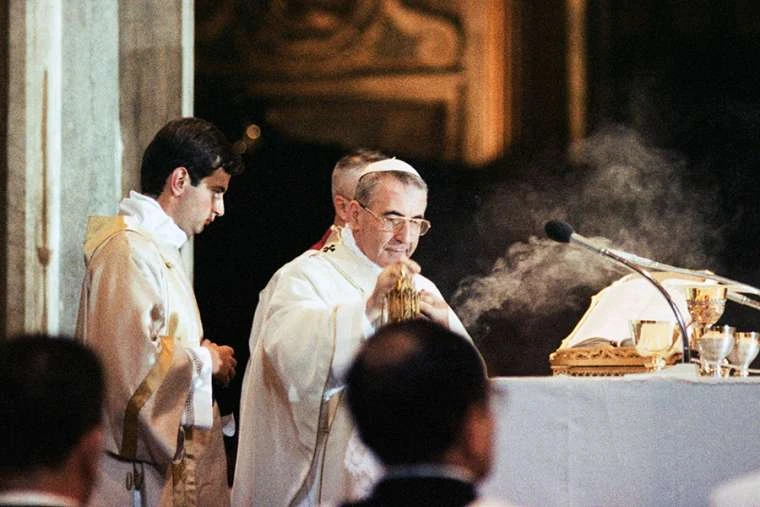
Vatican City, Nov 17, 2017 / 03:01 am (CNA/EWTN News).- Last week Albino Luciani, better known by his papal name, John Paul I, took the next step on the path to sainthood. Yet apart from the fame garnered by various theories that sprouted due to the enigmatic nature of his death, for many little is known of his saintly life and brief pontificate.
Born Oct. 17, 1912, in Italy’s northern Veneto region, Albino Luciani, known also as “the smiling Pope,” was elected Bishop of Rome Aug. 26, 1978. He made history when he became the first Pope to take a double name, after his two immediate predecessors, St. John XXIII and Bl. Paul VI.
He sent shock waves around the world when he died unexpectedly just 33 days later, making his one of the shortest pontificates in the history of the Church.
In addition to the novelty of his name and the surprise of his death, Luciani was also the first Pope born in the 20th century, and is also the most recent Italian-born Bishop of Rome.
Yet behind all the novelty of the month before his death and mystery of those that ensued, John Paul I has been hailed as a man of heroic humility and extraordinary simplicity, with a firm commitment to carrying forward the reforms of the Second Vatican Council and a knack for explaining complicated Church concepts in a way everyone can understand.
Life and background
Coming from a northern region in Italy that borders Austria, Luciani grew up with people from all cultures and backgrounds passing through. The area saw high levels of immigration and strong activity on the part of Catholic movements.
The priests around whom Luciani grew up had a keen social awareness and involvement with the faithful.
While all the basic needs of his family were met, Luciani grew up in relative poverty, with his father gone most of the time for work. However, according to Stefania Falasca, vice-postulator of his cause for canonization, this background gave the future Pope “a huge cultural suitcase” that he was able to bring with him in his various endevours.
Ordained a priest of the Diocese of Belluno e Feltre July 7, 1935, at the age of 22, Luciani was rector of the diocese’s seminary for 10 years. He taught various courses throughout his tenure, including dogmatic and moral theology, canon law, and sacred art.
In 1941 he received a dispensation from Ven. Pius XII to continue teaching while pursuing his doctorate in Sacred Theology from the Pontifical Gregorian University.
He was named Bishop of Vittorio Veneto by St. John XXIII in 1958.
In 1969 he was named Patriarch of Venice by Bl. Paul VI. He was elevated to the cardinalate in 1973, and was elected Bishop of Rome five years later.
Literature also played a key role in Luciani’s formation. According to Falasca, he had a library full of books in different languages and a special fondness for Anglo-American literature.
Though he knew English, French, German and Russian, his favorite authors were from the Anglo world, and included authors such as G.K. Chesterton, Willa Cather, and Mark Twain.
As cardinal, he wrote his own book called “Illustrissimi,” which is a series of letters penned to a variety of historical and fictional persons, including Jesus, King David, Figaro the Barber, Austrian Empress Maria Theresa Habsburg, Pinocchio, Mark Twain, Charles Dickens, and Christopher Marlowe.
Luciani, Falasca said, was considered by Paul VI to be “one of the most advanced theologians” of the time, and was held in high esteem because he not just knew theology, but also knew how to explain it.
The clarity he had was “highly considered right away among the Italian bishops,” she said. “He was considered the brightest pen because of this ‘cultural suitcase,’ which knew how to synthesize in a very delicate writing, but clear and full of references.”
Luciani, she said, had “an ease of language” in his writing, which was coupled with “a solid theological preparation,” making him both credible and accessible.
Pontificate – ‘an Apostle of the Council’
John Paul I above all else was “a son of the Council,” Falasca said. Luciani “translated and communicated the directives in a natural and simple way … So he was an apostle of the Council in this sense.”
“He explained it, he put it into practice, he put the directives into action in a crystalline way.” It was this desire to carry the Council forward that formed the basis for his priorities during his 33 days in office.
Among these priorities was a “renewed sense of mission” for the Church, Falasca said, explaining that for Luciani, to accomplish this mission it was important “to go back to the sources of the Gospel.”
“This, you can say, was the meaning of the Council for Luciani.” And for him, going to the sources also meant “communicating the Gospel in simplicity and conforming his ministry” to it.
In addition to mission, John Paul I also placed a special emphasis on spiritual poverty in the Church and the search for peace and ecumenism.
Ecumenism and dialogue in particular are topics Luciani felt were “a duty that is part of being a Christian.”
Collegiality also was another key topic for Luciani, and it was the subject of his only written intervention during the Council, which he contributed in 1963.
Luciani also placed a strong emphasis on mercy, Falasca said, explaining that in many ways he was “was the Pope of mercy ‘par excellence,’” and was known for his warm and friendly demeanor.
These priorities can be clearly seen in the four general audiences John Paul I gave during his pontificate, with the subjects being poverty, faith, hope, and charity.
And the way he spoke about these and other topics, with “the simplicity of his approach (and) of his language,” left “an indelible memory in the People of God,” Falasca said.
John Paul I, she said, moved people with his naturalness and his ordinary way of speaking to the faithful.
Luciani had put this quality into writing long before his pontificate when in 1949, he published his first book, titled “Catechesis in Crumbs,” which focused on how to teach the essential truths of the faith in a simple and direct way, understandable to everyone.
Death
When John Paul I died 33 days after his election, his sudden and unexpected death led to various conspiracy theories that Luciani had been murdered.
However, in a book titled “John Paul I: The Chronicle of a Death” and published Nov. 7 to coincide with the announcement that Luciani’s sainthood cause was moving forward, Falasca dispels the theories by outlining the evidence gathered on John Paul I’s death while researching for his cause.
In the book, she recounts how the evening before his death Luciani suffered a severe pain in his chest for about five minutes, a symptom of a heart problem, which occurred while he was praying Vespers with his Irish secretary, Msgr. John Magee, before dinner.
The Pope rejected the suggestion to call for a doctor when the pain subsided, and his doctor, Renato Buzzonetti, was only informed of the episode after his death.
Heroic Virtue
Luciani’s prime virtue was humility, which is “the base without which you can’t go toward God.” Humility, Falasca said, “was so embedded in him, that he understood it as the only way to reach Christ.”
Luciani’s connection with the Lord was also evident in the way that he spoke about God, she said, explaining that he was able to make the love of God close to people, and felt by them.
Falasca said she believes he is an ideal model of the priesthood. To this end, she recalled how during her time working on Luciani’s cause, many young priests came to her saying they felt the call of their vocation when they saw his election on TV.
Another sign of his sanctity was the “spontaneous reputation” that grew over time, and is a “distinctive sign” in determining the heroic virtue of a person.
“The reputation for holiness is the condition ‘sine quo non’ (without which it could not be) to open a cause of canonization; there must be a reputation,” she said, and “Luciani enjoys much of it, and he enjoys it not in an artificial way.”
Many people pray to him and have continued to travel to his birth town over the past 40 years, she said, because people are attracted “by his charm.”
“He won over many with his stand in the face of contemporaneity, his closeness to the people of his time with that simplicity and with that familiarity of communication.”
Luciani opened “a new season in being and in the exercise of the Petrine ministry…with his charm, which knew how to conjugate in perfect synthesis, in my view, what was old and what was new.”
He also lived an extraordinary sense of poverty of spirit as seen in the Beatitudes, and had an “extreme fidelity to the Gospel in the circumstance and the status that he embraced.”
In a testimony given for documentation in the Luciani’s cause for canonization, Benedict XVI said that when Luciani appeared on the balcony in his white cassock after his election, “we were all deeply impressed by his humility and his goodness.”
“Even during the meals, then, he was took a place with us. So thanks to a direct contact we immediately understood that the right Pope had been elected.”
Benedict XVI’s testimony regarding John Paul I is four pages long and is one of the documents included in Falasca’s book. In her comments to CNA, she said they had originally planned to interview him in 2005 while he was still a cardinal, but he was elected Pope on the same day he was scheduled to speak, and since a Pope is technically the one judging a saints’ cause, he is not allowed to give testimony for it.
However, there are currently no previsions for a retired Pope, so when Benedict XVI resigned in 2013, Falasca and her team advancing Luciani’s cause reached out again, receiving the testimony that has now been published in her book.
In his testimony, Benedict recalled that he first met Luciani while the latter was Patriarch of Venice. He had decided to visit the seminary in Bressanone with his brother, Msgr. Georg Ratzinger, for vacation in August 1977, shortly after becoming a bishop.
Luciani came to visit the brothers after learning of their visit, and to go out of his way to do this in the oppressive heat of August “was a expression of a nobility of spirit that went well beyond usual,” Benedict wrote. “The cordiality, simplicity and goodness that he showed to me are indelibly impressed in my memory.”
Benedict said he was shocked when he received news of John Paul I’s death in the middle of the night and didn’t initially believe it, but slowly accepted the news in Mass the next day, during which the celebrant offered prayer for the “deceased Pope John Paul I.”
Speaking of John Paul I’s pontificate, Benedict noted that in 1978 it was evident that “the post-conciliar Church was passing through a great crisis, and the good figure of John Paul I, who was a courageous man on the basis of faith, represented a sign of hope.” And this figure, he said, still represents “a message” for the Church today.
Benedict also noted that during the various public speeches Luciani gave, whether it was a general audience or a Sunday Angelus, the late Pope “spoke several times off-the-cuff and with the heart, touching the people in a much more direct way.”
Luciani often called children up to him during general audiences to ask them about their faith, Benedict said, explaining that “his simplicity and his love for simple people were convincing. And yet, behind that simplicity was a great and rich formation, especially of the literary type.”
So far hundreds of graces and favors have been recorded for those who pray to Luciani, and there are already two miracles being studied and considered for his beatification and eventual canonization. Falasca said they are currently trying to decide which to present first.
 […]
[…]



 By
By 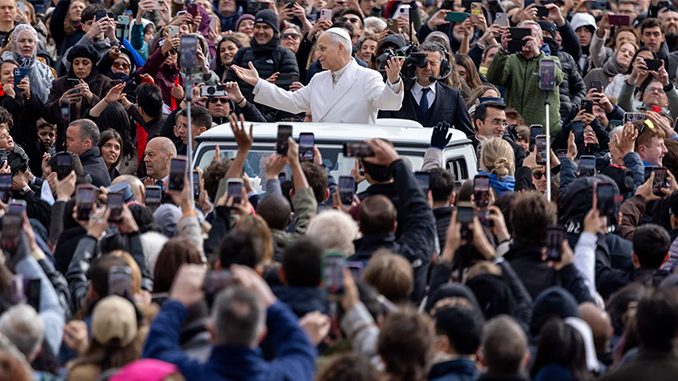

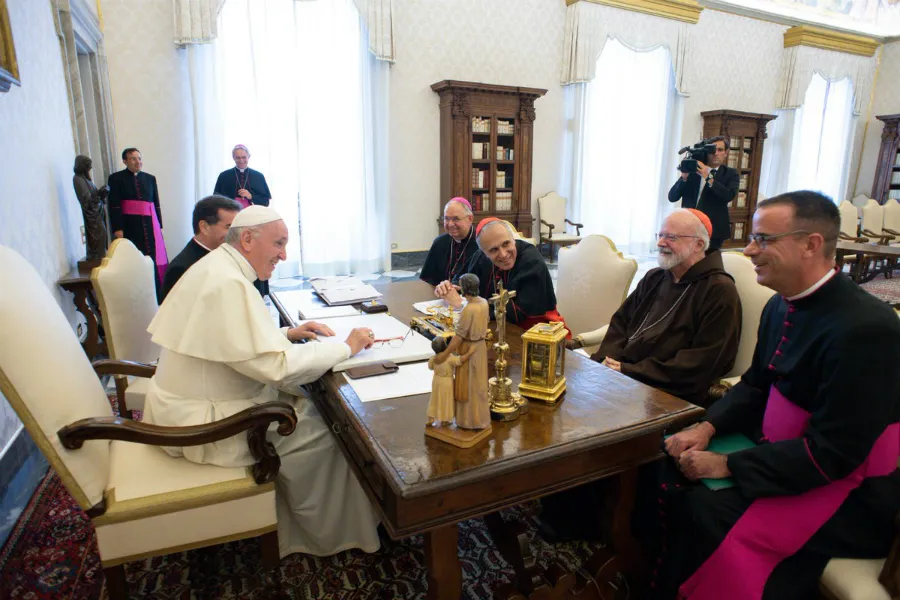

What State was St. Peter the first Pope the head of? And, since the Pope is the Vicar of Christ, where was Jesus’ State?
The Vatican State is not a theologically necessary componemt of the Papacy, it is a practically useful one, as it keeps the Pope relatively clear of being strongarmed by the temporal rulers of Rome. Early Church history shows a fair amount of that, including physical threats to the Pope, exile, and the like, from the Roman Emperor on numerous occasions – after the Emperor was Christian. Not that politics or persecution will ever go away completely, but there are advantages to toning down their influence.
“Not that politics or persecution will ever go away completely,”
China.
Danced with wind and danced with fire
Killed the truth and called the liar
Bleeding in its mystery when the moon began to fall
Dreamers are not all they seem
Sleeping in her silent dream
She locks it all inside and hides it all away
China, China
Calling out to history
Is that the way it will always be?
China, China…
“China” Red Rockers 1983
This piece unwittingly confirms a bad trend of Francis and Leo: the official papal spokesman says the job of the pope as head of the Church/Christianity is to ‘invite the world to higher principles of justice and fraternity?’ Noooo. It’s to proclaim the gospel and invite people to follow Christ, to repent, convert, etc., especially non-christians, such as muslims. And the article’s author blindly adopts and repeats this sad description.
“the article’s author blindly adopts and repeats”
I’d like to be able to say that’s a peculiar feature of this article, or even this author, but it seems to be an a rather consistent feature of EWTN News of late. They really need fewer credulous stenographers.
If the Papacy and some of our short-sighted Catholic faithful insist on hitching the Church’s wagon to a temporal State like any other run of the mill country, they haven’t considered one reality. That is, when radical Islam fully overruns Europe and take control of governments, culture and society at large, their intention very unmistakably will be to eliminate the Vatican City-State altogether. If the Pope or anyone else think their intentions lie elsewhere, they are fools of the worst order and are ignorant of history and haven’t picked up a newspaper in years (admittedly ‘picking uo a newspaper’ is an anachronism).
Jesus is head of the Kingdom of God.
And your point is? You write in riddles.
Diogenes: no riddle at all. Jesus does rule in hearts not geography. He is “Christ the King” that the Church celebrates.
Now I understand and agree wholeheartedly.
The head of the Catholic Church is Jesus Christ. The pope should remember that.
Romystree :With all due respect, what makes you think that the Pope does not remember that Jesus is the head of the Church? Quite a presumption on your part!
Because other Popes clearly have not understood it, it is a useful reminder to this Pope or any other Pope.
Perhaps it was Divine Providence that made the Vatican a State in 1929. It has given the Pope a place on the world stage equal to that of the most influential and powerful nations. It allows him to speak in parliaments and congress and even the United Nations, and is given the opportunity to address moral issues on the World Stage. It also allows him to weigh in on mediation of belligerent conflicts. I do not understand why some Catholics are bothered by this and think he should stick to strictly Church issues.
James Connor: For the simple reason that when the leaders of our Catholic faith start acting like: kings, prime ministers, presidents, etc they are operating in the realm of politics which has the potential of compromising the very mission of the Church which is to proclaim Christ. We’ve had recent Popes who do NOT proclaim Christ at all times and in fact Francis issued major documents that hardly even made reference to Christ.