


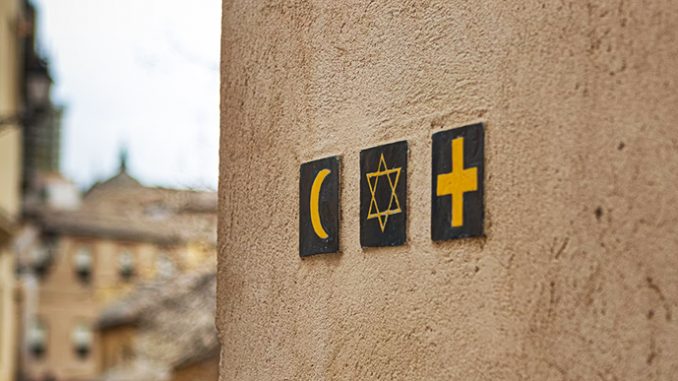
In June, the writer, producer, and nonprofit founder Ashley L. Jackson converted to Judaism. That fact itself is somewhat unusual, as only somewhere between 2,000 and 5,000 Americans convert to the Jewish faith every year. Also unusual is Jackson’s patrimony: she’s the daughter of Baptist minister and Democratic politician Jesse L. Jackson, who died earlier this year at age eighty-four.
Yet reading Ms. Jackson’s testimonial reveals far more about the modern politicization of religious faith than it does what we would consider the traditional religious conversion, reflecting a paradigmatic change in worldview and how to conceive reality.
The irony and disconnect
Though Ms. Jackson makes no reference to it in her op-ed, there is a certain irony to the daughter of Rev. Jackson converting to the Jewish faith. In 1984, Rev. Jackson called New York City “Hymietown” and used the slur “Hymie” to describe Jews. (He later apologized for his “Hymie” remarks and sought to make amends with the Jewish community). According to his daughter Ashley, he fully supported her conversion to Judaism. “My father sat in the front row — holding my hand, dancing to prayers in a language he did not speak, eating the Sunkist candies the congregation had tossed to celebrate a bar mitzvah,” she wrote. Towards the end of the service, she notes, Rev. Jackson wept.
One would think, based on Ms. Jackson’s religious upbringing—her father was, after all, a Baptist minister, who presumably encouraged her to have a personal relationship with Christ—that her conversion story would offer a robust argument in favor of the Jewish faith. And yet that is curiously absent. “In that [Jewish] community, I recognized myself, and over time, we became bound to one another,” she writes:
The ethical language of my childhood was shaped by a Black prophetic tradition that responded to dehumanization with an unyielding insistence on the sanctity of life. Judaism supports this struggle for dignity, affirming that whoever destroys a single soul destroys an entire world, and that whoever saves one saves an entire world. Both traditions tell a liberation story that begins with a particular people but does not end there.
A singularly political conversion story
And that, dear readers, is more or less it. Reflecting on the bond shared by Black and Jewish Americans, Ms. Jackson writes: “Amid widespread concerns about antisemitism and anti-Blackness, it is necessary to recall that our differences do not preclude unity.” Ethics, protecting the sanctity of life, championing dignity and liberation, and combating antisemitism and anti-Blackness—these are the things that drew her to the Jewish faith.
Now, granted, what Ms. Jackson describes are good things, of course (though one wonders, does Ms. Jackson include the unborn in her comment about “the sanctity of life)? Worldly justice is an outworking and effect of religious faith, rather than its warp and woof. “Justice is the moral virtue that consists in the constant and firm will to give their due to God and neighbor,” says the Catechism (CCC 1807). “The principle of solidarity, also articulated in terms of ‘friendship’ or ‘social charity,’ is a direct demand of human and Christian brotherhood” (CCC 1939).
Startlingly absent from her narrative is any mention of Jesus. Did she stop believing he was the Messiah, the incarnate Son of God? Did she come to believe that Judaism, not Christianity, represented the most coherent and authentic conception of God and His relationship to the world?
In sum, Jackson’s conversion reads like a decidedly political decision, rather than a religious one. Ironically enough, despite many Americans’ aversion to mixing politics and religion—based on a faulty conception of Thomas Jefferson’s (extra-constitutional) discussion of the separation of church and state—this is actually where many feel most comfortable talking about religion. Indeed, Jackson’s description of religion as being good in exclusive this-worldly language concerned with political and cultural phenomena is emblematic of a broader trend in contemporary Western discourse.
Our political and cultural Christian moment…
Perhaps most famous, Richard Dawkins, one of the notorious “four horsemen” of the New Atheism, attracted headlines a few years ago for his appreciation of cultural Christianity.
“I do think that we are culturally a Christian country, and I call myself a cultural Christian,” he declared. “It [Christianity] seems to me to be a fundamentally decent religion, in a way that I think Islam is not,” he added.
“To live in a Western country is to live in a society still utterly saturated by Christian concepts and assumptions,” asserted historian Tom Holland in his popular recent book Dominion. “No one rejects the concept of human rights… but when you ask, ‘Where did you get that idea from and why do you believe in them?’ it is ultimately as theological an idea as believing that Jesus Christ was raised from the dead on the third day…” he has said elsewhere.
Psychologist Jordan Peterson, who has written books and taught courses analyzing the Bible within a largely Jungian framework, has similarly praised Christianity’s cultural and political contributions. “It’s very difficult to overestimate how fundamental the biblical stories are. They’re the pillars upon which Western civilization rests, for better or for worse. I happen to be a big fan of Western civilization; I think it beats the hell out of tyranny and starvation,” he stated.
All of this seems to give the impression that religion, and even specifically Christianity, is experiencing a revival of sorts.
None of this is necessarily wrong. Western civilization is deeply influenced by, and even incomprehensible, without understanding and appreciating Christianity. And even if I were not a religious person, I would certainly prefer to live in a historically Christian society than one that is, say, Muslim, Buddhist, or something else. From a Catholic perspective, the reason many people feel this way is in large part derived from the fact that there is a natural law, which, if followed, results in happier and more beautiful civilizations, because it accords with what humans need to flourish on a natural level.
And Christianity, and especially Catholicism, is the religious tradition that best manifests the natural law.
…is incomplete, vacuous, and untenable
But an admiration for the political and cultural benefits of Christianity is also incomplete. Because we have eternal souls, we need the transcendent. We were made for more than simply living in a neighborly, charitable manner or to admire beautiful, man-made things. We were made to worship, to direct our entire life towards the eternal, not simply to enjoy “fulfilled” lives.
Thus, any discussion of religion that celebrates Christianity (or Judaism, for that matter, in Ms. Jackson’s case) in strictly cultural or political terms is a conception of faith that lacks true vitality. It is, in a sense, trying to live off the fumes of something that is dying, which much of Western civilization is, severed as it is from its life-giving source, namely Christ and His Church. “The real power of belief comes from being an active member of a faith community for a long period of time,” writes Washington University professor Ryan Burge, not simply “vibes” that religion retains a unique power to shape and define a society such as America.
I would go even further than Burge, and say that the real power of belief stems from the grace of God intervening in human affairs to transform us in ways that, ultimately oriented towards the eternal, but which have “side-effect” blessings upon this world as we grow in holiness and virtue. People simply acknowledging that the Christian Faith results in objective goods but keeping Christianity at arms-length is not the same thing as actually preserving and extending those objective goods in a society. It is akin to expressing appreciation for the craftsmanship of the ship as it slowly sinks in rough ocean waters, rather than actively working to keep it afloat.
I don’t know how Ashley L. Jackson came to terms with giving up her Christian upbringing for the Jewish faith, given that these two belief systems are in many respects incompatible. One recognizes Jesus as the Messiah and the Son of God; the other does not. Yet I think I understand why her conversion story focuses exclusively on politics. It’s the vapid, ultimately untenable way we’ve come to “respect” religious faith in the contemporary West: by political ideology celebrating this-worldly goods that subsume or supplant religious dogma that directs our hearts, minds, and totality of our lives heavenward.
If you value the news and views Catholic World Report provides, please consider donating to support our efforts. Your contribution will help us continue to make CWR available to all readers worldwide for free, without a subscription. Thank you for your generosity!
Click here for more information on donating to CWR. Click here to sign up for our newsletter.

Leave a Reply