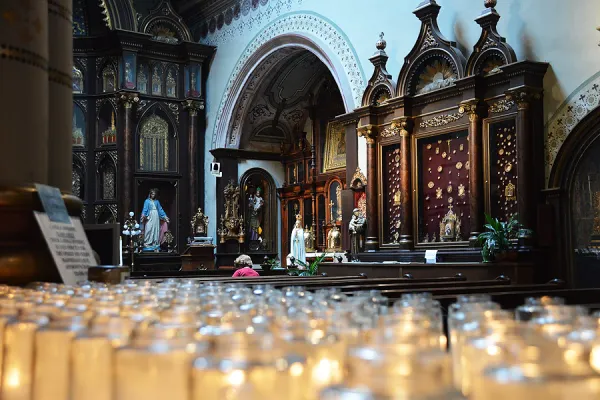
Pittsburgh, Pa., Apr 10, 2020 / 09:00 am (CNA).- Nestled in a sleepy neighborhood in the hills rising over Pittsburgh lies a small chapel. Inside St. Anthony’s Chapel lies a piece from the Crown of Thorns, a tooth of St. Anthony of Padua, and more than 5,000 other verified relics, or remains, of saints from around the world.
Indeed for the fragments from the bodies and scraps of the belongings of countless saints, these relics continued to have earthly adventures long after the saints’ deaths. Many of the relics traveled across the world to escape war, confiscation, and desecration to make it into the safe hands of a Belgian-born physician and priest, Fr. Suitbert Mollinger, who founded the chapel.
The chapel now holds the largest collection of relics outside of Rome.
“Fr. Stewart Mollinger, well, he had an unusual hobby in which he liked to acquire relics of the saints,” Carole Brueckner, chairperson of the committee for St. Anthony’s Chapel, explained to CNA.
But in the midst of the political and social turmoil which Europe experienced at the end of the 19th century, this curious hobby was crucial to saving relics from across the continent.
Since the second century, Catholics have honored the relics of saints- either pieces of body parts or cherished belongings of holy men and women. While theologians and Church documents clarify that relics are not to be worshiped, nor do they hold magical powers, the teaching adds that relics must be treated with respect, as they belong to persons now in heaven. While relics do not have power in and of themselves, God can continue to work miracles in the presence of the saint’s body even after death, the Church teaches. Relics are present in, or below, many Catholic altars.
Because of their important place in Catholic devotion as well as their presence at Mass, relics became a target of anti-Catholic persecution in Europe.
“It was a very chaotic time, in a sense, for Catholics, because people were fighting for territories and countries,” Brueckner said. During the mid- to late- 19th century the political boundaries – and also religious identities – of regions across Europe shifted as the modern nation-states of Germany, Italy, France, and Belgium formed, the power of the nobility and the Church ebbed, and secular governments arose.
Many nobles and religious “were afraid that their governments or the monarchies under which they lived would commit and confiscate the relics from them,” she explained. In some regions, Brueckner continued, authorities even “desecrated the relics and on occasion they would put someone in prison for having a relic in their possession.”
“Due to what was happening in Europe, this was an opportune time for Father to enrich upon his own personal collection of relics of the saints,” she elaborated. While it is forbidden for Catholics to sell or purchase relics, Fr. Mollinger was loaned or granted relics from friends in his home country of Belgium, as well as from his travels in the Netherlands, Italy, and elsewhere.
“Many times, his friends, who are also religious, would write and ask him if he could take some of their relics and keep them in safekeeping, until their countries or monarchies became stable, and Father always responded ‘yes’,” she explained. “Father also had agents that he had throughout Europe that were looking for the relics, because in essence, he would try to rescue them from being destroyed by governments and monarchies that existed in Europe at this time.”
Initially, Fr. Mollinger kept the growing relic collection in his rectory. Medical patients as well as faithful Catholics would visit the doctor-priest for both spiritual and physical treatment, and “they had the opportunity to venerate them those relics when they were there.”
Many pilgrims, Brueckner said, “were cured of their anomaly or disability” after receiving physical or spiritual aid in the presence of the relics. As a result, “Father was gaining the reputation as a priest-physician-healer,” she elaborated. Records of local Pittsburgh newspapers of the time documented Fr. Mollinger’s treatments, as well as the thousands of people who traveled to venerate the relics.
Fr. Mollinger, however, “thought they belonged in a beautiful church so that everybody could visit and venerate the relics,” and thus built with his own funds a chapel to house them.
The first section of the chapel was completed on the feast of St. Anthony in 1883, and houses the thousands of relics collected by Fr. Mollinger at the time. The second section was also completed on the feast of St. Anthony, nine years later in 1892, and contains the Stations of the Cross and relics collected after the chapel’s completion. Fr. Mollinger died two days after the last section of the chapel was completed.
Among the relics the chapel currently claims are splinters from the True Cross and the Column of Flagellation; stone from the Garden of Gethsemane; a nail that held Christ to the Cross; material from Jesus, Mary and Joseph’s clothing; a “piece of bone from all of the apostles”; and relics from St Therese of Liseux, St. Rose of Lima, St. Faustina, St. Kateri Tekawitha.
“If I had to name all the saints, we’d be here forever,” Brueckner exclaimed.
Nearly all these relics have been verified, as well.
“When a relic is placed within that reliquary, it is sealed and it can never be opened again,” Brueckner said, explaining that the Church’s strict rules guard against tampering and forgery of relics. “For a relic to be venerated, you do need to have a document, and the document comes from the hierarchy in the Church. That document will tell you who the saint is, what the relic is, and it is saying that the Catholic Church has done their research and we can say what the relic is.”
“We do have the certificates of authenticity for almost all of our relics here within the chapel.”
While belief in the authenticity of the relics relies on a trust that “the Catholic Church has done their research, and I’m going to believe what the Catholic Church is saying,” Brueckner said, visitors still experience the same presence documented by the first pilgrims to the collection of saintly relics. “Many times when people come into the chapel they will say that they actually feel a presence.”
“I say that it’s like stepping into a little piece of heaven, because you are surrounded by so many people that our Church tells us are in heaven,” she remarked.
This story was originally published on CNA Aug. 20, 2015.
 […]



This is discusting. Mandatory reporting of abuse would have saved many children. The practice of Confession is not an original tenet of the church. Human life is more important then ANY church doctrine.
This is why many of us are leaving the Catholic church and religion altogether.
Miss Sherry do you believe that someone would confess those crimes to a priest knowing they would be reported to law enforcement?
The fact is that the Constitution guarantees the free practice of religion just as it guarantees the right of a fair trial. This isn’t a religious issue. It’s constitutional. If you can confess your crimes to your lawyer without fear of those facts being revealed then you can do the same in the confessional. This is your right. Other people aren’t protected because for them it isn’t a constitutional issue.
Also, I wasn’t aware that you were capable of reading the minds of all Catholics in order to determine the reasons why they are leaving the Church. Perhaps you took a poll? It’s my opinion that neither apply. You’re just guessing.
To Sherry Speer: Let us take this apart a little and see how this law will protect no one. The seal of the confessional assures every penitent that his admission of sin to God and his plea for forgiveness from God will remain between the penitent and God. That promise encourages each of us to receive that grace needed to receive the Body and Blood of Christ in Communion with His Church (the Mystical Body of Christ) on earth. That is why priests are bound to keep that seal under penalty of excommunication. If this law takes affect two things likely would result. People will fear going to confession and thereby put their own souls in jeopardy fearing that if the State can do this for child abuse it can start listing virtually all crimes. That is a crime against everyone’s right to practice their faith.
Now consider a child abuser who legitimately is remorseful for his sins and first seeks spiritual counsel in the Confessional where by the priest can give serious counsel to the penitent and even withhold absolution (which is not guaranteed anyway if one is not repentant at all) until the penitent promises to report himself (or herself) to the authorities to make amends. Knowing that possibility the penitent might never go to confession at all. If he does go he might seek the anonymity in the confessional where the voices are muffled and the penitent cannot be seen. If the priest does not know the penitent he cannot report anything but he can still do hid best to press the penitent to confess to proper authorities.
Now, if the priest does know the identity of the penitent and chooses obedience to his priestly vow he risks going to prison himself. Remember, that this scenario can easily be staged as a trap by secular authorities who would tape a fake confession just to see what the priest will do with info. That risks losing a priest to prison. If the priest breaks the seal and reports what he was told to the authorities he breaks his solemn vow as a priest and risks excommunication or at least his priestly orders. Either way we would all be losing priests. That is the ultimate aim of Satan who remains ever so active in our world. Cunning, baffling and powerful he is. The law will serve no one but the Devil himself. And remember that if this comes about it will be the beginning of the end for ALL people of any faith as the government will be free to ursurp the God given rights to all of us to follow our faith as God leads us even if we don’t believe in God.
One last issue that you raise that I am sad does not get more attention than it deserves. Bearing in mind again the Church is the Mystical Body of Christ on earth. We are members of that Body thru our Baptism in Christ though we be all sinners in search of need of forgiveness. While child abuse and the horrific abuse by many against others remain tragic crimes against humanity they are ultimately sins against the very Body of our Lord Jesus Christ. We should be upset and appalled by those horrific sins but leaving the Church because of them is abandoning the victim who is Christ. Again, I am not saying that lawmakers are demonic but I am say we all are at risk for falling into the play of Satan war against God. Please pray for our Holy Catholic Church and all who suffer and sin in it.
The excellent Bishop Barron. A blessing to the church!