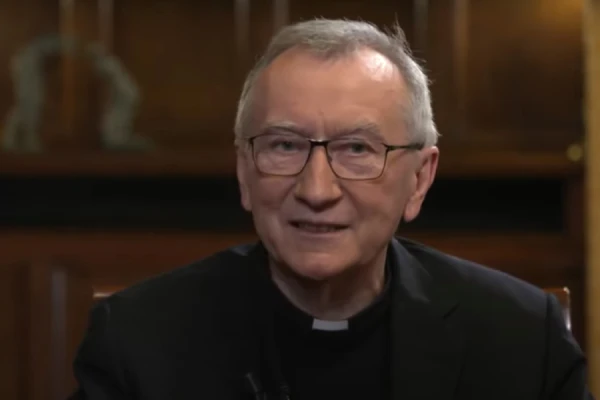
Rome Newsroom, Jan 30, 2021 / 06:00 am (CNA).- Cardinal Pietro Parolin has said that he does not consider the Vatican’s financial scandals to be “a crisis,” but pointed to the recent headlines as a sign of the Vatican’s transparency.
In a television interview aired by French Catholic network KTO on Jan. 29, the Vatican Secretary of State downplayed the reports of financial mismanagement that led to the conviction of the former president of the Vatican bank, the forced resignation of Cardinal Angelo Becciu, and the dismissal of several employees from the Secretariat of State.
“Perhaps talking about a crisis is a bit excessive in my opinion,” Parolin said.
“If we look at history, there have always been difficult times. There have always been situations, how to put it … not entirely transparent. … We can even refer to the recent past as well.”
Pope Francis issued a new law transferring financial responsibilities away from the Vatican’s Secretariat of State to the Administration of the Patrimony of the Apostolic See (APSA) one month ago. This shake up was first announced in an Aug. 25 letter to Cardinal Parolin that was made public on Nov. 5 after the Secretariat of State was engulfed in accusations of financial mismanagement, particularly regarding an investment in a London property.
The Vatican official said in the French interview that Pope Francis wanted to “directly face these problems which have arisen precisely to make the Roman Curia as transparent as possible, precisely so that she can … really exercise the service to which she is called … the service of the Gospel.”
“You know very well that people today will not accept the Gospel except from a totally transparent Church,” Parolin said, according to a transcript of the interview provided by KTO.
The cardinal said he believed that “considerable progress” had already been made in the pope’s reform of the Roman Curia, particularly with regard to Vatican finances, pointing to the creation of the Council for the Economy, the Secretariat for the Economy, and the Office of the Revisor General.
He said that further reforms might entail the merger of the Congregation for the Evangelization of Peoples with the Pontifical Council for the New Evangelization and the combination of the Congregation for Catholic Education with the Pontifical Council for Culture.
“But these are minor actions compared to what has already been done,” he said. “Now it is a question of giving homogeneity to all the reforms which have been made, by means of the new apostolic constitution which has for at least provisional title: ‘Predicate Evangelii.’”
The apostolic constitution overhauling the Roman Curia — entitled “Praedicate evangelium,” which means “Preach the Gospel” — is largely finished, according to Parolin, who said that the text should be published “before the end of this year.”
During the 30-minute sit-down interview conducted before Parolin’s trip to Cameroon, the cardinal was also asked about the Vatican’s provisional agreement with China on the appointment of bishops, a diplomatic effort in which Parolin himself has played a leading role.
“First of all, I would say that I deeply respect anyone who has a different opinion and who criticizes, say, criticizes the Holy See’s policy on China. And it is a right to do so, because it is an extremely complex and difficult situation. There can be different points of view,” he said.
The Vatican Secretary of State said that the agreement signed with the leaders of the Chinese Communist Party was “a small step from which to start to seek to improve the situation of the Church,” comparing it to the Gospel parable of the sower who plants a seed hoping that it will grow and bear fruit.
“This agreement was not intended to be, and could not, be an agreement to solve all the problems that the Church faces in China,” he said.
Parolin was also asked if Pope Francis intends to visit France to which he said: “I think that there is an availability and a desire of the pope to come and visit France, but don’t ask me for the date!”
Pope Francis’ next scheduled international trip is to Iraq on March 5-8. The cardinal said that interreligious dialogue will “certainly be one of the themes that the pope will address,” in addition to encouraging “the political stability of the country.”
“But the pope wants to go to Iraq above all to encourage Christians. Today Iraq, and all the countries in the region, have suffered a hemorrhage of Christians, due to the situation of war, conflict, due to which the Christian community has been reduced to the strict minimum. The Pope feels the need to go there, to give courage to these Christians, to invite them to continue to bear witness in these circumstances which are not easy,” Parolin said.

[…]




A Catholic pope will do very well.
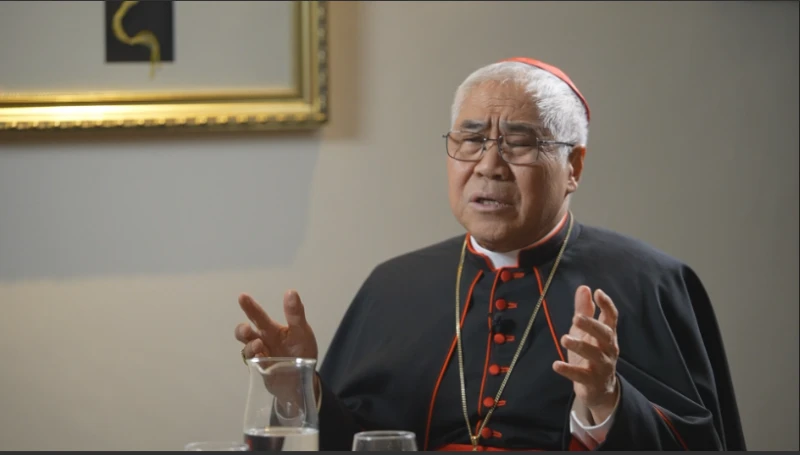
About “discern[ing] what kind of pope the Church needs in this present day,” a healthy minimum would be a pope who preaches the whole gospel (mercy and conversion) and who restores the difference between a town hall meeting and a “synod of bishops” as successors to the Apostles. About which, check out this April 2024 interview with Cardinal Goh: https://www.catholicworldreport.com/2024/05/03/cardinal-goh-of-singapore-deep-encounter-with-jesus-is-key-to-passing-on-the-faith/. Cardinal Goh:
“But I don’t believe that we should try to compromise the Gospel. And that is my fear: that, today, even Church leaders are compromising the Gospel. I don’t think Jesus ever compromised the Gospel, even for the adulterous woman. He says, ‘I do not judge you, I do not condemn you, but please sin no more.’ I think that has to be mentioned. This is where the importance of truthfulness, mercy, and compassion [comes in].”
“…as has often been said, or some bishops are suggesting, perhaps there should be another level where it is really a Synod of Bishops, after hearing the laypeople, after journeying with them; there should be that level of bishop synods, where the bishops can come together, because that synod [with laity] cannot really be considered a theological dogmatic synod, because not all are theologically trained.”
The diocese of crossroads Singapore also hails from a deeply multicultural setting, celebrates four national languages, is near 21st century’s atheistic Chinese regime, and is roughly and refreshingly almost equidistant from (central to?) Europe and North and South America. (And, yet, continental Africa also has much to offer, in its clear-eyed rejection to Fernandez’ anti-binary Fiducia Supplicans.)
Singapore, not big geographically, but neither were synodaler Cardinal Hollerich’s Luxembourg nor synodaler Cardinal Grech’s Malta….After all, at 284 square miles, the Singapore city-state is still 1700 times as big as the Vatican’s 109 acres…an interesting numerology as we enter the 1700th anniversary of Nicaea!