


The work of a missionary is often trying, but the missionaries themselves are usually the first to tell you what a tremendous blessing it is. Father Barry Martinson, S.J., is one such missionary. He has worked for decades in Southeast Asia and is now writing his memoirs, chronicling those years of work.
The newest volume in Father Martinson’s memoir is Diary of a Young Missionary: All This Freshness Fuming (Ignatius Press, 2026). A follow-up to the first volume Diary of a Young Jesuit: All This Beauty Blooming (Ignatius Press, 2025), this book recounts Fr. Martinson’s first seven years as a missionary in Taiwan, from 1969 to 1976.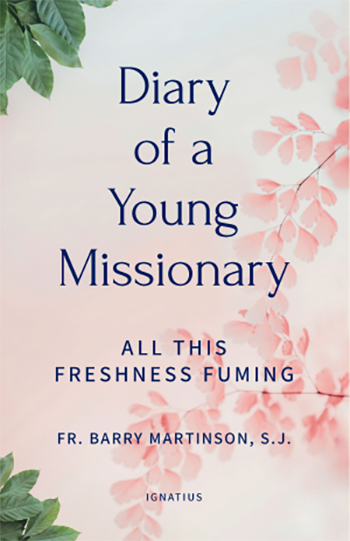
His personal stories are often humorous, always inspiring, and filled with the trials and joys of a stranger in a strange land.
Fr. Martinson recently spoke with Catholic World Report about his new book, his vocation story, and his life as a missionary in the Far East.
Catholic World Report: How did this book come about?
Father Barry Martinson, S.J.: As with my previous two Diary books, the voluminous stack of letters I wrote to my mother (which she saved) in the years since I entered the Jesuits until her death served as a basis to trigger my memory into reliving the events described in this book.
In addition, I had written some previous stories about my early life in Taiwan, which I looked forward to having a wider readership. My missionary life was an adventure of the heart–exciting, sometimes profound, and replete with humor. As can be seen from the stories in Diary of a Young Missionary, there was never a dull moment.
CWR: How did you end up as a missionary in Taiwan?
Martinson: I was drawn to missionary work since my early days in the Society of Jesus. In meditating on the life of Jesus, I envisioned his public life as a service to those most in need of both bodily and spiritual healing. I desired to follow this aspect of his life and ask to be sent as a missionary to another country.
My first choice was Latin America. But that was unfeasible at the time. Since the Far East had a historical connection to the California Jesuits, and in particular because my brother Jerry had been sent to Taiwan as a Jesuit missionary two years previously, I applied and was accepted for the Taiwan mission.
CWR: Did being an “outsider” help or hinder me in my missionary work?
Martinson: One of the most pleasant surprises during my first years of studying Mandarin in preparation for missionary work was hearing students shout “I love you!” from the balcony of the local high school whenever I passed by on my way to classes. Or being continuously asked to play my guitar and sing American songs.
So, being an “outsider” definitely had its advantages. I can’t count the times I was told I looked like James Bond or some other character in an American movie. Taiwanese people, and in particular the indigenous tribes with whom I later spent most of my time, were more than welcoming. They adopted me as part of their families.
On the other hand, being an “outsider” meant that I missed many of the nuances in the local culture and language. These subtleties took some time to learn and even longer to adapt to. In a sense, it was like becoming a child again and learning from scratch what it means to grow up in another culture. This was especially true during my two years of studying the Chinese language.
CWR: The challenges of being in an area where Catholics are a small minority.
Martinson: Of course, I have never encountered any persecution since Taiwan is a very open society and allows every sort of religious expression. In that sense, I was very fortunate.
On the other hand, despite having strong ties to traditional Chinese religions such as Buddhism and Taoism, there is the phenomenon that most people are not very interested in religion, much less in being “converted.” Their indifference was never a problem for me, however, since I did not go to Taiwan specifically with the idea of converting people either to my religion or my way of thinking. I simply wanted to enter into their culture, make friends when I could, and if the opportunity to share my faith presented itself, to go from there.
This made life in Taiwan a very pleasant experience, with no pressure to make converts, but just to be myself and let the Lord work through me if He chose to do so.
CWR: Is it important to do missionary work in person?
Martinson: Not necessarily. My brother, Father Jerry, spent years in front of a TV camera as a successful media missionary. For generations of Taiwanese, he was an influential and well-known figure on television. Although he had numerous personal friends, his most meaningful work was done within the confines of a television studio, where he was able to reach millions of viewers.
As for me, my missionary work was mostly person-to-person until some of my books were published in Chinese and received wide readership in Taiwan and mainland China. That, and the religious stained-glass studio I began, evolved into a type of missionary work done more through writing and art than person-to-person. So, I suppose it depends upon the particular missionary and his or her special talents.
As far as the classification “missionary” goes, it can sometimes be used in the exclusive sense of “conversion” rather than a broader and more natural concept of “sharing one’s faith life” with others, especially in countries or areas other than one’s own. In fact, rather than a “missionary,” I would consider myself a “shepherd” since I have been ministering as a parish priest to Taiwan’s indigenous tribes for over 50 years–and most of them are now Christian.
This being said, in sharing one’s faith, there is nothing like true person-to-person contact because in this way there can be a growth of understanding between both the giver, as well as the receiver. This ordinarily takes place because of friendship.
Diary of a Young Missionary is about such friendships. As a young seminarian beginning a new life in a foreign country–and still with years of language studies and theology courses ahead of him–nothing gave me more joy on my path to ordination than the comfort of newfound friends. The challenges of missionary life, even in those early years of study and preparation, were immense—isolation, homesickness, language difficulties, doubts about whether to stay or give up. They were all there.
It was the love and guidance of my brother Jerry and the blessings of the lasting friends I made along the journey that kept me going.
CWR: What do you hope others can take away from this book?
Martinson: My stories are very personal, and in this sense, they should be relatable to anyone regardless of age, profession, or religion. The desire to do something meaningful with one’s life, to help others, to study a difficult language, to adapt to a new environment… to try with all one’s might and fail and to still keep trying… all this may sound familiar to those looking back on the course of their lives.
But it also might inspire young people who are looking for something worthwhile to do in the future for God’s greater glory. Although this is in no way a self-help book and there is a noticeable absence of sermonizing in it, my hope is that readers can simply immerse themselves in its stories and perhaps see themselves in my adventures, meet my friends, and come away with a happy heart. Maybe some of them may choose to follow a similar path.
CWR: Any final thoughts?
Martinson: The most unique section in Diary of a Young Missionary might be Chapter Two, which is about the year I spent on Taiwan’s remote Orchid Island and the enduring friendships I forged with the islanders during that time. Fresh from six years of Jesuit studies and two years of Mandarin courses, I was fuming with a passion to serve the poorest of Taiwan’s indigenous tribes.
My adventures with the remarkable Yami tribe of Orchid Island describe a young Jesuit on the cusp of his missionary vocation, becoming one with the people he had been called to serve. This is my favorite chapter in the book because it was one of the best years of my life. I can remember every detail of those thrilling adventures as if it were yesterday, and it is a joy to be able to share these stories with others.
• Related at CWR: “New book recounts Jesuit formation, missionary work during The Sixties” (March 20, 2025), an interview with Fr. Barry Martinson, SJ, about Diary of a Young Jesuit: All This Beauty Blooming (Ignatius Press, 2025).
If you value the news and views Catholic World Report provides, please consider donating to support our efforts. Your contribution will help us continue to make CWR available to all readers worldwide for free, without a subscription. Thank you for your generosity!
Click here for more information on donating to CWR. Click here to sign up for our newsletter.

Leave a Reply