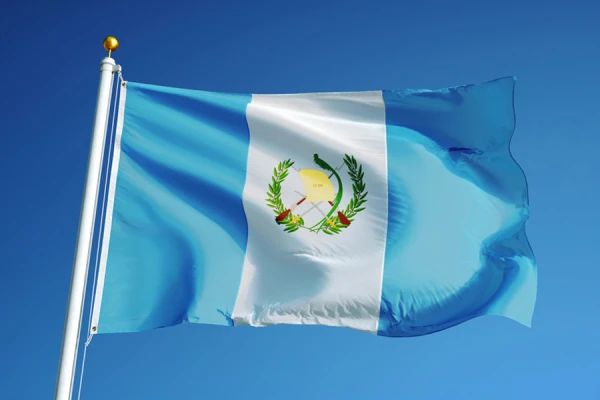
CNA Staff, Nov 5, 2020 / 02:48 pm (CNA).- Guatemala’s Interior Ministry rescinded Wednesday an agreement it had made last month allowing Planned Parenthood to establish and operate branch office in the country.
The Nov. 4 statement repealed the agreement of Oct. 7, stating it was “not in accord with the interests of the State of Guatemala.”
Guatemalan President Alejandro Giammattei announced the repeal Nov. 2, declaring he would not allow Planned Parenthood to operate in the country. Giammattei’s response was in reaction the initial agreement authorizing Planned Parenthood, which became official that same day.
“I recognize life from conception and therefore I will not tolerate in my administration any movement that violates what is established in our Political Constitution of the Republic, that goes against the values with which I was raised and that conflicts with my principles as doctor,” Giammattei said.
“I am a faithful defender of life and I am emphatic in stating that I will not endorse in my administration the creation, registration or start-up of any organization that goes against life,” the president underscored.
PublinewsGT confirmed Nov. 3 that the Interior Minister, Oliverio García Rodas, submitted his resignation, which was accepted.
“Oliverio García Rodas, taking responsibility, informed me in the evening that he had made the decision to resign due to the error he had committed and considering that it was strongly opposed,” the president said.
“I reiterate the government’s commitment to respect life from conception, since it is something that my faith and the Political Constitution of the Republic profess,” Giammattei told the press.
When the initial agreement authorizing Planned Parenthood was made public Nov. 2, various political and citizen groups voiced their opposition, and lawmakers from the Viva party called for the Interior Minister to resign.
The Family Matters Association of Guatemala issued a statement thanking Giammattei “for his firm statement” defending and protecting “the lives of Guatemalans from conception, as established in our Magna Carta.”
AFI Guatemala pointed out that Planned Parenthood “is responsible for more than 350,000 abortions in the United States annually. It’s public knowledge that Planned Parenthood’s major source of income is from abortion” and that company executives have acknowledged its involvement “in the sale and trafficking of organs of aborted babies,” the pro-life organization said.
If you value the news and views Catholic World Report provides, please consider donating to support our efforts. Your contribution will help us continue to make CWR available to all readers worldwide for free, without a subscription. Thank you for your generosity!
Click here for more information on donating to CWR. Click here to sign up for our newsletter.
The President of the Communications Commission of the 2024 International Eucharistic Congress, Father Livingston Olivares (left), accompanies EWTN Vice President for Programming and Production Peter Gagnon (center-right), EWTN Vice President for Spanish-language Production, Marketing, and Radio Enrique Duprat (center-left), EWTN Production Director Michael Holmes (far right), and IEC Quito 2024 Communications Coordinator Marcelo Mejía (front, kneeling) at the Monument to the Equator, the exact location of the Equator (from which the country of Ecuador takes its name) on the outskirts of the country’s capital city of Quito, site of the 2024 International Eucharistic Congress. / Credit: Communications Commission of the 2024 International Eucharistic Congress
ACI Prensa Staff, May 21, 2024 / 06:40 am (CNA).
The 53rd International Eucharistic Congress (IEC) has chosen EWTN as the official channel for providing live coverage of the event, which will take place from Sept. 8–15 in Quito, Ecuador.
“The 53rd International Eucharistic Congress, which will be held in Quito Sept. 8–15, has chosen EWTN as its official channel, which will broadcast everything related” to this great event, said Father Juan Carlos Garzón, secretary-general of the IEC Quito 2024, in a statement sent from Rome to ACI Prensa, CNA’s Spanish-language news partner.
The theme for this year’s International Eucharistic Congress is “Fraternity to Heal the World.” On Monday, the Vatican also announced that Pope Francis designated Cardinal Kevin Farrell, prefect for the Dicastery for the Laity, the Family, and Life, as pontifical legate to the congress.
Garzón was in Rome last week as part of a delegation, chaired by Alfredo Espinoza Mateus, archbishop of Quito and primate of Ecuador, “to hold a series of meetings with the main papal authorities.”
Since the beginning of the preparations for IEC 2024, Garzón added: “EWTN has been present at the orientation and training for IEC 2024 communications personnel.”
Logo for the 53rd International Eucharistic Congress that will take place in Quito, Ecuador, from Sept. 8-15, 2024. Credit: Communications Commission of the 2024 International Eucharistic Congress
EWTN preparations for IEC Quito 2024
In tandem, to coordinate EWTN’s transmissions of IEC Quito 2024, a team from the network visited the Ecuadorian capital, including the Quito Metropolitan Convention Center, where the congress will be held.
The team was comprised of EWTN Vice President for Programming and Production Peter Gagnon, EWTN Director of Production Michael Holmes, and EWTN Vice President for Spanish-language Production, Marketing, and Radio Enrique Duprat.
Gagnon said EWTN transmissions of the event will be offered in Spanish, English, and German. “This will be a wonderful event for those attending and for those watching,” Gagnon said.
“For EWTN, it is an immense joy to be the channel for the Quito 2024 International Eucharistic Congress,” Duprat said. “It is essential for us to be the platform on which, no matter where our audience is, everyone can enjoy the most important Catholic events in the Church.”
As for coverage details, Duprat said: “The plan is to be able to offer this International Eucharistic Congress live and direct from Quito and in multiple languages [Spanish, English, and German] both through our television and radio signals, the internet, and through our digital app.”
The event coincides with the 150th anniversary of the 1874 consecration of Ecuador to the Sacred Heart of Jesus. In 1886, Quito was also the site of the first National Eucharistic Congress.
During their preparatory visit, the EWTN team traveled the route of a procession that will take place on Sept. 14 in the historic center of Quito, which will begin with a Mass in San Francisco Plaza and then head to the Basilica of the National Vow, where benediction will be given.
They also visited the IEC offices, where they were received by Garzón, who explained how the organization of the event is progressing, including the schedule of a theological symposium to be held Sept. 4–7, just prior to the Sept. 8–15 congress.
The EWTN delegation also visited the Middle of the World Park and Monument to the Equator, marking the equator dividing the northern and southern hemispheres and where a Liturgy of the Word is planned with emphasis on care for creation.
Registration underway
Registration for the International Eucharistic Congress, both for the theological symposium and for the congress itself, is underway and available through the event website.
The largest Catholic media organization in the world, EWTN’s 11 global TV channels and numerous regional channels are broadcast in multiple languages 24 hours a day, seven days a week to over 425 million television households in more than 160 countries and territories. EWTN platforms also include radio services transmitted through SIRIUS/XM, iHeart Radio, and more than 600 domestic and international AM and FM radio affiliates and a worldwide shortwave radio service.
Headquartered in Washington, D.C., EWTN News operates multiple global news services, including Catholic News Agency; The National Catholic Register newspaper and digital platform; ACI Prensa in Spanish; ACI Digital in Portuguese; ACI Stampa in Italian; ACI Africa in English, French, and Portuguese; ACI Mena in Arabic; CNA Deutsch in German; and ChurchPop, a digital platform that creates content in several languages. It also produces numerous television news programs including “EWTN News Nightly,” “EWTN News In Depth,” “EWTN Pro-Life Weekly,” and “The World Over with Raymond Arroyo.”
This story was first published by ACI Prensa, CNA’s Spanish-language news partner. It has been translated and adapted by CNA.
Managua, Nicaragua, Jul 19, 2018 / 01:04 pm (ACI Prensa).- The Council of Latin American Bishops has expressed solidarity with the people of Nicaragua and declared Sunday, July 22, a day of prayer for the country.
The bishops of Nicaragua have also called for a day of fasting on July 20, and a month of prayer including adoration, the rosary, fasting, penance and the renewal of baptismal promises.
In a message released July 18, the bishops of Latin America and the Caribbean expressed their “closeness and solidarity with the Nicaraguan people and with their pastors, prophets of justice, in the face of the dramatic and painful social and political crisis currently experienced there.”
“In the face of this grave situation, we are called to be the voice of those who have no voice to uphold their rights, to finds ways to dialogue and establish justice and peace, ‘so that in Christ all may have life,’ especially those who feel disconsolate because of the deaths and violence.”
“We encourage you to continue to defend human rights and to be bearers of hope,” the council told the bishops of Nicaragua.
Since April 18, there have been massive demonstrations in Nicaragua against President Daniel Ortega, who has been in power since 2007 and was reelected in 2016 in elections disputed by the opposition. In January 2014, he oversaw the abolition of presidential term limits.
The demonstrations have been put down by police and paramilitaries, with more than 300 deaths.
The Catholic Church has participated as a mediator and witness to national peace talks convened by Ortega. However, Church officials have also faced attacks from groups with ties to the government.
On July 9, Cardinal Leopoldo Brenes, apostolic nuncio Archbishop Waldemar Stanislaw Sommertag, and Bishop Silvio Báez were assaulted during a pastoral visit to Diriamba.
Divine Mercy parish in Managua, where more than 100 students had taken refuge, was also attacked by police and paramilitaries during the night of July 13.
The following day, pro-government mobs attacked the car of Bishop Abelardo Mata of Estelí. The bishop took refuge in a nearby house and was able to return to his diocese only after dark, with the help of Cardinal Brenes, who intervened with the government to send police commissioner Ramon Avellan to guarantee Mata’s physical safety.
The Organization of American States condemned the violence in Nicaragua July 18 and urged Ortega to hold early elections in March 2019 to alleviate the crisis. The bishops of Nicaragua made a similar request last June, but Ortega has ruled this out.
In their July 14 statement, the Nicaraguan Bishops’ Conference denounced “the lack of political will by the government to dialogue” and seek real processes that would lead the country to a true democracy.
Nicaragua’s crisis began after Ortega announced social security and pension reforms. The changes were soon abandoned in the face of widespread, vocal opposition, but protests only intensified after more than 40 protesters were killed by security forces initially.
Anti-government protesters have been attacked by “combined forces” made up of regular police, riot police, paramilitaries, and pro-government vigilantes.
The Nicaraguan government has suggested that protesters are killing their own supporters so as to destabilize Ortega’s administration.
The pension reforms which triggered the unrest were modest, but protests quickly turned to Ortega’s authoritarian bent.
Ortega was a leader in the Sandinista National Liberation Front, which had ousted the Somoza dictatorship in 1979 and fought US-backed right-wing counterrevolutionaries during the 1980s. Ortega was also leader of Nicaragua from 1979 to 1990.
Aid to the Church in Need has launched an online global prayer campaign for Nicaragua, stressing that the nation is facing “its bloodiest crisis since the 80s.”
This article was originally published by our sister agency, ACI Prensa. It has been translated and adapted by CNA.





Leave a Reply