No Picture
News Briefs

Tomb of Carlo Acutis is opened for veneration ahead of beatification
October 1, 2020 CNA Daily News 0

Rome Newsroom, Oct 1, 2020 / 09:00 am (CNA).-  

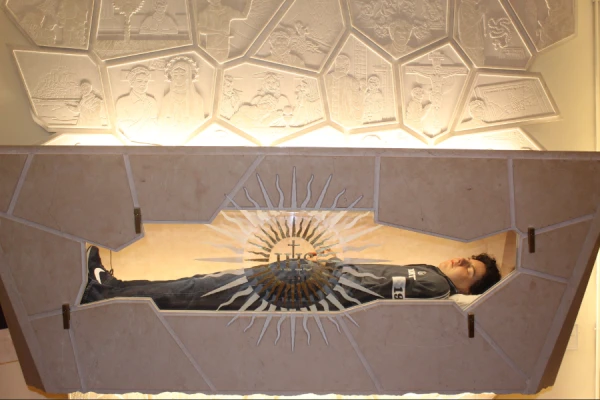
The tomb of Venerable Carlo Acutis was opened for public veneration Thursday ahead of the computer-programming teen’s beatification. 

A spokeswoman for Acutis’ beatification told CNA that the entire body was present, but “not incorrupt.”

“Today we … see him again in his mortal body. A body that has passed, in the years of burial in Assisi, through the normal process of decay, which is the legacy of the human condition after sin has removed it from God, the source of life. But this mortal body is destined for resurrection,” Archbishop Domenico Sorrentino of Assisi said at a Mass at the opening of the tomb Oct. 1.

The bishop explained that Acutis’ body was “reassembled with art and love.”

Acutis, who died of leukemia in 2006 at the age of 15, was known for his computer-programming skills, and love of the Eucharist and the Virgin Mary.

The heart of Acutis, which can now be considered a relic, will be displayed in a reliquary in the Basilica of St. Francis in Assisi. His mother said that his family had wanted to donate his organs when he died, but were unable to do so because of the leukemia.

“Carlo is a boy of our time. A boy of the internet age, and a model of holiness of the digital age, as Pope Francis presented him in his letter to young people around the world. The computer … has become a way of going through the streets of the world, like the first disciples of Jesus, to bring to hearts and homes the announcement of true peace, that which quenches the thirst for the infinite that inhabits the human heart,” Sorrentino said.

The rector for the Sanctuary of Spoliation in Assisi, where Acutis’ tomb is located, told EWTN that reconstruction work on Acutis’ face was necessary before the public viewing of the tomb. 

Acutis had brain hemorrhaging at the time of his death, and he offered his suffering for the pope and the Church. 

“His body was discovered to be fully integral, not intact, but integral, having all its organs. Work was done on his face,” Fr. Carlos Acácio Gonçalves Ferreira said.

“In some way, his earthly face will be seen again. But that face — let us not forget — by now does not point to itself, but to God,” Archbishop Sorrentino said.

Acutis’ tomb is open for public veneration Oct. 1-17 in Assisi to allow as many people as possible to make a prayerful visit in the weeks before and after his beatification Oct. 10, despite coronavirus measures limiting attendance.

In his interview with EWTN, Ferreira lauded Acutis as a witness that holiness is attainable for teenagers. 

In the tomb, Acutis is dressed in the casual clothes he wore in daily life. While he was not buried in this clothes, it is hoped that they will give evidence of the teen’s life.

“For the first time in history we will see a saint dressed in jeans, sneakers, and a sweater,” the rector said.

“This is a great message for us, we can feel holiness not as a distant thing but as something very much within everyone’s reach because the Lord is the Lord of everyone.”

In the year before he died, the Italian teen researched Eucharistic miracles to create a website cataloging and sharing this information with others.

As part of the 17-day celebration of Acutis’ beatification in Assisi, two churches are hosting exhibitions of the Eucharistic miracles and Marian apparitions cataloged by Acutis. 

Acutis’ tomb is in Assisi’s Sanctuary of the Spoliation, where a young St. Francis of Assisi is said to have cast off his rich clothes in favor of a poor habit.

“Carlo Acutis, like St. Francis, had in common, in addition to love for Jesus and in particular for the Eucharist, a great love for the poor,” Archbishop Sorrentino said as he announced Oct. 1 that a soup kitchen would be opened near the Sanctuary of the Spoliation in remembrance of Acutis.

Carlo’s mother, Antonia Salzano (pictured above), said that she was very moved by the opening of her son’s tomb for public veneration.

“We are thrilled that finally Carlo’s tomb has been opened, especially because the faithful that Carlo has scattered around the world will be able to see him and to be able to venerate him in a stronger and more engaging way,” she said.

“We hope that through the exposition of Carlo’s body, the faithful can raise their prayers to God with more fervor and faith who through Carlo invites us all to have more faith, hope, and love for him, and for our brothers just as Carlo did in his earthly life. We pray that Carlo will intercede for all of us with God and obtain many graces for us.”


[…]

No Picture
News Briefs

Economy prefect says Vatican must be ‘a house of glass’ as 2019 figures released

October 1, 2020 CNA Daily News 1

Vatican City, Oct 1, 2020 / 07:00 am (CNA).- The Vatican’s Secretariat for the Economy released the 2019 balance sheet for the Roman Curia Thursday.

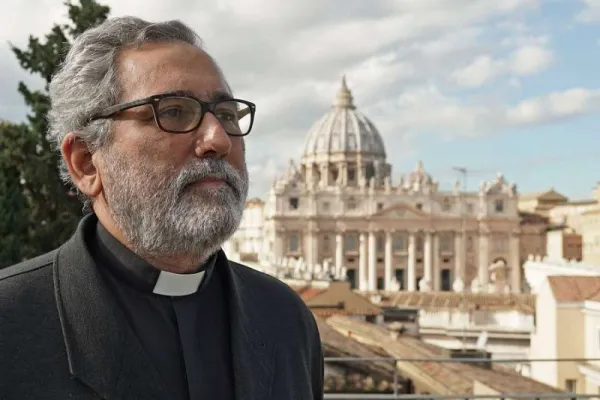
Fr. Juan A. Guerrero, S.J., the department’s prefect, told Vatican News Oct. 1 “the economy of the Holy See should be a house of glass.”

“We want the budget to explain how the Holy See uses its resources to carry out its mission,” he said.

The report comes a week after the resignation of Cardinal Angelo Becciu from the Roman Curia, which followed more than a year of reporting by CNA and other news outlets on various financial scandals involving Becciu and the Holy See’s Secretariat of State.

Guerrero told Vatican News he “reads the newspapers” and that “it is possible that, in some cases, the Holy See was not only badly advised but also cheated.”

“I believe we are learning from past mistakes or recklessness,” he said.

The Holy See balance sheet was also published as the Holy See undergoes an onsite financial inspection by Moneyval, the Council of Europe’s anti-money laundering watchdog.

The evaluation will likely include looking at the role of the Administration of the Patrimony of the Apostolic See (APSA), which functions as the Holy See treasury, sovereign wealth manager, and administers payroll and operating expenses for Vatican City.

In 2018, Pope Francis asked for Vatican investments to be centralized under APSA’s management.  

Guerrero said that the project of centralizing investments in APSA was advancing “little by little.”

The prefect also acknowledged that he made a request in April that all dicasteries transfer their liquid assets to APSA, saying he did it in anticipation of revenue loss due to Italy’s coronavirus lockdown. 

In May, Guerrero said that in the wake of the coronavirus pandemic, the Vatican is forecasting a reduction in income of between 30% and 80% for the next fiscal year.  

The Oct. 1 Holy See financial report for 2019 showed that the expenditure of the 60 curial offices for 2019 totaled 318 million euros (around $374 million) out of an income of 307 million euros.

The deficit of 11 million euros was smaller than the 2018 deficit due to 68 million euros in investment returns, the report showed. It said that the increase was “mostly attributable to the effect of the recovery of share prices in 2019.”

The report did not include financial statements for other Vatican entities which collaborate with the Holy See, such as the governorate of Vatican City State, the IOR, or Peter’s Pence, the pope’s charitable fund which comes from an annual Church-wide collection.

These institutions and others “present their results, and report to the corresponding authorities,” Guerrero said.

Despite not being part of the report, Guerrero said that Peter’s Pence covered 32% of the expenses “for the mission of the Holy See.”

The prefect said that Peter’s Pence in 2019 “collaborated with the mission of the Holy Father” for a total of 66 million euros, with 23 million coming from reserve funds in addition to what was donated in 2019.

Guerrero noted that this shortage has happened in the last few years, lowering the capital of Peter’s Pence overall.

The balance sheet showed overall income and expenditure figures for 2019 and a breakdown of how much went to each curial department.

Expense categories were listed as apostolic mission, assets management, and services and administration.

Under apostolic mission, the largest expense went to “message diffusion” at 22% and apostolic nunciatures — the Holy See’s embassies abroad — at 21%.

Supporting local churches in difficulty and mission territories accounted for 16%. Donations made up 12%, and 9% was spent on maintaining the Curia’s historic assets.

APSA had the largest expenditure at over 66 million euros toward asset management, followed by the Secretariat of State with more than 65 million in expenses, over 22 million attributed to administration costs.

The Dicastery for Communication, the department which employs the greatest number of lay people in the Holy See, spent almost 46 million euros.


[…]

No Picture
News Briefs

Michigan AG to announce new abuse charges against Catholic priests

September 30, 2020 CNA Daily News 0

CNA Staff, Sep 30, 2020 / 04:00 pm (CNA).-  

Michigan attorney general Dana Nessel told local news this week that she plans to announce new charges against “a dozen or more” priests in the state, as part of a now two-year long investigation into abuse by Catholic clergy.

Nessel had most recently announced on Sept. 29 charges against a 78-year-old laicized priest of the Archdiocese of Detroit, Gary Berthiaume, who is accused of abusing a 14-year-old victim.

Nessel announced one count of second-degree criminal sexual conduct against Berthiaume, which could lead to a 15-year prison sentence if he’s convicted, the Detroit News reported.

Spurred by the release of a grand jury report out of Pennsylvania in 2018, which documented hundreds of cases of clergy sex abuse that took place over several decades in almost every diocese in the state, Michigan’s then-Attorney General Bill Schuette launched the state’s own investigation in August that year.

So far, the state’s investigation has led to charges against 11 people, and Nessel says she hopes to complete the investigation within the next six months, WoodTV reports. Nessel has in the past suggested the investigation could uncover as many as 1,000 sex abuse victims, though she has not discussed how her office estimated that number.

In May 2019, Nessel announced that five priests would be charged with 21 counts of sex abuse for abusing a total of five victims. None of the priests were in active ministry and one had already been removed from the clerical state.

After the announcement of the state’s investigation, Michigan’s dioceses said they welcomed the investigation and pledged their full cooperation. In Oct. 2018, police executed search warrants at all seven of the state’s dioceses.

To date, the Michigan investigation team has reviewed hundreds of tips, as well as 1.5 million paper documents and 3.5 million electronic documents seized the raids. Most of the tips have come through a hotline established specifically for abuse.

Early in 2019, Nessel claimed that the state’s dioceses are “self-policing,” using non-disclosure agreements to quiet allegations, and “failing to deliver” on their promises to cooperate with law enforcement authorities.

In response, the Archdiocese of Detroit reaffirmed its commitment to reporting sex abuse allegations to authorities. 

In 2018 Michigan extended the statue of limitations in sexual assault cases to 15 years in criminal cases, and 10 in civil. Indictments for abuse of minor victims can be filed within 15 years of the crime or by the victim’s 28th birthday.

In March of last year, Michigan’s Governor Gretchen Whitmer asked the state’s legislature for an additional $2 million in funding for the abuse investigation, which is expected to last two years.

Similar clergy sex abuse investigations have been launched in multiple states throughout the country, including in Georgia, Illinois, New York, New Jersey, Virginia, and Nebraska.


[…]

No Picture
News Briefs

Los Angeles archbishop to lead ‘virtual rosary’ for US

September 30, 2020 CNA Daily News 1

CNA Staff, Sep 30, 2020 / 03:28 pm (CNA).- Archbishop Jose Gomez of Los Angeles will lead a ‘virtual rosary’ Oct. 7, the feast of Our Lady of the Rosary, to seek Mary’s intercession for the United States.

“Our hope is to unite Catholic people from across the country in a moment of prayer for our nation, at a time when there is so much unrest and uncertainty,” Gomez said in a Sept. 30 column.

Gomez said Mary offers Catholics maternal care, and Catholics should seek to understand “her way of seeing and her way of living.”

“Everything that Mary does points us to her Son — to his commandments, to the mysteries of his life, to giving up our own will to follow him and share in his mission,” he wrote.

“As we seek our Blessed Mother’s intercession for our nation, I hope that we will also make this a moment to deepen our own commitments to Mary — to dedicate ourselves to her and to let her teach us how to offer our hearts to serve Christ and his beautiful plan of salvation history. Let us live all for Jesus through the heart of Mary!”

Gomez noted that the Franciscan missionaries who evangelized California— including St. Junipero Serra— were deeply devoted to Mary, particularly to Our Lady of Guadalupe, who since 1999 has been formally recognized as Patroness of all America.

“[Our Lady of Guadalupe] was sent by God to the people of Mexico at a time of great uncertainty and political unrest. Plague and earthquakes were devastating the population, and there was violence and racial conflict, and widespread suffering and injustice,” Gomez said.

“Into this historical and cultural moment, Our Lady came as a mother bearing a message of hope.”

Gomez earlier this year led the bishops of the United States in reconsecrating the nation to Mary.

Reconsecrating the country, the US bishops said in an April 23 announcement, is meant to serve as a reminder to the faithful of Mary’s witness to the Gospel, and as a way of asking for Mary’s intercession before Christ on behalf of those in need.

The act of consecration to Mary, Archbishop Gomez said at the time, “will give the Church the occasion to pray for Our Lady’s continued protection of the vulnerable, healing of the unwell, and wisdom for those who work to cure this terrible virus.”


[…]