Vatican City, Dec 3, 2019 / 10:03 am (CNA).- Pope Francis said Tuesday that disabled people make important contributions to humanity, and called discrimination against them a sin. The pope added that disabled people are not members of humanity’s minor “leagues.”
“We are called to recognize in every person with a disability, even with complex and serious disabilities, a unique contribution to the common good through their original life story,” he said Dec. 3.
“Recognize the dignity of each one, knowing that it does not depend on the functionality of the five senses.”
Pope Francis sent his message on the 2019 World Day of People with Disabilities, the theme of which is “the future is accessible.”
The Gospel teaches the dignity of every person, the pope said, adding that everyone must work to fight a culture which considers some people to be part of “Serie A” and others “Serie B,” a reference to the major and minor Italian soccer leagues.
“A culture that considers some lives to be ‘League A’ and others ‘League B’” based on their physical or mental abilities is “a social sin!” he added.
Francis noted that unfortunately, in some countries, people with disabilities are not treated with equal dignity, “as brothers and sisters in humanity.”
“Have the courage to give voice to those who are discriminated against due to their disability,” he said.
Inclusive laws and protections against discrimination are important, but they are not enough if not accompanied by a change of mentality, he said, “if we do not overcome a widespread culture that continues to produce inequalities, preventing active participation in ordinary life for people with disabilities.”
Pope Francis asked everyone, on this World Day of People with Disabilities, to renew their faith, a faith which sees “in every brother and sister the presence of Christ himself, who considers every gesture of love for one of the least of his brothers to be made for him.”
“On this occasion, I would like to recall that today the promotion of participation rights has a central role to combat discrimination and promote a culture of encounter and quality life,” he said.
He explained that a lot of progress has been made in the medical and welfare fields, but even today there is a culture of waste, and a feeling for many that they exist “without belonging and without participating.”
“All this calls [us] not only to protect the rights of people with disabilities and their families,” he said, “but urges us to make the world more human by removing all that prevents them from full citizenship, the obstacles of prejudice, and by promoting the accessibility of places and quality of life, which takes into account all the dimensions of the human.”
If you value the news and views Catholic World Report provides, please consider donating to support our efforts. Your contribution will help us continue to make CWR available to all readers worldwide for free, without a subscription. Thank you for your generosity!
Click here for more information on donating to CWR. Click here to sign up for our newsletter.
Vatican City, Sep 17, 2020 / 09:32 am (CNA).- Pope Francis’ newest prayer card, which he hands out to the people he meets, features a grandmother and grandchild from his trip to Romania in early summer 2019.
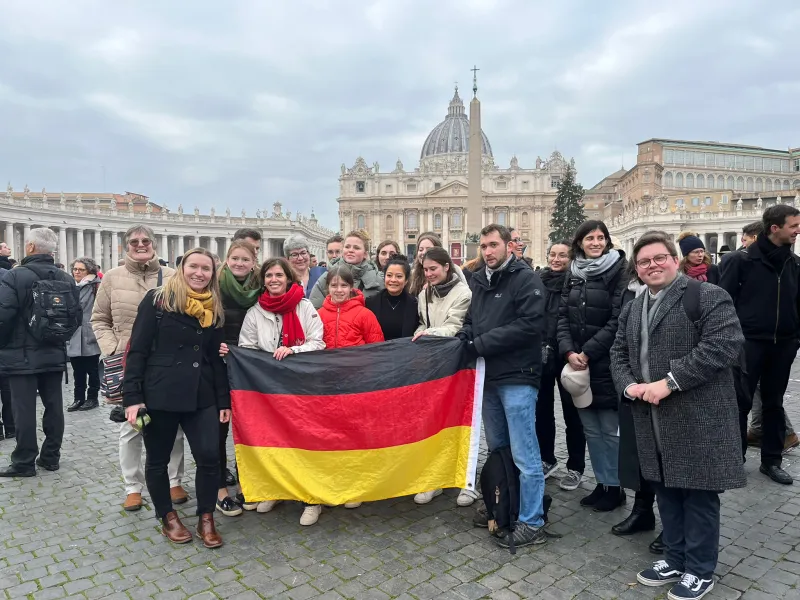
Tabea Schneider (far left) with a group of other pilgrims who traveled 20 hours by bus from Cologne, Germany, to attend the funeral of Pope Benedict XVI on Jan. 5, 2023, in St. Peter’s Square at the Vatican. / Courtney Mares / CNA
Vatican City, Jan 5, 2023 / 08:36 am (CNA).
Catholics from Germany, France, Ghana, India, Australia, Uganda, and many more countries who attended the funeral Mass for Pope Emeritus Benedict XVI on Thursday have shared their favorite memories of the late pope and why some decided to join in the chants of “santo subito” at the end of the ceremony.
More than 50,000 people attended the Jan. 5 funeral for the pope emeritus, who died at the age of 95 last Saturday.
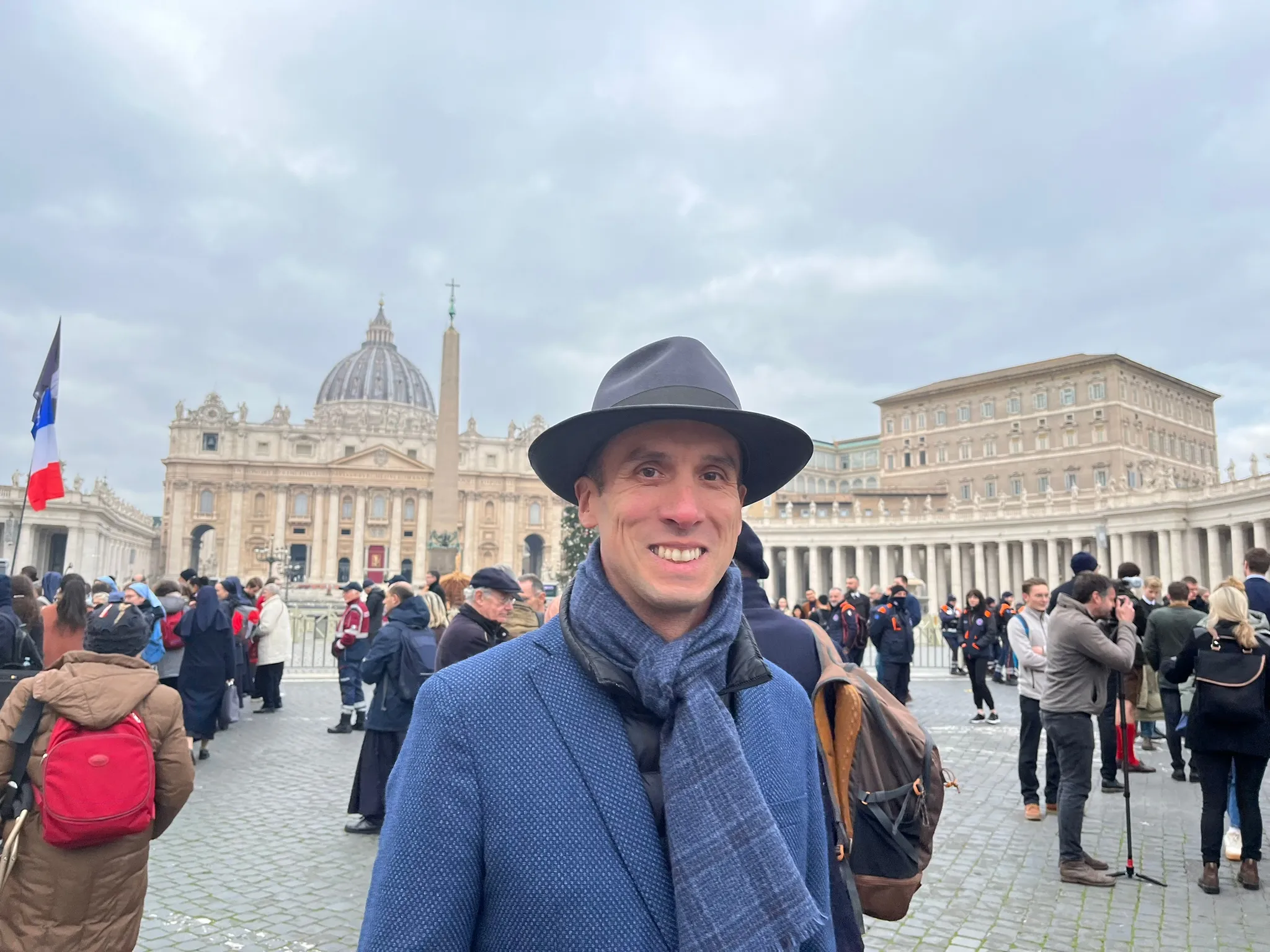
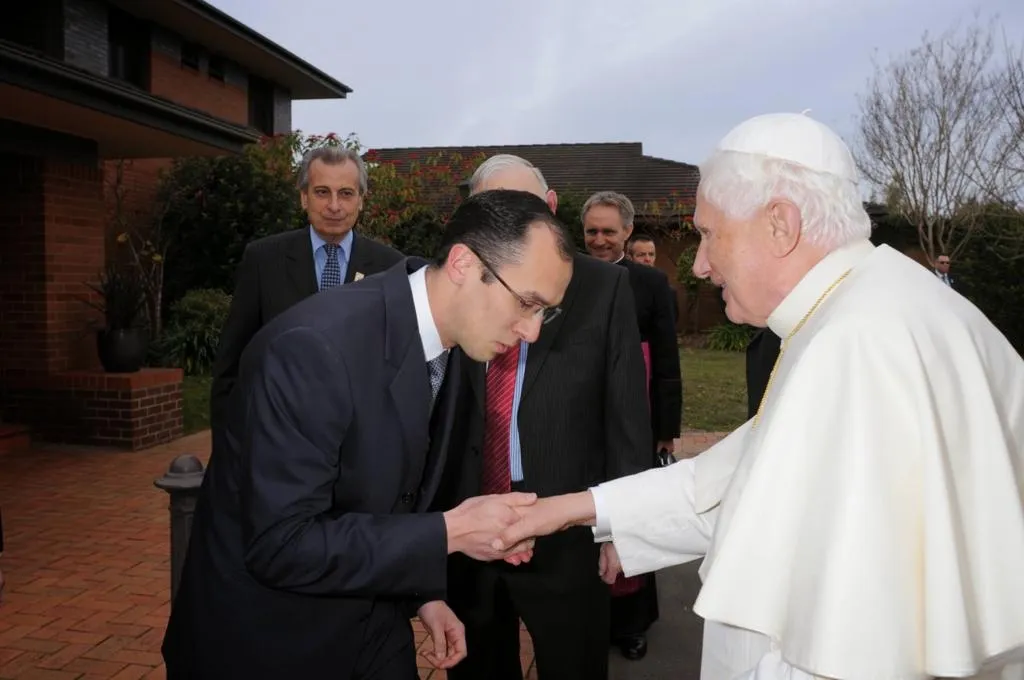
Among those in the crowd for the funeral was Arthur Escamila, who got to know Benedict XVI personally during the 2008 World Youth Day in Australia.
“It was emotional seeing the coffin coming out of the basilica,” he told CNA.
Escamila, a numerary from Opus Dei, recalled how Benedict XVI rested for a few days in the Opus Dei center in Sydney where he was living at the time.
“I had the privilege of living together with him for three days in Sydney in 2008 just before World Youth Day. We spent three days together. I attended his Mass. I ate with him. I listened to music with him,” he said.
Among those in the crowd for the funeral of Pope Benedict XVI on Jan. 5, 2023, in St. Peter’s Square at the Vatican, was Arthur Escamila, who got to know Benedict XVI personally during the 2008 World Youth Day in Australia. Courtney Mares / CNA
Benedict XVI was “very humble” and “approachable,” Escamila remembered. “From the beginning he learned my name. He addressed me by my first name and I was very impressed by that.”
Arthur Escamila meets Pope Benedict XVI during the pope’s trip to World Youth Day in Sydney, Australia, July 15–20, 2008. Vatican Media
“My father had recently died. He was interested in that and asked me questions about my father, my family. He wanted to know about his illness. So I was personally touched,” he said.
“So his death meant a lot because it was closing a chapter where I knew the pope emeritus personally and had a connection with him that was personal.”
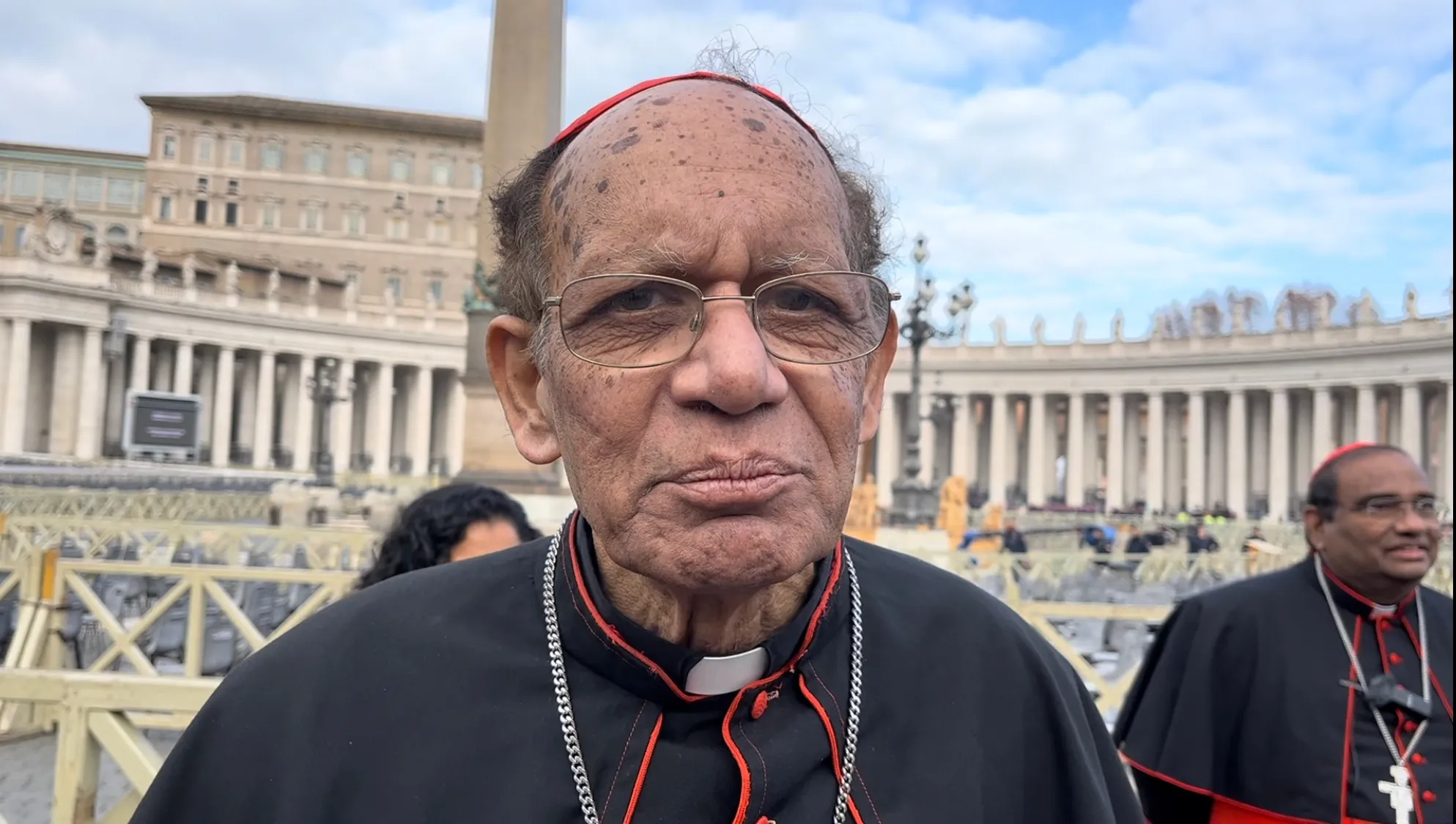
Cardinal Oswald Gracias, the archbishop of Bombay, also spoke about his personal memories of Benedict XVI.
The cardinal, who traveled from India for the funeral, told CNA that he found the funeral “very moving” and a “fitting farewell for the Holy Father Emeritus.”
Cardinal Oswald Gracias, the archbishop of Bombay, spoke about his personal memories of Pope Benedict XVI at the pope’s funeral on Jan. 5, 2023, in St. Peter’s Square at the Vatican. Courtney Mares / CNA
“He was a great theologian, the greatest of the 20th century I think. I personally … whenever I read any article, any book, any homily of his I always got a new insight into theology or spirituality. His was a great contribution for the Church,” Gracias said.
The Indian cardinal also expressed gratitude for the many ways that the former pope touched his life: “He created me cardinal. He appointed me archbishop of Bombay … and we met often. I was on the committee for the translation of liturgical texts and so we discussed much there.”
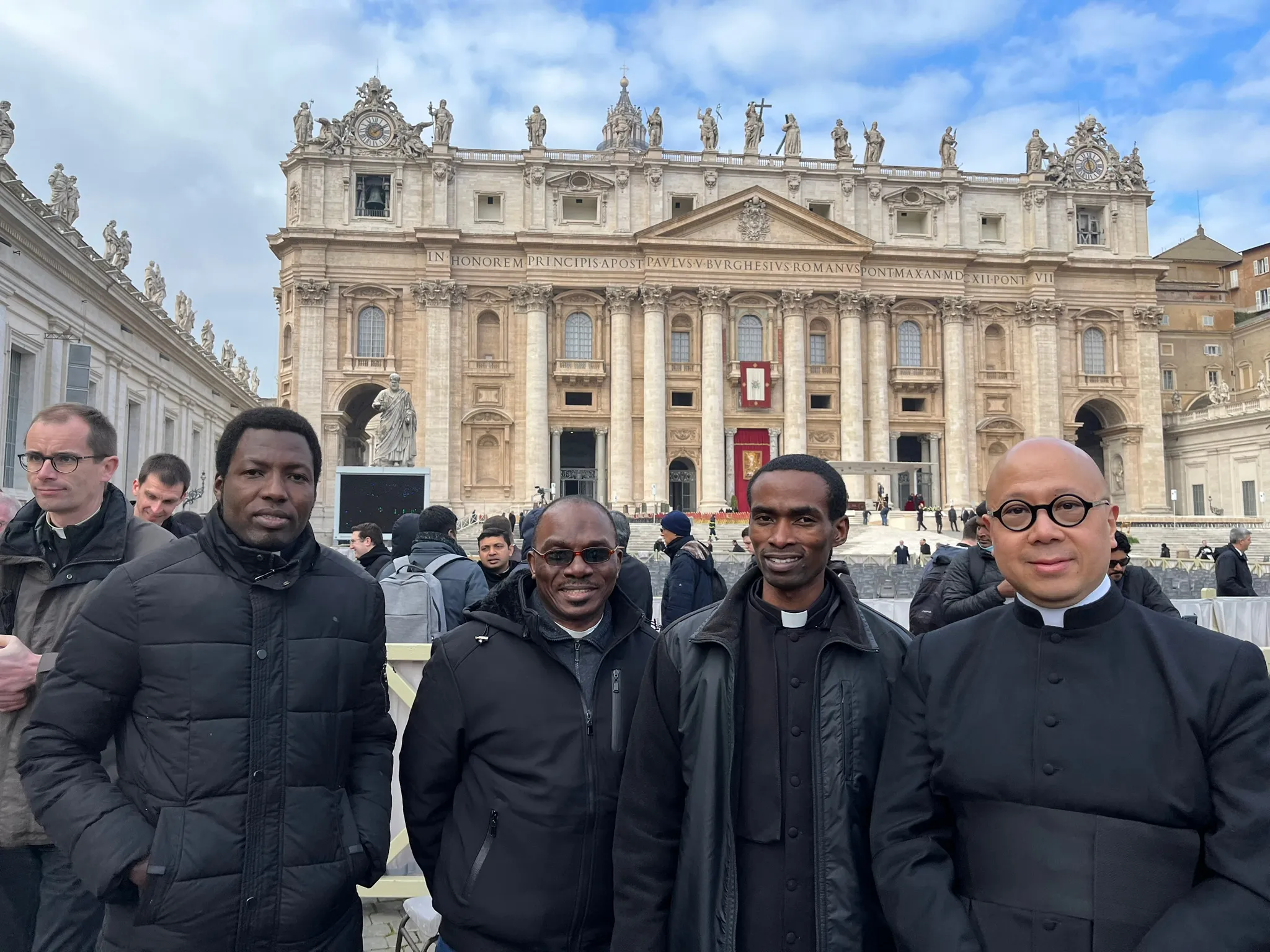
Father Albert Musinguzi from Uganda said that he felt “deep spiritual joy” at the funeral, especially because it was the first Mass he had ever concelebrated at the Vatican.
Father Albert Musinguzi (second from right) with other priests and deacons at the funeral of Pope Benedict XVI on Jan. 5, 2023, in St. Peter’s Square at the Vatican. Courtney Mares / CNA
“Although we have lost a great man, we are not mourning. We are celebrating a spiritual giant, a great man, a gift to the Church and to the entire world because Pope Benedict was a man not only for the Church but for the entire world,” he said.
The priest from Uganda’s Archdiocese of Mbarara, currently studying in Rome, said that he believes that the late pope emeritus is a saint.
“Pope Benedict was a humble pope, but a great theologian. We have learned from his humility to approach God from the Word of God. But what I like most from his preaching is that God and science are not opposed to each other … And what touched me most recently in the life of Pope Benedict XVI were his last words,” Musinguzi said.
“As we know Pope Benedict was 95 years old, so for 71 years he has given homilies and innumerable essays. He has written 66 books, three encyclicals, four exhortations, and he has summarized all of them in four words, which were his last four words: ‘Jesus, I love you.’”
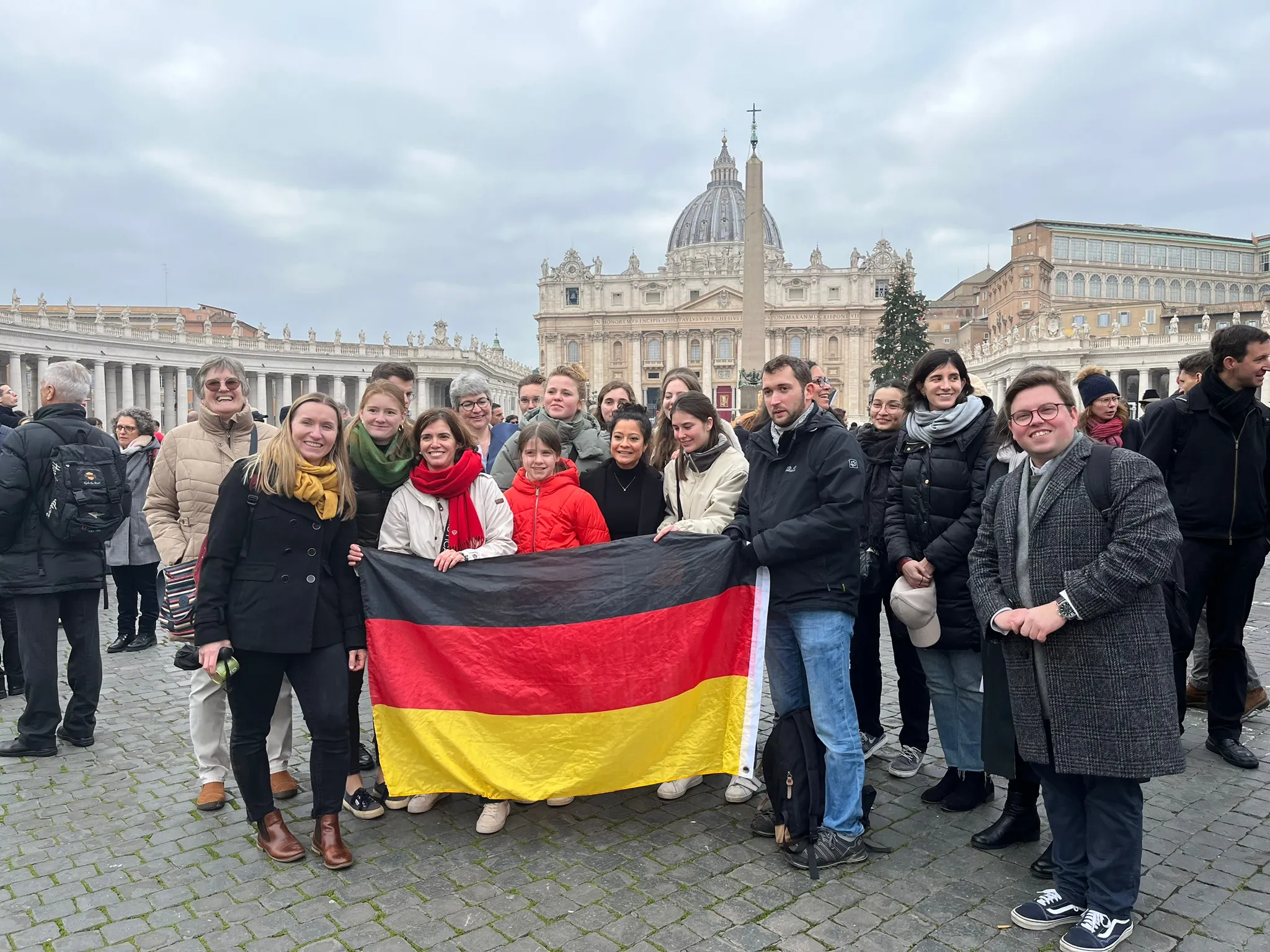
Tabea Schneider traveled 20 hours by bus from Cologne, Germany, with many other enthusiastic German pilgrims who spontaneously decided to come to Rome for the funeral. She said that she was very moved when Pope Francis touched the coffin of Benedict XVI.
Tabea Schneider (far left) with a group of other pilgrims who traveled 20 hours by bus from Cologne, Germany, to attend the funeral of Pope Benedict XVI on Jan. 5, 2023, in St. Peter’s Square at the Vatican. Courtney Mares / CNA
“It was a very emotional moment,” she said.
A group of approximately 65 people from all across France traveled together to Rome for Benedict’s funeral.
The Famille Missionnaire de Notre-Dame, a men and women’s religious community, organized two buses.
After the funeral, the group prayed the Liturgy of the Hours outside St. Peter’s Square for the repose of the soul of Benedict XVI.
Members of the Famille Missionnaire de Notre Dame traveled to Rome from France for Benedict XVI’s funeral.
Sister Maksymiliana Domini, originally from Poland, told CNA the group arrived on Tuesday evening and will depart the night of the funeral.
“We love Pope Benedict,” she said, adding that they wanted to honor him and his legacy.
The Famille Missionnarie de Notre-Dame, she said, feels very close to Benedict because of their shared love for the Church’s liturgy and for an interpretation of the Second Vatican Council in the hermeneutic of continuity.
“We are 100% aligned with him spiritually,” Domini said.
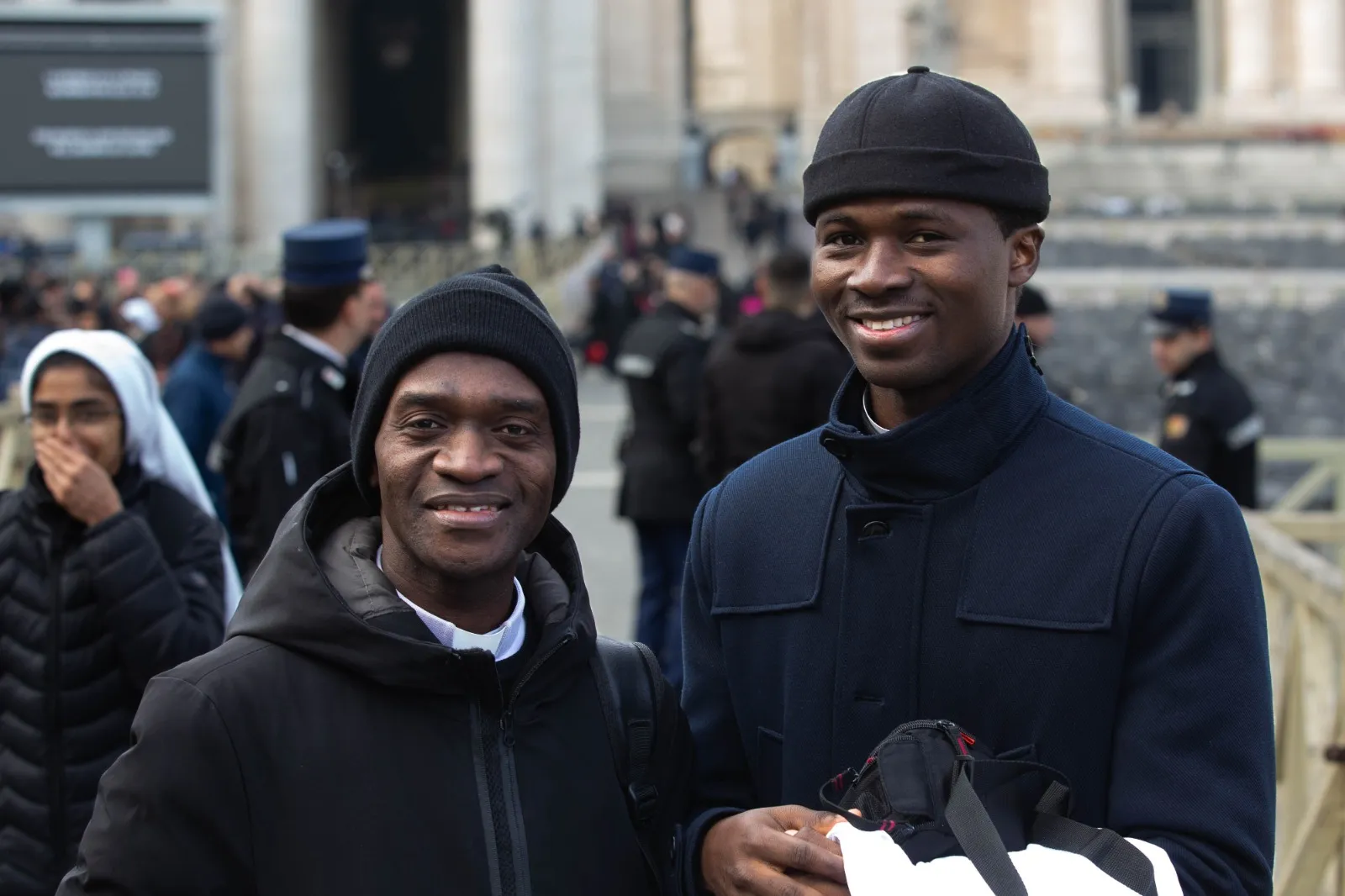
Father Anthony Agnes Adu Mensah from Accra, Ghana, said that he enthusiastically joined in the chants of “santo subito” at the end of the Mass.
“I feel in my heart that Pope Benedict is a saint,” the priest said.
Father Anthony Agnes Adu Mensah from Accra, Ghana, (left) with a seminarian from his diocese at the funeral of Pope Benedict XVI on Jan. 5, 2023, in St. Peter’s Square at the Vatican. Alan Koppschall / EWTN
On the Solemnity of Corpus Christi, Pope Francis explained that just as Jesus “did not keep his life for himself, but gave it to us,” so too are Christians called to make their lives a gift for others. / Credit: Vatican Media
“Make the world more human by removing all that prevents them from full citizenship promoting accessibility of places and quality of life”. Totally compassionate people oriented. How do we understand the Pontiff’s visible care for the less fortunate within Christianity? Should we ask? Yes we should if his vision of less fortunate people is Myth. People not the individual rather understood as an overarching abstract that determines Justice. Dec 1 Anagni Sandro Magister talked of “A Pope with the Myth of a people” published in L’Espresso Dec 3. A brilliant analysis from Jorge Bergoglio’s Peronist youth to the present reinventing thru the years Peron’s premise Reality is more important than Ideas. People mythology similar to Saul Alinsky’s adaptation of minorities [as the oppressed] as instruments for radical social conversion. The end always an egalitarian world in which personal belief, rules, do not matter and are employed solely for achieving that end. An example of this Myth process is extracted here from S Magister’s Dec 3 article: “Francis systematically says and does not say, retracts, contradicts himself. At the Lutheran church in Rome his response to a Protestant woman who asked him if she could receive communion with her Catholic husband he said a little of everything to her: yes, no, I don’t know, you work it out. The result was that from then on in the Catholic Church everyone does as he pleases. When some cardinals presented the ‘dubia’ he did not respond. But that’s just the point, he couldn’t respond. Those cardinals had fully grasped the essence of his magisterium”. Although I add it must also be recognized that the Pontiff is not consistent in employing a pure egalitarian Myth as policy that dismisses specificity of belief as necessary. And if held by some tolerable. Instead of such a pluralistic form of egalitarianism the Pontiff in essence favors a univocal form of non belief evidenced in his strong disfavor of Rules. A world vision within which Christianity has no place.
Out there in the forest of bliss at India’s Anandwan, disability is a non issue. Leprosy victors are accompanied by differently-abled allies in the gigantic task or world-building.



“Make the world more human by removing all that prevents them from full citizenship promoting accessibility of places and quality of life”. Totally compassionate people oriented. How do we understand the Pontiff’s visible care for the less fortunate within Christianity? Should we ask? Yes we should if his vision of less fortunate people is Myth. People not the individual rather understood as an overarching abstract that determines Justice. Dec 1 Anagni Sandro Magister talked of “A Pope with the Myth of a people” published in L’Espresso Dec 3. A brilliant analysis from Jorge Bergoglio’s Peronist youth to the present reinventing thru the years Peron’s premise Reality is more important than Ideas. People mythology similar to Saul Alinsky’s adaptation of minorities [as the oppressed] as instruments for radical social conversion. The end always an egalitarian world in which personal belief, rules, do not matter and are employed solely for achieving that end. An example of this Myth process is extracted here from S Magister’s Dec 3 article: “Francis systematically says and does not say, retracts, contradicts himself. At the Lutheran church in Rome his response to a Protestant woman who asked him if she could receive communion with her Catholic husband he said a little of everything to her: yes, no, I don’t know, you work it out. The result was that from then on in the Catholic Church everyone does as he pleases. When some cardinals presented the ‘dubia’ he did not respond. But that’s just the point, he couldn’t respond. Those cardinals had fully grasped the essence of his magisterium”. Although I add it must also be recognized that the Pontiff is not consistent in employing a pure egalitarian Myth as policy that dismisses specificity of belief as necessary. And if held by some tolerable. Instead of such a pluralistic form of egalitarianism the Pontiff in essence favors a univocal form of non belief evidenced in his strong disfavor of Rules. A world vision within which Christianity has no place.
Out there in the forest of bliss at India’s Anandwan, disability is a non issue. Leprosy victors are accompanied by differently-abled allies in the gigantic task or world-building.