Pope Francis attends a general audience at the Vatican. / Daniel Ibáñez/CNA.
Vatican City, Aug 31, 2021 / 07:32 am (CNA).
In a new interview, Pope Francis said that a nurse saved his life, in reference to a medical issue he had earlier this sum… […]
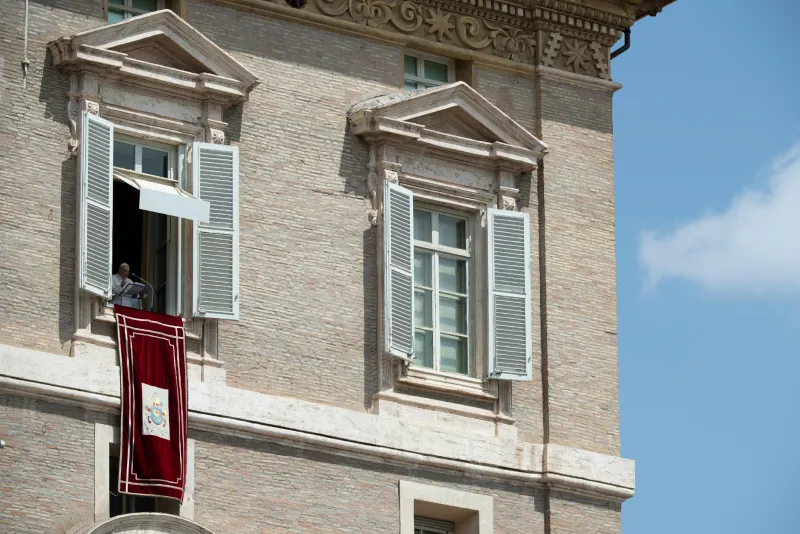
Pope Francis gives the Angelus message from a window overlooking St. Peter’s Square / Vatican Media
Vatican City, Aug 29, 2021 / 06:35 am (CNA).
Complaining and blaming others is a waste of time; the way to defeat evil is to conquer it first within our own hearts, Pope Francis said Sunday.
“If we look inside, we will find almost all that we despise outside. And if, sincerely, we ask God to purify our heart, that is when we will start making the world cleaner,” the pope said in his weekly Sunday Angelus message.
“Because there is an infallible way to defeat evil: by starting to conquer it within yourself.”
From a window overlooking St. Peter’s Square, Pope Francis spoke Aug. 29 about the need to stop blaming others for everything wrong in the world and in our lives.
“We often think that evil comes mainly from the outside: from other people’s conduct, from those who think badly of us, from society,” he said. “How often we blame others, society, the world, for everything that happens to us! It is always the fault of ‘others’: it is the fault of people, of those who govern, of misfortune, and so on.”
According to Pope Francis, it is easy to spend time assigning blame, “but spending time blaming others is wasting time.”
“We become angry, bitter and keep God away from our heart,” he explained, pointing to the Pharisees, as described in the day’s Gospel from St. Mark, who are scandalized that Jesus and his disciples “eat without purifying themselves.”
“Complaining poisons, it leads you to anger, to resentment and to sadness, that of the heart, which closes the door to God,” the pope stressed.
“Let us ask in prayer for the grace not to waste time polluting the world with complaints,” he said, “because this is not Christian. Jesus instead invites us to look at life and the world starting from our heart.”
He urged people to ask the Lord to free them from blaming others today and he recalled a message of the Fathers of the Church, who said the first step on the path to holiness is to “blame yourself.”
“How many of us, during the day, in a moment during the day or a moment during the week, area able to blame ourselves within?” Francis said. “Try to do it, it will do you good. It does me good, when I manage to do so, but it is good for us, it is good for everyone.”
“May the Virgin Mary, who changed history through the purity of her heart, help us to purify our own, by overcoming first and foremost the vice of blaming others and complaining about everything,” he concluded.
Pope Francis speaks during the Angelus prayer. / Vatican Media
Vatican City, Aug 29, 2021 / 05:30 am (CNA).
Pope Francis on Sunday urged Christians to intensify their prayer, penance, and fasting for the situation in Afghanistan, as he entrusted… […]
Pope Francis greets a child at a general audience at the Vatican, April 20, 2016. / Vatican Media.
Vatican City, Aug 27, 2021 / 12:00 pm (CNA).
Pope Francis has released a video with an encouraging message for pregnant mothers that also asks Cat… […]
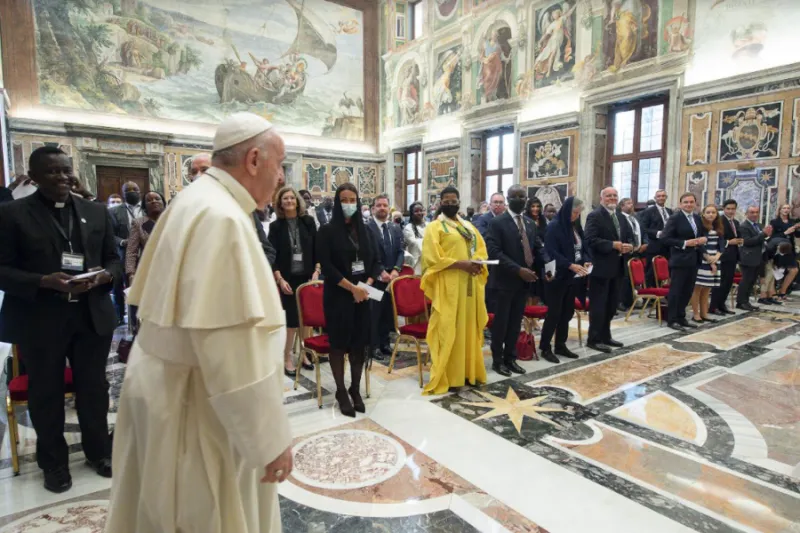
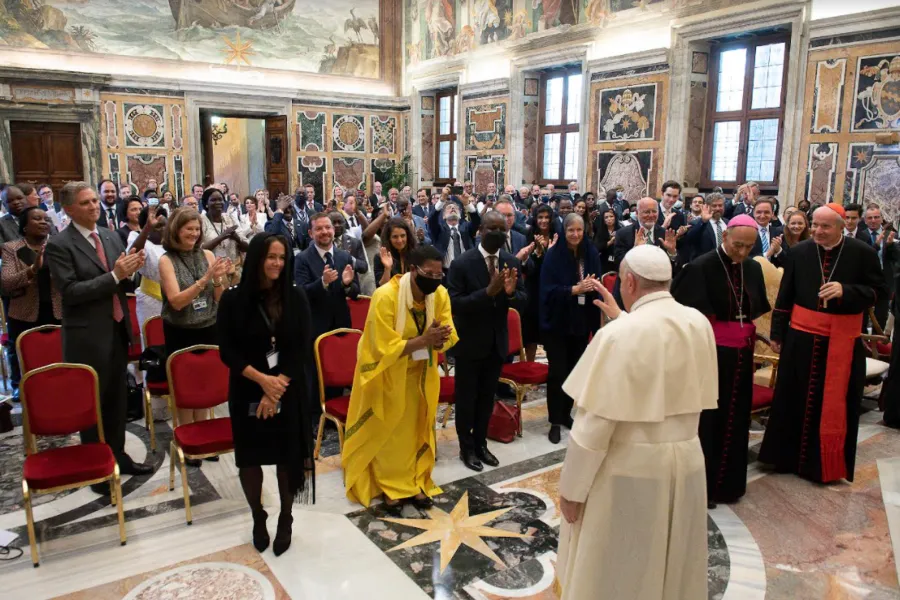
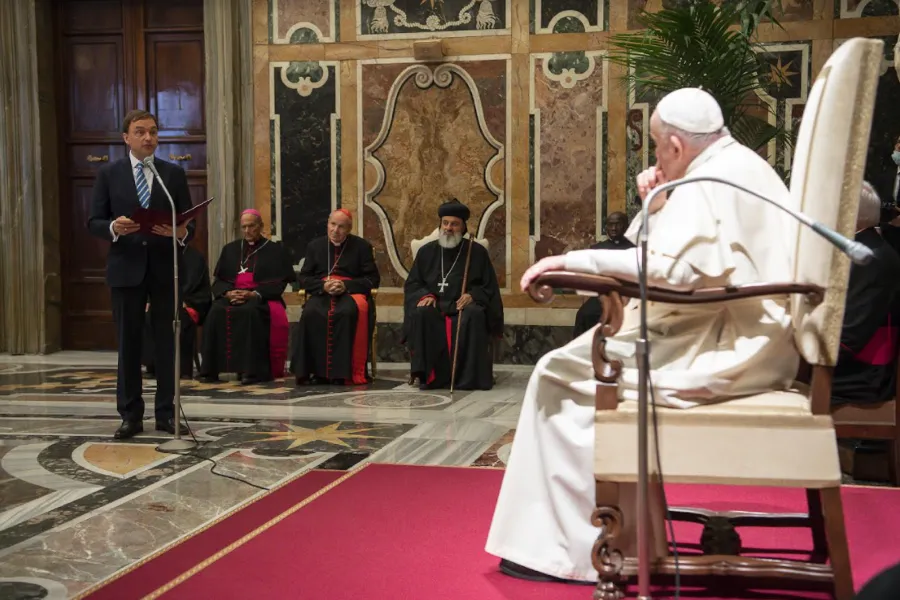
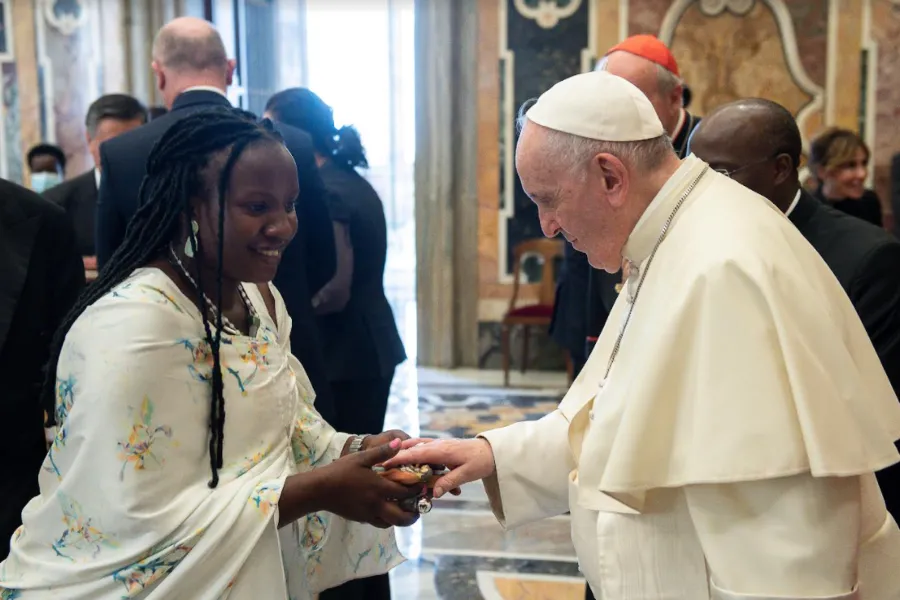
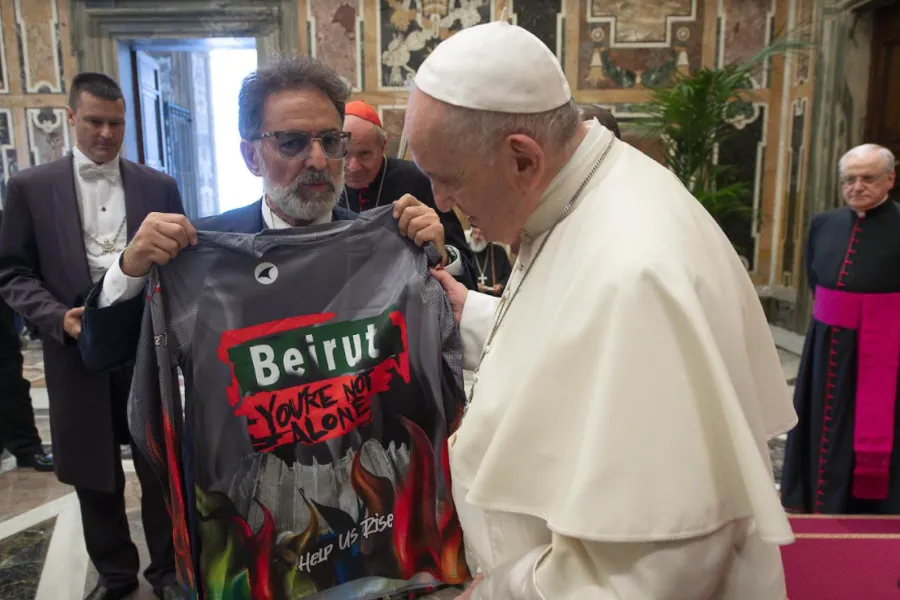
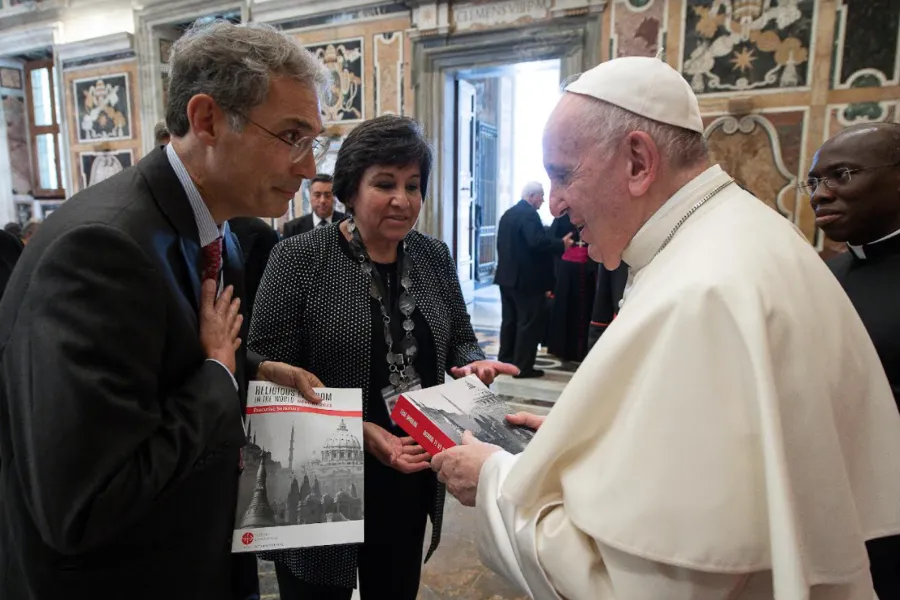
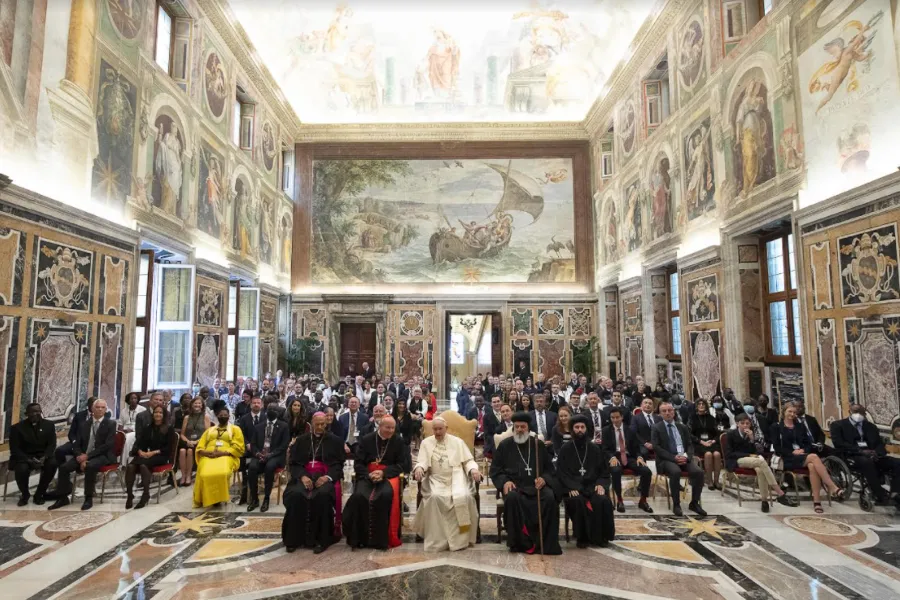
Pope Francis greets participants in a meeting promoted by the International Catholic Legislators Network in the Vatican’s Clementine Hall, Aug. 27, 2021. / Vatican Media.
Vatican City, Aug 27, 2021 / 05:30 am (CNA).
Pope Francis urged Catholic lawmakers Friday to protect human dignity online by using public policy to combat child pornography, data breaches, and cyber attacks.
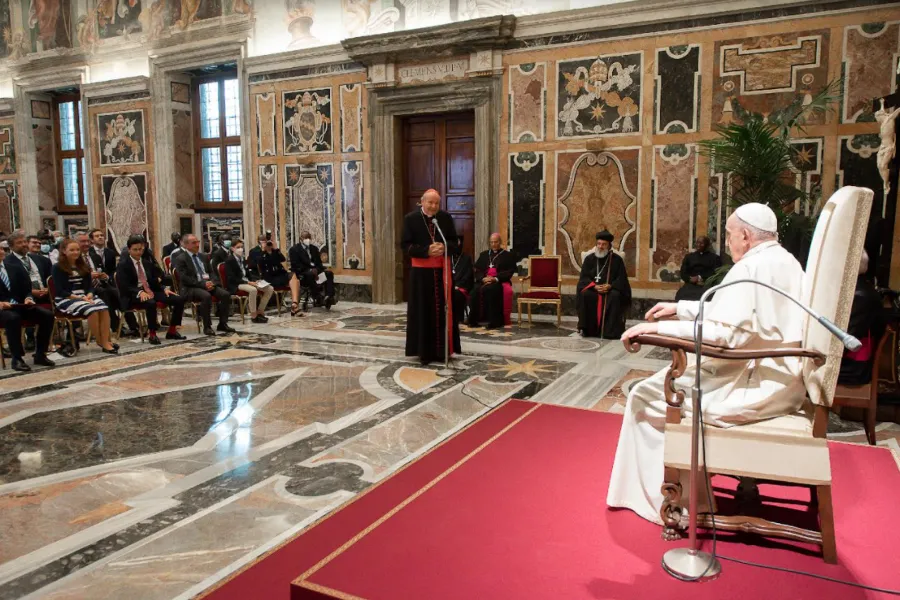
“In our age particularly, one of the greatest challenges confronting us is the administration of technology for the common good,” Pope Francis said in the Apostolic Palace on Aug. 27.
Vatican Media.
“By means of policies and regulations, lawmakers can protect human dignity from whatever may threaten it. I think, for example, of the scourge of child pornography, the misuse of personal data, attacks on critical infrastructures such as hospitals, and the spread of false information on social media and so on,” he said.
Speaking to the International Catholic Legislators Network, the pope encouraged the politicians to “make every effort to undertake serious and in-depth moral reflection on the risks and possibilities associated with scientific and technological advances.”
Pope Francis said that moral reflection on technology would help ensure that laws and regulations focus on “promoting integral human development rather than progress as an end in itself.”
Vatican Media.
“The wonders of modern science and technology have increased our quality of life,” he said. “At the same time, left to themselves and to market forces alone, without suitable guidelines provided by legislative assemblies and public authorities guided by a sense of social responsibility, these innovations can end up becoming a threat to the dignity of the human person.”
The International Catholic Legislators Network is a group of Catholic parliamentarians from around the world that holds an annual private meeting in Rome.
Vatican Media.
The group, founded in 2010 by the Austrian Cardinal Christoph Schönborn and David Alton, a member of Britain’s House of Lords, is dedicated to religious liberty, Church-state relations, the protection of life, and communicating Catholic thought in secular politics.
Vatican Media.
“Your work as lawmakers and political leaders is more important than ever. Charged with serving the common good, you are now being challenged to direct your efforts to the integral renewal of your communities and of society as a whole,” Pope Francis said.
“This entails more than simply combating the virus or seeking to return to the status quo prior to the pandemic — no, that would be a failure — it demands confronting the deeper causes that the crisis has laid bare and aggravated: poverty, social inequality, widespread unemployment, and the lack of access to education.”
Vatican Media.
Among those present at the papal audience were Christiaan Alting von Geusau, president and rector of the International Theological Institute in Vienna, Cardinal Schönborn, and Patriarch Ignatius Aphrem II of the Syriac Orthodox Church.
Vatican Media.
“In an age of upheaval and political polarization, legislators and politicians in general are not always held in high esteem,” the pope said. “Yet what loftier vocation can there be than that of serving the common good and placing the welfare of the community before our personal advantage?”
Vatican Media.
“If we are to heal our world so harshly tried by the pandemic, and build a more inclusive and sustainable future in which technology serves human needs without isolating us from one another, we need not only responsible citizens, but also capable leaders inspired by the principle of the common good,” Pope Francis said.