

In 1938, Monsignor Fulton Sheen wrote, “There are not over a hundred people in the United States who hate the Catholic Church. There are millions, however, who hate what they wrongly believe to be the Catholic Church—which is, of course, quite a different thing.”
Observing the widespread contentions that, for example, Catholics worship Mary or that Catholics worship idols, Sheen notes that this caricature of the Catholic Church was viral. Of course, there was an easily available cure for the millions who suffered from this disease of misinformation: they could have done a little research.
But, alas, these men and women did not. And worse, many of them infected others.
Nine decades later, Sheen’s reflections on the virus remain, but we now have a new strain. This infection is not coming from non-Catholics, but rather from Catholics themselves. And social media is rotten with it.
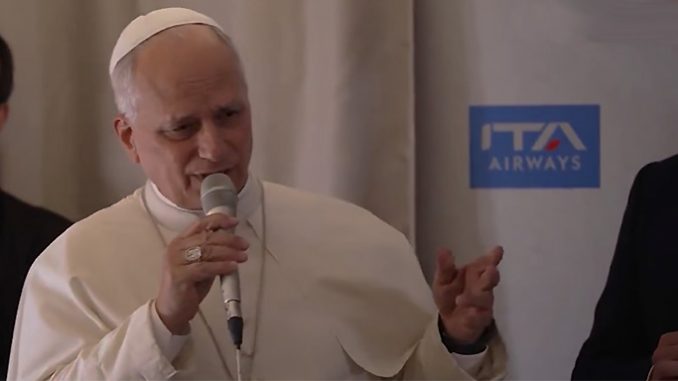
For the past several weeks, it has become chic to post objections to Pope Leo XIV based on second-hand and third-hand reported comments. It is seen as avant-garde to doom-troll for negatively biased interpretations of decades-old stories that might cast sensationalist aspersions on him—and then, of course, to repost these items. It is wildly popular to Like, Love, and Share pseudo-journalistic hot takes from the goat rodeo that is the world of fringe-Catholic sites.
In short, many Catholics have come to believe—and repost—things that are verifiably untrue about the Vicar of Christ.
If Bishop Sheen could look around now and provide us with an observation, he might state: “There are not over a hundred people in the United States who hate Pope Leo XIV. There are millions, however, who hate who they wrongly believe to be Pope Leo XIV—which is, of course, quite a different thing.”
Of course, hating the Pope would be an objectively grievous sin against charity, regardless of what a Pope’s sins might truly be. But hating him on the basis of untruths would constitute an objectively grave sin against both charity and justice.
Now, as in 1938, a few minutes of research would disprove some very obvious yet widespread errors—including the following.
We are told that Pope Leo is in favor of open borders. That’s not true. He has clearly stated to the contrary: “No one has said that the United States should have open borders. I think every country has a right to determine who and how and when people enter.”
We are told that Pope Leo has green-lighted the country of Iran building or obtaining a nuclear weapon. That is not true.
Comprehensively, on July 14, 2025, he stated that “Nuclear arms offend our shared humanity and also betray the dignity of creation.”
We are told that Pope Leo has not spoken out about the violence of the Iranian government. But on April 23, reporter Anneliese Taggart of Newsmax TV, asked Pope Leo: “Do you condemn these actions, and do you have any message to the Iranian regime?” Pope Leo responded, “So when a regime, when a country takes decisions which takes away the lives of other people unjustly, then obviously that is something that should be condemned.”
But much more broadly, we are told that Pope Leo XIV should stop speaking about political matters at all—especially war. “He should,” many insist, “stay in his lane!”
But since political life touches upon all Ten Commandments in immediate, practical, and profound ways, that would be a very narrow lane indeed—and make it impossible to navigate the Ark of Salvation.
Bluntly, the idea that the pope “should stay out of politics” amounts to a fallacious rehash of “the Church should stay out of the bedroom.” The latter dismisses the idea that a pope has any business discussing matters involving the sixth and ninth commandments. The former—especially regarding war—dismisses the idea that a pope has any business discussing matters deeply involving the fourth, fifth, seventh, and tenth commandments.
In truth, a pope has both a right and a duty to guide the faithful in both public and private matters of morality.
Moreover, if the pope should stay out of politics is the working principle of some Catholics, their correction should not be aimed at Pope Leo XIV, but rather at Pope Leo I, whose meeting with Attila the Hun saved the lands of Christendom from mass pillage in 452.
Perhaps their criticism should be aimed at Pope Alexander III, who condemned King Henry II of England for creating an environment that led to the murder of Thomas Becket in 1170. Or at Pope Saint Pius V, whose 1570 papal bull Regnans in Excelsis not only excommunicated Queen Elizabeth but referred to her as “the pretended Queen of England,” and lifted the obligation of English Catholics to obey her rule.
Maybe their objections should be toward Pope Pius VII, who excommunicated Napoleon in 1809. Or at Pope Pius XI for having Nazism condemned at every pulpit in Germany with his encyclical Mit Brennender Sorge in 1937. Perhaps it should be aimed at Pope Saint John Paul II, whose nine-day visit to Soviet-controlled Poland in 1979 helped bring down Soviet communism. Even more à propos, perhaps their umbrage should again fall on Pope Saint John Paul II, who declared the injustice of the war against, and embargo on, Iraq in 2003.
It’s a shame we didn’t listen.
To claim that Pope Leo XIV has neither the right nor the duty to speak about political matters is to object to practices and precedents that date back to patristic times. And if that is the goal—to silence the pope on these issues—the question might be asked: Is the object of condemnation the person of Leo, or the papacy itself?
We Catholics have a serious moral duty to fact-check our posts—as well as our words and our very thoughts—regarding Pope Leo XIV. And even prior to that, we have a duty to love the pope, to respect the pope, and to pray for the intentions of the Holy Father, Pope Leo XIV. If we’re not doing that—if we are not protecting the true reputation of the Vicar of Christ—millions of people will find themselves hating both pope and papacy. And, in some measure, it will be our fault.
If you value the news and views Catholic World Report provides, please consider donating to support our efforts. Your contribution will help us continue to make CWR available to all readers worldwide for free, without a subscription. Thank you for your generosity!
Click here for more information on donating to CWR. Click here to sign up for our newsletter.

John
His quotes come across as being pacifist. God doesn’t listen to those making war. The Church has just war principles that need interpretation. You are ignoring obvious problems in his judgement. He was involved in appointing our archbishop in Detroit that said “all Catholics working in ICE should be excommunicated.”
The truly sad thing is an archbishop would likely say that a catholic politician that supports abortion should be excommunicated. It seems to me, maybe incorrectly, that the recently appointed Cardinals etc are likely to be leftist, which includes being struck with TDS.
A Catholic who denies the Sanctity and Dignity of the marital act within The Sacrament Of Holy Matrimony and thus God’s intention that we respect The Sanctity and Dignity of Human Life from the moment of conception, ipso facto, excommunicates themselves from The Catholic Church.
Code of Canon Law(Latin Church)
Canon 750 1. Those things are to be believed by divine and catholic faith which are contained in the word of God as it has been written or handed down by tradition, that is, in the single deposit of faith entrusted to the Church, and which are at the same time proposed as divinely revealed either by the solemn Magisterium of the Church, or by its ordinary and universal Magisterium, which in fact is manifested by the common adherence of Christ’s faithful under the guidance of the sacred Magisterium. All are therefore bound to avoid any contrary doctrines. 2. Furthermore, each and everything set forth definitively by the Magisterium of the Church regarding teaching on faith and morals must be firmly accepted and held; namely those things required for the holy keeping and faithful exposition of the deposit of faith; therefore, anyone who rejects propositions which are to be held definitively sets himself against the teaching of the Catholic Church.[new]
Furthermore, “Canon 188 §4 states that among the actions which automatically (ipso facto) cause any cleric to lose his office, even without any declaration on the part of a superior, is that of “defect[ing] publicly from the Catholic faith” (” A fide catholica publice defecerit“).
https://www.lifesitenews.com/news/synod-report-suggests-homosexual-relationships-may-not-be-sinful
The members of the synod are clearly in a state of schism and have no authority in The Catholic Church, thus the fact that the current Papacy accommodates and promotes these schismatics means we are dealing with a counterfeit magisterium that is attempting to subsist within The One Body Of Christ while denying The Unity Of The Holy Ghost, and those whose competence it is must declare this counterfeit magisterium anathema least they led The Faithful into schism in their blasphemy of The Holy Ghost. Our Call To Holiness Is A Call To Be Temples Of The Holy Ghost; It is not a call to become schismatic and reject The Holy Ghost by those who claim “if there is a union of a private nature, there is neither a third party nor is society affected”, in order to claim sin done in private, is not sin, or the desire to engage in a demeaning act can change the essence of the demeaning act.
This counterfeit magisterium which is attempting to eclipse The True Magisterium must be declared anathema for The Salvation of Souls,
Meant to say that a bishop is unlikely to say that a catholic politician who supports or votes for abortion bills should be excommunicated.
In no rational world would Cupich been made a Cardinal.
All Catholics in ICE should be excommunicated though.
Why, because some members of ICE exceed their mandate? Then should we also excommunicate all Catholics working for the IRS? Think before you post, please.
suzanne: give yourself a mental health holiday.
How about those in THE FRYING PAN, those in the HOT WATER POT, or those in THE LAVA FLOW?
BTW, who are YOU to judge??
A Catholic with a well formed conscience has a duty to call a spade a spade. A rogue secret police killing citizens is evil. Those that cooperate with evil are evil. Unrepentant sinners are not in communion with the Church.
To call a spade a spade, all Catholics who support abortion or look the other way and vote for Dems should be excommunicated. How can anyone who supports the evil upon evil of butchering of untold millions of babies be allowed to call themselves Catholic must not be allowed. Additionally Rogue abortion supporting Catholic politician should be outed and posted in every Catholic Church bulletin.
Suzanne: Besides sounding hysterical, you’re fears betray paranoia. You really do need a mental health break.
Aside from an apparently unrepentant refusal to acknowledge your bearing false witness regarding actions, intent, and mission of the Immagration and Customs Enforcement agency, when you condemn their mission, you aligh your sympathies with their targets of rapists, murderers, drug dealers, sex traffickers, and families who abandon their children.
To Suzanne: A wildly ignorant, misinformed and outright false statement that does more to promote violence toward law enforcement, as well as discouraging them from tackling the enormous problems associated with illegal, unchecked, unvetted immigration including but not limited to our high rate of drug trafficking that kills, human trafficking including thousands of children as well as adults for sex, slave labor, and drug dealing. Ice is not nor ever been a ‘rogue secret police’ and killings prompted by violence against them and innocent bystanders is not evil. I have little patience or respect for the increasing habit of blaming victims while supporting criminals. Don’t know what church you belong to but its not the Catholic Church.
You misspelled C A N O N I Z E D.
If misspelling were her only problem, she’d be in fine shape. Writing from the bottom up, it seems she never quite makes it up to the intellect.
Exactly. When Leo starts speaking less like a leftist Chicago pol and more like a Pope, I’ll take him more seriously. He dilutes his message on the faith when he treats his personal political likes and dislikes as Gospel.
Popes get into deep trouble when they engage in off-the-cuff conversations with media types in the rear of airplanes. If a Pope wants to speak using his teaching authority, it should be long-reflected upon, measured and said after consideration with his closest advisors. To do otherwise runs the risk of saying foolish things, having the Vatican do “popesplaining”, and getting enmeshed in unwanted political arguments all resulting in people dismissing what he says. He’s frankly running into the same problem Pope Francis did which is diminishing the stature of the papacy in many people’s eyes. Many of us experienced “Francis Fatigue” and I fear we’re quickly developing “Leo Fatigue.” It is unseemly for popes to involve the papacy in verbal skirmishes.
We read here about Pope Leo I and such. Without contesting John Clark’s essay, yours truly is simply reminded of another litany regarding what papal infallibility is and what it is not:
“What have excommunication and interdict to do with infallibility? Was St. Peter infallible on that occasion at Antioch when St. Paul withstood him? Was St. Victor infallible when he separated from his communion the Asiatic Churches? Or Liberius when in like manner he excommunicated Athanasius? And, to come to later times, was Gregory XIII, when he had a medal struck in honour of the Bartholomew massacre? Or Paul IV in his conduct towards Elizabeth? Or Sixtus V when he blessed the Armada? Or Urban VIII when he persecuted Galileo? No Catholic ever pretends that these Popes were infallible in these acts” (editor Vincent Blehl commenting on a Letter to the Duke of Norfolk [1876], in “The Essential Newman” [Mentor Omega, 1963], p. 269).
In a digital cosmos of slogans, memes and talking-head bullet points, what a difference a few words can make–as if precision still matters.
There is a difference between being a sinner, and repenting of one’s sin and denying sin is sin, and that difference makes all the difference when it comes to accepting Salvational Love, God’s Gift Of Grace .
Popes get into deep trouble when they engage in off-the-cuff conversations with media types in the rear of airplanes. If what a Pope wants to speak using his teaching authority, it should be long-reflected upon, measured and said after consideration with his closest advisors. To do otherwise runs the risk of saying foolish things, having the Vatican do “popesplaining”, and getting enmeshed in unwanted political arguments all resulting in people dismissing what he says. He’s frankly running into the same problem Pope Francis did which is diminishing the stature of the papacy in many people’s eyes. Many of us experienced “Francis Fatigue” and I fear we’re quickly developing “Leo Fatigue.” It is unseemly for popes to involve the papacy in verbal skirmishes.
I definitely have Leo fatigue. He sounds naive and does not address the evil of an oppressive, destructive and murderous regime, terrible theocratic government that has been a scourge on the whole world for forty seven years.
Wish he would not talk so much. Be somewhat removed and concentrated on the dignity of the Papicy.
This piece is Catholic guilt-mongering at its worst. The laity in the Church are not children to be spoken to in this manner.
Having spent far too much time on X and other social media, I can assure that the author correctly describes and criticizes the comments and actions of many childish Catholics.
If only you would spend more time here at CWR! Surely you’d hear more from grown-ups!?!
Ha! Right?
If you read Carl’s articles, you find he is very prudent with masterful authentic Catholic insights. We are very fortunate to have him working for our good.
Of course Carl is good for us. We are also good for him. Every sigh we bring about enhances his blood oxygen levels, promotes gas exchange within his lungs, and contributes to emotional well being.
Now, Mr. Ghostley, if you spent a little time here at CWR, you’d surely find an occasional genius of a comment. If you are diligently observant, you may find a bite of tongue-in-cheek. Carl is wonderfully adept at that. However, readers may not recognize or be receptive to that style of humor. GBY.
“If we are not protecting the true reputation of the Vicar of Christ—millions of people will find themselves hating both pope and papacy. And, in some measure, it will be our fault.”
Actually, it will be our fault to indulge falsehoods made in defense of a failing pope, while trivializing false characterizations of his critics, which leads to a hatred for the truth of God.
Popes, like any man, can be effective at speaking while being oblivious to the law of self-contradiction. Like his predecessor, Leo is quite clear about his disbelief that truth is inherently immutable because all truth originates exclusively with God. His creatures create no truth.
Instead Leo supports the farcical, synodal, dialectic practice of dictating to God how His church needs to change its doctrine. “Once the people are taught and conditioned to accept these changes” as he said in an interview.
It’s easy to speak about a nation’s right to secure borders but then insult the integrity of those charged with arresting the criminals who violate that border. It’s an easy and cheap sentiment to express a belief in the evil of abortion and then downplay or even praise the work those who enable it as though it means nothing.
There are no consequences of prestige downplaying sexual sin, the root cause of the abortion holocaust, to a corrupt world wanting to absorb falsehoods and have their vanities affirmed. But a lot more babies end up dead when a pope conveys the impression to the whole world that we just make stuff up as we go along like everyone else. While trivializing sexual sins, including homosexuality, ignoring the hundreds of millions of lives and families damaged from such sins, Leo instead substitutes obedience to the silly meaningless catch phrases of “social justice” and “equity,” both of which are abstract terms, cynically used to advance all manner of tyrannical ideologies, from the cultic evil of feminism to Marxism, and all the principalities of evil within this vale of tears world.
It’s easy to pretend that a prohibition of capital punishment represents taking the high road, while remaining unfamiliar as to why the Church doctrinally accepted its limited use. It is a lack not a granting of mercy to deny moral criminals the opportunity to concentrate their heart, mind, and soul when they know their time is limited and not spent joining the culture of sin denial that permeates prison life.
Leo’s refusal to meet with marginalized Catholics who retain Catholic liturgy and moral sensitivities are exacerbated by his ignorant dismissive assumption that their concerns are limited to idiosyncratic fondness for the Latin language.
Usually when Leo says something orthodox, it is typically only in response to the prodding of those shocked by his failures to have done so on his own. Leo should “stay in his lane” rather than publicly demonstrate his ignorance, charitably speaking, of Catholic witness and Catholic values.
Social justice is a core Catholic value and means of witness. It is one that Jesus spoke about more than sexual sin. Rather than telling the Holy Father what lane is his, you might want to stay in yours.
Good grief another post about sex. Your obsession is unhealthy.
And there’s at least fifteen verses condemning fornication.
susanne: You are bearing false witness against Jesus. The Gospels do not show Our Lord ever inferring a word concerning, let alone promoting, the morally depraved notion of social justice, a phony platitude that justifies Marxist tyranny. If you actually read the Gospels, you would learn that the corporal works of mercy are imperatives for an individual soul, not an abstraction for a fantasy utopianism that does not require getting off the couch, yet, through tolerance of such an evil concept, will inevitably lead to the mass murder of all opponents. Grand scale fantasies of perfecting the human condition have no tolerance of dissenters.
Your ideological allies like Hitler and Stalin, and others, tried it, and the results were not good.
You use a lot of words to be very very wrong.
Just as there is a time for war and a time for peace, so there is a place and a way to speak. There is a place and a way to be effectively silent. Blather in front of a press corp doesn’t suit the pope any more than it does the emperor. This pope has so far mismanaged much in the way of demonstrating charitable and fair speech as it relates to politics. He has reinforced the schism dividing progressive and orthodox Christians. He could not have planned it better.
As a progressive and orthodox Catholic, I feel your criticism is uncharitable and incorrect.
Catholic as a proper name is capitalized.
Please explain, as a progressive orthodox, your feelings. Perhaps one of those Feelings Wheel – Emotions Charts (sold on Amazon) can help.
I suspect your schism is big. Good luck in shrinking it and making yourself one whole again.
I’m not a liberal or “progressive” Catholic and have no difficulty understanding the Pope’s warnings against unjust wars and the arrogance of power. But he has certainly set the cat amongst the pigeons when it comes to conservatives, who are torn between their worldview and Catholic social teaching. Very timely. Excellent management from Rome.
I’d be a little more sympathetic, but the Synod Group Report 9 just dropped and contains a quote that has already shaken Lifesite News and trad sites online:
.
“the account bears witness to the discovery that sin, at its root, does not consist in the (same-sex) couple relationship, but in a lack of faith in a God who desires our fulfilment.”
.
That’s on page 25 (26 pdf version) of STUDY GROUP N. 9, which can be found here: https://www.synod.va/content/dam/synod/process/implementation/10workinggroups/final-reports/sg9/SG-9_Final-Report.pdf
.
The document does not affirm that SSA activities are sinless, but it certainly seems to be a step in said direction.
.
It is about trust. And a lot of us have a very meager supply these days.
It is not possible for any person to engage in demeaning sexual acts even if they be consensual, including if the actors are a man and woman, united in marriage as husband and wife, without demeaning the inherent Sanctity and Dignity of all Human Persons.
Our Call To Holiness prohibits the engaging in of demeaning sexual acts that because these acts deny The Sanctity and Dignity of all Human Persons, in all cases, and are thus devoid of Love and sinful in direct violation of God’s Divine Law regarding sexual morality which does not discriminate against any person, but rather Rejoices In The Truth Of Love.
Actually this report from the communist reeducation camps of the synod does deny the sinful nature of homosexual acts, taking refuge in the “lived experience” sophistry.
The reeducation camps do not even allow meaningful discussion. Groups are assigned an agenda issue, and the only discussion allowed revolves around discussing what psychological shortcomings they might have causing them to resist “new realities” for the “New Church.”
A real discussion, especially among alleged Christians, might examine the psychological shortcomings, leading to the statistical reality, without exaggeration, that cause 99 percent of gays, and everyone else in the alphabet acronym, are supporters of abortion. And a majority see nothing particularly wrong with sex with children. There are no “born this way” explanations that can account for this.
Of course we all remember back in 1979 when Pope John Paul was visiting the USA that Sister Theresa Kane RSM publicly confronted the Pope to his face and tried to embarrass him by demanding that he ordain women to the priesthood. She was also an advocate for support of homosexuality in the Church.
The Pope didn’t excommunicate her. Should he have done so?
Cbalducc: yours is a total non-sequitor. But we don’t expect much better from heterodox leftists.
Don’t the two usually go hand in hand?
I don’t think people take issue with Leo speaking about politics as a general rule. Most popes have done that, so the current situation is not historically unique. Very often, however, Leo sounds like he’s just regurgitation progressive talking points, and that undermines his credibility and authority with those of us who don’t support that perspective.
This is because such “progressive” ideology does not Rejoice In The Truth Of Love but denies The Word Of God, Our Savior, Jesus The Christ, which is anathema for all Baptized Catholics, which includes all Popes.
Very true. You would think that this would be obvious to those who claim to know Christ, but what should be obvious is not necessarily obvious to a darkened mind.
“progressive” ideology is a fantasy at odds with any understanding of human nature.
And like most things of the left, the label is a polarly opposed lie. It’s regressive, not progressive. Benign labelling doesn’t cover up the mass graves of tens of millions that died for this malevolent force. Stalin, Mao, Castro, Pol Pot and Hitler all resorted to mechanized slaughter and surveillance to impose their will on people who expected prosperity and liberation, but received privation and oppression.
Yes, progressivism is the primorial sin first indulged in the Garden of Eden. You shall be as Gods. Progress in all that leads to the betterment of the material human condition is good, but a refusal to accept that the creatures of a creator create no truth at all defines vanity, the root of all evil.
Hitler was a “leftist?” I thought he was a right wing Fascist, like Mussolini.
Hitler and Stalin were both Socialists. All you have to do is take a look at what they named their cause. Oh, and they both exterminated Jews!
Too much snark in some of these comments.
Methinks the devil loves snark.
Just sayin’.
And the devil loves false characterizations, especially without specifics. This does tend to abuse the Eighth Commandment.
Leo has gone out of his way to make very clear anti-American statements and actually blasphemous statements about Just War Theory which is quite remarkable coming from a supposed Augustinian…And his clear silence on Christian and Catholic persecution throughout the world has been deafening. He even lied about a photograph he claims to carry with him to buttress he absurd defence of Islam and Islamists.We know what we have heard…
on April 23, reporter Anneliese Taggart of Newsmax TV, asked Pope Leo: “Do you condemn these actions, and do you have any message to the Iranian regime?” Pope Leo responded, “So when a regime, when a country takes decisions which takes away the lives of other people unjustly, then obviously that is something that should be condemned.”
“J’Accuse…!” Two simple words that changed history.. Pope Leo’s words regarding the atrocities being committed by Iran can be read above. “”Something should be condemned”.
A year ago when he was elected, I was completely unfamiliar with him. But I did find a couple of Catholic scholars, who track such things, describing him as “wishy washy.” Sadly, they seem to be right.
Hate feels like an extreme way to describe how some people view Pope Leo XIV. Dislike, sure – wishing he would focus on other, more important topics, yes, but hate? I’ve never met anyone who hates Pope Leo or Pope Francis.
The world around us seems to be falling apart. The social fabric is fraying. It is clearly evident there is a breakdown of the family unit, a confusion over motherhood versus career, a clarity on basic truths like a boy being a boy and a girl being a girl, the global attacks on Christianity, and the Church’s failure to consistently address priests who are sexually active or abusive. Father Marko Rupnik remains unaddressed, ignored, and still active as a priest.
Then there are the baffling restrictions on the Extraordinary Form of the Mass. How does this even make sense, and why is it happening now? Imagine having a pope who speaks the truth of the gospel boldly every day, stands firmly for what is right, eradicates heresy from the Church, leads Christians in spreading the gospel, heals the wounds caused by disobedience and sin, and inspires hope for what lies ahead.
We are tired, but we do not hate. We observe the Pope’s words and actions and we are confused. Where is the Church of the last 2,000 years? How do we abandon Tradition so willingly and still proclaim any connection to Tradition? Fatigue does not begin to define what we are feeling.
I don’t hate the Pope. Or my bishop. Or even my priest, or any of the priests I have encountered over the years. I roll my eyes at Cupich and Marx, but that isn’t hate.
.
As a convert, however, I am disappointed.
.
As an outsider looking in, I thought I was joining a people/community that supported marriage and didn’t divorce. Didn’t use contraception or have abortions. I wasn’t too keen on the mandatory celibacy for the priesthood, but willing to go along with that because priestess had certainly taken over my parents’ church (Epsicopal), and that caused a lot of hurt to my mother.
.
I turned out to be wrong. No matter what the Church teaches on those issues (on paper), the fact is, the people/community (in-person community) pretty much align with the rest of country in terms of fornicaton, contraception, divorce, and a good many support ordaining women, gay marriage, etc. I don’t feel supported in my beliefs (contraception is wrong, divorce is wrong, and we shouldn’t use fetal cells in the making of vaccines) by any priest. I have had a really good marriage and NFP was pretty easy for us–but what if we had had trouble and needed help?
.
Even “really good” marriages have their less than stellar moments. And standing on your own with nothing but a Catechism with no help for an indifferent clergy is tough. And lonely. And disappointing. And tiring.
.
.
MrsHess: A word of encouragement: While a supportive community of like-minded believers would be welcome, you should remind yourself that your personal path in marriage does NOT go unnoticed by the Lord. Hitch your wagon to no man but only to that of the Person Jesus Christ. It is going to feel like a battle you’re fighting alone but the fact is you are never alone. Christ on the cross felt abandoned by His Father. The fact is He never was. There are those of us on these pages who recognize your courage to live in Truth.
Thank you for your kindness. Really.
.
To Mrs Hess: I am sorry you feel as you do and I have at times been tempted to feel the same. I am a revert to Catholicism. Raised Catholic but secretly an atheist from age 9 to 31 when a 12 step program brought me back to God and God to Holy Spirit and both to Jesus Christ tho with a Church. Joined Roof Friends ( Quakers) in 1990 to 2004 when I could no longer abide by the less religious and more left wing socialist influence that took over. Months after leaving them I encountered the Real Presence of Jesus during a Mass that the Holy Spirit brought me to. It was powerful, life changing and ultimately brought me back into the Church in early 2005. I was thoroughly in love with the Church and still am. Became a daily Mass goer and Communicant, studied the Catechism, Scripture, read top Catholic authors and articles, two years in a Diocesan Catholic Studies program, and more. The most important thing I learned from all this experience is that the Church is the Mystical Body of Christ and that “all Christians are it members who make up that body”. That means when any member, which includes you and me and clergy and the Pope, sins they sin against the body of Jesus Christ. I also learned that Judas did not go to hell because he betrayed Christ but that for refusing to accept God’s forgiveness. You are correct to feel dismay about the state of the Church today. But it is imperative for Catholics to understand that the wrongs we witness from amongst the Church members are nails in the Body of Christ. The cunning and baffling power of the Evil one is working hard to confuse us daily to trick us into thinking that it is the Church ( Christ’s Mystical Body on earth that is the evil and we, the human members are the victims. It is the other way around. The failure of its members to know and understand and most importantly the teachings of Christ’s Church and the consequences of our sins must be seen as an imminent threat to Christ on earth and a call to deepen our commitment to uphold our Faith, evangelize in whatever way we are able, to forgive one another, to not presume others sins that we have no direct knowledge of, to trust God knows all about all, to practice the virtues and ultimately draw Christ into us and grow in His image and likeness as He intended, to draw others to His Mystical Body the Church and to pray always for those who have strayed that they will be bought back into the fold by Jesus and His Holy Spirit. For all the failings in faith that we witness we must match with successes in Charity. I pray for you. Please pray for me.
“Months after leaving them I encountered the Real Presence of Jesus during a Mass that the Holy Spirit brought me to.”
In my 30 years as a Catholic (and adult convert in 1996), I’ve never felt that. Not once.
Mrs. Hess, you are NOT alone. If you are not supported by your priest, perhaps you can find another one? I live in the PNW, historically a loony place for those of the orthodox/conservative persuasion. Over the past 30 years, I have belonged to five different parishes, in search of a reverent liturgy and an even-keeled priest.
You are not alone. Please listen to the Deacon and to Mary McCurry. Know that I am ASHAMED of the behavior and words of many in the hierarchy. I am a cradle Catholic, and I feel as you. Keep up the fight and win the crown in the race. Read St. Paul. He was shipwrecked, imprisoned, and martyred. Today his epistles inspire many, many, many good folk such as yourself. Look at Jesus, his gentle and beautiful soul and body on the cross. Go to Him. He is worth it, and His Church holds onto the truth, even when his priests and his people do not. God bless you.
MrsHess: To quote a liberal plattitude, but with honesty instead of a politician’s cynicism, I feel your pain.
I too am a convert, from atheism. I agree about the painfulness of witnessing the culture of non-Catholic values among professed Catholics. I witnessed this for many years years before my late wife inspired the final stages of my conversion. I’ve always been pro-life even during my years of atheism.
I’ll never forget when Human Vitae was promulgated. I was still on my campus as an undergrad taking a summer course. I thought that HV was a beautiful teaching. Yet, by happenstance I passed by a room used by the Newman Club in the Student Union. I was shocked. They all looked like their best friend just died and eventually someone grabbed a guitar and they all sat around joined in singing protest songs with tears streaming down their cheeks.
I later overcame atheism by finding intelligent design in my scientific work, but the memmory of those silly students, and many other encounters with weak Catholics, was a factor in delaying my conversion by more years than it should have been. The main fault was mine, but witnessing pseudo-Catholicism didn’t help.
And sadly, the culture of non-Catholicism among Catholics has metastasized to include the episcopate. Will we ever see intelligent popes like JPII and Benedict again?
There are many things which a Pope might or should do; but God help him if he dares to criticise the USA ! For it should be obvious to any Pope that the USA is beyond reproach – the Declaration of Independence surely makes that clear?
So you believe that criticizing a criticism is unacceptable and needs to be interpreted as assuming the original object of criticism is sacrosanct?
The beginning of the Declaration of Independence is wonderful and I really recommend reading it. But some of what follows I doubt I would have agreed with if I’d been a colonial back then.
For example, “statements that explain very forcefully and very clearly that no one can go to heaven without true contrition for one’s sins, no one can expect mercy from the Good Lord unless one seriously regrets one’s sins…“ is a True Statement, that becomes false once the claim is made that a sin is not a sin but an act of Love.
The new statement created by the ideology that denies a sin is sin, and thus devoid of Love becomes, in that context, “statements that explain very forcefully and very clearly that no one can go to heaven without true contrition for one’s acts of Love, no one can expect mercy from the Good Lord unless one seriously regrets one’s acts of Love, serves as a contradiction to The Truth Of Love Who Rejoices With The Truth Of Love and thus would never deny that sin is sin, replacing God’s Ultimate Truth with the ultimate lie.
Perhaps the Pope should preface his remarks when making prudential comment with “in my humble opinion” and dogmatic comments with “it is the teaching of the Church that” that without are simply trepid remarks, neither hot nor cold to to add to the chaos of the world at the expense of the Created Order.
If Christ says love your enemies, pray for those who persecute you – we certainly must include a straying, rambling pontiff.
Difficulty is we also have an obligation to the Church faithful to clarify what is good and what is evil. Although, in doing so we frequently allow ourselves to criticize the person rather than the subject.
Complicating this is that frequently a Roman pontiff may behave in such a way that adds to confusion, contradiction of the subject at hand. There are multiple examples in Leo’s predecessor who would criticize abortion then embrace a notorious abortionist in a public forum. Leo XIV has revealed this form of comportment by appointing persons who espouse progressive agendas while he alleges to oppose such agendas.
John Clark rightly advises that we remain respectful of the Office of Peter by – I would add, tempering our justifiable criticisms.
“If Christ says love your enemies, pray for those who persecute you – we certainly must include a straying, rambling pontiff.”
Or two, (in a row). Have you noticed that despite his rabid fan base, nobody is chanting Santo Subito, Francesco?
We don’t have to go to Rome to find enemies. There’s plenty of Cardinals, Bishops and priests who stray and ramble. And while we’ll praying for them, let’s pray first and foremost for the victims of their malfeasance, whose are scandalized or dispirited by their blithering. Let David Axlerod and Sarah Mullaly pray for the Pope. Boy that meeting with Cosplay Sarah was productive, huh?
I’m glad I’ll never run into Seitz, McElroy or Cupich. I despite effete, effeminate pomposity and the temptation to use the obligatory gesture of a handshake to crush their soft hands would be overwhelming. They’re only redeeming quality is proximity to retirement. Unfortunately, now we’re getting actual illegal border crossers, not just open borders advocates to be our “shepherds”.
Last I checked, the Pater Noster didn’t say “Our Father, who art in heaven, lead us into foreign lands”, but who knows maybe Francis fiddled with the Lord’s prayer as well, we know he opined about the “lead us not into temptation part”. Maybe he’s like that Lutheran pastor who claimed Christ’s disapproval of Martha required correction.
Something tells me none of them have the physical vitality of Tom Green, the stage 4 kidney cancer survivor who is using his second lease at life to play (D3) college football-and not as a ceremonial place kicker-but as 6-1 245 pound defensive lineman. He will attain the age of 61 in June. At that age and after once being told to get his affairs in order, he still has a 315 pound bench press. Let’s just say he and I are similar, physically, so I’m pretty confident my temptations could be acted upon.
I’m hoping I made up for the inadequate snark in other comments, because contra Cleo, I don’t see enough. None of us will be confused with St. Catherine of Siena, but I’ve been a big fan since I learned of the remark about “I can smell the stench from here” attributed to her.
Their, not They’re. Stupid autocorrect.
Indeed. For your comment, not your reply.
Bravo!
I simply find the current pope saying a lot of peace/love/dove platitudes, generic “this is what a Christian should say” (according to him and advisors), talking a LOT of world events of geopolitical nature far outside his own and his advisors’ competence, and as all too common in the modern age, almost utterly silent on true concrete spiritual guidance, where if more people had that guidance, there would not be near so many worldly problems upon which to hold press interviews.
Pope Leo is nothing like Bishop Fulton Sheen. Leo blessed a block of ice with Arnold Swartzenegger.
Popes bless water and all kinds of sacramentals. What is your point other than pedantic criticism?
Bravo!
on April 23, reporter Anneliese Taggart of Newsmax TV, asked Pope Leo: “Do you condemn these actions, and do you have any message to the Iranian regime?” Pope Leo responded, “So when a regime, when a country takes decisions which takes away the lives of other people unjustly, then obviously that is something that should be condemned.”
“J’Accuse…!” Two simple words that changed history.. Pope Leo’s words regarding the atrocities being committed by Iran can be read above. “”Something should be condemned”. It should have been said. Je Condamne
My brothers and sisters,
I have never written here. But reading this discussion moved me to write. What is this you are doing here? I do not mean all participants in this discussion and I don’t mean to attack any of your positions with regard to their content. I mean the way you treat each other. Our own bishops and cardinals and our pope are characterised as „enemies“. One of our sisters described as a schismatic.
This is all rooted in serious discussions about specific and important points of doctrine but you don’t discuss those in charity, do you? When you encounter someone that deeply disagrees with you that person is a schismatic, an enemy- that is not true. These people are part of the one body of Christ to which we all belong. This is not an empty phrase- we are commanded over and over again to love one another. We don’t have to be sentimental about, we have to be serious about it. You cannot honestly tell me that you felt love for the people you fought with here. There is a way to correct one of our fellow Christians (although I would be remiss not to mention how we should go about removing splinters…) but this correction must come from a place of Love. Otherwise we are just heaping division on division.
Reading all of this saddened me at first. But no longer. I strongly trust that you are motivated by a firm belief in the good news. I do not want to appear here and speak condescendingly. I have deep respect for you and for the vigor with which you argue. But please, if you consider the position of the other as sin, have love for the sinner, remind yourself how Christ treats all of us who without His grace were doomed to destruction.
Thank you L.S.
“But please, if you consider the position of the other as sin, have love for the sinner, ”
You do know admonishing the sinner is a corporal work of mercy, correct?
“When you encounter someone that deeply disagrees with you that person is a schismatic, an enemy- that is not true. These people are part of the one body of Christ to which we all belong.”
When I meet professed Catholics who deny the humanity of the unborn and who rejects the divinity of Christ and who unambiguously boasts of worshiping Satan, I can rationally conclude that they are heretical, not because “they disagree with me.” Responding to articles of faith are not on the level of choosing a favorite sports team.
I’m not a liberal or “progressive” Catholic and have no difficulty understanding the Pope’s warnings against unjust wars and the arrogance of power. But he has certainly set the cat amongst the pigeons when it comes to conservatives, who are torn between their worldview and Catholic social teaching. Very timely. Excellent management from Rome.
??????
MC:
Catholic social teaching is summed up in subsidiarity, which is exactly the same world view of conservatives.
Edward, it couldn’t be the same, not even in the most inexact understanding. Subsidiarity isn’t laissez faire. Catholic social teaching also rejects the idea (so dear to Edmund Burke) that just because a contract is agreed by both sides it’s moral. Catholic teaching also holds society to be accountable to natural law, which is not merely a synthesis of social conventions, no matter how venerable. It holds that the individual person has a worth that precedes societies which, unlike him, are not eternal; nor are civil sociaties spiritual entities, as Burke and Kirk maintained. These teachings are very hard to reconcile with the beliefs of figures like Burke, Kirk and Scruton.
Your inclinations for strawman contentions are based on your prejudiced assumptions of figures you apparently choose to know little before reducing them to caricatures. I don’t need to have you say Catholic teaching is accountable to natural law. Humanity being subject to immutable innate truth and natural law is what conservatives have always affirmed, along with rights as divine endowments and never political inventions. Your reading of Burke is reductionist. Agreements between individual interests in themselves are always moral provided the substance of the agreement and transaction is moral, after which, it is none of the business of the state.
Your contempt for the “world view” of conservatives is based on false presuppositions and lacks the honorability to seek elaborations of subsidiarity, where you falsely associate me as associating it with laissez faire economics.
A near synonym for subsidiarity was captured by former communist and atheist Jacques Maritain, as well as Charley Kirk for that matter of whom you give false witness. Both emphasize the word personalism. A value that requires personal altruistic virtue exercised at the human level. The former communist saw the futility of socialism, and Kirk saw the evil of contemporary academia preaching its restoration and anti-Christian leftists in government seeking its implementation. A more formal Catholic definition affirms that human problems are always best addressed at the lowest level of adjudication as possible. It is the principle that central governments should have no more than a secondary function where they only undertake tasks that cannot be performed locally. Such limitations are a better means of preventing grand scale social manipulations where tyrannies inevitably become dominant.
And Trump has exercised the forcefulness sane people have craved for decades, admittedly in crude terms at times. Elitists are not only evil in their intentions, they are both imprudent, and they are the real fascists, self-evident to any honest mind above the age of twenty. But it is their crimes against humanity that the anti-fascist, anti-elitist Trump, who despite suffering slings and arrows of Orwellian false accusations from the invincibly foolish, has achieved some level of success. Pope Leo shows little resistance to conventional leftist sentiment, including a non-Catholic leaning towards relativism, and including his unintentional support of actual tyranny. He is best ignored.
Your addiction to being the highest court of appeal on the judgement of people’s intentions is regrettable. Let’s skip Stalinist show trial for a minute though.
If you look again, I said that societies need to be subject to natural law. As the Church is the mystical body of Christ, it is the final arbiter of what that is, and civil societies are accountable to that arbitrage. Unfortunately, the founders of conservatism have not clearly affirmed that societies are subject to natural law. I mentioned Burke, Kirk (Russell Kirk, not Charles Kirk, an activist who was not iconic as a conservative ideologue) and Scruton. If you put up some facts to show where they clearly supported society’s subjection to natural law, I will happily provide you with further information.
You’ve only quibbled with contract. On contract, Burke wrote (Thoughts and Details on Scarcity), “The impossibility of the subsistence of a man who carries his labor to a market is totally beside the question… The only question is, What is it worth to the buyer?”. Burke therefore claimed it was “impossible” that ostensibly free contracts between labourer and employer could be to the detriment of one of the other, but this is rejected by Pope Leo XIII explicitly.
Conservatives often associate subsidiarity with laissez faire. I didn’t have you in mind. But since you have associated Trump with “subsidiarity” and “anti-elitism”, your own interpretation of Church social teaching appears a bit dodgy. Trump returned to power buttressed by the worst coterie of technocrat elitists in the history of the US. Despite coasting to the White House on whatever platform it was, his main “worth” is to have been able to give these elites things they had only dreamed of.
“…summed up in subsidiarity”? Said the cyclops?
Not exactly summed up, but at least compiled into the “Compendium of Catholic Social Teaching” (2004), we find what I humbly propose is a family of binary aspects of the universal Natural Law, evoking the moral virtues of courage, temperance, justice and prudence:
Centering above all on the transcendent (!) dignity of each human person without exception, we then have: (1) the transcendent human person AND the family, always together, (2) wider Solidarity AND concrete Subsidiarity always together (!), (3) rights AND responsibilities always together, (4) faithful citizenship AND informed conscience always together, (5) the option for the poor AND the dignity of work always together, and (6) solidarity AND sustainable/intergenerational care for God’s creation always together.
Parallax and depth perception?
To MC where there was no reply button.
You fault me for the very Marxist presumptions of intentionality that you then proceed to exercise without any sense of irony. If you look again, I clearly affirmed that societies need to be subject to natural law, to which I added that this is a bedrock principle of a conservative world view.
You falsely claim that I “only” quibble with contract. You are incomplete in your selective understanding of Burke. Contracts between parties, fully cognizant of their implications, are moral according to natural law, just as Jesus conducted them in his dealings as a carpenter. It is not the proper affair of civil society to have supervised the economic actions of Our Lord nor anyone else.
Your presumptuousness of intentionality links me as a Trumpian, which I am not nor did I infer I was. I do observe that Trump’s appeal to sane people is his proper contempt for elitists of group think that dominate academia, government bureaucracies, media, and entertainment and assume the totality of human action can and should be monitored by an “all knowing” government, one that can reject natural law.
Your sociological reductionism is wrong in associating conservatives with promoting unlimited laissez faire economics as you impose your sociological assumptions of intention, including those of Russel Kirk. Burke and other conservative theorists, whose discussions of morality you ignore to contrive a false conclusion they are promoting amoral transactions, wrote of a morality conservatives recognize but the political left rejects, objective morality, to which leftists substitute the pseudo-science of sociology, which you, in your projections, appear to indulge.
There is nothing inherently elitist about the super wealthy, nor is it inherently evil to have large scale ownership of enterprises that produce wealth for human flourishing. There is no such thing as “techno elitists” despite that, as individuals, many of the wealthy do pursue what elitism really means, the assumption of a hierarchy of human worth and intellect, which also affirms the privilege of reinventing morality in accord with their vision. Our Church suffers an episcopate who often demonstrates the same tendency.
It is immoral when monopolistic practices defraud would be competition, which is why real conservatives have led opposition to monopolistic practices, which are not consistent with economic freedom. But social engineering can never eradicate original sin. And the braggadocios displays of Trump, obnoxious at times, have nonetheless never boasted of his enormous personal generosity to the struggling.
Once again putting show trials to one side, your assertion “Contracts between parties, fully cognizant of their implications, are moral according to natural law” is incomplete from the point of view of Catholic social teaching, as Pope Leo XIII said in Rerum novarum, 45: “there underlies a dictate of natural justice more imperious and ancient than any bargain between man and man”. Freely agreed contracts are accountable to universal natural law, which is not necessarily implied in their “free agreement”. Ostensibly free contracts can indeed be unjust and make the employee the “victim of force and injustice”, as Pope Leo said.
The conclusion that your association of Trump with subsidiarity and “anti-elitism” casts doubt upon your understanding of Catholic social teaching stands. There is no way imaginable that the two can be associated.
Trump is backed by the worst elites. In full view at his inauguration were Sam Altman, Bezos, Musk, Zuckerberg, Pichai, Shou Zi Chew and Cook, and they haven’t taken a step back since. Vance describes “Dark Enlightenment” Curtis Yarvin as one of those who formed his own worldview. Yarvin’s associated with Nick Land, and with Andreessen’s Techno-optimist Manifesto, an appalling profession of faith in secularism. It’s not very illuminating to try to put this bunch of elitists up against the older “UNESCO” liberal brand. They’re not so much opposed as a changing of the guard of Enlightenment secularism for the worse. The corruption already manifest in the circles and relations closest to Trump does not augur well for the future. In any case, whether it’s beliefs or practice, the coterie of elitists Trump has opened wide the doors to can in no way be described as compatible with Church social teaching.
The Pope has done a fantastic job to show this up. Whatever his shortcomings on other matters, he will win on this issue. When it comes to natural law, the Church has “all the cards”, if it decides to use them.
Striking depth perception.
A fortifying read.
“I’m not a liberal or “progressive” Catholic”
Huh?
L.S. you write: “You cannot honestly tell me that you felt love for the people you fought with here.”
Unfortunately, love is not a “feeling”; love is an act. Feelings are transient, ephemeral, many times intense but simultaneously shallow.
Secondly, when anyone refrains from speaking the truth to a brother, he can hardly be accused of loving him. Speaking truth can oftentimes disturb our sensibilities but we must spek it nonetheless.
Prudery can be a problem viz. the situation in Simon the Pharisee’s house with the woman coming out of nowhere to cry at the Lord’s feet at the dinner table. It’s possible this was the woman’s own initiative and her very first approach to the Lord.
I don’t mean to focus on the woman, rather the set of explicit remarks made by the Lord and that He could “read” what they were thinking. As the other time with the woman “caught in adultery” they tried to use it to set it up for evil process and results.
Or consider the image from the wrangler, lassoing every little calfling to brand it fast and make it run with the herd to a slaughter house but it hasn’t even put on ten pounds yet. That wouldn’t be pastoral, charitable, sensible, well-balanced, & etc.
Captive and dis-enlivening.
It’s telling that when the Holy Father condemned tyranny and unjust war, he never mentioned Trump or his administration by name. And yet, MAGA world instantly assumed the remarks were about them. No identification was necessary; they recognized themselves in the Pope’s words. That snowflake reaction of Trump and his admin suggests the Holy Father struck a nerve and exposed some uneasy consciences.
Can a Pope speak on political matters? Yes, he can.
Should Pope Leo be more judicious in managing how frequently he expresses himself on political matters? Yes, he should, especially when answering questions from reporters about current events and topics. This should not be occurring on a weekly basis. The Holy Father does not need to feed the 24-hour news cycle, nor is it in his benefit to do so. The more often he is drawn into reacting to current controversies, the more likely it is that his words will be used and misused: misinterpreted, taken out of context, recontextualized in a way that alters the intent, etc. If the larger goal is, as John Clark indicates, to exercise “a right and a duty to guide the faithful in both public and private matters of morality,” that guidance can be hard to discern from an assortment of individual remarks made in response to questions about whatever is going on right now, and re-communicated in bits and pieces. This disjointed pattern of communication is, itself, exacerbating the confusion, and Pope Leo ends up losing control over whatever he is trying to convey.
And he subverts his moral authority as a Catholic leader, as the Vicar of Christ. That, causes me shame.
The problem is that Pope Leo kept calling for peace negotiations, which Iran had no interest in until they were bombed into oblivion with their government leaders being destroyed. We must remember that Iran leadership was an arm of fundamentalist Islam as handed by Mohammed through the Koran with the goal “convert or die.” It is a religion of hatred and violence. Look at the number of their own people that they murdered.