

 By
By Recent excavations at the site match the account of an eighth-century Bavarian bishop who wrote about a church in Bethsaida that was built over the home of Sts. Peter and Andrew.
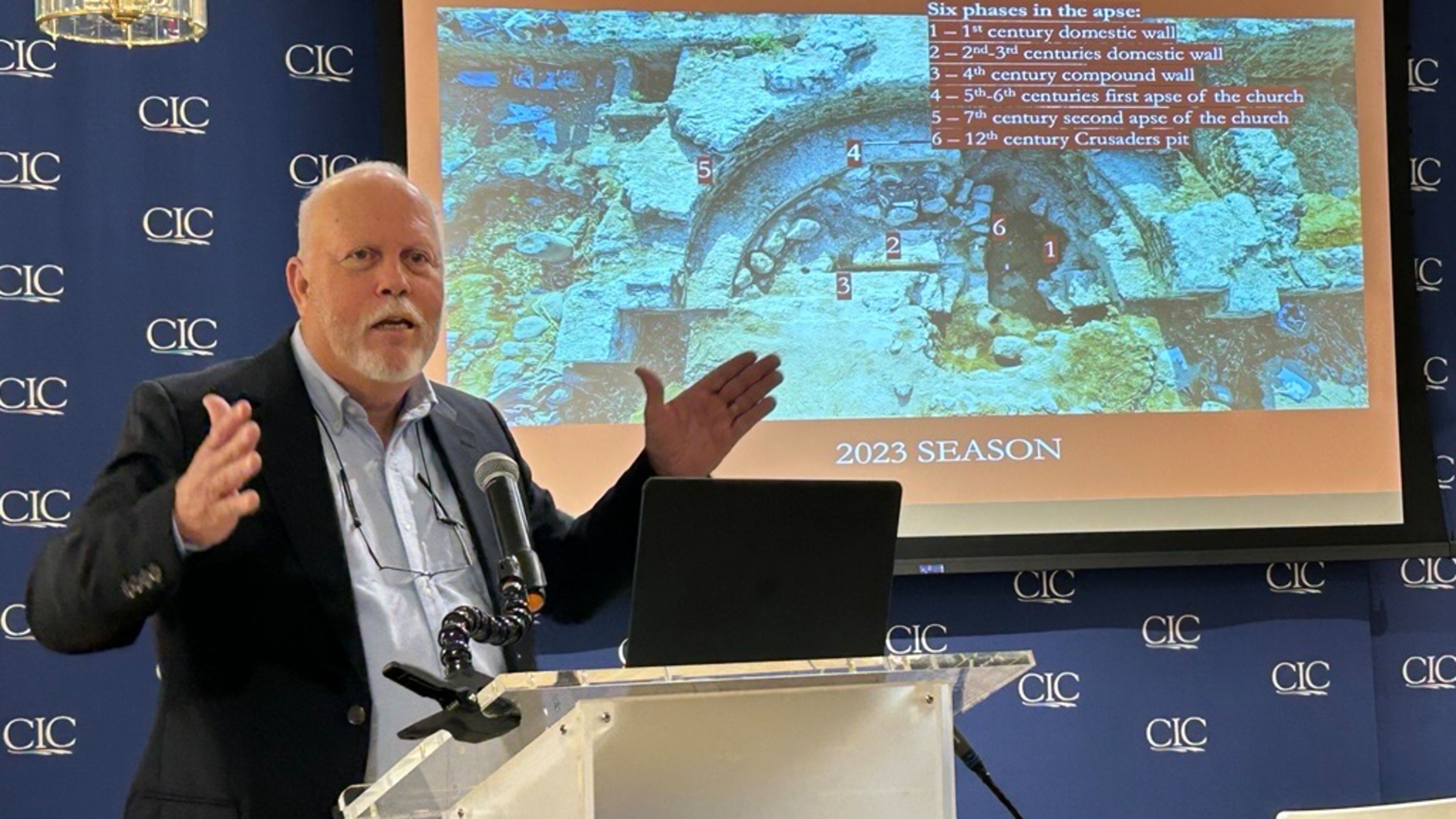
WASHINGTON — The academic director of one of the most celebrated current archaeological digs in Israel was in Washington, D.C., this week to provide an update on the ongoing excavation of Bethsaida, the town that the Gospel of John (1:44) records as the home of the apostles Peter, his brother Andrew, and Philip and where Jesus performed various miracles.
In a May 5 presentation at the Catholic Information Center, Steven Notley, the academic director of the El Araj Excavation Project, said the excavation of the last town of apostolic times to be discovered, which began in 2016 and has been ongoing since then, has essentially confirmed that the site, known as El Araj, is indeed the location of the Galilean seaside town of Bethsaida, which is referenced several times in the New Testament.
Notley, who is also executive director of the Center for the Study of Ancient Judaism and Christian Origins, lived in Jerusalem with his wife and four children for 16 years and has been leading groups of students and laypeople to Israel and the eastern Mediterranean region for over 35 years.
Melissa Overmyer, a Catholic evangelist who has participated in the dig at Bethsaida, shared her own testimony at the event, saying being a part of such experiences in the Holy Land turns “Bible stories into Bible realities.”
Notley said excavations at the site in 2018 uncovered the remains of a Byzantine-era basilica and a first-century house located directly under its apse in 2023.
These remains, he said, match the historic account of Willibald, an eighth-century bishop of Eichstätt in Bavaria, Germany, who traveled to the Holy Land in 725 A.D. and wrote about a church in Bethsaida that was built over the home of Sts. Peter and Andrew.
Among the discoveries made at this basilica is a mosaic, uncovered in 2022, with the inscription “Chief of the apostles and keeper of the keys of heaven, intercede for him and his children George and Theophano.”
Last year, the site also endured a wildfire, the results of which Notley said have subsequently allowed the team to uncover evidence of columns and other structures previously overlooked due to dense underbrush.
Notley told EWTN News that the archaeological team was able to identify a structure underneath the apse of the basilica by identifying pottery they discovered there as first-century pottery. The team also found first-century fishing weights.
“So, we have a first-century house wall under the apse. It doesnʼt have a plaque on it that says ‘Peter slept here,’ but from a perspective of archaeology, it doesnʼt get much better than that,” Notley said.
Notley said he welcomes volunteers to participate in the ongoing dig, which he said is entirely privately funded. Information about how to volunteer may be found on the excavation’s website.
If you value the news and views Catholic World Report provides, please consider donating to support our efforts. Your contribution will help us continue to make CWR available to all readers worldwide for free, without a subscription. Thank you for your generosity!
Click here for more information on donating to CWR. Click here to sign up for our newsletter.

Leave a Reply