No Picture
News Briefs

The Impossible Burger: Ethics and a CNA taste test

November 9, 2019 CNA Daily News 11

Washington D.C., Nov 9, 2019 / 05:00 am (CNA).- Food trends come and go, and the trend du jour is plant-based “meat” that is partially made in a laboratory.

Many vegans and vegetarians have rejoiced at the growing popularity and relative mainstream success of both the “Beyond” and “Impossible” brands, and there is a growing claim that eschewing meat choices in favor of these new products is a more ethical choice for consumers.

CNA spoke to Catholic moral theologians to discuss the ethics of eating meat, and the morality of eating faux meat during penitential fasts. And, lest CNA coverage of these products seem incomplete, we conducted a taste test.

According to Dr. Joseph Capizzi, a professor of moral theology at the Catholic University of America a person is not morally obligated to choose a vegan patty, like the Impossible Burger, over a beef or chicken burger.

“There’s no reason, in my opinion, to think the consumption of products so dependent upon technology are superior to the consumption of animal products,” said Capizzi.

“I do think, however, in both cases, ethically relevant issues include the production of the foods, including not merely the environmental impact, but also the ways technologies might distance the human being from creation,” he added.

Capizzi told CNA that while he does not think it is ethically superior for people to stick to eating mostly plant-based food, he does think that “people need to reflect on the ethical nature of eating.”

“Though eating is a basic human need, how we eat, what we eat, with whom we eat–including whom we exclude–are all questions that need our reflection,” said Capizzi. While these alternative products have done some work to address some of these concerns, there is much work to be done.

“One thing I’ve noticed is the lack of hospitality that can accompany over-restrictive diets,” he explained, recounting the experience of seeing a poor person offer meat to guests, presented as a luxury, only to see the meat rejected because of the guests’ vegetarianism.

Dr. Charles Camosy, a professor at Fordham University who has written extensively about veganism and vegetarianism, disagreed with Capizzi’s take. Camosy told CNA that these new products make it harder for American Catholics to justify eating meat.

“The Catechism of the Catholic Church insists we have a moral duty not to cause animals to suffer or die needlessly,” said Camosy.

“With good-tasting protein available from so many sources now, including from new imitation meat products, the teaching of the Church would seem to indicate that the necessity of participating in the suffering of death of animals, for most of us, isn’t what it might have been in the past.”

Camosy noted that the Bible states that in the new Kingdom of God that will come with Christ’s second coming, “animals are to be our companions, not our food.”

The new kingdom “will be a Peaceable Kingdom among all creatures: lambs, lions, snakes, and babies,” he said, and there will be no need to slaughter animals.

The faux hamburger market is dominated by two companies: Beyond Meat makes the Beyond Burger patty, Beyond Beef ground meat substitute, Beyond Sausage, and Beyond Beef Crumbles. Impossible Foods sells the Impossible Burger patty and the Impossible Sausage.

“Protein, fat, minerals, carbohydrates, and water are the five building blocks of meat,” says Beyond Meat’s website. Beyond uses plant-based versions of protein–including protein from peas, mung beans, fava beans, brown rice, and sunflowers–and fats to create its products. Additionally, Beyond uses beet juice to create a burger that “bleeds.”

Impossible Food uses “heme,” a protein that is found in nearly all living things, to make its plant-based burgers taste like meat. This heme also mimics a  “bleeding” effect.

“Impossible Burger gets its heme from the protein soy leghemoglobin, which is naturally found in soy roots. Impossible Foods produces soy leghemoglobin through genetic engineering and fermentation. Thanks to heme, Impossible Burger has a rich, beefy flavor that satisfies the most discerning meat-eaters — but it contains no animal products whatsoever,” the company’s website says.

Dunkin’, the restaurant once known as Dunkin’ Donuts, launched a Beyond Sausage sandwich nationwide Nov. 6 after a successful test market in Manhattan. Customers can choose to substitute a veggie egg white patty for the fried egg. CNA paid $3.99 for the Beyond Sausage sandwich.

An ordinary pork sausage, egg, and cheese sandwich on an English muffin from Dunkin’ costs $4.99.

CNA recruited three journalists for a blind taste test of the Beyond Sausage sandwich and pork sausage sandwich. Two out of the three testers were unable to determine at first glance if the sandwich they were eating contained Beyond or pork sausage, and one mistakenly thought the pork sausage she was eating was actually the Beyond Sausage.

Two out of the three testers said they preferred the pork sausage sandwich to the Beyond sandwich, but one said she liked that the Beyond sandwich reminded her of a falafel. This tester was the only one who said she would order the sandwich again in the future.

The sandwich was not extremely popular among testers. But some Catholics have asked whether it would be good enough to eat on a Friday, when Catholics are instructed to abstain from (actual) meat.

CNA asked Fr. Thomas Petri, O.P., the academic dean and vice president of the Dominican House of Studies, to weigh in on whether or not an Impossible Burger (or similar product) would be appropriate for a day when Catholics abstain from meat.

“The Church’s universal norms say that we should abstain from meat on Fridays, especially Fridays in Lent,” explained Petri. “The Impossible Burgers are not technically meat. So, of course, someone could argue that we can eat them on Fridays.”

Still, he said that “giving up meat but having Impossible Burgers that taste like meat seems to me to be a technicality to get out of the spirit of the penance,” he said.

“We should remember the point here is to give up something in union with Christ crucified. If a person is seeking Impossible meat to skirt the penance, it’s hard to believe they’ve really understood the point of it all.”

It is important for Catholics to remember that fasting and abstinence are not done for purposes of dieting, or to respect animals, said Petri. The purpose of fasting is to “unite our offerings to the perfect offering of Christ, and so to prepare for the great feast of his coming.”

And for those who are still struggling (or hungry) on a Friday, Petri had some advice.

“If you’re craving meat on a Friday, offer it up.” 


[…]

No Picture
News Briefs

Holy See won’t participate in Nairobi Summit

November 8, 2019 CNA Daily News 1

New York City, N.Y., Nov 8, 2019 / 12:01 pm (CNA).- The Holy See will not participate in next week’s Nairobi Summit, its mission to the UN announced Friday, saying next week’s international gathering is too focused on “reproductive rights”.

The Nov. 12-14 Nairobi Summit is sponsored by the UN Population Fund and the governments of Kenya and Denmark, and it marks the 25th anniversary of the International Conference on Population and Development, which was held in Cairo.

Its program includes five themes, among which are “Universal access to sexual and reproductive health and rights as a part of universal health coverage” and “Upholding the right to sexual and reproductive health care even in humanitarian and fragile contexts.”

“The organizers’ decision … to focus the conference on a few controversial and divisive issues that do not enjoy international consensus and that do not reflect accurately the broader population and development agenda outlined by the ICPD, is regrettable,” the Permanent Observer Mission of the Holy See to the United Nations said Nov. 8.

The Holy See had informed Kenya Oct. 24 it would not be participating in the summit.

“The ICPD and its encompassing Programme of Action within the international community’s broad development agenda should not be reduced to so-called ‘sexual and reproductive health and rights’ and ‘comprehensive sexuality education,’”, the Holy See stated.

Rather, there is an “urgent need to focus on critical aspects of the Programme of Action, such as women and children living in extreme poverty, migration, strategies for development, literacy and education, the promotion of a culture of peace, support for the family as the basic unit of society, ending violence against women, and ensuring access to employment, land, capital and technology, etc.”

The permanent observer mission said the Holy See cannot support the Nairobi Statement, citing that “no substantive and substantial consultations on the text were carried out. The Holy See notes that if more time and a truly inclusive approach had been chosen, broader support could have been ensured for the text and for the conference.”

It added that “the conference will be held outside of the United Nations framework, thus precluding transparent intergovernmental negotiations while conveying the misleading impression of ‘consensus’ on the ‘Nairobi Statement.’ Therefore, ‘The Nairobi Summit’ cannot be deemed a meeting requested by the United Nations or held under its auspices.”

The permanent observer mission added that “the Holy See is and remains a staunch supporter of ensuring the advancement of equitable, sustainable and integral human development that fosters human dignity and the common good of every man, woman and child.”

Several African bishops have also noted grave concerns with the gathering in Nairobi.

Bishop Alfred Rotich, Bishop Emeritus of the Military Ordinariate of Kenya and chair of the Kenyan bishops’ family life office, told ACI Africa: “We find such a conference not good for us, (and) destroying the agenda for life.”

Archbishop Martin Kivuva of Mombasa described the summit’s agenda as “unacceptable according to our teaching of the Catholic Church” and he encouraged Kenyan president Uhuru Kenyatta to be wary of the forum.

To counter the agenda of the Nairobi Summit, the Kenya Christian Professionals Forum, with the backing of Kenya’s bishops, has organized a parallel convention to be held Nov. 11-14.

[…]

No Picture
News Briefs

Saginaw diocese buries the forgotten dead on All Souls’ Day

November 7, 2019 CNA Daily News 0

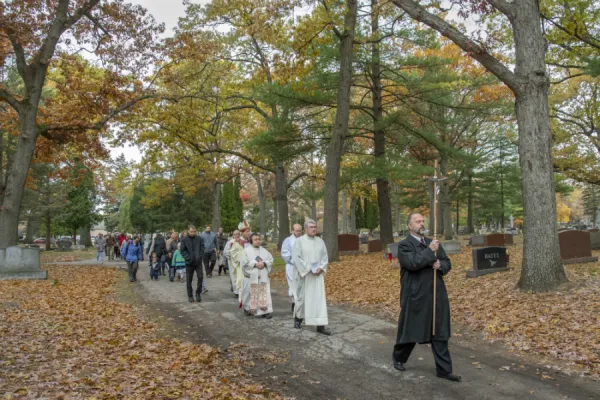
Saginaw, Mich., Nov 7, 2019 / 03:01 pm (CNA).- On Saturday Bishop Robert Gruss of Saginaw said a Mass of All Souls’ Day for 175 people whose mortal frames had been unclaimed, and which were then buried at one of the diocese’s cemeteries.

“The Church invites us to pray in a very special way, give alms and do works of penance for all the deceased, for our loved ones and friends, but also for all those who have died whom we have never known. There are many who have no one to pray for them,” Bishop Gruss preached during the Nov. 2 Mass at Calvary Cemetery in Kawkawlin, Mich., about 20 miles north of Saginaw.

“This is why we gather today in this special way for this memorial service for these unclaimed cremains. These individuals have no one to pray for them. They have not received a burial proper to their human dignity. But we will doing this today, giving these men, women and children a proper burial.”

The cremated bodies of 175 people were entombed in a crypt at the cemetery. Their remains had been in a county medical examiner’s office or funeral homes, and while some of the people had died quite recently, the oldest remains were of someone who died in 1972. Among those whose remains were entombed were 13 veterans, and military honors were presented by the Bay County Veterans Council Honor Guard.

“These individuals, these children of God, we know very little about. We know their names, but we know very little about them. But we do know that their lives have value; in the eyes of God and in our eyes, they belong to Him,” Bishop Gruss reflected.

“We are here today to show our love and care and concern for our brothers and sisters by upholding their God given dignity and providing them a final resting place where they will be remembered.”

The bishop noted that those who were being buried after the Mass “have all been part of a family. Why their cremains have been left behind is unknown to me. Though their lives remain a mystery to all of us, every aspect of their lives, every experience of their lives is known [to] God … And in the mystery of Christ’s love, they too have been offered salvation because it is God’s will that all people will be saved.”

Bishop Gruss began his homily saying, “the Church has always promoted the praying for our deceased loved ones and teaches the value of this practice. Oftentimes people make the assumption that their loved one is automatically going to heaven. We can never presume anything such as this.Yes, it is God’s will that all people are saved, but the ultimate judgment belongs to God and not to us. We can only live in hope that heaven becomes a reality for our loved onesand for us by the way we live our lives. If heaven were automatic, why would the Church need to pray for their deceased loved ones?”

He added that “we gather here today to pray for all of our loved ones who have gone before us. We gather here today to pray for these men, women and children whom we will lay rest.”

Alice Lefevre, Cemeteries Director for the Diocese of Saginaw, noted ahead of the interment that “Our Lord instructs us to bury the dead. It is a corporal work of mercy.”

The diocese reported that the students of St. Brigid of Kildare Catholic School in Midland held a “penn war” to raise money for expenses associated with the burials, raising more than $500, which was used for memorial flowers, among other things.

According to MLive, the diocese reached an agreement with Saginaw County in August that it will inter any cremated remains accumulated by the county.

The county controller, Robert Belleman, says he contacted the diocese to see if they could assist with proper burial of the cremated remains of 47 people which were held at the county medical examiner’s office.

“We really appreciate that willingness by the Diocese of Saginaw to agree to properly bury these 47 cremains,” Belleman told MLive.

[…]