No Picture
News Briefs

US bishops approve hymn translations for Liturgy of the Hours

November 12, 2019 CNA Daily News 4

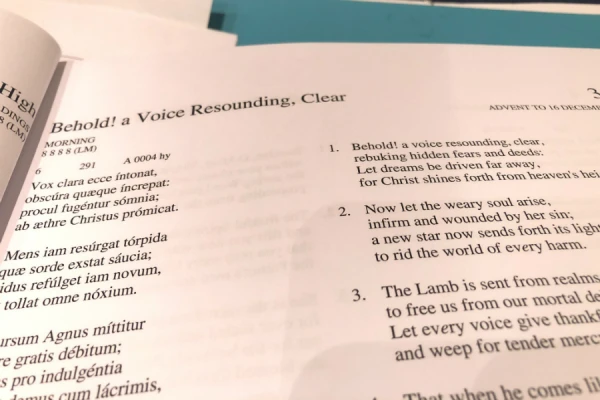
Baltimore, Md., Nov 12, 2019 / 03:01 pm (CNA).- The Latin rite bishops of the US voted overwhelmingly Tuesday morning to approve the International Commission on English in the Liturgy gray book translation of the hymns of the Liturgy of the Hours.

The Nov. 12 vote was 204 in favor, and five against.

Bishop Daniel Flores of Brownsville tweeted that “the translation of the Latin hymnody in the editio typica of the Liturgy of the Hours is a tremendous contribution to the liturgical heritage. The theological insight and aesthetic of the Latin hymns will have an English voice into the future; a work of theological transmission.”

But before the vote, the Fall General Assembly was treated to a concert performance in which the hymn translations were sung for the bishops.

The choir, which was directed by Adam Bartlett of Denver, consisted of Fellowship of Catholic University Students missionaries who live in the Baltimore area, as well as music students from the Catholic University of America. The choir sang the opening verse of the hymns, and were then joined by the bishops.

Bartlett told CNA that the choir had only just met up and rehearsed Tuesday morning before performing before the bishops. He knew some of the singers through his work with FOCUS, and he has directed the choir that performed at the organization’s national conference for the past four years.

Before ICEL did this translation, the vast majority the hymns that were printed in the English edition of the Liturgy of the Hours were translations of those found in the editio typica.

“What’s unique about this translation is that the hymns of the Latin typical edition are actually being translated, which didn’t happen the first time around,” said Bartlett.

“So we have hymns from St. Ambrose, Gregory the Great, you know, all of the great hymn writers … that are being translated and also paired with chant tunes that come from our rich tradition. In addition, of course, to modern melodies that they can be sung with,” he added. He said these translations created “great utility” as they could be sung with different tunes.

Bartlett said he found the updated hymns to be “absolutely gorgeous” and “so rich with theological imagery.” He thinks that these hymns are going to “make a really remarkable contribution to the musical life of the Church.”

“These are our hymns as Catholics,” he said. “These are the ones that come from the liturgy itself, and are put in the place where they ought to be sung, which is the Liturgy of the Hours. But I think that’s probably going to have an impact on the hymns that we sing at Mass as well.”

Valeria Lamarra, a chorister who sang on Tuesday, got involved with the ICEL hymn project through her school’s campus ministry. She had never met anyone she performed with before Tuesday morning.

“We had half an hour to practice, before getting up in front of 200 bishops,” said Lamarra. “It feels like a huge victory that the changes passed.”

[…]

No Picture
News Briefs

Bishop Barron on how to reach out to the ‘nones’

November 12, 2019 CNA Daily News 5

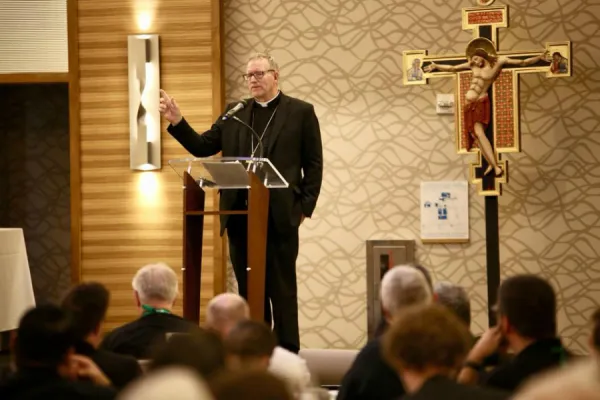
Baltimore, Md., Nov 12, 2019 / 02:38 pm (CNA).- Bishop Robert Barron, auxiliary bishop of Los Angeles and chairman of the US bishop’ committee on evangelization on Monday outlining five paths Church leaders should take to re-energize the religiously unaffiliated.

Barron’s Nov. 11 presentation was on the opening day of the USCCB’s Fall General Assembly, held in Baltimore. His presentation opened with a trailer for a new video that fully expands on how better to reach the religiously unaffiliated.

To better engage people who are not affiliated with any religion or who may be fallen-away Catholics, Barron said that the transcendentals – truth, goodness, and beauty – must be communicated to young people in order to pique their interest in religion. Barron presented five strategies and techniques that can be deployed in order to communicate these concepts to young people and the religiously unaffiliated.

These strategies highlight the Church’s teachings on justice, her beauty, her intellectualism, her missionary mission, as well as encouraging “creative use of the new media.”

Young people, said Barron, do not respond well to some of Catholicism’s teachings – particularly those on sex. What they do seem to appreciate, however, is the Church’s teachings on social justice. Barron suggested that it could be effective to lead with the Church’s teachings on social justice, referring to this as the “path of justice.”

“We have a very powerful tradition around doing the works of justice. And young people like that. They get it,” said Barron. He cited figures such as Dorothy Day, Thomas Merton, and St. Teresa of Calcutta as figures who have lived out Church teachings of social justice who should be held up as examples to the young people of today.

“We know this tradition. We should propagate it,” he said.

Barron said it was important to flex the beauty of the Church to young people, in what he called “Via Pulchritudinis,” or “The Way of Beauty.”

This beauty, said Barron, extends to more than just physical church buildings. There must also be beauty present in liturgies, as well as in things such as websites – where young people may first encounter their local parish. Barron stressed the importance of having a parish having a solid online presence, as well as engaging Catholic artists and writers and promoting their work.

“Beauty,” said Barron “is a great path to follow.”

Shifting gears to what he called the “intellectual path,” Barron was critical in how he believes the faith was currently being pitched to young people.

“We have to stop dumbing down the faith,” he said. He said there has been two generations of a “pastoral disaster” of bad formation, where key tenets of the faith were not effectively taught to young people.

This failure, said Barron, has led to people being unable to properly answer the tough questions that may be asked. When these questions go unanswered, said Barron, people may abandon faith altogether.

Despite what Barron called a “smart tradition” of Catholicism, he said it has not been properly articulated to young people through catechesis. He stressed the need for Catholic schools to better prepare their students so they are fully equipped to enter the next stage of life being able to properly defend the faith and answer those tough questions.

Next, Barron detailed his belief that it would be beneficial to “turn every parish into a missionary society,” to seek to better evangelize with young people and the religiously unaffiliated.

Barron said there must be “a dialogue with our priests and our people” regarding evangelization. He called for a change in mindset, and said that all parishes should be reaching out to the community with evangelization and mission work in mind. Parishes should “knock down the walls,” said Barron, and interact with the surrounding area.

“The young people aren’t going to come to us,” said Barron. “We have to go out to them.”

To properly execute these various techniques and strategies, Barron said priests, bishops, and parishes must embrace a “creative use of new media,” namely, social media platforms such as Reddit, Twitter, YouTube, and Facebook.

Social media is the “prime tool” to reach the young people, said Barron. He noted that young people are easily reached through social media, which are platforms that did not exist even a decade ago. The Church needs to embrace social media, which are platforms that can easily and simply reach large amounts of people, in order to reach into the world of young people, said Barron.

“It’s a tool that we can and should use to reach out to this world,” said Barron. He said that social media has a “sticky” quality about it that can draw in a user to continue to consume content. He cited an example of someone who came to embrace Catholicism after finding Barron’s videos regarding Bob Dylan and religion, which led to the person watching more and more videos on the Church.

The Church, said Barron, must invest in this, as well as hire “really good people” to work on social media.

After all, said the bishop, “young people live” online, and they must be reached where they can be found.

“Now we want to get them to parishes,” he said, “but as a first step, I think that’s one way to do it.”

[…]

No Picture
News Briefs

US bishops elect new committee leadership 

November 12, 2019 CNA Daily News 1

Baltimore, Md., Nov 12, 2019 / 09:50 am (CNA).- Members of the United States Conference of Catholic Bishops (USCCB) elected six new chairmen on Nov. 12 at their Fall General Assembly in Baltimore. The Board of Directors for Catholic Relief Services was… […]

No Picture
News Briefs

Archbishops Gomez and Vigneron elected USCCB president and vice president

November 12, 2019 CNA Daily News 1

Baltimore, Md., Nov 12, 2019 / 09:13 am (CNA).- The bishops of the US have elected a new president and vice president to lead the USCCB for the next three years. On Tuesday morning, the second day of their fall general session, the bishops elected Archbishop Jose Gomez of Los Angeles as president and Archbishop Allen Vigneron of Detroit as vice president of the conference.
 
As the votes were cast Nov. 12, Archbishop Gomez was serving as the USCCB vice president, and the bishops customarily elected the vice president to the presidency. From a slate of 10 candidates, Gomez was elected with 176 votes, more than double the number of the second-place candidate.
 
If Gomez’s election was a formality, the election of the vice president was more evenly contested. The bishops needed three rounds of voting to winnow down the nine remaining candidates.
 
Archbishop Vigneron led after the first ballot, with 77 votes but falling short of a majority. On the second round, that number rose to 106, with Archbishop Timothy Broglio of the Archdiocese for the Military Services the next placed candidate with 52 votes. The two archbishops were then put forward in a run-off third ballot, with Vigneron being elected with 151 out of 241 votes cast.
 
Gomez, 67, born in Monterrey, Mexico, and ordained a priest of Opus Dei in Spain, is the first Latino to lead the bishops’ conference. He is also the first immigrant at the conference helm.
 
Vigneron, a Michigan native, has led the Detroit archdiocese since 2009. He was ordained a priest for the archdiocese in 1975 and made an auxiliary bishop for Detroit in 1996. In 2003 he was named co-adjutor and later ordinary of the Diocese of Oakland.
 
Vigneron is widely considered to have provided steady leadership in Detroit during the recent sexual abuse crisis, even as the dioceses of the state face an ongoing Attorney General investigation. In April, he gave a speech in which he explained the importance of lay collaboration in the ministry of bishops as they govern their dioceses.
 
“In order to act well, I recognize that I am in need of what I might call ‘co-agents’–others who help me by thinking and acting along with me,” he said during a speech at the Catholic University of America.
 
“All the laity can continue to be engaged at the spiritual level, to realize that if there’s going to be change in the Church, part of it has to be that we all pray for that to happen,” he said.
“The other thing is to continue to hold the pastors accountable, to urge us to do what we need to do to advance the purification of the Church and to support us as we’re engaged in those challenges.”
Seen as a moderate conservative, earlier this year he announced that archdiocesan sporting events and leagues would no longer play on Sundays to help encourage families to observe the day of rest.
 
Vigneron had been serving as the bishops’ conference secretary, and was elected to the vice presidency from a crowded field of candidates. Despite the long list of names on the ballot, the election was marked by the absence of any notably theologically progressive candidates.
 
One of the more thorny issues facing the newly elected leadership team will be how to deal with bishops, both active and retired, who face accusations of either negligence or abuse of office.
 
In June, the conference adopted a set of protocols on how diocesan bishops could limit the ministry of their retired or removed predecessors in the event that allegations came to light. Among those provisions was the option to “disinvite” emeritus bishops from attending future USCCB meetings.
 
Shortly before the November meeting, Bishop Mark Brennan of Wheeling-Charleston wrote to the outgoing conference president Cardinal Daniel DiNardo of Galveston-Houston, asking him to disinvite former Wheeling Bishop Michael Bransfield, who faces numerous allegations of misconduct, both financial and sexual.
 
During a Nov. 11 press conference, CNA asked Cardinal DiNardo if similar requests to bar retired bishops from attending conference meetings would be made public.
 
“Bishop Bransfield was the first [such case] that we had, and I did a consultation with the administrative board,” DiNardo told CNA. “Not a vote taking, but a good consultation, but [the president] is the one who makes the decision.”
 
With investigations open in several dioceses, including into serving diocesan bishops in the dioceses of Crookston and Buffalo, Archbishop Gomez is likely to face several similarly sensitive decisions in the coming year.
 
Gomez and Vigneron also take the helm of the conference ahead of the release of the Vatican’s widely anticipated report on former cardinal Theodore McCarrick. On Monday, Cardinal Sean O’Malley of Boston updated the conference on the Vatican Secretariat of State’s progress on the investigation into McCarrick’s career rise through ecclesiastical ranks despite decades of alleged abuse.
 
O’Malley told the U.S. bishops that the Vatican process had uncovered “a much larger corpus of information than had been expected,” and that this had delayed the publication of a report.
 
A draft was now complete, O’Malley said, and was in the process of being translated and would be presented to Pope Francis in the near future. “The intention is to publish the Holy See’s response soon, if not before Christmas, soon in the New Year,” O’Malley said.
 
How that report is presented to and received by the faithful in the United States will likely be the most important part of the first year of the Gomez-Vigneron leadership.

[…]

No Picture
News Briefs

Ukrainian archbishop: No amount of world progress can replace friendship

November 12, 2019 CNA Daily News 0

South Bend, Ind., Nov 12, 2019 / 02:48 am (CNA).- Are the times these days good or bad?

That depends, in part, on how one reads the times.

On the one hand, technological advances have brought illiteracy levels throughout the world from 90% to only 10%. Advances in science and medicine are allowing people to live longer and healthier lives.

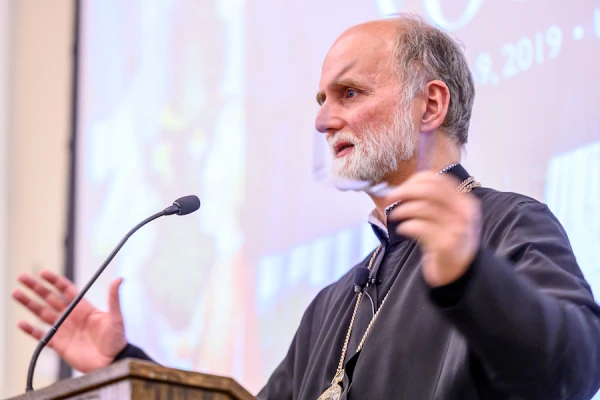
“These are some of the good things that are happening. I think a lot of it is done out of friendship, out of good intention,” Archbishop Borys Gudziak, the Ukrainian Catholic Archeparch of Philadelphia, and the Metropolitan for the Ukrainian Catholic Church in the U.S., said November 7. Gudziak was one of the keynote speakers for the Notre Dame Center for Ethics and Culture 21st annual fall conference, which this year had the theme: “I have called you friends.”

“I don’t canonize our times and I don’t canonize longevity, but we do appreciate these things,” he said.

“And yet the times are not so good,” Gudziak added.

“In fact, they’re similar to…what it was in 1914 when the Western world was convinced that progress would lead us to great happiness. Then the massacres began. World wars. The genocides,” Gudziak said.

He noted that for all of our technological and social progress, Americans are lonelier, more depressed and more stressed than ever. In Pennsylvania, one of the states where he serves, the opioid crisis has left people sick, dying, lonely and without hope.

“It’s important to focus on friendship because no amount of material, educational, technological, industrial welfare can compensate for the relationships that we are called to,” he said.

Gudziak said some of the most profound friendships he’s seen are those he witnessed in Soviet Russia before it fell, and those he continues to witness in countries controlled by communism, although these friendships are not easy or without cost.

“In all of these countries that were or continue to be communist, where millions of people were killed, where the system killed systematically, people over generations developed a reflex to put on a mask, put up a facade, build a wall because the outside world is dangerous,” Gudziak said.

Families are encouraged to inform authorities against each other in communist countries, “so people in the family don’t say things, because you can’t trust. It becomes like a radiation.”

“You can’t taste it, has no smell, no color, but it mutates the genes. There’s an extra fear chromosome. It’s a reflex. You can’t control it. Two billion people have an added obstacle to cultivate profound friendship.”

And yet it was in these oppressive conditions in Soviet Russia that the Ukrainian Catholic Church, while it lost many members, grew deep roots and bonds of friendship among those that remained.

“(T)he Ukrainian Greek Catholic Church, which had about 4 million members in 1939, with 3,000 priests, was totally – on a visible level – liquidated,” Gudziak said.

“In 1945-46 all the bishops were arrested, hundreds of priests with their families were deported to Siberia. The church was rendered illegal and it remained the biggest illegal church in the world for 43 years until 1989. And it was very reduced. By 1989 there were only 300 priests left,” he said.

“But what a community it was! Forged in that fire of persecution,” he added.

When he met the underground Church, Gudziak said everything was stripped to the bare minimum – bishops had jobs as ambulance drivers or coal workers, there were no schools or churches or official institutions of any kind. The bishops didn’t even know one another’s names, because it was too dangerous to tell someone your name in underground seminary.

“And yet they were profoundly friends of Christ, and it was an incredible, intense relationship of those in the underground,” Gudziak said.

“The friendship was not just kind of a nice thing, it cost profoundly to be a friend of Christ in an atheist totalitarian system,” he said. “It cost to pass down the faith to your children. But the fruits are amazing.”

The Ukranian Catholic Church now again has 3,000 priests, 5 million members and 800 seminarians.

The story of the Ukranian Catholic Church is important because “it’s the story of the cross,” Gudziak told CNA in an interview.

“I think the story of the Ukrainian Greek Catholic Church, its persecution, its underground life, its survival…it’s not a philosophy, it’s a story of human faithfulness to God…the faithfulness of concrete people to God and to each other.”

From the beginning of humanity, God has been teaching human beings about true friendship, Gudziak noted in his talk.

“From the scriptures we know from our faith, we experience that the Lord so yearns to make us his friends. Moses had a special privilege to see face-to-face. Abraham was called a friend. The value of friendship was modeled by David and Jonathan,” he said.

“Then, Jesus came to us. Our faith, our church, our theology, our civilization is based on this incredible gesture that God comes to be close, to convey his divinity. He sits next to us,” he said.

“What a God, what a Lord, and what is He conveying? He’s conveying the divine life shared by the Father, Son, and Holy Spirit. Friendship…motivates the Father to send his Son into (the world’s) grime, into our anxiety, our sin, the pitch blackness that we can create, into our hell, into our death, to create relationship, to create trust, intimacy, to establish an alliance.”

“Friendship,” he said, “is the school of the spiritual life which reflects the gift of relationship that we have, by virtue of being created in the image and likeness of God. God is triune. He’s personal and there’s relationship. We as persons are called to relationship. We’re called to friendship.”

Besides his appointments in the U.S., Gudziak also serves as the president of the Ukrainian Catholic University in Lviv, Ukraine. In striving to teach their students about true friendship, the university invites academics as well as students with disabilities into its classes and campus, he said.

“Not because they need us, because they need our social handout, but because the children of God with special needs have special gifts. They don’t care where you got your Ph.D. or how many publications you have. They don’t notice how rich or poor you are or, which title you carry,” he said.

“They have one basic question: Can you love?…There’s no more important pedagogical question.”

In a world increasingly divided along political, religious and other ideological lines, Gudziak told CNA it is all the more important that Christians reflect on God’s friendship to us, and in turn our friendship with him and with others.

“I think ever since The Enlightenment, when we’ve really been focusing a lot on ideas, there’s a tendency for ideas to become ideologies. And our consciousness in the Western world is very intellectualized, and our relationships can become abstract. They can be categorized according to different positions, world views, and they’re in our head,” he said.

“If we look carefully at the Gospels and listen to Jesus, he doesn’t speak about grand ideas. He talks about the Father, the Holy Spirit. He talks about relationships,” he added. “He talks about persons and interaction among persons, and he uses very personal, very concrete examples and stories to teach about life. He doesn’t start from ideas and systems and ideologies and systems.”

In his talk at the conference, Gudziak noted that Jesus became friends with “very concrete people, Peter and John and Nathaniel. It’s not an ideology, it’s not a system. There weren’t too many buildings there in Jesus’s time, nor in Paul’s or for 300 years.”

“So maybe if we lose the buildings and the endowments and the properties, maybe that’s not the end of things, if we can recover or develop more profoundly our friendship.”

[…]

No Picture
News Briefs

Blessed Sacrament stolen from Texas Catholic parish

November 11, 2019 CNA Daily News 2

El Paso, Texas, Nov 12, 2019 / 12:18 am (CNA).- The pastor of a Catholic parish in El Paso, Texas is calling for prayer and reparation after a tabernacle containing the Eucharist was stolen from the church.

On Oct. 28, Holy Spirit Parish in Horizon City was broken into by unknown individuals.

“It is with a very saddened heart that I write these words to you,” said Father Jose Morales, pastor of the parish, in a Nov. 1 letter. “Sunday night into Monday morning we had some intruders in the church that caused damages and stole items including the tabernacle with the Blessed Sacrament.”

The incident resulted in minor property damage and stolen items equal to a few thousand dollars, the priest said. He stressed that the worst aspect of the attack was the theft of the Eucharist, the value of which cannot be estimated. Catholic teaching holds that the consecrated Eucharist is the body and blood of Christ.

“The desecration of the greatest gift possessed by the Church, the Most Blessed Sacrament, is a very serious matter,” he said.

He encouraged anyone with any information on the crime to contact the Horizon Police Department. He also asked parishioners to respond to the theft with acts of penance.

“Due to the desecration of the Blessed Sacrament I join our Bishop Mark Seitz in inviting you to make reparation for this violation by visiting the Blessed Sacrament and participating in any act of reparation,” he said.

“The indifference of the world towards God in the holiness Most Blessed Sacrament needs to be overcome with the devotion, love and the holiness of His children. Let us remain united and strong in the Lord and manifest that we are his faithful followers regardless of the violations that some express.”

Roberto Ceballos, a parishioner of 20 years, told KVIA that the theft made him feel unsafe in the neighborhood.

“When we heard the news about it, we felt bad…We couldn’t believe that it had happened here, of course, in the neighborhood and of course in a Catholic church,” said Ceballos.

“I don’t feel secure now… It’s just a half-block away from my house,” he added.

Morales said it is difficult to understand the reasons behind the theft, but he urged the perpetrators to come forward and return the tabernacle.

“I don’t see the reason for something like this being done. We know God is merciful and if they would return what they took and repent it would be greatly appreciated, not just by us, but God will take that into account,” he told KVIA.

The priest encouraged his congregation to pray that the thieves repent and change their ways, and he asked Our Lady of Guadalupe to intercede for the parish.

“May our Blessed Mother, Our Lady of Guadalupe, who witnessed the acts of hatred and indifference towards her beloved Son, bring us consolation and guide us closer to the Sacred Heart of our Lord Jesus Christ. May the Holy Spirit protect us always,” he said in his letter to parishioners.

[…]

No Picture
News Briefs

Cardinal DiNardo notes search for justice in last USCCB presidential address

November 11, 2019 CNA Daily News 1

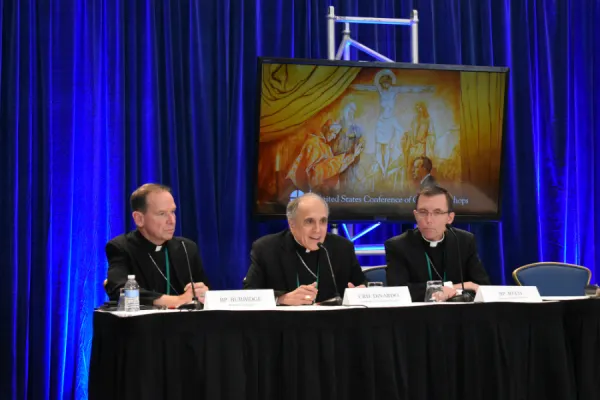
Baltimore, Md., Nov 11, 2019 / 11:35 am (CNA).- Cardinal Daniel DiNardo of Galveston-Houston, outgoing president of the US Conference of Catholic Bishops, highlighted Monday his experience leading the conference and detailing his personal growth over the last three years as his presidential term comes to an end.

“My service as president has been a continual reminder that, indeed, ‘the light shines in the darkness and the darkness has not overcome it,’” DiNardo said at the US bishops’ autumn general assembly in Baltimore Nov. 11. While “our present culture can seem overtaken by various ideological or political divisions,” bishops and other followers of Christ need to be different, he affirmed.

“Follow a simple truth: ‘God is always courteous,’” said DiNardo. “Let us be courteous.”

DiNardo remarked that while his tenure was during the “difficult times within our own Church,” that the bishops must continue to seek justice and to work for “relationships that are ordered in the right way–that is, towards the salvation of souls, including our own.”

DiNardo presided over the USCCB after it came to light that former cardinal Theodore McCarrick sexually abused minors and seminarians on many occasions, as well as during the release of a grand jury investigation in Pennsylvania. Other states have since begun grand jury investigations.

Properly ordered relationships, said the cardinal, exclude any trace of clericalism. An ordained man cannot act “as if he is a lord and master” over others, he said.

“The privilege of a cleric is to be a humble servant to all,” he said. “Justice demands that those who are shepherds should lead from in front, as courage requires, and from behind, as humility requires, going to those who are lost.”

The cardinal said that his experience meeting with victims of sexual abuse as president of the conference was one that “forever changed” his life.

“When too many within the Church sought to keep them in the darkness, they refused to be relegated to the shadows,” said DiNardo. “Their witness brought help to countless fellow survivors. It fueled the resolve of my brother bishops to respond with pastoral support and prevention programs.”

Sexual abuse victims empowered the bishops “with the knowledge needed to respond,” said DiNardo.

“We must never stop striving for justice and working unceasingly to prevent any future abuse from happening,” he said. “The measures we approved last June are a beginning of this renewed striving, but they are only a beginning – more needs to and will be done.”

“Traveling on your behalf these past three years, it was a privilege to learn from so many people along the way,” said DiNardo.

He spoke about his time visiting the border detention centers, and witnessing the faith of the children who were detained and separated from their parents, as well as his experience with other bishops visiting refugees and volunteers at respite centers.

“I met dozens of children who called upon their Catholic faith and the firm knowledge that Christ and His Church would be present with them. Along with my brother bishops, we went because Jesus was already there. We followed our shepherd,” said DiNardo. He extended an invitation to all present to “share our journey of solidarity with migrants and refugees.”

DiNardo said that workers at respite centers, who provided medical care and other needs for people at the border, were “doing God’s work,” as were people who worked at pregnancy centers. He praised the work of pregnancy centers, as well as public policy advocates seeking to change the country’s healthcare system.

“The continued fight to defend unborn children is one of the most significant things we do,” said DiNardo. “And it will remain so as long as the most innocent lives are left unprotected.”

The cardinal’s successor as USCCB president will be elected Nov. 12. The bishops are almost certain to choose Archbishop José Gomez of Los Angeles, who is currently vice president of the conference.

[…]