NJ bishop: Independent avenue for reporting abuse is needed

August 9, 2018 CNA Daily News 0

Metuchen, N.J., Aug 9, 2018 / 05:01 pm (CNA/EWTN News).- In light of a scandal involving one of its former bishops, Theodore McCarrick, the Diocese of Metuchen is working to establish an independent avenue for victims to report abuse conducted by Church leaders, including bishops.

“I continue to be saddened and ashamed… by reports of the abhorrent events we have been learning about in regard to Archbishop McCarrick – I know you must be, too. Our efforts to evangelize, and spread the Good News of Christ, have been hobbled by these atrocities,” Bishop James Checchio of Metuchen said in an Aug. 7 letter.

“I am praying for all those who have been hurt and praying that God’s mercy will bring healing and consolation,” he stated. “I am also working to address how we can ensure that similar abuses, especially of seminarians or young priests, would not happen again, particularly by those in positions of authority over them.”

Archbishop McCarrick was Bishop of Metuchen from 1982 to 1986.

The Archdiocese of New York announced in June that it had concluded an investigation into an allegation that McCarrick had sexually abused a minor in the early 1970s, finding the claim to be “credible and substantiated.”

Since that announcement, media reports have detailed additional allegations, charging that McCarrick sexually abused, assaulted, or coerced seminarians and young priests during his time as a bishop. The Metuchen diocese and the Archdiocese of Newark disclosed that they had received three allegations of  sexual misconduct with adults by McCarrick, and had reached settlements in two cases.

McCarrick resigned as a cardinal July 28.

Bishop Checchio said that “The case of Archbishop McCarrick demonstrates that the culture of the Church is changing and that no one is exempt from its censure – regardless of a person’s rank or status, or the number of years that have passed since an incident occurred. As I have done in the past, I continue to urge anyone who has been abused to bring the situation to the attention of law enforcement officials. Also, I want to reiterate that the Diocese stands poised and ready to help any who have been abused.”

The bishop said he is heartbroken “for our faithful people, and the clergy and religious of our Diocese, as we face another tragic situation within the Church that we love. Nonetheless, I am grateful that the processes the Church has in place regarding child sexual abuse have been shown to work.”

To address the abuse of seminarians or young priests “I have begun to bring together a senior team of advisors to examine reporting processes,” he said. “Clearly, the safety of an independent reporting structure that allows for anyone to bring an allegation forward without the fear of retribution of any kind is needed.”

“Accountability on all levels helps to ensure that a healthy, wholesome environment prevails to form and train our future priests. I know that I do not have to reiterate to the people of this Diocese that proper priestly formation is central to renewal in the life of the Church.”

He reflected that the Metuchen diocese is “seeing a new springtime with men studying for the priesthood. We are blessed with the most seminarians we have had in 25 years. They are good men, striving to make over their hearts like the Good Shepherd’s own caring heart.”

While at one time the decision to become a priest would have been lauded by society at large, “that is not the case now,” Bishop Checchio said. “Our young men seek to join in this life of service to God and His people at a time when it would be easy to ignore the call and choose another path. Yet, they choose to listen to the quiet call of the Lord …  I thank God for them, as I thank God as well for you, who support these dedicated young men in their response to God’s call in these challenging times.”

The bishop asked for prayer “as the Church faces so many challenges in our world today. We know that the Holy Spirit protects the Church by ensuring the truth of the presence of Christ who is its keystone, its heart and its foundation. The Holy Spirit wraps the Church in this protection in spite of our sinfulness.”

“Despite the failings of the past, however, we remain steadfast in hope. This hope anchors our faith in the credibility of this sinful yet holy Assembly of Believers, a living paradox of unity in diversity, as we endeavor to build the Kingdom of God established through the incarnation, suffering, death and resurrection of Jesus Christ who is ‘the same yesterday, today and forever.’”

Bishop Checchio concluded, saying, “In the midst of the trials we currently face, I do not want to miss pointing out that Christ is still at work in His Church!”

“This summer, in addition to my weekend visits to parishes for Mass, I have been taking advantage of the lighter weekday schedule to visit some vacation bible schools, religious communities of sisters, nursing homes, prisons and some parishes for daily Mass. It is an honor to be with you, and it is evident that people everywhere are still yearning to see Christ in us – a willingness to place their hope in the many ministries and initiatives through which the Lord Himself uses our humble humanity to touch us with His grace.”

“We must never forget that, in every age, the antidote to the ills that beset the Church is for men and women everywhere to rise up in sanctity. Let us not lose our vision: to ‘keep our eyes fixed on Jesus, who inspires and perfects our faith.’ To Him be glory and praise forever.”

[…]

Nun in Mexico celebrates 75th anniversary of her first profession

August 9, 2018 CNA Daily News 0

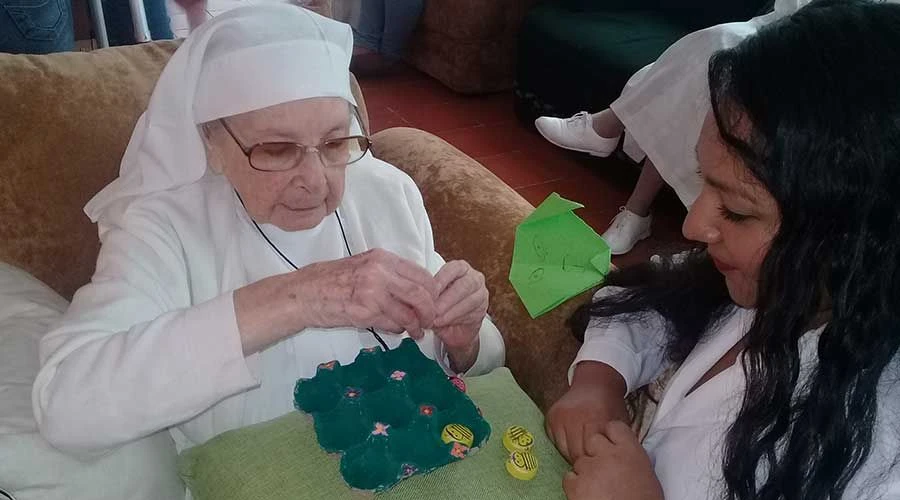
Guadalajara, Mexico, Aug 9, 2018 / 03:01 pm (ACI Prensa).- Sister Emma of the Immaculate Heart of Mary, 97, celebrated last month her “diamond anniversary” of consecration to Christ.

The religious, born in 1921 Yahualica in the Mexican state of Jalisco, celebrated July 19 the 75th anniversary of her profession in the Congregation of the Servants of the Most Holy Trinity and of the Poor.

The congregation noted that the milestone marks for Sister Emma “75 years of living united to the Divine Spouse and of jubilant dedication to our most needy brothers, especially the sick and the elderly.”

Sister Emma entered the congregation Dec. 4, 1940. She made her first profession July 16, 1943, and made her final vows six years later.

She now lives in the congregation’s community at Most Holy Trinity Hospital in Guadalajara.

The congregation said that in the witness of Sister Emma’s life “we can see our charism radically lived out, because she has known and has experienced being loved and indwelt by the Triune God and so has discovered the presence of God in the people she lives with and has served and loved as living temples of the Most Holy Trinity.”

The religious, they said, “always reminds us that it’s God’s work and that he will send us in his time many vocations, and that we should continue working and giving glory to God.”

The Congregation of the Servants of the Most Holy Trinity and of the Poor was founded by Blessed Vicenta Chávez Orozco amid the societal hardships and attacks against the Church in the late 19th and early 20th centuries in Mexico. It was established as a religious institute in 1905 in Guadalajara.

At 113 years from their foundation, they are currently in several Mexican states, serving hospitals, medical clinics, mission centers, and infirmaries.


This article was originally published by our sister agency, ACI Prensa. It has been translated and adapted by CNA.

[…]

Archbishop Fisichella talks Veritatis splendor, Francis, and development of doctrine

August 9, 2018 CNA Daily News 0

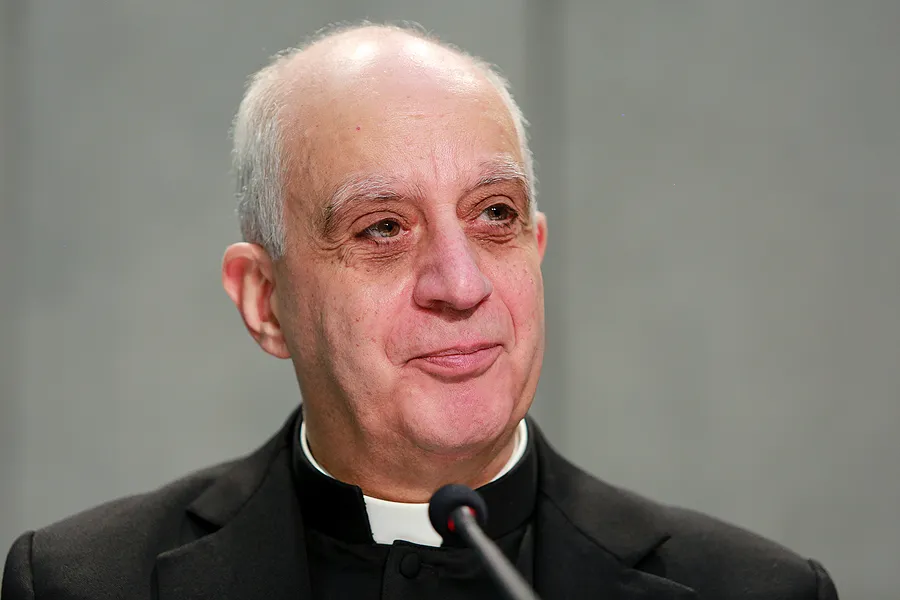
Vatican City, Aug 9, 2018 / 01:01 pm (CNA/EWTN News).- In an interview with Vatican News marking the 25th anniversary of St. John Paul II’s encyclical Veritatis splendor, Archbishop Salvatore Rino Fisichella said that “the magisterium must never be used instrumentally to place a contrast in the development of the doctrine.”

Veritatis splendor, written on some fundamental questions of the Church’s moral doctrine, encouraged a renewal of moral theology and taught that there are intrinsically evil acts, that absolute truths exist across various cultures. It also urged sharp caution against moral relativism and the misuse of conscience to justify false or subjective morals.

Archbishop Fisichella, president of the Pontifical Council for Promoting the New Evangelization, stated that “when we speak about the truth, we must always have a dynamic concept.”

“The truth is not a ‘fixistic’ dimension. The truth, for the Christian, is first of all that living Word that the Lord has left us. Let us not forget Jesus who says: ‘I am the way, the truth and the life’,” the archbishop said.

“Therefore, the dimension of truth opens to a personal encounter: it is the truth of the Gospel, it is the truth represented by the person of Jesus Christ. All that is the content that Jesus wanted to transmit to His disciples, and that comes from the Apostles to us, is a truth that opens up more and more to a discovery of the mystery that has been revealed.”

He said that “There are some fundamental points that remain as milestones in the dogmatic and moral teaching of the Church. These are elements that remain in their immutability,” and that

“All this then requires from the theologians … a great work of interpretation,” Archbishop Fisichella stated.

Immutuable norms “must, however, be continuously opened through the discovery of the truth of the Word of God.”

The archbishop said that in his opinion, the Church “cannot accept an idea of truth closed in on itself. Truth, by its very nature, refers to fidelity and also to freedom: ‘The truth will set you free.’ A truth that opens up more and more is a truth that makes every believer, every man, discover a more profound freedom. However, this also requires fidelity. The link between fidelity and truth is a typical link in the biblical conception of truth.”

Asked about fidelity to truth and those who criticize Pope Francis for, they believe, diverging from Catholic doctrine, and who refer to Veritatis splendor, Archbishop Fisichella said that “I don’t think there are any grounds that justify challenging the teaching of Pope Francis in the light of the previous Magisterium.”

The question is an implicit reference to the ‘dubia letter’ sent by four cardinals to Pope Francis in September 2016. The letter asked the Pope to clarify some passages of Amoris laetitia, and four of the five dubia quoted Veritatis splendor and noted that Francis’ apostolic exhortation could be interpreted as contrasting with St. John Paul II’s encyclical.

Pope Francis has not responded to the dubia.

The Vatican News interview also comes on the heels of a change to the text of the Catechism of the Catholic Church regarding capital punishment, which has been widely interpreted as a change in doctrine.

Archbishop Fisichella said that “when there is an instumental use” of the Magisterium, “then I fear there is no desire for a discovery of the truth, and also that there is no fidelity to the tradition of the Church. I don’t think there are any grounds that justify challenging the teaching of Pope Francis in the light of the previous Magisterium. On the contrary, we need to reiterate how much continuity there is in development.”

“I think, however, that it is also important to carefully consider the whole teaching of Pope Francis and not just a single particular aspect of it: the mosaic is produced by the whole deck, not by a single card.”

For Archbishop Fisichella, the teaching of Pope Francis is “a great openness in the work of evangelization” without “anticipating the norm of the proclamation.”

According to the prelate, Francis’ pontificate is about “being able … to accompany our contemporaries, to walk beside them in order to help them understand, to really understand its application, and sometimes also, perhaps, to take a step back. And so this dimension emerges together with the need for mercy. The Jubilee of Mercy was the concrete sign of how Pope Francis identifies and orients his Pontificate.”

[…]