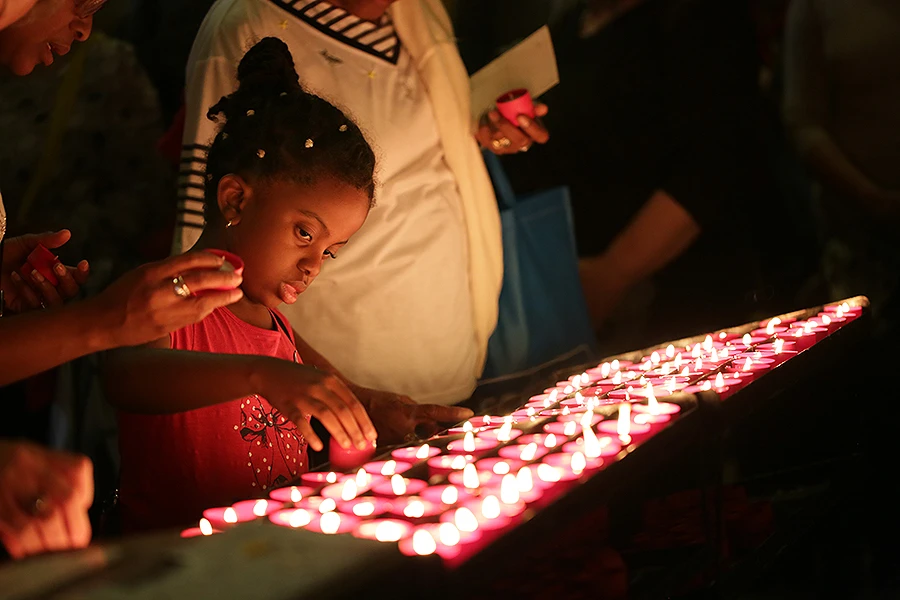
Caritas India offers assistance to victims of monsoon floods in Kerala

August 16, 2018 CNA Daily News 0

Thiruvananthapuram, India, Aug 16, 2018 / 04:24 pm (CNA/EWTN News).- After at least 73 people were killed in floods caused by monsoon rains in India’s Kerala state, Caritas India and local Catholic groups are assisting victims of the torrent with relief materials.

More than 85,000 people in the southern Indian state have been displaced by the flooding since Aug. 9, which has also caused landslides.

“The Catholic Church is already out in the field through … Caritas India,” read an Aug. 15 statement from the Indian bishops’ conference.

“Our local Bishops, Clergy, Religious Sisters and lay volunteers are also involved in relief and succour operations. In different dioceses, Church authorities have opened church schools and other institutions to the displaced people, and are distributing food, clothes and other relief materials. Many parishes, schools and other Church institutions have become the centres of aid and assistance to people in need.”

Caritas India is also providing blankets, mosquito nets, and hygiene kits. It has set up health camps to treat those affected and to prevent the outbreak of disease.

The Indian bishops stated, “We share the anguish of the people affected by this huge natural disaster and we wish to express our closeness to them.”

They expressed appreciation for the quick and efficient relief work undertaken by the local and State Government authorities. We also appreciate the strong and immediate support being provided by the Union government in the relief operations.”

“The solidarity manifested and the help being provided cutting across political divides and religious or class belongingness is exemplary … The Catholic Church condoles the death of our brothers and sisters who were caught unaware as nature’s fury took hold of large parts of Kerala. We express our solidarity with the injured and the suffering.”

The bishops also indicated their “ardent desire to work with the Government and all like-minded agencies to provide relief and help in all possible ways to the suffering people.”

They then stated that after the flood waters have resided, “it would be desirable to analyse the causes of the floods, and take urgent steps to preserve our environment and prevent further ecological damage to our Common Home, Mother Earth, destruction often brought about by our human actions.”

“We pray for all those affected and also for all who are actively or through contributions helping the people in dire distress.”

[…]

Muslim woman who declined handshake wins labor case in Sweden

August 16, 2018 CNA Daily News 0

Stockholm, Sweden, Aug 16, 2018 / 12:17 pm (CNA).- A labor court in Sweden has sided with a Muslim woman whose job interview was cut short when she refused a handshake for religious reasons.

The court, in a 3-2 vote, ordered the company to pay the woman 40,000 kronor – or $4,350 – on the grounds of discrimination against her, the BBC reports.

Farah Alhajeh was applying for a job with an interpreting company in Uppsala. During the interview, she would not shake her male interviewer’s hand. Instead, she placed her hand over her heart, later saying she was trying to avoid offending the interviewer.

The 24-year-old says her Muslim faith prohibits her from physical contact with members of the opposite sex, outside of her family.

The company argued that Alhejah’s refusal to shake hands could hamper her effectiveness as an interpreter. However, the court disagreed. According to The Local, Alhajeh was applying for a job doing video and phone interpretation, where she would not have to interact in-person with clients.

Company policy and anti-discrimination laws prohibit treating people differently because of sex, the employer said. It said it could not have staff members refusing a handshake because they are women. The company does allow staff members to decline handshakes due to germophobia and autism.

The Swedish labor court said the company could rightly demand equal treatment for men and women, but not by insisting upon a handshake. Doing so, it said, is discrimination against Muslims.

The court said that the European Convention on Human Rights protects the refusal to shake hands on religious grounds.

Sweden’s discrimination ombudsman’s office, which represented Alhajeh in the case, applauded the ruling, saying that it had balanced “the employer’s interests, the individual’s right to bodily integrity, and the importance of the state to maintain protection for religious freedom.”

“I believe in God, which is very rare in Sweden… and I should be able to do that and be accepted as long as I’m not hurting anyone,” Alhajah told the BBC.

Handshakes, a traditional greeting in some parts of Europe, have been the center of other controversies in recent years as well.

In both France and Switzerland, Muslim individuals who refused to shake hands with opposite-sex officials had their citizenship processes suspended or denied.

[…]

Where is Jesus in the midst of the Church’s sex abuse crisis?

August 16, 2018 CNA Daily News 2

Washington D.C., Aug 16, 2018 / 03:16 am (CNA).- Fr. Thomas Berg is a priest of the Archdiocese of New York, a former Legionary of Christ, and professor of moral theology, vice rector, and director of admissions at St. Joseph’s Seminary in Dunwoodie, NY.  He is author of Hurting in the Church: A Way Forward for Wounded Catholics. He spoke recently with CNA’s Courtney Grogan about the challenges Catholics face amid the Church’s sexual abuse and misconduct scandals. The interview is below, edited for clarity and length.


With everything that has been coming out in the news recently about sexual abuse in the Church, how do you think that your book, “Hurting in the Church: A Way Forward for Wounded Catholics,” could be helpful?

In the wake of the McCarrick scandal and ongoing revelations of priest sexual abuse, a very common reaction is one of betrayal.

That’s what I have heard a lot of from persons who have reached out to me, especially persons who for years have collaborated with bishops, worked in chanceries, worked for bishops, collaborated in apostolates, have headed-up bishop’s capital campaigns, have been donors and so on. Part of the very common experience is this raw emotional wound of betrayal.

Much of my book speaks directly to that experience. That’s where I really hope that persons who are going through that betrayal, profound discouragement, disappointment, the bewilderment of the moral failures of bishops, who either failed to report what they should have reported or did not act on what was reported to them.

That is scandalous and that opens up a wound of betrayal really in the whole mystical body.

I very much believe that the book can, hopefully, point to where is the good news in this — Where is the hope in this? Where is Jesus in the midst of this crisis?

Where is Jesus in the midst of this crisis?

Jesus is the healer of wounds, and Jesus does not leave the members of his mystical body without healing when we seek it.

We are in the midst of a massive crisis, notwithstanding some resistance to that idea by some of our prelates.

And those wounds are opened up. This is where not only can Jesus bring healing, but he can also use that experience of woundedness, whether that is personally or institutionally or spiritually as the body of Christ. He uses those wounds to bring greater good, to bring grace and healing to His Church.

Part of what I do in the book is just to reflect, often with these individuals [victims of abuse] and sometimes in their own words, on this mystery that the Jesus who comes into this experience is Jesus who appeared with his glorious wounds. The wounds were still there. The wounds are mystically important and we can unite our wounds to Jesus and allow him to unite those in a mystical way, in a redemptive way to His redemptive work.

So, where is Jesus in all of this? Jesus is continuing in the midst of our brokenness, in the midst of the utter moral failures of our pastors, in the midst of our own sinfulness and brokenness. The risen Good Shepherd comes with his glorious wounds by which he intends to bring about healing in his Church and to bring about a much greater good and a much more glorious future precisely in and through the tragedies that we are experiencing.

We will also experience this in a much more glorious and beautiful day for the Church in the future, and certainly for the Church when all time has been consummated and we are all, by God’s grace, caught up in the glory of the heavenly kingdom.

You discuss in the book how uprooting a betrayal of trust can be and how we really need to be grounded in Christ’s love. What are some concrete ways that Catholics can really root themselves in Christ’s love and find that grounding in a time when they might feel destabilized in the Church?

First, very practical immediate answer: Eucharistic adoration. No doubt about it.

That was essentially my homily when we were talking two weeks ago about the McCarrick thing from the pulpit. It means, as always in crisis, we need to be earnestly and deeply seeking the Lord by frequenting Eucharistic adoration and intensifying one’s life of prayer.

In my own story, I had to go on retreat. I had to just go take some time to just be by myself to get that down to the solid foundation of what did I stand on. What was the foundation that everything that I believed stood on?

What one can come to in those experiences is that experience of Jesus — the experience that our risen and glorious Lord still stands present in the midst of our lives. He is there.

When we are hurting, we need to do whatever it takes: adoration, retreat, increased prayer, asceticism, solid spiritual reading, all of the things that we can avail ourselves of God’s grace to re-experience ourselves as rooted and grounded in His love.

God has a very big safety net for us and it is that reality of being truly rooted and grounded in Him and in His love that encompasses us.

It is just that when we are hurting, when we are scandalized, when we are angry, when we are experiencing all of this emotional turbulence, it is just — it takes time and prayer and I think a lot of coming to silence and coming to quiet to get through that and to realize that our Lord is still there. Our Lord is still holding his hands out to us. Our Lord is still there to embrace us and pick us up and guide us and help us to move forward.

What would you say to the priest who just doesn’t know how to address this from the pulpit, who is dealing with his own feelings of hurt and confusion, and maybe is on the fence about whether he should address it in a homily?

I think that the best thing that priest can do is to talk about that in his homily. It is emotionally exhausting for most of us. It is heartbreaking. When I preached a couple of weekends ago, I got emotional. I think it is very healing and good if priests allow themselves to feel and show that emotion. Feel and show how personally upsetting it is. If a priest is angry, tell your people, ‘Yeah, I’m angry too, and you should be angry.’ It should start there.

It is absolutely essential that this is addressed. No priest should be waiting for some directive from his bishop. I would hope that across the country most priests have already addressed this from the pulpit. If not, it absolutely has to happen.

People are very angry right now, and I do not think that they are identifying that anger as a hurt. Many people are channeling their anger into what needs to change in the Church. Some channel it at specific people in the Church.

You address healthy anger in the book, and I want to hear your thoughts on it in this context. What would you say to people who are very angry?

There is certainly such a thing as just anger. I would hope that most of the anger that what most committed Catholics are experiencing right now is precisely that — “just anger.” I have experienced a good deal of bit of it in the past few weeks.

Hopefully that anger does get channelled into good positive, action steps that I think Catholics are taking. But people should also be very honest with themselves: This hurts.

I think that our brothers and sisters who are going through this right now, and they are many, need to own up to that.

That is a very healthy starting point to getting to a better place. In this context, it is an important part of rightly channeling our energies and our reactions prayerfully and in docility to the Holy Spirit. We have to allow the Holy Spirit to come fully into that experience of hurt in this ecclesial context.

The immediate victims of McCarrick, those who have suffered sexual exploitation, they are hurt in a very unique way, but in some sense this has inflicted a hurt on all of us. And those who failed, those who enabled him, those who pulled him up the ecclesiastical ladder, if they did so with knowledge of his sexual predation, that inflicts a real emotional hurt on all of us, and we should just admit that.

Many Catholics first faced these initial feelings of betrayal, shock, bewilderment in 2002. After positive steps forward like the Dallas Charter, these Catholics found some consolation in the fact that the Church had made positive changes. Now there are layers of hurt there, particularly the hurt of thinking that things were better and then discovering that they are not.

The Church might not change in our lifetimes. Reform in the Church takes so long. The Church is very good at reforming herself, but it can take centuries sometimes. I’m worried for people who are looking for a quick fix.

I think that you are hitting at the heart of the problem. One thing that we are being faced with in this crisis is the reality that effective change within the Church takes a very, very long time. Even within organizations, people talk about changing the internal culture of a business, even that in itself can take a long time.

First of all, there is no reason why we cannot continue to take genuine pride in the programs that have been set in place with the sacrifice and dedication by the way of hundreds of lay Catholic men and women who have jumped into this breach and who have instituted requirements for background checks, safe environment training, safe environment programs, who serve the Church as sexual abuse assistance coordinators in dioceses (these are people who deal one on one especially with victims of clergy sexual abuse.) So we have every reason frankly to be confident that we are in a much better place then we were 15 years ago to protect our children. There is no reason to doubt that.

What people are still reeling from, and this has been the real revelation, is that there has been, especially within the episcopacy, there has been an internal culture which allowed — and I am not faulting all bishops here, but McCarrick is the child of an old boys school mentality, a culture where bishops too often understood themselves as members of this kind of privileged caste who used power and authority to manipulate and frankly to bring about all kind of harms and hurts in people’s lives. Bishops have sadly often been the perpetrators of much of the hurt that has been experienced on many levels and in many forms in the Church. And that is a sickly culture and it has to change.

The Church desperately needs a healing in its episcopacy. This is very much a crisis of the episcopacy. The current ethos is in so many ways it is failing us. It is failing the Church. What we have is, in far too many cases, a kind of managerial approach. Bishops simply seek to manage, to contain, to bureaucratize our apostolates, and that is not a culture where the Church is going to thrive.

Is that going to change anytime soon? No, but I think that we have an opportunity. This crisis is putting a spotlight on that problematic culture within the episcopate. I think that we can be hopeful for some kind of change, maybe even sea change.

There are good and holy bishops out there who are as incensed about this as you or I or any of us are. It is my prayer and hope that they will begin to exercise some very kind of unprecedented leadership within the body of bishops and certainly within their own dioceses.

So what do Catholics do meanwhile? Well, we are challenged to exercise the supernatural virtue of hope. We are challenged to believe that that kind of change, if it is meant to be, will take time, but we have to support every bishop who shows signs that they are getting it.

We have to support every bishop who shows signs that they understand and that they are taking unprecedented steps towards transparency, toward addressing even the faults of their own brother bishops.

We need to be supportive and helpful, and I guess that is a long way of saying that we need to hang in there and trust in the Holy Spirit. Change does take a long time in the Church. We are called to continue to exercise hope and it is by sustaining hope and sustaining a healthy pressure on the bishops that can bring about some really positive change here, maybe faster than we think.

As outrageous as it is, I can imagine the temptation a leader might feel to keep something so scandalous secret, to think that they were protecting Catholics from scandal by a sort of false charity, if you will. How does a leader find the courage or strength to come forward with the truth after they have covered up?

In the context of the Church, bishops who get it have come to understand that the scandal has been the supposed effort to “avoid scandal.” The scandal has been covering this stuff up. The scandal has been keeping this stuff quiet.

This is what I always tell our seminarians. Transparency is your friend. Light and truth are our friends. Institutionally, I think that we are understanding that. In the context of seminary formation, I really believe earnestly that the vast majority of our men understand that.

And I think understanding that also makes it easier to come clean when there has been a failure of any sort. In a sense, it all boils down to the old adage, ‘Honesty is the best policy.’

Obviously, when you are talking about something as complex as sexual abuse and exploitation, that is obviously much more complex because sometimes you are dealing with victims who desire to remain anonymous.

It takes an enormous amount of courage for victims of abuse to come forward and go public. That’s been one sad part of this whole tragedy. It is so difficult. The courage there is just amazing sometimes. I think the message of what we are learning in the sexual abuse crisis is that transparency is the only way to go.

Honestly trying to protect the requirements of justice and people’s reputations is a difficult balance and it definitely requires that transparency.

What do you recommend for those who are specifically dealing with disillusionment? How do Catholics keep their eyes open to the truth without totally succumbing to cynicism?

I think that the level of cynicism and disillusionment right now is off the charts.

You know people often use that image of having a bandage ripped off a wound. I don’t think that we have yet healed from — I know we haven’t healed from 2002. This isn’t having a bandage ripped off. This is having that wound ripped open and stamped on.

I’m fully expecting that the level of disillusionment and just shear kind of numb confusion is going to be a very common experience. I think that there will be different outcomes. I hope that Catholics can believe that there is a way forward here, especially committed Catholics.

It leads you to question your faith. I have been there. I have had that experience. The more you expose yourself to this, the more faith is going to be severely challenged.

I would just hope though that Catholics can understand that Jesus can lead them through that fire. He can lead us through this fire and make it a purifying fire, so that we can emerge from this really sad and really critical chapter of crisis in the Church, that we can emerge from this as stronger disciples and more committed Catholic Christians.

What transformation the Holy Spirit brings about, I hope we could no matter how hard this is, I hope we could kind of look forward to that with a sense of hope and expectation and maybe even the sense that as bad as it is, I want to be a part of what happens now. I want to be a part of the renewal that the Holy Spirit is going to necessarily going to bring about. I want to be a part of the action here. I want to be a part of what the Holy Spirit is going to do now in the Church.

I am absolutely convinced that the Holy Spirit is working in and through this crisis in a very real way. I have experienced it myself. I have seen it and I have heard it from others.

We have to allow the Holy Spirit to bring us beyond this very profound disillusionment.


[…]

Combat racism with a childlike spirit, Springfield priest says

August 15, 2018 CNA Daily News 0

Springfield, Ill., Aug 16, 2018 / 12:45 am (CNA/EWTN News).- A Mass in the Diocese of Springfield, Ill commemorated the anniversary of racially-motivated riots that destroyed black-owned business and homes in the city, and left at least 13 people dead during a three-day period in 1908. A priest of the diocese encouraged Catholics to counteract hatred with the spirit of universal brotherhood and childlike love.

Monsignor David Hoefler, vicar general for the Diocese of Springfield, celebrated the Mass Aug. 14 at Saint Patrick Church. He emphasized the universal origin of the human race and the need to imitate the receptivity of children.

“We have one set of parents, Adam and Eve. That’s why we have one savior because he came to save…the human race, all races,” Hoefler said in his homily.

Christ came “that we all might be recreated, reunited, brought together, reconciled with God. It’s not just something that’s supposed to be meant for heaven for later, but hopefully we are working on that now,” he added.

On Aug. 14-15, 1908, nearly 5,000 people rioted violently throughout the streets of Springfield after trying unsuccessfully to lynch two black men, suspected of rape and attempted rape, who were believed to be held at a local jail. When it was discovered that the men were not at that jail, the mob destroyed African-American business, homes, and killed at least eight people. Five rioters were also killed during the melee, and an infant died during the riot as well, after her family’s home was destroyed.

Human brokenness and violence between people are nothing new, explained Hoefler. He pointed to conflict between Adam and Eve in the scriptural story of creation, and to racial hardships faced by Jewish people during the time of Christ.

He said that Adam and Eve each acted in from self-interest at the time of their downfall, distancing themselves from one another.

“Instead of checking with each other, instead of having a communion or a communication with each other, they started going their own way,” he said, noting the couple did not ask for forgiveness, but instead blamed someone else or something else.

“[Adam] throws his wife under the bus – ‘she did it.’ Scapegoating they call it. So the Lord goes to Eve, ‘what did you do?’ ‘It did it!’ Blames the serpent, Satan.”

The results of sin were immediate, he said and led to the murder of Abel by Cain. The priest said the same thing occurred during Springfield’s riots; that people made scapegoats of racial minorities rather than taking responsibility for themselves.

“People acted out of hatred, bigotry, racism, and they let their emotions run wild – destroyed property, and, worse, killed their brothers and sisters, other human beings. It gets that way all too easy. That was played out over, and over, and over again by this street.”

He pointed to parallels among the Jews of Jesus Christ’s time on earth.

“When Jesus was born… he came into the one of the most abused races that existed at the time,” he said. “He came into the depths of our suffering and the worst of it all. He assumed the worst that had been known to that point in history and redeemed it from there.”

However, the only way to embrace redemption is through a child-like spirit, he said, reflecting on the words of Christ in the Gospel of Mark – “anyone who will not receive the kingdom of God like a little child will never enter it.”

“In other words,” Monsignor Hoefler said “a child is somebody that does listen, somebody that likes to learn, somebody that doesn’t impose other things onto other people, somebody that receives in all innocence what another says, somebody who receives people for who they are.”

“It’s the way we should be: that kind of innocence, receptivity, open heartedness.”

He gave a few examples of people who have put to practice this receptivity, noting especially the people of Rwanda. Next April, he said, it will be 25 years since the Rwandan genocide – a brutal slaughter, in which an estimated 800,000 Rwandans, primarily Tutsis, were killed in the span of a few months, between April and June in 1994.

Monsignor Hoefler said now the country is one of the safest places in Africa because the two groups learned from their mistakes. The people, he said, knew racism would perpetuate unless love was chosen over hate, namely listening to others and embracing forgiveness.

“God never asks something of us that he isn’t willing to do himself,” he said, noting that Christ provided an example of this receptivity.

“He spent thirty years listening to the human the race… listening to his community, his town, and his people. He spent thirty years before he began speaking, being quiet, noticing the injustices, realizing what needed reconciliation, and then he went to move for healing.”


[…]

Bishop Trautman responds to release of Pennsylvania grand jury report

August 15, 2018 CNA Daily News 0

Erie, Pa., Aug 15, 2018 / 04:59 pm (CNA).- Bishop Donald Trautman responded Tuesday to the Pennsylvania grand jury report on allegations of clerical sex abuse of minors, saying he did not condone or enable such abuse during his tenure leading the Diocese of Erie.

Abuse victims “should understand that neither this Statement nor my Response to the grand jury Report is intended to diminish the horrible abuse inflicted upon them and the immense suffering they have endured. I desire only to clarify that I neither condoned nor enabled clergy abuse. Rather, I did just the opposite,” Bishop Trautman said in his Aug. 14 statement.

A redacted version of the report had been released earlier that day, following an 18-month investigation into thousands of alleged instances of abuse spanning several decades. The report detailed allegations made in the dioceses of Allentown, Erie, Greensburg, Harrisburg, Pittsburgh, and Scranton.

Trautman was Bishop of Erie from 1990 until his 2012 retirement, at the age of 76.

The grand jury report’s section on the Diocese of Erie recounted priests’ sexual contact with minors, and said that “Diocesan administrators, including the Bishops, had knowledge of this conduct and yet priests were regularly placed in ministry after the Diocese was on notice that a complaint of child sexual abuse had been made. This conduct enabled offenders and endangered the welfare of children.”

The report also said the Erie diocese made settlements with victims which contained confidentiality agreements, and that diocesan administrators, including bishops, “often dissuaded victims from reporting abuse to police, pressured law enforcement to terminate or avoid an investigation, or conducted their own deficient, biased investigating without reporting crimes against children to the proper authorities.”

It identified 41 offenders from the diocese, and gave lengthy accounts of what it called three “examples of institutional failure”: the cases of Fathers Chester Gawronski, William Presley, and Thomas Smith.

Bishop Trautman’s statement indicated his “prayerful support to all victims of clergy sexual abuse” and “a sincere apology to all who have been harmed by clergy abuse.”

“My time spent as Bishop of the Diocese addressing sexual abuse has been the most demoralizing, trying and pain-filled experience of my priestly life. I have seen first-hand how the terrible acts of clergy abusers devastate the lives of innocent victims,” he said.

He commended the grand jury’s efforts to help abuse victims, saying its report “rightfully chastises clergy who committed horrible crimes against children. Unfortunately, the grand jury Report neglects to also emphasize the concrete steps some Church leaders took to correct and curtail abuse and to help victims.”

The bishop said that his record “includes disciplining, defrocking and ultimately laicizing pedophiles in the Diocese.”

He added that it “also includes efforts to provide care and support for victims,” which statement he supported with appended letters from victims expressing gratitude for his pastoral care.

“As a pastor of souls, I shepherd the good – the innocent victims of abuse – as well as the bad, the abusers who undeniably engaged in despicable acts and were rightfully removed from ministry,” Bishop Trautman wrote.

Noting the report’s lengthy discussions of three priests whose situations it called “examples of institutional failures”, the bishop emphasized “that I removed each of them from ministry and had each laicized. All of their improper conduct with children pre-dated me becoming Bishop of Erie.”

He maintained his faithful fulfillment of the Charter for the Protection of Childen and Young People, adopted by the US bishops in 2002, and his faithful fulfillment of all Pennsylvania laws on sex abuse.

“From the day I took office as Bishop of the Diocese of Erie, I did my best to correct the sin of sex abuse,” Bishop Trautman said. “I personally met with and counseled abuse victims. I removed sixteen offenders from active ministry … As early as 1993, I established new guidelines concerning clergy abuse.”

He also recounted the several measures he took from 2002 onwards regarding clerical abuse.

“These are not the actions of a Bishop trying to hide or mask pedophile priests to the detriment of children or victims of abuse,” he wrote. “I did not move priests from parish to parish to cover up abuse allegations or fail to take action when an allegation was raised … There simply is no pattern or practice of putting the Church’s image or a priest’s reputation above the protection of children.”

Bishop Trautman said that the report “does not fully or accurately discuss my record as Bishop for twenty-two years in dealing with clergy abuse. While unfortunate, these omissions are consistent with the Pennsylvania Supreme Court’s findings that the grand jury process that produced the Report suffered from ‘limitations upon its truth-finding capabilities’ and lacked ‘fundamental fairness.’”

The bishop concluded that “In the end, the focus should be on the victims and helping them heal. I send my prayers and deepest support to all victims of abuse, not just those abused by clergy, but victims of abuse across all segments of our society. Hopefully, the grand jury Report, despite its flaws, aids in the healing of all victims and furthers the just cause of stamping out abuse. Let God’s law prevail; let healing continue.”

Attached to Bishop Trautman’s 923-word statement were his June 20 response to the report, with several appended exhibitory documents, and an Aug. 2 joint stipulation to dismiss appeal, from the bishop and from state attorney general Josh Shapiro, in which the attorney general agreed that several statements in the report are “not specifically directed at Bishop Trautman.”

The bishop’s 15-page response to the report focused on his desire “to clarify, contrary to the tenor of the Report, that he neither condoned nor enabled clergy abuse.”

The response noted that “While the Grand Jury adopted and issued the Report, under typical grand jury practices, the language of the Report was drafted by the [Office of the Attorney General] not the Grand Jury.”

It mentions that the report made no mention of letters sent to Bishop Trautman by abuse victims expressing appreciation for his pastoral care (which letters were provided to the grand jury), and that written testimony submitted by Bishops Trautman and Persico, his successor, “is not substantively discussed in the Report, let alone included in it in full.”

“What these examples demonstrate is that the OAG, via the Grand Jury, with an agenda, has selectively chosen the words in the Report, what words to include in the Report, and how to portray those words in a manner – often a misleading one – that best suits their agenda.”

The response also noted that Bishop Trautman met personally, or attempted to do so, with each abuse victim. And, “when victims would permit him, he personally provided pastoral counselling for the victims’ well-being. He also helped ensure that victims had appropriate mental health treatment paid for by the Diocese.”

“Certainly, with hindsight, some isolated decisions made by Bishop Trautman concerning certain priests … might be subject to critique. But, what is clear from his overall conduct – and complete actual record – is that he cared deeply about the victims of abuse, did his best to help the victims both pastorally and financially, did not condone the horrific conduct of priests who abused minors, and consistently took action to remove abusers from active ministry.”

Since the report detailed the cases of  Fathers Chester Gawronski, William Presley, and Thomas Smith, Bishop Trautman’s response addressed these at length.

The response explained that “New allegations against priests made while Bishop Trautman was in office resulted in the priest being taken out of active ministry.”

The exceptions to this rule were priests who “had been sent for a psychological evaluation” under Bishop Murphy, Trautman’s predecessor.

Each of these – including Gawronski, Presley, and Smith –  were “already on a monitoring/aftercare program that had been recommended by psychiatric professionals. While in hindsight he might now act differently, given the recommendations and plans made before Bishop Trautman came to the Diocese from Buffalo and out of deference to Bishop Murphy, Bishop Trautman continued the monitoring/aftercare plans and assignments recommended by the professionals and put in place by his predecessor.”

And according to the response, “In several instances, even though mental health professionals advised that a priest could be returned to ministry, Bishop Trautman kept the priest out of public ministry.”

The response also noted that neither Gawronski, nor Presley, nor Smith “is known to have reoffended. During the time period each of these priests remained in active ministry after initial allegations were made, no allegation that they offended while in such ministry was or has been made.”

“When allegations of prior (usually decades old) abuse by each priest were raised while Bishop Trautman was in office, he acted to take each priest out of any ministry that would include contact with children and ultimately took each out of ministry all together,” the response stated.

Each of the three priests were dismissed from the clerical state in processes which were initiated by Bishop Trautman.

The bishop’s response included examples of potentially misleading writing in the grand jury report, authored by the Pennsylvania attorney general’s office.

For instance, it noted the report’s mention that Bishop Trautman allowed Fr. Gawronski to hear confessions for persons with disabilities in 1996.

The report stated: “By 1996, there was no possible doubt that Gawronski had spent most of his priesthood preying on the vulnerable. However, even as complaints continued, on November 6, 1996, Gawronski was notified that Trautman had approved his request to hear confessions for persons with disabilities.”

“What the Report does not include,” the response states, “is that this was a one-time event, with multiple priests and church personnel participating, that the event would take place at the St. Mark’s Center (the building where the Diocesan offices, including the Bishop’s office, are located), and that Gawronski’s participation was at the request of a religious sister who served as Coordinator for the Ministry to Persons with Disabilities. Why not disclose the full facts about the request? Does the request lose its sensational nature when put in actual context?”

The response also pointed to potentially misleading statements in the report regarding Fr. Presley.

The report mentioned an April 2003 press release from the Erie diocese regarding the removal of Fr. Presley’s faculties, in which the diocese stated it had “no information to provide on other possible allegations against the priest.” The report called the press release “false and misleading.”

The response noted that the press release quoted in the report, while “inartful … is simply a statement of ‘no comment.’ Contrary to the allegation in the Report, this was not a false statement.”

The response also addressed the report’s presentation of a 2005 diocesan investigation undertaken with a view to having Fr. Presley, who had retired in 2000, dismissed from the clerical state.

The investigation was led by Msgr. Mark Bartchak, who wrote to Bishop Trautman Aug. 25 of that year indicating he had gathered sufficient evidence for Presley’s dismissal, and asking if he should continue to follow up on further potential leads. Bartchak indicated that Trautman said that would be unnecessary.

The report called this a “curb” of the diocese’s investigation intented “to prevent finding additional victims.”

“When read in context,” the response says, “Bishop Trautman is simply answering an inquiry from Rev. Bartchak and, using the same words from the inquiry, telling him that, if the Diocese had enough evidence to succeed in the laicization process (which they did), he need not further investigate facts that likely would not lead to a violation of Cannon law [sic] because of the age of the victim. Again, this simply is not an effort to somehow hide Presley and his conduct.”

The report also read that with regard to Presley, “The truth was that Murphy, Trautman, and the Diocese of Erie intentionally waited out the statute of limitations and curbed their own investigation to prevent finding additional victims.”

The response called the allegation that Bishop Trautman had “intentionally waited out” the statute of limitations “baseless.”

“The allegations brought to Bishop Trautman’s attention in 2002 – on which he quickly acted – concerned conduct that occurred in the 1960s and 1970s. The statute of limitations had, unfortunately, expired long ago,” the response said.

“Despite their artful (and sometimes misleading) construction, a close reading of the summaries found in the Report’s Appendix reveals the same course of action throughout Bishop Trautman’s 22 years in office,” the response concluded: “Bishop Trautman consistently acted to protect children and remove priests from ministry.”


[…]