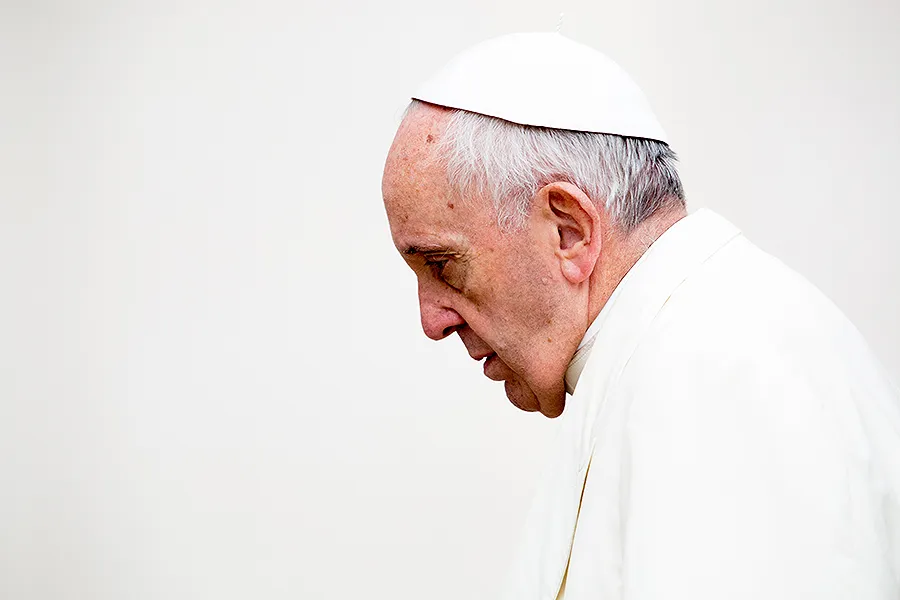
Vatican City, Aug 16, 2018 / 02:33 pm (CNA/EWTN News).- The Holy See on Thursday denounced sexual abuse and called for accountability for both perpetrators and leaders who covered up their crimes, following the release of a report detailing alleged clerical abuse in Pennsylvania.
“The abuses described in the report are criminal and morally reprehensible,” said the statement, released Aug. 16.
“Those acts were betrayals of trust that robbed survivors of their dignity and their faith. The Church must learn hard lessons from its past, and there should be accountability for both abusers and those who permitted abuse to occur.”
The statement responded to a grand jury report in Pennsylvania that was released earlier this week following an 18-month investigation into alleged instances of abuse spanning several decades. The report detailed allegations against some 300 priests, from more than 1,000 victims, in the dioceses of Allentown, Erie, Greensburg, Harrisburg, Pittsburgh, and Scranton.
Pope Francis takes the subject of abuse seriously, the statement said, stressing that “The Holy See condemns unequivocally the sexual abuse of minors.”
“The Holy Father understands well how much these crimes can shake the faith and the spirit of believers and reiterates the call to make every effort to create a safe environment for minors and vulnerable adults in the Church and in all of society,” it said.
“Victims should know that the Pope is on their side. Those who have suffered are his priority, and the Church wants to listen to them to root out this tragic horror that destroys the lives of the innocent.”
The Holy See noted that most allegations mentioned in the report are from before the Charter for the Protection of Children and Young People, adopted by the US bishops in 2002 to prevent clerical abuse.
“By finding almost no cases after 2002, the Grand Jury’s conclusions are consistent with previous studies showing that Catholic Church reforms in the United States drastically reduced the incidence of clergy child abuse,” the Holy See said.
The statement encouraged “continued reform and vigilance at all levels of the Catholic Church, to help ensure the protection of minors and vulnerable adults from harm.” It also emphasized the importance of adhering to civil law, including abuse reporting requirements.
If you value the news and views Catholic World Report provides, please consider donating to support our efforts. Your contribution will help us continue to make CWR available to all readers worldwide for free, without a subscription. Thank you for your generosity!
Click here for more information on donating to CWR. Click here to sign up for our newsletter.

Pope Leo XIV smiles during his first general audience in St. Peter’s Square on May 21, 2025. / Credit: Daniel Ibanez/CNA
Lima Newsroom, May 30, 2025 / 16:53 pm (CNA).
Pope Leo XIV encouraged the Anabaptist (Mennonite) movement to live with love the call to Christian unity and the mandate to serve others.
The Holy Father made the statement in a message published May 29 by the Vatican and sent to participants commemorating the 500th anniversary of the Anabaptist movement in Zurich, Switzerland.
At the beginning of his message, Pope Leo emphasized that “by receiving the Lord’s peace and accepting his call, which includes being open to the gifts of the Holy Spirit, all the followers of Jesus can immerse themselves in the radical newness of Christian faith and life. Indeed, such a desire for renewal characterizes the Anabaptist movement itself.”
“The motto chosen for your celebration, ‘The Courage to Love,’ reminds us, above all, of the need for Catholics and Mennonites to make every effort to live out the commandment of love, the call to Christian unity, and the mandate to serve others,” Leo XIV emphasized.
Likewise, the pontiff’s text continues, the motto “points to the need for honesty and kindness in reflecting on our common history, which includes painful wounds and narratives that affect Catholic-Mennonite relationships and perceptions up to the present day.”
“How important, then, is that purification of memories and common re-reading of history that can enable us to heal past wounds and build a new future through the ‘courage to love,’” he pointed out.
“What is more, only in such a way can theological and pastoral dialogue bear fruit, fruit that will last. This is certainly no easy task! Yet, it was precisely at particular moments of trial that Christ revealed the Father’s will: It was when challenged by the Pharisees that he taught us that the two greatest commandments are to love God and our neighbor,” the pope said.
“It was on the eve of his passion,” he noted, “that he spoke of the need for unity, ‘that all may be one… so that the world may believe.’ My wish for each of us, then, is that we can say with St. Augustine: ‘My entire hope is exclusively in your very great mercy. Grant what you command, and command what you will.’”
In the context of “our war-torn world,” the pope continued, “our ongoing journey of healing and of deepening fraternity has a vital role to play, for the more united Christians are the more effective will be our witness to Christ, the prince of peace, in building up a civilization of loving encounter.”
Who are the Mennonites?
The Mennonites are an Anabaptist Christian group that originated during the Protestant Reformation of the 16th century.
Their name comes from Menno Simons, a Catholic priest who would become an important theologian of this movement.
Distinguishing features of the Mennonites are their pacifism or rejection of war, their emphasis on baptism in adulthood, and their community life in which they share goods and services and work together to maintain the community.
This story was first published by ACI Prensa, CNA’s Spanish-language news partner. It has been translated and adapted by CNA.
Pope Francis at the general audience in St. Peter’s Square, Oct. 5, 2016. / Daniel Ibanez/CNA.
Washington, D.C. Newsroom, Mar 13, 2023 / 13:15 pm (CNA).
Today marks the 10th anniversary of the election of Pope Francis as the 265th successor of St. Peter. Here is a timeline of key events during his papacy:
2013
March 13 — About two weeks after Pope Benedict XVI steps down from the papacy, Cardinal Jorge Bergoglio is elected pope. He takes the papal name Francis in honor of St. Francis of Assisi and proclaims from the central balcony of St. Peter’s Basilica: “Let us begin this journey, the bishop and people, this journey of the Church of Rome, which presides in charity over all the Churches, a journey of brotherhood in love, of mutual trust. Let us always pray for one another.”
March 14 — The day after he begins his pontificate, Pope Francis returns to his hotel to personally pay his hotel bill and collect his luggage.
July 8 — Pope Francis visits Italy’s island of Lampedusa and meets with a group of 50 migrants, most of whom are young men from Somalia and Eritrea. The island, which is about 200 miles off the coast of Tunisia, is a common entry point for migrants who flee parts of Africa and the Middle East to enter Europe. This is the pope’s first pastoral visit outside of Rome and sets the stage for making reaching out to the peripheries a significant focus.
Pope Francis gives the Wednesday general audience in St. Peter’s Square on Oct. 2, 2013. . Elise Harris/CNA.
July 23–28 — Pope Francis visits Rio de Janeiro, Brazil, to participate in World Youth Day 2013. More than 3 million people from around the world attend the event.
July 29 — On the return flight from Brazil, Pope Francis gives his first papal news conference and sparks controversy by saying “if a person is gay and seeks God and has goodwill, who am I to judge?” The phrase is prompted by a reporter asking the pope a question about priests who have homosexual attraction.
Nov. 24 — Pope Francis publishes his first apostolic exhortation Evangelii gaudium (The Joy of the Gospel). The document illustrates the pope’s vision for how to approach evangelization in the modern world.
2014
Feb. 22 — Pope Francis holds his first papal consistory to appoint 19 new cardinals, including ones from countries in the developing world that have never previously been represented in the College of Cardinals, such as Haiti.
March 22 — Pope Francis creates the Pontifical Commission for the Protection of Minors. The commission works to protect the dignity of minors and vulnerable adults, such as the victims of sexual abuse.
Pope Francis greets pilgrims during his general audience on Nov. 29, 2014. Bohumil Petrik/CNA.
Oct. 5 — The Synod on the Family begins. The bishops discuss a variety of concerns, including single-parent homes, cohabitation, homosexual adoption of children, and interreligious marriages.
Dec. 6 — After facing some pushback for his efforts to reform the Roman Curia, Pope Francis discusses his opinion in an interview with La Nacion, an Argentine news outlet: “Resistance is now evident. And that is a good sign for me, getting the resistance out into the open, no stealthy mumbling when there is disagreement. It’s healthy to get things out into the open, it’s very healthy.”
2015
Jan. 18 — To conclude a trip to Asia, Pope Francis celebrates Mass in Manila, Philippines. Approximately 6 million to 7 million people attend the record-setting Mass, despite heavy rain.
March 23 — Pope Francis visits Naples, Italy, to show the Church’s commitment to helping the fight against corruption and organized crime in the city.
May 24 — To emphasize the Church’s mission to combat global warming and care for the environment, Pope Francis publishes the encyclical Laudato si’, which urges people to take care of the environment and encourages political action to address climate problems.
Pope Francis at a Wednesday general audience in St. Peter’s Square on June 17, 2015. Bohumil Petrik.
Sept. 19–22 — Pope Francis visits Cuba and meets with Fidel Castro in the first papal visit to the country since Pope John Paul II in 1998. During his homily, Francis discusses the dignity of the human person: “Being a Christian entails promoting the dignity of our brothers and sisters, fighting for it, living for it.”
Sept. 22–27 — After departing from Cuba, Pope Francis makes his first papal visit to the United States. In Washington, D.C., he speaks to a joint session of Congress, in which he urges lawmakers to work toward promoting the common good, and canonizes the Franciscan missionary St. Junípero Serra. He also attends the World Meeting of Families in Philadelphia, which focuses on celebrating the gift of the family.
Oct. 4 — Pope Francis begins the second Synod on the Family to address issues within the modern family, such as single-parent homes, cohabitation, poverty, and abuse.
Oct. 18 — The pope canonizes St. Louis Martin and St. Marie-Azélie “Zelie” Guérin. The married couple were parents to five nuns, including St. Therese of Lisieux. They are the first married couple to be canonized together.
Dec. 8 — Pope Francis’ Jubilee Year of Mercy begins. The year focuses on God’s mercy and forgiveness and people’s redemption from sin. The pope delegates certain priests in each diocese to be Missionaries of Mercy who have the authority to forgive sins that are usually reserved for the Holy See.
2016
March 19 — Pope Francis publishes the apostolic exhortation Amoris laetitia, which discusses a wide variety of issues facing the modern family based on discussions from the two synods on the family. The pope garners significant controversy from within the Church for comments he makes in Chapter 8 about Communion for the divorced and remarried.
April 16 — After visiting refugees on the Greek island of Lesbos, Pope Francis allows three Muslim refugee families to join him on his flight back to Rome. He says the move was not a political statement.
Pope Francis at the General Audience in St. Peter’s Square, Feb. 24, 2016. Daniel Ibanez/CNA.
July 26–31 — Pope Francis visits Krakow, Poland, as part of the World Youth Day festivities. About 3 million young Catholic pilgrims from around the world attend.
Sept. 4 — The pope canonizes St. Teresa of Calcutta, who is also known as Mother Teresa. The saint, a nun from Albania, dedicated her life to missionary and charity work, primarily in India.
Sept. 30–Oct. 2 — Pope Francis visits Georgia and Azerbaijan on his 16th trip outside of Rome since the start of his papacy. His trip focuses on Catholic relations with Orthodox Christians and Muslims.
Oct. 4 — Pope Francis makes a surprise visit to Amatrice, Italy, to pray for the victims of an earthquake in central Italy that killed nearly 300 people.
2017
May 12–13 — In another papal trip, Francis travels to Fatima, Portugal, to visit the Shrine of Our Lady of Fatima. May 13 marks the 100th anniversary of the first Marian apparition to three children in the city.
July 11 — Pope Francis adds another category of Christian life suitable for the consideration of sainthood: “offering of life.” The category is distinct from martyrdom, which only applies to someone who is killed for his or her faith. The new category applies to those who died prematurely through an offering of their life to God and neighbor.
Pope Francis greets a participant in the World Day of the Poor in Rome, Nov. 16, 2017. L’Osservatore Romano.
Nov. 19 — On the first-ever World Day of the Poor, Pope Francis eats lunch with 4,000 poor and people in need in Rome.
Nov. 27–Dec. 2 — In another trip to Asia, Pope Francis travels to Myanmar and Bangladesh. He visits landmarks and meets with government officials, Catholic clergy, and Buddhist monks. He also preaches the Gospel and promotes peace in the region.
2018
Jan. 15–21 — The pope takes another trip to Latin America, this time visiting Chile and Peru. The pontiff meets with government officials and members of the clergy while urging the faithful to remain close to the clergy and reject secularism. The Chilean visit leads to controversy over Chilean clergy sex abuse scandals.
Aug. 2 — The Vatican formally revises No. 2267 of the Catechism of the Catholic Church, which concerns the death penalty. The previous text suggested the death penalty could be permissible in certain circumstances, but the revision states that the death penalty is “inadmissible.”
Aug. 25 — Archbishop Carlo Viganò, former papal nuncio to the United States, publishes an 11-page letter calling for the resignation of Pope Francis and accusing him and other Vatican officials of covering up sexual abuse including allegations against former Cardinal Theodore McCarrick. The pope initially does not directly respond to the letter, but nine months after its publication he denies having prior knowledge about McCarrick’s conduct.
Aug. 25–26 — Pope Francis visits Dublin, Ireland, to attend the World Meeting of Families. The theme is “the Gospel of family, joy for the world.”
Pope Francis at the 2018 World Meeting of Families in Ireland. . Daniel Ibanez/CNA.
Oct. 3–28 — The Synod on Young People, the Faith, and Vocational Discernment takes place. The synod focuses on best practices to teach the faith to young people and to help them discern God’s will.
2019
Jan. 22–27 — The third World Youth Day during Pope Francis’ pontificate takes place during these six days in Panama City, Panama. Young Catholics from around the world gather for the event, with approximately 3 million people in attendance.
Feb. 4 — Pope Francis signs a joint document in with Sheikh Ahmed el-Tayeb, the grand imam of Al-Azhar, in Abu Dhabi, United Arab Emirates, titled the “Document on Human Fraternity for World Peace and Living Together.” The document focuses on people of different faiths uniting together to live peacefully and advance a culture of mutual respect.
Pope Francis and Ahmed el-Tayeb, grand imam of al-Azhar, signed a joint declaration on human fraternity during an interreligious meeting in Abu Dhabi, UAE, Feb. 4, 2019. Vatican Media.
Feb. 21–24 — The Meeting on the Protection of Minors in the Church, which is labeled the Vatican Sexual Abuse Summit, takes place. The meeting focuses on sexual abuse scandals in the Church and emphasizes responsibility, accountability, and transparency.
Oct. 6–27 — The Church holds the Synod of Bishops for the Pan-Amazon region, which is also known as the Amazon Synod. The synod is meant to present ways in which the Church can better evangelize the Amazon region but leads to controversy when carved images of a pregnant Amazonian woman, referred to by the pope as Pachamama, are used in several events and displayed in a basilica near the Vatican.
Oct. 13 — St. John Henry Newman, an Anglican convert to Catholicism and a cardinal, is canonized by Pope Francis. Newman’s writings inspired Catholic student associations at nonreligious colleges and universities in the United States and other countries.
2020
March 15 — Pope Francis takes a walking pilgrimage in Rome to the chapel of the crucifix and prays for an end to the COVID-19 pandemic. The crucifix was carried through Rome during the plague of 1522.
March 27 — Pope Francis gives an extraordinary Urbi et Orbi blessing in an empty and rain-covered St. Peter’s Square, praying for the world during the coronavirus pandemic.
Pope Francis venerates the miraculous crucifix of San Marcello al Corso in St. Peter’s Square during his Urbi et Orbi blessing, March 27, 2020. Vatican Media.
2021
March 5–8 — In his first papal trip since the start of the COVID-19 pandemic, Pope Francis becomes the first pope to visit Iraq. On his trip, he signs a joint statement with Grand Ayatollah Ali al-Sistani condemning extremism and promoting peace.
July 3 — Cardinal Giovanni Angelo Becciu, who was elevated to the College of Cardinals by Pope Francis, is indicted in a Vatican court for embezzlement, money laundering, and other crimes. The pope gives approval for the indictment.
July 4 — Pope Francis undergoes colon surgery for diverticulitis, a common condition in older people. The Vatican releases a statement that assures the pope “reacted well” to the surgery. Francis is released from the hospital after 10 days.
July 16 — Pope Francis issues a motu proprio titled Traditionis custodes. The document imposes heavy restrictions on the celebration of the Traditional Latin Mass.
Dec. 2–6 — The pope travels to Cyprus and Greece. The trip includes another visit to the Greek island of Lesbos to meet with migrants.
Pope Francis greets His Beatitude Ieronymos II in Athens, Greece on Dec. 5, 2021. Vatican Media
2022
Jan. 11 — Pope Francis makes a surprise visit to a record store in Rome called StereoSound. The pope, who has an affinity for classical music, blesses the newly renovated store.
March 19 — The pope promulgates Praedicate evangelium, which reforms the Roman Curia. The reforms emphasize evangelization and establish more opportunities for the laity to be in leadership positions.
May 5 — Pope Francis is seen in a wheelchair for the first time in public and begins to use one more frequently. The pope has been suffering from knee problems for months.
Pope Francis greeted the crowd in a wheelchair at the end of his general audience on Aug. 3, 2022. Daniel Ibanez/CNA
July 24–30 — In his first papal visit to Canada, Pope Francis apologizes for the harsh treatment of the indigenous Canadians, saying many Christians and members of the Catholic Church were complicit.
2023
Jan. 31–Feb. 5 — Pope Francis travels to the Democratic Republic of Congo and South Sudan. During his visit, the pope condemns political violence in the countries and promotes peace. He also participates in an ecumenical prayer service with Anglican Archbishop of Canterbury Justin Welby and Moderator of the Church of Scotland Iain Greenshields.
New York City, N.Y., Sep 11, 2019 / 10:59 am (CNA).- Amid calls for his resignation, Bishop Richard J. Malone of Buffalo remains firm in his conviction not to step down from office, even as Cardinal Timothy Dolan of New York assesses whether to open an investigation into Malone’s alleged mishandling of abuse cases.
“Cardinal Dolan has been following the situation in Buffalo very carefully. He is aware of his responsibilities under Vos estis lux mundi, he has been consulting extensively both with individuals in Buffalo, including Bishop Malone, clergy and laity,” Joseph Zwilling, communication director for the New York archdiocese, told CNA in a Sept. 10 interview.
“He has been in touch with the nuncio, and with the Holy See. So he has been remaining on top of it, and I expect that we will hear something, some development sometime in the near future,” Zwilling continued.
Malone took the reigns in Buffalo in 2012. Though no allegations of abuse have been made against Malone, he has recently faced accusations of mishandling or covering up accusations of clerical sexual abuse by priests in the diocese.
Vos estis lux mundi, Pope Francis’ new norms which came into force in June, puts “metropolitan” archbishops in charge of investigations into suffragan bishops, with authorization from the Holy See required.
The motu proprio also calls for an investigation into “actions or omissions intended to interfere with or avoid civil investigations or canonical investigations, whether administrative or penal, against a cleric or a religious.”
In this case, Cardinal Timothy Dolan of the Archdiocese of New York is Malone’s metropolitan archbishop.
“I can’t tell you exactly when, or what the development will be, but I would expect there to be some kind of development in the near future.”
A Buffalo lay group called the Movement to Restore Trust (MRT), which Malone considered an ally after it formed in 2018, on Sept. 5 joined the call for Malone’s resignation.
MRT is calling for the Vatican to appoint a temporary diocesan administrator with no ties to the Diocese of Buffalo while considering the appointment of a permanent bishop.
“Bishop Malone was looking forward to continuing to cooperate with the MRT and regrets that the work will now have to be done without their assistance,” the diocese said in a subsequent statement.
At least two whistleblowers with high-level access in the diocese— Malone’s former executive assistant and former priest secretary— have gone public with accusations that Malone mishandled several cases of sexual abuse by priests in the diocese, some of which involved minors.
One such case is that of Father Fabian Maryanski, whom a now 50-year-old woman accused of sexually abusing her beginning when she was 15. She reported the abuse in 1995, but a letter from the victim’s attorney seemed to suggest that the woman was in her twenties when the abuse occurred.
The diocesan victim compensation panel found her story believable and offered her compensation, but Bishop Malone said last year that there was still confusion about whether the victim was a minor at the time of the abuse.
In another case, Father Robert Yetter garnered three sexual harassment complaints. Malone and Grosz reprimanded Yetter, and placed him on “voluntary leave,” WKBW reported late last year. Because the case did not involve minors, the diocese does not publicly list Yetter’s name.
Malone has also faced questions about his handling of the case of Fr. Art Smith, whom Malone’s predecessor Bishop Edward Urban Kmiec placed on leave in 2011, after the mother of a boy at St. Mary of the Lake school complained that the priest was sending inappropriate Facebook messages to her son.
Malone reinstated Smith to ministry in 2012, after the accused priest spent time in a Philadelphia treatment center, according to an investigation by local news station WKBW.
“Maybe I could have looked at it in a different way,” Malone said last November.
“We had decided with Art Smith— because, again, the Facebook incident did not rise technically to be sexual abuse— to keep him in some limited ministry,” Malone told WBEN.
Malone pointed out that he did not again assign Smith to a parish setting. Despite this, the WKBW investigation revealed that while working in nursing home, Smith heard confessions at a diocesan Catholic youth conference attended by hundreds of teenagers in 2013. There were also reports of inappropriate conduct with adults in the nursing home.
“That backfired, too, because even sending him to work in a nursing home…nothing happened with children, but there were some inappropriate actions with adults. So we were dealing with him, but not in a way that I would do now. I admit my failure there,” the bishop said.
He also signed off to allow Smith to become a chaplain on a cruise ship in 2015, and the bishop said now he is “kicking [himself] for that.”
Smith is currently listed on the diocesan page for clergy with substantiated claims of sexual abuse of a minor.
Malone has since suspended a number of clerics, including in Nov. 2018 a young priest from south of Buffalo for alleged sexual misconduct with an adult woman. Most recently, on Sept. 7, the diocese announced that allegations of abuse of a minor against Father Louis S. Dolinic had been substantiated and the priest would remain on administrative leave while the Vatican made a final determination.
In August 2018, WKBW published an investigative report revealing that Malone’s former executive assistant, Siobhan O’Connor, leaked internal diocesan documents to the press which suggested that Malone worked with diocesan lawyers to avoid releasing publicly the names of some diocesan priests accused of misconduct.
Several of the allegations involved boundary violations or sexual misconduct against adults, meaning that the diocese was not required to take action against them in the same way that it would allegations of sexual abuse of minors, under the 2002 Charter for Protection of Children and Young People.
Malone said that while he sought to follow the Charter’s requirements, he “may have lost sight of the Charter’s spirit, which applies to people of all ages.”
O’Connor has been continually calling for Malone’s resignation.
“Be truthful with us, Bishop Malone. Put an end to this toxic secrecy and painful silence,” she wrote in a Nov. 4, 2018 op-ed in The Buffalo News.
“And, if you love us, begin the process of allowing new episcopal leadership to come to our diocese.”
In Sept. 2019, WKBW released recordings of private conversations between Bishop Malone and Fr. Ryszard Biernat, Malone’s former priest secretary, which appear to show that Malone believed sexual harassment accusations made against a diocesan priest months before the diocese removed the priest from ministry.
Biernat recorded the conversations as the bishop discussed how to deal with accusations against Fr. Jeffrey Nowak by then-seminarian Matthew Bojanowski, who accused Nowak of grooming him, sexually harassing him, and violating the Seal of the Confessional.
In an Aug. 2 conversation, Malone can reportedly be heard saying, “We are in a true crisis situation. True crisis. And everyone in the office is convinced this could be the end for me as bishop.”
In one conversation from March, Bishop Malone seems to acknowledge the legitimacy of Bojanowski’s accusation against Nowak months before the diocese removed Nowak from active ministry.
Biernat says he made the secret recording after Nowak became jealous of Biernat and Bojanowski’s close friendship. According to a conversation taped Aug. 2, the bishop was concerned that media coverage would focus on a possible “love triangle” between Nowak, Bojanowski, and Biernat.
Biernat also says he was a victim of sexual abuse by Father Art Smith. He alleges that Auxiliary Bishop Grosz threatened to halt his ordination as a priest and have him deported to Poland after Biernat complained in 2004 to Buffalo Diocese administrators that he was sexually assaulted by a priest, according to The Buffalo News.
Grosz has since “categorically” denied the claim.
Reaction in Buffalo
Malone is remaining firm that he will not step down. He reiterated his conviction that he will remain as bishop in a Sept. 6 interview with WBEN Radio.
A lay-led petition calling for his resignation has garnered nearly 10,000 signatures as of press time. A number of clergy have written open letters to local publications calling for Malone’s resignation.
Father Robert Zilliox, of St. Mary’s Catholic Church, drafted a letter in early September calling for Malone and Auxiliary Bishop Grosz to resign.
“We, the People of God that constitute our diocese, are angry, hurt, and in need of authentic, humble, sincere and holy spiritual leadership. We believe that despite your good work in the past you are no longer able to provide that leadership,” the letter reads, as quoted by WKBW.
In mid-August 2019, twenty-two plaintiffs filed a lawsuit against the Diocese of Buffalo, a province of the Society of Jesus, multiple priests, eight parishes, three high schools, a seminary, among others, alleging “a pattern of racketeering activity” that enabled and covered up clerical sexual abuse.
The lawsuit was filed on the first day of a legal “window” allowing for sexual abuse lawsuits to be filed in New York even after their civil statute of limitations had expired.
Among the plaintiffs, who have not been publicly named, are several alleged victims of clerical sexual abuse. The lawsuit alleges specific instances of sexual abuse by priests, and claims that the diocese failed in its duty of care towards children by allowing abusive priests to have contact with minors through parishes and schools.
Calling the diocese and affiliated organizations an “association in fact” for the purposes of federal racketeering laws, the suit alleges “common purpose” in “harassing, threatening, extorting, and misleading victims of sexual abuse committed by priests” and of “misleading priests’ victims and the media” to prevent reporting or disclosure of sexual misconduct.
““The Holy See condemns unequivocally the sexual abuse of minors.”
“The Holy Father understands well how much these crimes can shake the faith and the spirit of believers and reiterates the call to make every effort to create a safe environment for minors and vulnerable adults in the Church and in all of society,” it said.”
This is the moment of truth for Pope Francis. His dilemma is reversal of accommodation of homosexuality evident among the 9 Cardinal advisers, appointments to Fr Thomas Rosica and James Martin SJ, the presence of notorious Cardinal Kevin Farrell to the Dicastery for the Family and so on. That means he either begins the process of immediate removal of prelates already indicted by evidence and takes action for a thorough inquisition of all prelates throughout the Church. Or he continues with words that match the insincere failed policies of the past. My prayer is he will act. His previous responses actions indicate that the responsibility lies with faithful clergy and laity.
““The Holy See condemns unequivocally the sexual abuse of minors.”
“The Holy Father understands well how much these crimes can shake the faith and the spirit of believers and reiterates the call to make every effort to create a safe environment for minors and vulnerable adults in the Church and in all of society,” it said.”
Anybody notice the word that is missing?
This is the moment of truth for Pope Francis. His dilemma is reversal of accommodation of homosexuality evident among the 9 Cardinal advisers, appointments to Fr Thomas Rosica and James Martin SJ, the presence of notorious Cardinal Kevin Farrell to the Dicastery for the Family and so on. That means he either begins the process of immediate removal of prelates already indicted by evidence and takes action for a thorough inquisition of all prelates throughout the Church. Or he continues with words that match the insincere failed policies of the past. My prayer is he will act. His previous responses actions indicate that the responsibility lies with faithful clergy and laity.