Pope Francis calls restrictions to religious freedom a ‘white martyrdom’

November 16, 2018 CNA Daily News 1

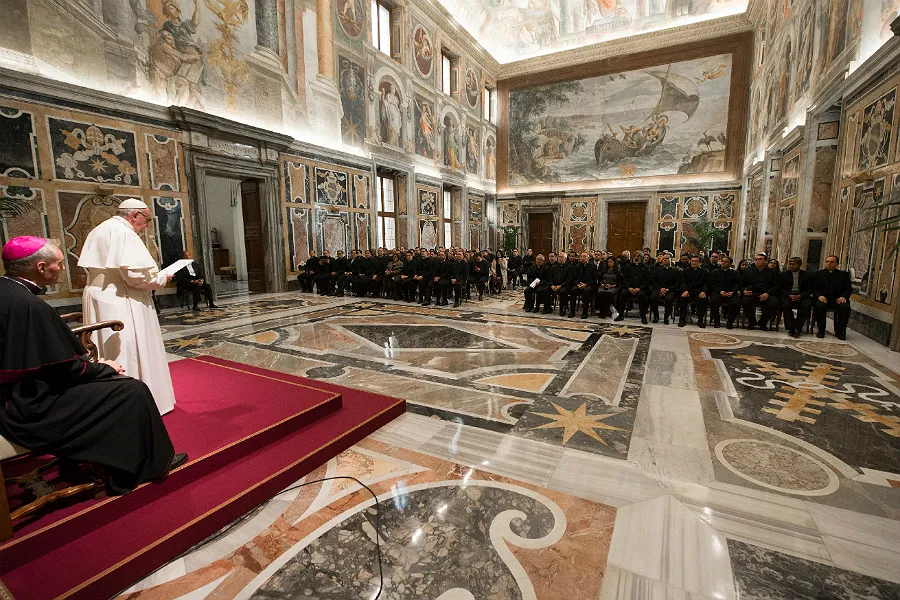
Vatican City, Nov 16, 2018 / 02:06 pm (CNA/EWTN News).- There is the bloody martyrdom of Christians killed for their faith, but also another “martyrdom” which takes place when religious freedom is unjustly limited, Pope Francis said Friday in an audience with a group which assists the Church in the Holy Land.

“It is in front of the whole world – which too often turns its gaze to the other side – the dramatic situation of Christians who are persecuted and killed in ever-increasing numbers,” the pope said Nov. 16 in the Clementine Hall of the Vatican’s Apostolic Palace.

“In addition to their martyrdom in their blood,” he said, “there is also their ‘white martyrdom,’ such as that which occurs in democratic countries when freedom of religion is restricted.”

Pope Francis spoke with around 130 members of the Equestrian Order of the Holy Sepulchre of Jerusalem on the final day of their Nov. 13-16 general assembly in Rome. The knighthood order provides financial support to the Latin Patriarchate of Jerusalem.

To their material support, the pope urged them to unite prayer under the intercession of Our Lady of Palestine. “She is caring Mother and the Help of Christians, for whom she obtains strength and comfort from the Lord in sorrow,” he said.

Emphasizing that the order is not just a “philanthropic agency,” he called its members to “place the evangelical love of your neighbor as the final aim of your works, to witness everywhere the goodness and care with which God loves everyone.”

Since the order’s last general assembly in 2013, it has grown in number, in geography, in pilgrimages, and in the material assistance it has offered to the Church in the Holy Land, the pope noted, thanking the members for their support of the Holy Land.

“It is a good sign that your initiatives in the field of training and health care are open to all, regardless of the communities they belong to and the professed religion.”

“In this way you help to pave the way to the knowledge of Christian values, to the promotion of interreligious dialogue, mutual respect and mutual understanding,” he said, adding: “your contribution to the construction of the path… will lead, we all hope, to the achievement of peace throughout the region.”

Francis also noted the assembly’s agenda, which focused on the role of the local leaders, but underlined the importance of remembering that their main purpose is the spiritual growth of members – not the success of charitable initiatives which cannot be separated from “religious formation programs” for members.

So that members, called knights and ladies, may “strengthen their indispensable relationship with the Lord Jesus, especially in prayer, in the meditation of the Holy Scriptures and in the deepening of the doctrine of the church,” he said.

Leaders of the order of the Holy Sepulchre, he urged, have the task in particular of giving an example “of intense spiritual life and concrete adherence to the Lord.”

Francis closed the audience by asking for the intercession of the Blessed Virgin Mary for the Church in the Holy Land and throughout the Middle East, “with her special intercession for those whose life and freedom are in danger.”

[…]

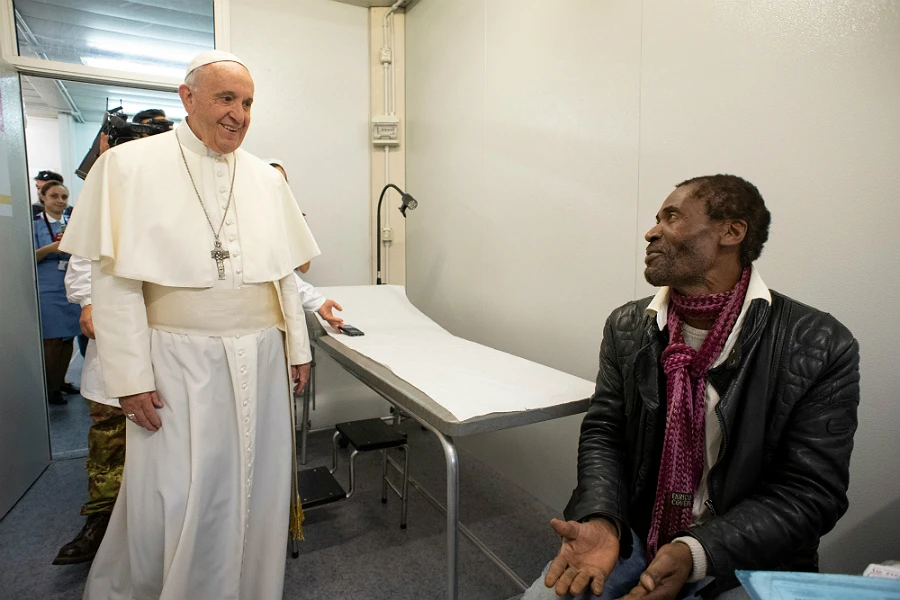
Pope Francis visits the poor at mobile clinic in St Peter’s Square

November 16, 2018 CNA Daily News 0

Vatican City, Nov 16, 2018 / 11:18 am (CNA/EWTN News).- Pope Francis visited Friday the temporary medical clinics serving Rome’s poor and homeless in St. Peter’s Square this week.

During the Nov. 16 visit to the free mobile health clinics, which lasted about 20 minutes, the pope greeted those present, speaking with them and giving them each a rosary he had blessed.

He also greeted the volunteers and medical professionals within each of the shelters. Archbishop Rino Fisichella, president of the Pontifical Council for the New Evangelization, accompanied the visit.

The mobile clinics, an initiative begun last year, have been open from 10 a.m. to 10 p.m. every day the week leading up to the World Day of the Poor, which will be celebrated Nov. 18.

The temporary center offers Rome’s poor and homeless free visits with doctors specializing in general medicine, cardiology, infectious diseases, gynecology, obstetrics, podiatry, dermatology, rheumatology, and ophthalmology. A laboratory for clinical analysis is also present.

Established by Pope Francis at the end of the Jubilee of Mercy, the World Day of the Poor takes its theme for 2018 from Psalm 34: “This poor one cried out and the Lord heard.”

The day will be marked by the pope with a Mass with the poor in St. Peter’s Basilica followed by lunch with around 3,000 poor men and women inside the Vatican’s Paul VI Hall.

Present at the tables of the lunch will also be members of the Roman community, such as volunteers from local charitable organizations, parish priests, and university students and faculty.

The evening prior a prayer vigil for charitable volunteers and others who help the poor will be held at the Basilica of St. Lawrence Outside the Walls.
 

[…]

Vatican dicastery emphasizes family as part of Europe’s cultural heritage

November 16, 2018 CNA Daily News 0

Brussels, Belgium, Nov 16, 2018 / 10:59 am (CNA/EWTN News).- In the wake of the European elections, a proposal was raised to consider “family” as the basis of Europe’s cultural heritage.

The idea was raised at a high-level conference at the European Parliament in Brussels that took place Nov. 6.

The conference was promoted by FAFCE, the Federation of Catholic Family Associations, that gathers all the National Catholic Family Associations in Europe in the framework of its biannual board.

The conference was entitled “Family: the Ecosystem of Cultural Life in Europe,” and was hosted by MEPs Anna Zaborska and Luigi Morgano, in cooperation with the Commission of the European Bishops Conferences, on the occasion of the European Year for Cultural Heritage.

The panel of the high-level meetings included representatives from the European Parliament, the top ranks of COMECE, and from the Dicastery for Laity, Family and Life.

The Dicastery for Laity, Family and Life participated at its highest levels, with a speech delivered by Dr. Gabriella Gambino, undersecretary of the section on the family.

In her intervention, Gambino stressed that the pope asked her to “collaborate with the Church in reconstructing an authentic culture of life and family within the big challenges posed to modernity,” and noted that the dicastery “is attentive to some of the most delicate current issues, especially with the upsurgence of new forms of so-called parenthood, also as a result of in vitro fertilization.”

Gambino stressed that “family is a source of society because it is at the root of the common good,” but also because “it is the place where the human being is culturally nurtured, and where each of us become every day more human from the first moment of conception.”

Marriage is important to protect the human being. It juridically guarantees two orders, that of sexuality and that of generation.

Gambino explained that “the order of sexuality must be exclusive between spouses,” while “the order of generation establishes the family role that comes from marriage,”

This is the reason why, she said, marriage is not just “a social institution of the couple, it is strong in generating cultural roles that go beyond spouses.”

In the end, the human being is “the subject in relations that need others and a strong bond,” and so “if bonds are fragile, the human being’s need to have roots is not fulfilled. This is why “it is important to work on the political field so that family can be a place of certainty and stability.”

Archbishop Jean-Claude Hollerich of Luxembourg, president of COMECE, stressed that family “is the most ancient foundation on which our society is based,” and it is “the first place where we found protection, counselling, solidarity and altruism.”

A participant of the Synod of Bishops on young people, faith and vocational discernment, Archbishop Hollerich said that “young people express the wish to live in family,” but “despite this deep desire to have a family, young people are scared.”

“Some people are scared because of economic situations, others because forced emigration make relations more unstable, and others are even scared not to be able to live in a conjugal life,” he said.

But family, Hollerich concluded, is crucial, because with no families “the European cultural heritage will not be inhabited anymore, and people will not be capable to create culture.”

Fr. Oliver Poquillon, general secretary of the COMECE, concluded that “family is the natural ecosystem of the human being. It is the natural environment for any person, and for this reason it must be at the heart of our political debate.”

Finally, Antoine Renard, President of FAFCE underscored that Europe needs trust, starting to promote a new cultural life from the most basic unit of society: “Politicians need to trust families and the families will trust them”.

The Board meeting of FAFCE followed the conference. The board discussed about the strategy and the future actions of the Federation.

For the first time a member from Slovenia participated in the Board : the Iskreni Institute. The Italian Federation of Kindergardens was accepted as a full member of FAFCE. Invited guests also attended this board meeting from Latvia, The Netherlands, and Ukraine.

[…]

Algerian martyrs are models for the Church, archbishop says

November 16, 2018 CNA Daily News 0

Algiers, Algeria, Nov 16, 2018 / 03:01 am (CNA/EWTN News).- Archbishop Paul Desfarges of Algiers has said that Bishop Pierre Claverie and his 18 companions, who were martyred in Algeria between 1994 and 1996, are “models for our lives as disciples today and tomorrow.”

The Algerian martyrs will be beatified Dec. 8 at the Shrine of Our Lady of the Holy Cross in Oran.

“The beatification of our brothers and sisters is a grace for our Church,” Archbishop Desfarges wrote in a November pastoral letter.

He urged the local Church “to love as they did in the freedom that the Holy Spirit gives” because the martyrs “go before us on the path of witness that our Church is called to give in this land of Algeria, which from the first century has been watered with the blood of the martyrs.”

Archbishop Desfarges said that the 19 martyrs “still continue their mission” and noted that “their lives were given to God and to the people to whom love had united them.” He encouraged the faithful to pray to them “asking for the grace of fidelity for our Church in its mission.”

The archbishop said that the witness of the future blesseds “takes us down the path of ordinary holiness.”

“Life is given to us in order to live it giving ourselves in the everyday…holiness is not a perfection in virtue or morals” but “is a matter of giving your own life, loving and serving in the ordinary things of every day life,” he stressed.

Archbishop Desfarges recalled that the Gospel of following Christ “invites us, encouraged by our blesseds, to live welcoming others to the point of completely divesting ourselves. To welcome the other person is to be totally present to his presence.”

He recalled that “there is no greater love than to lay down your own life for your own friends,” and emphasized the invitation to “endure humiliations” because “to welcome Jesus means to be welcoming to the enemy,” for “the Cross is lifted up when at the moment you are loving the most, you are rejected.”

Finally, the Archbishop of Algiers invited the faithful to live this “time of witnessing” through inter-religious dialogue.

“The witness of the Catholic Church is not a witness against another’s religion, but a witness that the love of Christ poured out in our hearts calls us to live a love for everyone, without distinction, even enemies,” he concluded.

In January Pope Francis had authorized the Congregation for the Causes of Saints to recognize the martyrdoms.

The future blesseds are Bishop Claverie, who was a French Algerian and the Bishop of Oran from 1981 until his Aug. 1, 1996 martyrdom. He and his companions were killed during the Algerian Civil War by Islamists.

In addition to Claverie, those being beatified are: Brother Henri Vergès, Sister Paul-Hélène Saint-Raymond, Sister Esther Paniagua Alonso, Sister Caridad Álvarez Martín, Fr. Jean Chevillard, Fr. Alain Dieulangard, Fr. Charles Deckers, Fr. Christian Chessel, Sister Angèle-Marie Littlejohn, Sister Bibiane Leclercq, Sister Odette Prévost, Brother Luc Dochier, Brother Christian de Chergé, Brother Christophe Lebreton, Brother Michel Fleury, Brother Bruno Lemarchand, Brother Célestin Ringeard, and Brother Paul Favre-Miville.

The best known of Claverie’s companions are the seven monks of Tibhirine, who were kidnapped from their Trappist priory in March 1996. They were kept as a bartering chip to procure the release of several imprisoned members of the Armed Islamic Group of Algeria, and were killed in May. Their story was dramatized in the 2010 French film Of Gods and Men, which won the Grand Prix at the Cannes Film Festival.

After the death of the monks of Tibhirine, Bishop Claverie knew his life was in serious danger. A bomb exploded at the entrance of his chancery Aug. 1, 1996, killing him and an aide, Mohamed Bouchikhi.

[…]

Pro-life display vandalized at Ohio university

November 15, 2018 CNA Daily News 0

Oxford, Ohio, Nov 16, 2018 / 12:06 am (CNA/EWTN News).- A pro-life display at an Ohio university has been vandalized three times since it was erected Monday by the school’s pro-life organization.

Students for Life America at Miami University&rsq… […]

Ohio House passes heartbeat abortion bill

November 15, 2018 CNA Daily News 0

Columbus, Ohio, Nov 15, 2018 / 06:01 pm (CNA/EWTN News).- The Ohio House has once again passed a pro-life bill that would ban abortions after a baby’s heartbeat is detected.

“This bill basically says if there is a heartbeat you cannot abor… […]

Be close to your people, Francis tells Latin American priests

November 15, 2018 CNA Daily News 0

Vatican City, Nov 15, 2018 / 04:13 pm (CNA/EWTN News).- Pope Francis encouraged the community of the Pontifical Latin American College Thursday to avoid cultural fragmentation and to be close to their people.

“One of the phenomena currently afflicting the continent is cultural fragmentation, the polarization of the social fabric and the loss of roots,” the pope said Nov. 15 in the Clementine Hall of the Vatican’s Apostolic Palace.

“This is exacerbated when arguments are fomented that divide and propagate different types of confrontations and hatred towards those who ‘are not one of us’, even importing cultural models that have little or nothing to do with our history and identity and that, far from combining in new syntheses as in the past, end up uprooting our cultures from their richest autochthonous traditions.

He spoke to the community to mark the 160th anniversary of the college’s founding. He noted that it “is one of the few Roman Colleges whose identity does not refer to a nation or a charism, but which seeks rather to be the meeting place, in Rome, of our Latin American land … offering you, young priests, the opportunity to create a vision, a reflection and an experience of communion that is expressly ‘Latin Americanized’.”

Francis lamented that new generations are “uprooted and fragmented”, and said that “the Church is not external to this situation and is exposed to this temptation; since she is subject to the same environment, she runs the risk of becoming disoriented by falling prey to one form of polarization or another, or becoming uprooted if one forgets that the vocation is a meeting ground.”

He added that “the invasion of ideological colonization is also suffered in the Church.”

Because of this, he said it is important at the college “to create bonds and alliances of friendship and fraternity. And not because of a declaration of principles or gestures of goodwill, but because during these years you can learn to know better and make your own the joys and hopes, sorrows and anguish of your brothers; you can name and face specific situations that our people live, and face and feel your neighbour’s problems as if they were your own.”

The Pontifical Latin American College should help create a good priestly community “if one knows how to help oneself, if one is able to lay down roots in the lives of others, brothers and sons with a common history and heritage, part of a same presbytery and the same Latin American people. A priestly community that discovers that the greatest strength it has to build history is born of the concrete solidarity among you today, and will continue tomorrow between your churches and peoples to be able to transcend the merely ‘parochial’ and to lead communities that know how to open up to others to interact and to promote hope.”

Latin America needs, he said, “artisans of relationship and communion, open and trusting in the novelty that the Kingdom of God can inspire today … A priest in his parish, in his diocese, can do a lot – and this is fine – but he also runs the risk of burning himself out, of isolating himself or harvesting for himself. Feeling part of a priestly community, in which everyone is important – not because it is the sum of people living together, but because of the relationships they create, this feeling part of the community – can awaken and encourage processes and dynamics capable of transcending time.”

“This sense of belonging and recognition will help to creatively unleash and stimulate renewed missionary energies that promote an evangelical humanism capable of becoming intelligence and a driving force in our continent,” Pope Francis said.

“Without this sense of belonging and work hand in hand, on the contrary, we will disperse, we will weaken and, worse still, we will deprive so many of our brothers of the strength, the light and the consolation of friendship with Jesus Christ and of a community of faith that gives a horizon of meaning and life. And so, little by little, and almost without realizing it, we will end up offering Latin America … a God without Christ, a Christ without a Church, a Church without a people … pure re-elaborated Gnosticism.”

He said Latin America knows that “the love for Christ and of Christ can not manifest itself except in passion for life and for the destiny of our peoples, and especially solidarity with the poorest, the suffering and those in need.”

The pope said this “reminds us of the importance … of developing the pleasure of always being close to the life of our people; never isolating ourselves from them. The life of the diocesan presbyter is lived – the repetition is valid – in this identification and belonging. The mission is passion for Jesus, but at the same time, it is passion for His people. It is learning to look where He looks and to let ourselves be moved by the same things He is moved by: feelings for the life of His brothers, especially sinners and of all those who are despondent and fatigued, like sheep without a shepherd. Please, do not huddle in personal or community enclosures that keep us away from the hubs where history is written. Captivated by Jesus and members of His Body, we integrate fully into society, share life with everyone, listen to their concerns … rejoice with those who are happy, mourn with those who mourn and offer every Eucharist for all those faces that were entrusted to us.”

Francis said the linking of the college’s anniversary with the canonization of St. Oscar Romero, a sometime student, is providential, calling him a “living sign of the fruitfulness and sanctity of the Latin American Church. A man rooted in the Word of God and in the hearts of his people.”

“This reality allows us to make contact with that long chain of witnesses in which we are invited to place our roots and take inspiration from every day … Do not fear holiness, and do not fear spending your life for your people.”

“On the path of cultural and pastoral miscegenation we are not orphans; Our Mother accompanies us,” Pope Francis stated. “She wanted to be like that, mestizo and fertile, and that is how she is with us, our Mother of tenderness and strength who rescues us from the paralysis or confusion of fear, just because she is simply there, as our Mother.”

“Brother priests, let us not forget, and confidently ask her to show us the way, to free us from the perversion of clericalism, increasingly to make us ‘village pastors’ and not to let us become ‘clerics of the state’.”

He concluded with a message for his brother Jesuits who help run the college, saying that “one of the distinctive notes of the Society’s charism is seeking to harmonize contradictions without falling prey to reductionism. This is why Saint Ignatius wanted to think of the Jesuits as men of contemplation and action, men of discernment and obedience, committed to daily life and free to leave.”

The Jesuits at the college should help the young priests “to harmonize the contradictions that life presents to them and present them without falling into reductionism, gaining in the spirit of discernment and freedom,” he said.

“Teach how to embrace problems and conflicts without fear; to handle dissent and confrontation. Teach how to reveal all kinds of ‘correct’ but reductionist discourse is a crucial task for those who accompany their brothers in formation. Help them to discover the art and taste of discernment as a way of proceeding to find, in the midst of difficulties, the ways of the Spirit by tasting and feeling the Deus semper maior within. Be teachers of broad horizons and, at the same time, teach how to take charge of the small, to embrace the poor and the sick, and to take on the reality of everyday life. Non coereceri a maximo, contineri tamen a minimo divinum est.”

[…]