


This story, I think, will not be easy to read.
So, let me start by heartily congratulating U.S. Olympic bobsledder Kaillie Humphries on her two medals at the 2026 Winter Olympics. With six medals, she’s the most decorated woman in the sport. Her unwavering dedication to the physical and mental preparation necessary to be a champion is unparalleled. After alleged harassment from Canadian coaches, Humphries crossed the border and was naturalized in time to earn a gold for the United States in the monobob event at the 2022 Olympics. This year, in Milan Cortina, Humphries again represented her country well by winning another gold in the monobob and a bronze in the two-woman event.
Impressed with her accomplishments, President Trump invited Humphries to the Women’s History Month celebration at the White House last Thursday, at which she comported herself honorably and once again impressed Americans with her deep sense of loyalty to her country.
But, as hard as it is, if you adhere to the Catholic Church’s integral teaching on human love, marriage, and the transmission of life, there is a looming “but” to Humphries’ story that simply cannot be swept aside.
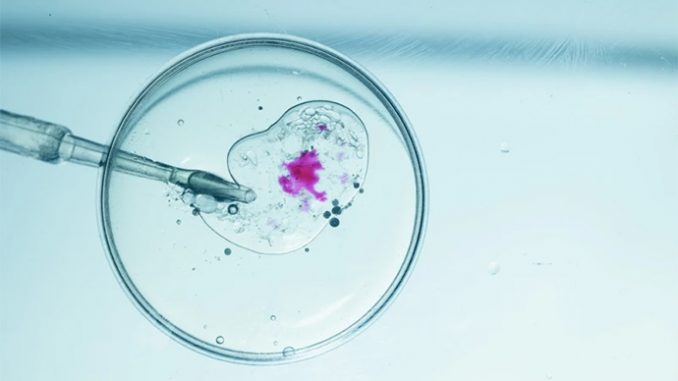
Suffering from endometriosis—a condition where tissue similar to the inner lining of the uterus grows outside of the uterus and presents difficulties for natural conception—Humphries and her husband, former USA bobsledder Travis Armbruster, embarked on the long, painful journey of trying to conceive through in-vitro fertilization (IVF). Humphries has been very open about the process, especially since she had to submit to drug testing to remain eligible for competition.
After two rounds of IVF beginning in the summer of 2022, the couple had a “handful of embryos” available for implantation, but Humphries decided to suspend the process in order to dedicate herself fully to the rigorous training necessary to reenter the sport.
Her husband explains that money was a factor in the decision. They needed to pay for the expensive, ongoing IVF treatments. A silver in the monobob and a bronze in the two-woman at the 2023 World Championships helped provide funding for three embryo transfers, all of which failed. Finally, after switching doctors and undergoing a fourth transfer, Humphries found out that she was pregnant with their son Aulden, healthily born June 14, 2024.
At the White House ceremony last Thursday, Humphries presented the Order of Ikkos medal to the president himself to fulfill her vow to pass it on to someone who helped her achieve her goals. Choking back tears, Humphries expressed gratitude to Trump not only for “standing up to keep biological women in women’s sports,” but also for “creating greater access to IVF, so families like mine can continue to grow,” suggesting that she and her husband are eager to embark on the IVF journey again.
As hard as it is to admit after listening to a story like Humphries’, we must acknowledge that the pro-life movement is much more than an anti-abortion movement. Back in 2003, when Congress was debating whether to place restrictions on partial-birth abortions, it was a matter of pulling on their heartstrings by showing them videos so they might understand what’s involved in the horrific procedure.
Now it is our heartstrings being pulled by testimonies of parents like Kaillie and Travis. If we once seemed unreasonable in our opposition to taking innocent life from the womb, we now seem all the more unreasonable for opposing the alleged “right” to conceive life outside of the womb.
After hearing heart-wrenching stories like Humphries’, it might be easy to turn a blind eye to Trump’s Executive Order last year expanding access to in-vitro fertilization. Who could find fault with Trump’s desire for American families to have “more babies,” allowing “new parents to deduct major newborn expenses from their taxes?” For, as he added in the very next sentence, “IVF treatments are expensive. It’s very hard for many people to do it and to get it, but I’ve been in favor of IVF, right from the beginning.”
Humphries’ testimony is an open reminder of how IVF inevitably involves the destruction of human embryos. This is too easily forgotten when a child as beautiful and perfect as Aulden is finally born. The Dicastery for the Doctrine of the Faith’s Donum Vitae (1987) issues a stark reminder that “the connection between in vitro fertilization and the voluntary destruction of human embryos occurs too often. This is significant,” the Instruction continues, for “through these procedures, with apparently contrary purposes, life and death are subjected to the decision of man, who thus sets himself up as the giver of life and death by decree.”
Kaillie’s hope is that her story will convince women that “they can have it all”: i.e., they can be Olympic champions and mothers. Admiration for her decision is only enhanced by the physical, emotional, and financial sacrifices she had to make to have her son. In their response to Trump’s Executive Order on IVF, Bishops Daniel Thomas and Robert Barron acknowledge the suffering Kaillie and Travis and many others experience in their “good and admirable” desire to have children, but this cannot extenuate the fact that IVF “ends countless human lives and treats persons like property.”
The late Pope Francis championed mothers who made the right decision because they acknowledged that they cannot have it all. No one likes to hear that, but the decision to have a child involves a decision to give other things up—even very important things. When it comes to conceiving a child naturally through the sharing of conjugal love, there’s hardly anything not worth giving up.
“We need to discover the beauty of human sexuality by once again turning to the great book of nature,” Francis taught, “learning to respect the value of the body and the generation of life, with a view to authentic experiences of conjugal love.” He emphasized the dire need for a deeper catechesis in the relational and procreative dimensions of human sexuality, especially “in a world by a relativistic and trivialized view of human sexuality.”
Unfortunately, relativism and trivialization seem far from the minds of Kaillie, Travis, and everyone who has praised their decision to use IVF. If anything, Kaillie and Travis seem to stand for the solid character it takes to be parents and the seriousness with which we should approach the conception of new human life. Their story, together with Trump’s seemingly benevolent desire that we “have more children,” seems all that needs to be said.
And yet, the pro-life teaching of the Catholic Church is one big, beautiful whole that we can no more afford to chop up into little pieces now than we could back in 2003.
If you value the news and views Catholic World Report provides, please consider donating to support our efforts. Your contribution will help us continue to make CWR available to all readers worldwide for free, without a subscription. Thank you for your generosity!
Click here for more information on donating to CWR. Click here to sign up for our newsletter.

I have a very close friend two of whose children went through 12 years of Catholic school education. One then went on to Notre Dame U. and the other to Catholic University. They have to date conceived four children by IVF between them. I’d say their Catholic school education in both cases was a failure.
As I said in my article earlier this year.
“Perhaps you are a child of surrogacy or IVF. Maybe you feel loved and wanted and your parents are wonderful. I’m happy for you. You were lucky. But surely you can agree that a humane legal system ought to protect the unlucky and the vulnerable. Under current U.S. law, it is the people with money who are protected: They get to do anything they want. The children must simply accept whatever the adults choose to give them.
I hope you are troubled by the heartless attitudes of these billionaires. You were lucky enough to have loving parents. But calloused men like these billionaires are hiding behind you and the other smiling babies on IVF clinic brochures.”
https://www.ncregister.com/commentaries/morse-surrogacy-gone-wild
Megan Kelly has had her children by IVF -she says the right way -i don’t know details-but I got the idea that her cycle was followed closely and there were not numerous embryos ?
I wish someone would elaborate
She is in good standing with the church
Believing one’s doing the right thing can differ from actually following Catholic teaching .
Very well put. This is one of them most important tests of civil society’s conformity with natural law. These practices also seem to inevitably connect to eugenics and its horrors.
The question of IVF, while multi-faceted, does boil down to something quite simple. Does the end justify the means? Sometimes the right answer is the hard answer, the answer that leads to suffering. But it is still the right answer. That’s life as a human being.
God Bless your work. Birth Control: the Pill, IUDs are also Abortifacients. Catholic bloggers should stop self-censorship. Please promote Restorative reproductive medicine (RRM) denounce IVF, the abortion pill and contraception. Thank you very much.🙏
Where should I begin?
First, kudos to Pope Francis for his eloquence about this. it is good to be reminded that his papacy had some positive points.
Second, the author appears to want to bend over backwards in expressing admiration for the athlete and her hard work, but, and I add that I like watching the Winter Olympics as much as anyone, though I far prefer other winter sports to the oblique, hidden skills of bobsledding, but as with any athlete at high levels, the question can too often be asked if an idolatry of achievement has entered in.
Third, the pro-life movement, especially but not only at the political level, has exhibited profound cowardice about this issue, the politicians and judges of Alabama being the most egregious example. They have made speaking and standing for the truth secondary to winning elections. That appears to come very close to succumbing to one of the three Satanic temptations of Jesus, trading truth for worldly power. For some, the President perhaps, this may just display the shallow, superficial nature of their thought, but for others, again the Alabama example applies, there has been a trade of truth for political advantage. One can lose one’s soul for many things, but it is sad to see so many “Christians” making the trade, for a baby, for an office, to be liked.
I used to do that; the local clergy did not support me, so I quit (except for combox comments, and that hardly counts).
The Creator’s revelation of the extent o His creation did not stop at the time of His execution on the cross. Why the fullness of creation comes to us in dribs and drabs with discoveries’ hidden from our cognisance for millennia nobody knows. Infertility within sacramental marriage, untaken by a man and woman with the explicit intent to be part of God’s creation process for human life engaged scientists for many years in the search for a cure which would allow completion of God’s creative process. And in His time, God revealed the truth that an embryo could be fertilised and implanted in a woman’s womb with the subsequent development of a new, healthy human being, created by Him through the agency of two married human beings. That is a fact . It is true. It is called IVF. It is a great gift from God, the origin of all truth. There is no moral problem with the use of this technology within the context of a marriage blessed by God as the instrument of creation of human life as He intended. As with all human behaviour the immorality comes when IVF is used beyond its God-given intention within sacramental union as in His plan for the creation of human life, to suit human desires outside His creative plan – same sex ‘couples’. payments for surrogacy, medical practitioners abusing the process for massive unwarranted profits.
I suspect there are those who would say that in this post I have earned a large red cross alongside my name in the big book recording my heresies and misdeeds which will be consulted when I reach the pearly gates. If so, I will attempt to convince the admitting archangel of his God’s truth in revelation!!!!