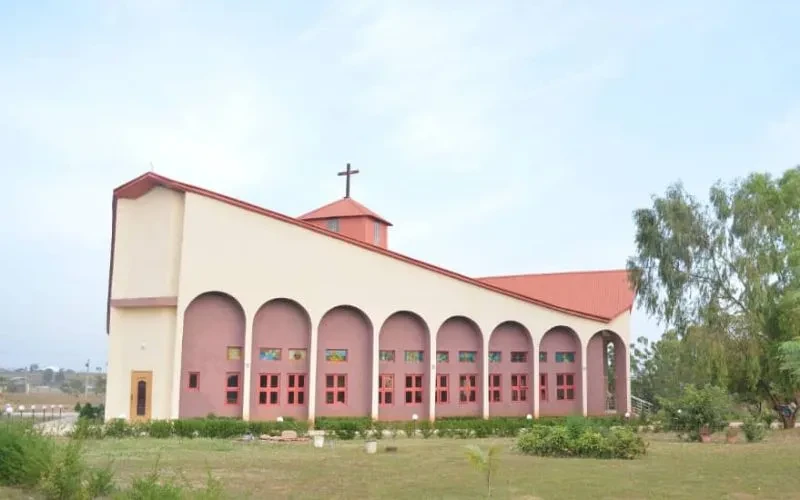
Church at the Good Shepherd Major Seminary in Kaduna, Nigeria. / Credit: Father Samuel Kanta Sakaba, rector of a Good Shepherd Major Seminary in Kaduna
Rome Newsroom, Jan 15, 2025 / 11:20 am (CNA).
Nigeria was the country with the most Christians killed and kidnapped in 2024, according to the latest report from advocacy group Open Doors.
The World Watch List, released Jan. 15, found that 3,100 Christians were killed and 2,830 Christians were kidnapped in Nigeria in 2024, far more than other countries in the same year.
The report also said the country with the most Christians arrested in 2024 was India, at 2,176, and Rwanda experienced the most attacks on Christian churches or buildings with 4,000.
The Open Doors watch list confirmed that Christian persecution continued to grow “in absolute terms” among the about 100 countries the group monitored in 2024, with 13 countries classified at “extreme levels” of Christian persecution.
The group estimates over 380 million Christians worldwide experienced at least a “high level” of persecution and discrimination because of their faith.
North Korea, Somalia, Yemen, Libya, and Sudan are the report’s top five countries for Christian persecution in 2024. Nigeria ranks No. 7 on the watch list. Eritrea, Pakistan, Iran, Afghanistan, India, Saudi Arabia, and Myanmar round out the top 13 countries, all classified as having “extreme” levels of anti-Christian persecution.
With the release of the World Watch List 2025, Open Doors Italy Director Cristian Nani said, “380 million Christians in the world do not enjoy the basic human right to believe what they want. How many more killed, displaced, abused, and imprisoned Christians do we need to count before we put religious freedom at the center of public debate?”
“In 32 years of research, we record a steady increase in anti-Christian persecution in absolute terms,” Nani added. “2024 is again a record year of intolerance: 1 in 7 Christians suffer discrimination or persecution because of their faith: It is crucial to get back to talking about religious freedom in the public debate.”
Open Doors, which supports persecuted Christians in more than 70 countries, compiles its annual World Watch List through information from local networks, national researchers, external experts, and an ad hoc team of analysts.
To formulate its ranking, the advocacy group analyzes the pressure on a Christian’s life in five areas: private, family, community, church, and public life. Violence is added as a separate element in the analysis.
Nigeria has been grappling with Muslim extremist violence since 2009, perpetrated by groups such as Boko Haram, which reportedly persecute Christians, sometimes kidnapping them for ransom and, in some cases, killing them.
While a 2025 report from the pontifical charity Aid to the Church in Need said the abduction of Catholic clergy and religious in Nigeria decreased from 28 in 2023 to 12 in 2024, it is still one of the most dangerous countries in which to be a priest or religious.
The latest religious to be kidnapped in Nigeria, Sisters Vincentia Maria Nwankwo and Grace Mariette Okoli, who were abducted on Jan. 7 from the Archdiocese of Onitsha, have been released and are “in good health,” according to the leadership of their congregation, the Immaculate Heart of Mary, Mother of Christ (IHM).
If you value the news and views Catholic World Report provides, please consider donating to support our efforts. Your contribution will help us continue to make CWR available to all readers worldwide for free, without a subscription. Thank you for your generosity!
Click here for more information on donating to CWR. Click here to sign up for our newsletter.
Kinshasa, Democratic Republic of the Congo, Jul 12, 2021 / 03:35 am (CNA).
Cardinal Laurent Monsengwo Pasinya, who championed human rights, freedom, and greater democracy in the D… […]
Father Francesco Patton, custos of the Holy Land, stops at the Eighth Station of the Via Dolorosa in Jerusalem during the Good Friday Via Crucis on March 29, 2024. / Credit: Marinella Bandini
Jerusalem, Jan 28, 2025 / 06:00 am (CNA).
Franciscan Father Francesco Patton’s nine-year tenure as custos of the Holy Land began unexpectedly in 2016 when he found himself “redirected” — as he put it — to a largely unfamiliar land while preparing to take on a different assignment in Italy.
“I had only visited the Holy Land a couple of times as a pilgrim,” he admitted. “At first, I was apprehensive about accepting this responsibility because I felt I lacked the necessary knowledge to fulfill it properly.”
As the friar approaches the conclusion of his second term as custos of the Holy Land, he spoke with CNA about his experiences, challenges, and key moments in the role.
Father Francesco Patton, OFM, custos of the Holy Land, holding the replica of the jubilee cross during the opening ceremony of the holy year on Nov. 29, 2024, in Nazareth. Credit: Marinella Bandini
Patton emphasized that listening and studying were crucial to immersing himself in his new reality when he arrived. He credited the support of friars and collaborators, including Shibli, his driver. “He taught me to celebrate Mass in Arabic. While traveling, I would practice reading, and he would correct me. We developed a truly fraternal relationship.”
The custos serves as a unique provincial minister within the Franciscan order, leading a community of friars while also being the Holy See’s official guardian of the Christian holy sites. This responsibility was entrusted to the Franciscans by Pope Clement VI through the papal bull Gratias Agimus on Nov. 21, 1342.
Over its 700-year history, the Custody of the Holy Land has also become a point of reference for politicians, diplomats, and local authorities due to its deep roots in the region.
This distinctive role is reflected in the process of electing the custos. Unlike other provincials, who are directly elected by their friars, the custos is selected by the “General Definitorium” (the order’s governing council) and approved by the Holy See. The process is currently underway and will culminate between March and April with the appointment of the 169th custos of the Holy Land.
Father Francesco Patton, OFM, custos of the Holy Land, takes a group photo with 16 friars who have just made their solemn profession. Looking ahead, Patton envisions the custody’s mission continuing amid complexity. Internally, he foresees a more international community with less European influence. “This will be both a challenge and a source of enrichment,” he observed. “We will need to work much harder on formation.” Credit: Marinella Bandini
Patton described his service as deeply centered on the friars’ growth and community life. “I have personally interpreted my role as more focused on accompanying and supporting the friars,” he said.
“Intensity, spirituality, and fraternity” are the three words Patton used to summarize his experience in the Holy Land.
These nine years, he noted, have been “a profound spiritual journey, beginning with the connection to the holy sites. I have moved from theoretical knowledge to tangible reality.”
“I am even more convinced that as Christians, we must be anchored to the historical dimension of the mystery of the Incarnation,” he added.
Father Francesco Patton, custos of the Holy Land, in prayer during the celebrations of St. Francis of Assisi, founder of the Franciscan order. According to St. Francis, the custos explained to CNA, “fraternity means approaching others with trust and seeing them as brothers, never enemies. “Trust is always worth it.” Credit: Marinella Bandini
Among the custos’ favorite sites are the basilicas of the Annunciation, the Nativity, and the Holy Sepulcher, as well as the sanctuaries around the Sea of Galilee. “These are places where Jesus shared the life of ordinary people, performed acts of fraternity, and had profound conversations, such as with Peter,” he reflected.
Franciscan fraternity, he explained, means approaching others with trust and seeing them as brothers, never enemies. “Trust is always worth it,” he emphasized.
This is precisely what took place in the paradigmatic encounter between St. Francis and Sultan Malik al-Kamil in 1219, an event that marked the beginning of the Franciscan presence in the Holy Land.
“War and evil produce only destruction and ugliness, while fraternity and peace create beauty,” he said. “I believe this is God’s dream, and we should nurture it more.”
Father Francesco Patton, custos of the Holy Land, at a moment of rest. On the left, the general minister of the Order of Friars Minor, Father Massimo Fusarelli; on the right, the vicar of the Custody of the Holy Land and the custos’ primary collaborator, Father Ibrahim Faltas. Credit: Marinella Bandini
Fraternity is also a style of governance, one that he has sought to follow throughout these nine years.
“My approach has been to lead by sharing,” he explained. “Today, people often speak of synodality; I personally prefer the term participation. While some decisions must be made individually, the more the friars are involved, the more fruitful those decisions will be, because those who are included also feel responsible.”
This participatory leadership reflects the Franciscan tradition, which at all its levels operates through a communal decision-making body — the chapter. “The fundamental idea,” Patton noted, “is that leadership is a service. It’s not always easy or successful, but it’s essential.”
Father Francesco Patton, custos of the Holy Land, in front of the Edicule of the Holy Sepulchre at the end of the Good Friday Via Crucis on March 19, 2024. Credit: Marinella Bandini
“I have always seen my role as temporary,” he said. “My suitcase is always ready. Sometimes people joke about how I travel with just a small backpack, but Jesus himself, in the Gospel (Luke 10:4), tells us not to carry a bag. So, even the backpack might be too much!”
Patton pointed to the Gospel account of Christ washing his disciples’ feet as the ultimate example of servant leadership — a lesson that continues to shape his vision of fraternity in action.
The Franciscan acknowledged the challenges of his tenure, including war, the COVID-19 pandemic, and political tensions.
Father Francesco Patton, custos of the Holy Land, in prayer at the chapel of the Seventh Station on the Via Dolorosa, in Jerusalem, during the Good Friday Via Crucis, March 29, 2024. Credit: Marinella Bandini
“I have lived through difficult moments,” Patton shared. “I was especially apprehensive for the friars serving in dangerous areas, such as Syria. However, I have not faced major misunderstandings, as I do not expect everyone to fully grasp what I am trying to accomplish, and I consider it legitimate for some to have differing opinions.”
When he arrived in 2016, the war in Syria was at its peak. “I asked Fra Hanna Jallouf, now Latin vicar of Aleppo, if he wanted to leave. He told me he would rather stay with his people, even if it meant dying, not abandon them like a mercenary. His faith helped me approach difficult decisions with greater serenity.”
Nine years later, with the new situation in the country, that decision now seems almost providential. “The friars were the only Christian presence in the Idlib region for many years. Now, they can play a role in facilitating dialogue with the new leadership,” he said, adding: “When I arrived, I prayed to the Heavenly Father that I might at least witness the end of one war during my term. Perhaps that prayer has been heard.”
Father Francesco Patton, custos of the Holy Land, walks together with the Latin patriarch of Jerusalem, Cardinal Pierbattista Pizzaballa, during the Palm Sunday procession in Jerusalem in 2024. Credit: Marinella Bandini
Reflecting on the war in Gaza, Patton emphasized the need for true peace, not just temporary truces. “We need to adopt a long-term perspective, even if the path to peace is arduous.”
During the pandemic, the custody faced severe economic challenges, also taking out loans to support employees. “We faced these difficulties with faith and a willingness to take personal risks,” he said.
Patton also noted growing political tensions and pressures, including attacks on Christian sites and increased challenges from the Israeli political climate.
“In 2018, we closed the Holy Sepulcher, in agreement with all the churches, in order to oppose a legislative initiative that we believed would unfairly tax us and introduce mechanisms that could ultimately lead to the expropriation of Church properties.”
Father Francesco Patton, custos of the Holy Land, presides over the Eucharistic celebration in Tabgha, on the shores of the Sea of Galilee, on the occasion of the feast of the Primacy of Peter in May 2024. Among the custos’ favorite sites are the sanctuaries around the Sea of Galilee: “These are places where Jesus shared the life of ordinary people, performed acts of fraternity, and had profound conversations, such as with Peter,” he told CNA. Credit: Marinella Bandini
Over the years, the custos explained, “I have witnessed a progressive shift in Israeli politics, steering the country toward a right-wing alignment that combines nationalist and religious fundamentalism. Pressure has increased on the West Bank, and the war in Gaza would have been fought differently with another government, with more attention given to the issue of hostages. We ourselves have faced growing pressure, such as on the issue of taxes, as well as an increase in attacks, both in the holy sites and personally, with insults and even spitting.”
In these circumstances, Patton expressed confidence in the custody’s contribution to a different future: “I am convinced that the custody is already making a contribution, starting with the schools where we educate everyone to have a fraternal perspective toward others.”
Father Francesco Patton, custos of the Holy Land, greets a group of children from the Terra Sancta School of Bethlehem in Manger Square during the Advent entrance in 2023. “I am convinced that the custody is already making a contribution to a different future starting with the schools where we educate everyone to have a fraternal perspective toward others,” he told CNA. Credit: Marinella Bandini
Looking ahead, Patton envisions the custody’s mission continuing amid complexity. Internally, he foresees a more international community with less European influence. “This will be both a challenge and a source of enrichment,” he observed. “We will need to work much harder on formation.”
When it comes to his own future, amid speculation about a possible episcopal appointment, he said: “Nine years ago, I thought I would be a parish priest in Turin, but I came to the Holy Land instead. Since then, I have resolved not to make plans but to trust in God.”
Rumbek, South Sudan, Mar 8, 2021 / 07:19 pm (CNA).- Father Christian Carlassare, who was appointed Bishop of Rumbek on Monday, nearly 10 years since the death of the diocese’s last bishop, described his appointment as an illustration of “the God of surprises.”
In a message to ACI Africa, Fr. Carlassare said he welcomed his episcopal appointment in a “spirit of faith” even though it was not among his expectations.
“God is the God of surprises. And his surprises, even though challenging, carry always a blessing,” the bishop-elect told ACI Africa March 8.
The member of the Comboni Missionaries added, “I did not expect this appointment, but I welcome it with spirit of faith and availability. May the loving plan of God for the Church of Rumbek and South Sudan be accomplished.”
“I am grateful to Pope Francis and the Church for the love and trust that have shown by calling me to the episcopal ministry and appointing me to be the Bishop of Rumbek.”
Fr. Carlassare, 43, was born in Italy. He studied at the Theological Faculty of Central Italy, and earned a baccalaureate in theology from the Pontifical Gregorian University and a baccalaureate in missiology from the Pontifical Urban University.
He made his solemn profession as a member of the Comboni Missionaries in 2003, and was ordained a priest of the institute in 2004.
The priest went to South Sudan in 2005, and has served as a pastor. He was vice provincial for the Comboni Missionaries in South Sudan from 2017 to 2019, and from 2020 he has served as vicar general of the Diocese of Malakal.
The Diocese of Rumbek became vacant in July 2011 upon the death of Bishop Cesare Mazzolari, who was also a Comboni Missionary.
Fr. Fernando Colombo, another Comboni Missionary, was administrator of the diocese until December 2013, when the Prefect of the Congregation for the Evangelization of Peoples appointed Fr. John Mathiang as diocesan coordinator.
Fr. Carlassare acknowledged with appreciation the leadership of Fr. Mathiang, alongside members of the clergy ministering in the diocese, members of various religious orders, as well as the people of God.
“My thought goes to all the people of the diocese and their desire to encounter Christ in the Church,” he said, adding, “My obligation goes to all priests that are serving in the diocese, in particular Fr. John Mathiang for his commitment to lead the diocese in the past years as diocesan coordinator.”
“My appreciation goes to all the religious institutes and communities of men and women that enrich the diocese with their charisms, among them I show special gratitude to my confreres, the Comboni Missionaries and Sisters, especially those we have shared in the ministry,” he told ACI Africa.
He recognized the commitment of laity serving in the Rumbek diocese, saying, “I also acknowledge the commitment of many lay people, whether native from Rumbek or from other places and countries, those who work in the offices and institutions of the diocese, and committed Christians such as catechists, members of church councils, associations, men and women, youth and elders who form and build up this family of God.”
“I want to express my readiness to join the Diocese of Rumbek entering in the journey that you have been doing so far and offering my humble self,” the bishop-elect said.
At this moment, he added, “what I ask you more is for your prayer, with the trust that our Lord who started this good work will assist me with his grace and bring it to completion.”
“I also recall the person of the late bishop Cesare Mazzolari who gave his life to the people of Rumbek with the spirit of a good shepherd,” Fr. Carlassare said.
He went on to thank the people of God in the Malakal diocese, among whom he has been ministering since he arrived in South Sudan in 2005, saying, “I am also indebted with the Diocese of Malakal for the spirit of communion, support and kindness: May God reward you.”
Meanwhile, Fr. Mathiang has expressed his best wishes to the bishop-elect, promising collaboration.
In an interview with ACI Africa March 8, he said, “The message is just wishing him the best and then we promise collaboration and a good progress, whatever we have been doing he comes and joins us and we push ahead.”
In his service as diocesan coordinator, Fr. Mathiang told ACI Africa he has learned love, and collaboration from the people of God in the diocese, as well as the “spirit of hard work and interest in development that they have been expressing to me and to the Church for all the things done over the years.”
The love, collaboration and hard work needs to continue, he said, adding, “It’s not all about me, it’s about Jesus Christ and about the Church. The people have to continue that spirit; what we need is the progress ahead.”
Leave a Reply
