

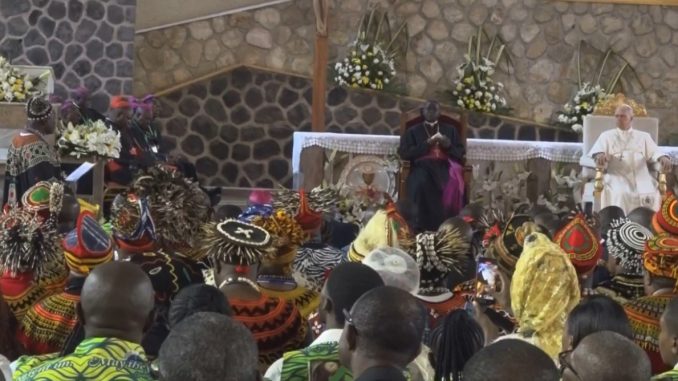
(CWR | Yaounde) Pope Leo XIV’s recent visit to Africa has reignited debate over the Church’s pastoral approach to polygamy. During an April 16, 2026, address at St. Joseph’s Metropolitan Cathedral in Bamenda, Fon Fru Asaah Angwafor IV, the traditional ruler of Mankon, called for a more compassionate and inclusive ecclesial posture toward those in polygamous unions.
While acknowledging that education has largely phased out traditions incompatible with Christian values, the Cameroonian monarch expressed gratitude for the Church’s focus on the issue during the 2023–2024 Synod on Synodality. He recalled that the Pope specifically asked African bishops to study how to better integrate people in polygamous situations into the life of the Church.
“We thank you that during the Synod on Synodality in Rome in 2023 and 2024, the Pope asked the African Bishops to carry out an in-depth study on Polygamy and see how people in these situations can be integrated into the life of the church,” Angwafor told the Holy Father, drawing suppressed laughter from the packed Cathedral.
“We are waiting for the results of that study, so that those traditional rulers and people who are in that situation may be able to worship God freely in the church without being judged or rejected within the same Church,” he appealed.
Tensions and challenges
While the Church consistently upholds matrimony as a union between one man and one woman, the situation in Africa—where polygamy is legal in 31 countries—creates tension because of those who wish to remain Catholic while adhering to traditional customs.
Last month, the Symposium of Episcopal Conferences for Africa and Madagascar (SECAM) finalized its report on the pastoral challenge of polygamy. Published on March 24, 2026, the 25-page document outlines a structured approach to the practice within the African context.
“This document directly responds to the mandate from the 2023 Synod on Synodality to provide theological and pastoral discernment on the issue,” said Father Humphrey Tatah Mbuy, a prominent Cameroonian priest and anthropologist.
The document examines the historical roots of polygamy in Africa, attributing the practice to the need for large families (for security and labor), alliances between families or tribes, social prestige, and the high value placed on posterity. It explains that, contrary to the belief that modernity would erase the practice, it is showing resilience driven by factors such as female sterility, the levirate, and, increasingly, women embracing it to balance motherhood with professional careers by sharing domestic burdens.
The document also highlights “veiled polygamy”, a modern form that exists alongside traditional structures, where men maintain multiple households or “offices” outside of legal marriage.
The SECAM document draws on biblical texts to explain why polygamy does not meet the Church’s requirements for marriage. While key biblical figures, including Abraham, Jacob, and David, were all polygamous for reasons of progeny and survival, the document notes that this was not the original ideal. It explains that from Creation (“male and female he created them”) to the prophets, the Bible increasingly exalts monogamy.
Catholic teaching is clear and settled
In exclusive comments to CWR, Bishop Michael Bibi of Cameroon’s Buea Diocese said that dealing with people in polygamous relationships “continues to challenge the Church pastorally, particularly within many African cultural contexts.”
However, he is firm that under no circumstances will the Church compromise its teaching on what marriage is.
“The Catholic Church’s teaching on marriage remains firmly rooted in Sacred Scripture and Sacred Tradition,” Bishop Bibi said.
“Marriage, as instituted by God,” he explained, “is a covenant between one man and one woman. In the Gospel, Our Lord Jesus Christ reaffirms this original plan of the Creator when He says: ‘from the beginning made them male and female…this is why a man leaves his father and mother and becomes attached to his wife, and the two become one flesh. They are no longer two, therefore, but one flesh. So then, what God has united, human beings must not divide’ (Matthew 19:4-6).”
“The Church, therefore, upholds monogamous and indissoluble marriage as the proper context for the Sacrament of Matrimony,” Bibi continued.
He also cited the Catechism of the Catholic Church, which states in paragraph 1645: “The unity of marriage, distinctly recognized by our Lord, is made clear in the equal personal dignity which must be accorded to man and wife in mutual and unreserved affection. Polygamy is contrary to conjugal love, which is undivided and exclusive.”
“Likewise, Saint Paul teaches that each man should have his own wife and each woman her own husband (1 Cor 7:2),” the bishop added. “This reflects the Christian understanding of a faithful and exclusive marital union.”
Despite this strict adherence to the Christian definition of marriage, Bishop Bibi recognizes the danger of losing those in polygamous situations. He described the Church as “a mother called to welcome, accompany, and guide all her children with charity and patience.”
“Families in polygamous unions must never feel rejected or excluded from the life of the Church,” the cleric asserted. “While certain sacramental limitations exist, particularly concerning the reception of the Eucharist and sacramental marriage, these faithful are still members of the Christian community. They are encouraged to participate in the life of the Church through prayer, attendance at Mass, acts of charity, catechesis, and the moral and spiritual upbringing of their children.”
Pastoral accompaniment, but without compromise
Bishop Bibi said “pastoral accompaniment” is at the core of his mission in his Diocese.
“Through our catechetical programs, Small Christian Communities, pastoral counseling, and parish outreach initiatives, we strive to ensure that persons in irregular marital situations encounter the mercy and love of Christ,” he said. “Priests, catechists, and pastoral agents are encouraged to approach such families with compassion, avoiding every form of condemnation or humiliation, while at the same time faithfully presenting the teachings of the Church.”
Emphasizing the universality of the Church, the cleric asserted that “her teachings on the Sacrament of Marriage cannot be altered according to cultural circumstances.” Yet, pastoral approaches, he explained, should take into account local realities, cultures, and the gradual journey of faith of individuals and families.
“This is in line with the Church’s longstanding principle of inculturation, whereby the Gospel is proclaimed within cultures without compromising the truths of the faith, which are not cultural but stem from the teaching of Christ himself,” he said.
Bishop Bibi’s approach in Buea Diocese mirrors the recommendations of the SECAM document. The document explains that pastoral action must be characterized by proximity, listening, and support rather than mere condemnation, because the Church is called to walk with those affected. It emphasizes that pastoral care must be “constitutive of the mission of the Church,” meaning it is essential to engage with the reality of polygamous families rather than excluding them.
Additionally, the document recommends that pastoral programs must specifically value women, ensuring that the Church’s defense of monogamy is perceived as a defense of the dignity and honor of women, rather than a purely legalistic rule.
For those in polygamous situations, the document urges the Church to develop appropriate pastoral care to help those who have encountered the Gospel while already living in polygamous relationships—helping them live a life of faith and charity within their current constraints. For all Christians, the Church must implement pastoral initiatives to help believers understand and adhere to the ideal of monogamous marriage.
Bishop Bibi said he understands the concerns of traditional leaders like Fon Angwafor, explaining that their voices “often reflect genuine pastoral concerns arising from lived realities within their communities.” He said the Church values dialogue with such leaders, especially when such dialogue seeks the dignity of persons and the strengthening of family life.
“Nevertheless, any pastoral response must remain faithful to the Gospel, the teachings of Christ, and the universal Magisterium (teaching authority) of the Church,” he asserted.
“As pastors, our responsibility is to hold together both truth and charity, proclaiming clearly the Church’s teaching while ensuring that every person experiences the closeness, mercy, and hope that Christ Himself offers to all.”
Father Tatah Mbuy told CWR simply that “Fon Angwafor’s worries, like those of many, have been answered.”
If you value the news and views Catholic World Report provides, please consider donating to support our efforts. Your contribution will help us continue to make CWR available to all readers worldwide for free, without a subscription. Thank you for your generosity!
Click here for more information on donating to CWR. Click here to sign up for our newsletter.

A few quotes from Twain regarding polygamy might help:
“No man can serve two masters” (cf., Matthew 6:24)
“Our stay in Salt Lake City amounted to only two days, and therefore we had no time to make the customary inquisition into the workings of polygamy and get up the usual statistics and deductions preparatory to calling the attention of the nation at large once more to the matter.
I had the will to do it. With the gushing self-sufficiency of youth I was feverish to plunge in headlong and achieve a great reform here—until I saw the Mormon women. Then I was touched. My heart was wiser than my head. It warmed toward these poor, ungainly and pathetically “homely” creatures, and as I turned to hide the generous moisture in my eyes, I said, “No–the man that marries one of them has done an act of Christian charity which entitles him to the kindly applause of mankind, not their harsh censure–and the man that marries sixty of them has done a deed of open-handed generosity so sublime that the nations should stand uncovered in his presence and worship in silence.”
(Roughing It)
I’m sure there can be a Study Group 9, 2.0 to solve the issue
We read: “[the document] explains that, contrary to the belief that modernity would erase the practice [of polygamy]…” Yes, the same modernity which in the West has given us sequential bigamy, co-habitation, the redefinition of “marriage” itself, and even a female U.S. Supreme Court justice who cannot even say what a woman is.
Prior to (ambivalent) “modernity,” both chronologically and in terms of permanent human reality, we have this from Pope Benedict XVI about (indigenous, pre-Christian, circumstantial, or Islamic) polygamy:
“From the standpoint of creation, eros directs man toward marriage, to a bond which is unique and definitive; thus, and only thus, does it fulfill its deepest purpose. Corresponding to the image of a monotheistic God is monogamous marriage [!]. Marriage based on exclusive and definitive love becomes the icon on the relationship between God and his people and vice versa. This close connection between eros and marriage in the Bible has practically no equivalent [!] in extra-biblical literature” (“God is Love,” 2005, n. 11).
I happened to look up some statistics on African polygamy last night. It’s strongest in West and Central Africa, especially among Muslims and adherents of native paganism. Countries where 30% or more of men are polygamists include: Burkina Faso, Guinea, Benin, Nigeria, Senegal, Togo, Mali, and Niger. Good luck persuading men that they have to stick to one wife when multiple younger, more fertile ones are on offer for non-Christians. It’s a bad system for women and leaves unfavored men with no chance to marry but the acids of modernity aren’t eroding it very fast. Nevertheless, the Church must not compromise.SM
We read about Muslims and paganism, and that “the Church must not compromise.” Indeed. And about compromises, had the following been published a year earlier, it might have served as a clarifying footnote to the bridge-building in Nostra Aetate:
“Islam has not wanted to choose between Heaven and Earth. It proposed instead a blending of heaven and earth, sex and mysticism [!], war and proselytism, conquest and apostolate. In more general terms, Islam proposed a blending of the spiritual and the temporal worlds which neither in Islam nor among the pagans have ever been divided” (Jean Guitton, “Great Heresies and Church Councils,” 1965, p. 116).
Some countries, like India, solved the problem with arranged marriages. Assuming 50/50 split. I worked with an Indian who told me he was in love with another woman, but his parents made him marry another
The desire to not grieve Holy Spirit & disempower Him from declaring what is of Jesus to us , instead for the glory to be more & more like Adam in the ‘original holiness’ that reigned in him & Eve as Divine Will before The Fall – thank God that in our times such good truths are available world over .
https://radiomaria.us/category/podcast/fr-robert-young/ – good gentle talks of Franciscan priest Robert Young (R.I.P.) who narrates how Divine Will truths helped him to fill the sense of something more needed in his life as a Franciscan and to help clarify the Scripture . Listening to him might be essential to not get confused about the metaphorical terms & occasions of trials depicted in the writings as Book of Heaven & others .
All the writings of Luisa have been approved by Vatican in 2024 ; the theme of unity in Spirit, the trust and hope with compassion in relaying the great graces Lord desires for our times in the message of our recent Popes can be heard with less bias / confusion when we trust the good source for same .
https://en.luisapiccarretaofficial.org/news/the-divine-will-at-the-heart-of-holiness/2003
The trials/ sacrifices needed to replace carnal appetites & its transient, even evil pleasures with joy of holiness, it dignity in lasting relationships of purity , united to The Lord to help bring the good of same unto generations – past , present , future in the Divine Will . The trust needed for same – may it be granted through our Mother, St.Joseph , Luisa..such that any after the first wife could be in the brother – sister relationship , being heroic for the good of all & the nation with help of our Mother . FIAT !
According to wikipedia, Luisa’ cause was halted in 2024 because of serious theological errors in her writings. But the diocese of Trani wants a saint and given the way Anna Katharina Emmerich was beatified by ignoring her partly ghostwritten writings, there may be hope for her yet.
Fr. Terry Staples did a useful critique of Luisa’s work in Crisis a decade ago: https://timstaples.com/luisa-piccaretta-and-the-divine-will-ii/ (I’m just linking to part 2.) This stuff is reminiscent of the teachings of Joachim of Fiore, condemned in the 14th C after promotion by the condemned Spiritual Franciscans. Only then, it was called the the Third Age of the Holy Spirit. Why on earth do people latch on to bizarre private revelations like this and the detestable Poem of the Man-God? We have the Scriptures, the Fathers, and two millennia of official Church teachings. No, Luisa isn’t going to resolve the Afrcan polgamy issue.
https://www.littlechildreninthedivinewill.com/questions
Guess the above site also should have been linked to help deal with the misunderstandings about writings of Luisa ; unlike writings of Bl.Emmerich, Church knows plenty as to the needed details on the life and writings of Luisa .
https://divinewilllife.org/series/an-introduction-to-the-divine-will/
Good talks to listen to , to get a good taste for same . Look forward to many skilled & learned being in footsteps of Fr. Young , who at first thought he did not need a ‘new spirituality’ ,yet once he got to know more about it, spent the rest of his life in learning and sharing same .He also mentions that St.Hannibale Di Francia of Rogationists – whose statue was put up in Vatican during time of Pope Benedict was also similarly much devoted to same .
Thank you and God Bless !
Dilemma occurs with change of the guard. In this instance the old guard, the European missionaries taught strict obedience to the Gospels and monogamy, the new guard the bishops now confronted with remnants of tribesmen living in polygamy, areas that were not reached or effectively converted by the missionaries. With that we have the softer, contemporary humanistic approach.
Most bishops have had access and at least some indoctrination with contemporary thought. My experience if it has value is that bishops, older clergy I met in Africa were aware of a trend toward contemporary laxity. As appears in this article, the pastoral posture of understanding, charity while addressing the truth of the Gospels is reasonable.
Difficulty arises in practice where exceptions to the rule gradually become fixed. As previously occurred in Europe. Again, experience reveals that compassion and understanding in the long run is best served by a distinctive, persistent negation of polygamy. Africans as do all of us realize to the degree that truth is demanded it must ring true.
It’s more than receiving the Eucharist though. If you are openly living a life of sin it is hard to see how you can be “integrated” into the life of the Church much less why you would want to be.
There are Catholics in marriages or relationships that cannot be sanctioned by the Church still pray and go to Mass although they cannot receive Communion. They suffer in a state of contradiction hoping that it might one day be resolved. Understand their predicament but don’t pretend their situation is licit to be “pastoral.”
Yes, Miss Sandra. I’ve known Catholics who came to Mass faithfully for years & years even though they couldn’t receive Communion. Eventually the death of one in the relationship brings an end to that. But in polygamous marriages with several people in a relationship I guess it could be a longer wait.
🙂
“It’s more than receiving the Eucharist though. If you are openly living a life of sin it is hard to see how you can be “integrated” into the life of the Church much less why you would want to be.”
Why can’t all your comments be this compelling, coherent and unassailable?
This would have best addressed to Mel Gibson when, after pronouncing his wife hellbound, they divorced and he took up with two paramours, instead many give his exhibition of serial scandal a pass because he makes religious themed movies.
That which denies The Word Of God cannot subsist within The One Body Of Christ ; Christ’s Church Is One, Holy, Catholic, And Apostolic In The Unity Of The Holy Ghost, The Spirit Of Perfect Divine Eternal Infinite Love Between The Father And His Only Begotten Son, Jesus The Christ, Who Proceeds From The Father And His Only Begotten Son, Jesus The Christ.
For all that has happened with marriage in the west, I have a challenging time being exercised about cultures where polygamy is both practiced and cherished. Obviously, it was much practiced by righteous people in the Old Testament. Once I get this beam out my eye I may then begin to discuss the shortcomings of others.
What the OT depicts about polygamous households shows why the practice is Not a Good Idea. I suspect that’s why the rivalries and tragedies are recorded in Holy Writ.
True, Sandra! I suppose that is why God The Father Chose To Send us His Only Son, To Show Us The Way, The Truth, And The Light (Life) Of Authentic Life affirming and Life sustaining Salvational Love, And Why Christ Came To Do His Father’s Will🙏✝️
It’s funny, I actually tried to post a comment very much like yours Mr Michael but the server error message came up and it disappeared into cyber space.
But yes.
Bigamy and virtual polygamy have a long history in the West and now we’re trying to export SSA relationship acceptance to Africa.
Specks and beams indeed.
In the list of biblical figures King Solomon was left out. His many foreign wives turned his heart away from God.
More whiny secularism dressed up as being cultural awareness. Here is a simple method: you give up spare spouses, ALL of them, or you cannot be Baptized. Period. We dont need attitudes like this in the church.
Bigamy was a rare and highly disapproved behavior in the West. Polygamy would be guaranteed to make you a pariah, at least until recently when it became the subject of a popular TV show. That being said the vast majority of Americans view it as bizarre and unacceptable behavior.
Bigamy was actually not an uncommon thing in places like the UK in the days when a divorce was very difficult to obtain. And before the internet was available to check on someone’s real identity & marital status. People could leave their spouse & reinvent themselves much more easily.
Catholics, even when living a mortally sinful lifestyle, still have the obligations of a Catholic: to go to Mass, fast as required, give to support the Church, raise their children as Catholics, etc. It makes sense to include them in parish activities, with some exceptions (e.g. reception of Sacraments, any sort of liturgical ministry, teaching, sponsor for Baptism or Confirmation, etc.). These are the same kinds of things non-Catholics should not be admitted to, no matter how long they’ve been coming to Mass.
Polygamy/adultery is not currently an excommunicable offense, so it does not make sense to exclude them entirely.