

 By
By Pope Leo XIV pointed out that both science and the Church clearly teach that caring for the planet is threatened by the irresponsible exploitation of both people and the natural world.
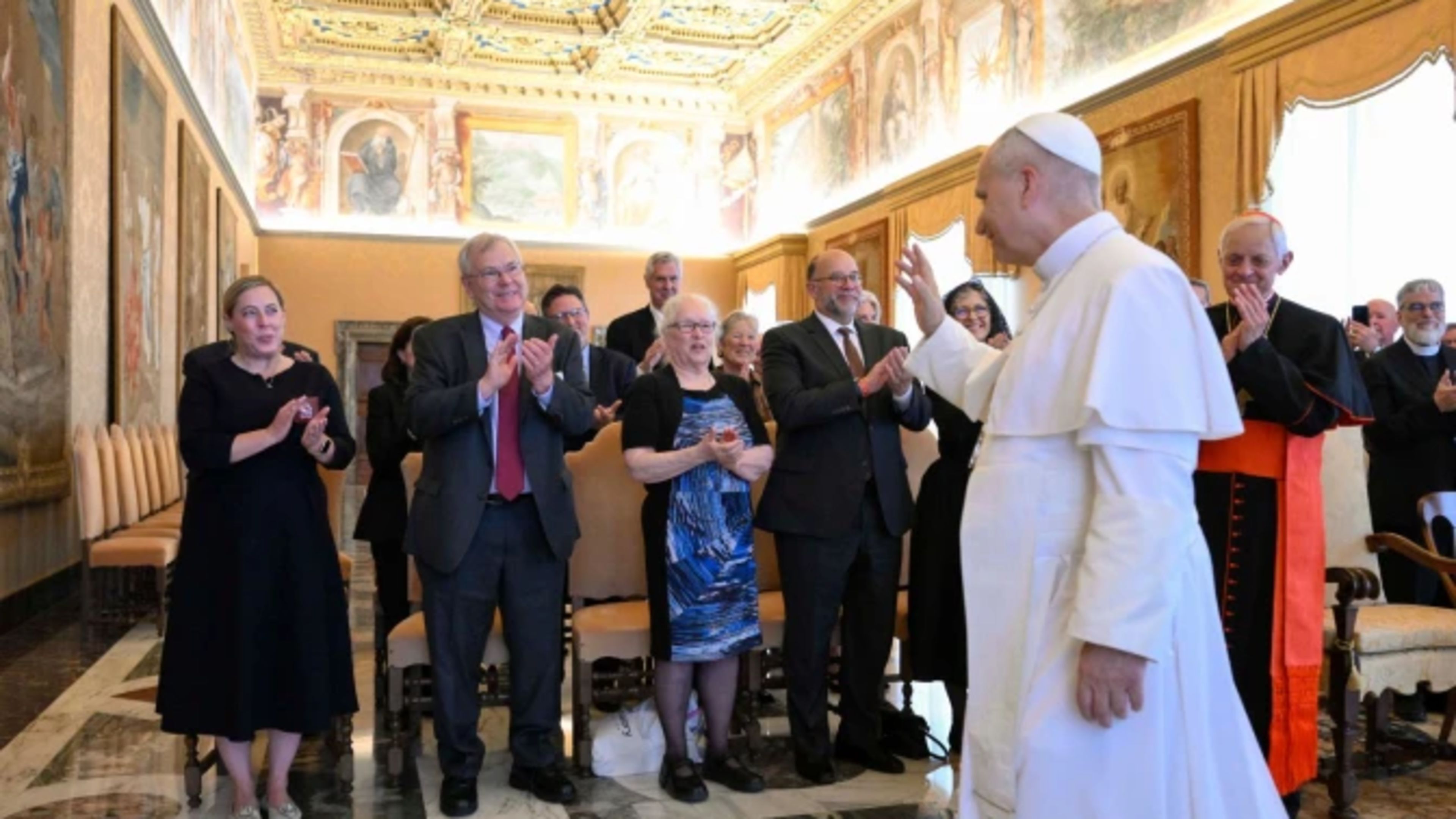
Pope Leo XIV said the principal threat facing both religion and science today is the denial of the existence of objective truth. He made this statement on May 11 during an audience granted to members of the Vatican Observatory Foundation, which supports the work of the observatory located in Castel Gandolfo.
“Today, however, science and religion face a different, and perhaps more insidious, threat: those who deny the very existence of objective truth,” the pontiff said.
During his address, he recalled that his predecessor Pope Leo XIII refounded the Vatican Observatory in 1891 in a context where science was beginning to emerge as a rival source of truth to religion. Because of this, he said, the Church felt the “urgent need to counter the growing perception that faith and science were enemies.”
Exploitation of natural resources
“Too many in our world refuse to acknowledge what both science and the Church clearly teach: that we bear a solemn responsibility for the care of our planet and for the well-being of those who inhabit it, especially the most vulnerable, whose lives are threatened by the irresponsible exploitation of both people and the natural world,” Leo said.
He underscored that the Church’s commitment to “rigorous and honest science remains not only valuable but essential.”
The pope also highlighted the unique role of astronomy within this context. “It occupies a particular place in this mission,” he affirmed while emphasizing its capacity to evoke wonder and a sense of proportion in human beings: “It awakens in us both admiration and a healthy sense of proportion.”
“Contemplating the heavens invites us to view our fears and failures in the light of God’s immensity,” he noted.
However, he lamented, “this gift is today threatened” by light pollution.
“To paraphrase Pope Benedict [XVI], we have filled our skies with artificial light that blinds us to the lights God has placed in them — an eloquent image,” he suggested, “of sin itself,” citing a 2012 homily by the German pontiff.
Gratitude for scientific work
The pope expressed his gratitude to the scientists and benefactors associated with the foundation, whose work sustains the activities of the Vatican Observatory.
“Your generosity makes it possible for the Vatican Observatory to share the wonder of astronomy with students around the world and to offer workshops and summer courses to those working in Catholic schools and parishes,” he said.
“Ultimately, it is your dedication that keeps the observatory’s telescopes and laboratories faithful to their original purpose: to be places where the glory of God’s creation is encountered with reverence, depth, and joy,” he added.
Finally, the pontiff exhorted them to “never lose sight of the theological vision that animates all of this.”
“It’s not surprising that people of deep faith feel called to explore the origins and workings of the universe,” he said. “The desire to better understand creation is but a reflection of that restless yearning for God that dwells in the heart of every human being.”
This story was first published by ACI Prensa, the Spanish-language sister service of EWTN News. It has been translated and adapted by EWTN News English.
If you value the news and views Catholic World Report provides, please consider donating to support our efforts. Your contribution will help us continue to make CWR available to all readers worldwide for free, without a subscription. Thank you for your generosity!
Click here for more information on donating to CWR. Click here to sign up for our newsletter.


Planet Earth is thirsting for respect, tender care, and nonviolence.
We read: “’Contemplating the heavens invites us to view our fears and failures in the light of God’s immensity [and that] this gift is today threatened’ by light pollution.”
Also the threat of non-analog, statistical, digitized/data-dump, and even AI pollution…
As a man of the family, the ex-Communist Whittaker Chambers guided his son to a hilltop free from the dulling haze of city lights. He encouraged his son to simply look up at the real stars and to see not only with the eyes, but through the eyes. In his words:
“What little I know of the stars I have passed on to my son over the years….We often stop to watch through the apple trees (Genesis!) the great sky triangle tipped by the evening stars: Vega in Lyra, Altair in Aquila and Deneb, burning in the constellation of the Swan.
“Sometimes, I draw my son’s eye to the constellation Hercules, especially to the great nebula dimly visible about the middle of the group. Now and again, I remind him that what we can just make out as a faint haze is another universe—the radiance of fifty thousand suns whose light had left its source thirty-four thousand years before it brushes the miracle of our straining sight.
“Those are the only statistics [!] that I shall ever trouble my son with….I want him to have a standard as simple as stepping into the dark and raising his eyes whereby to measure what he is and what he is not against the order of reality. I want him to see for himself upon the scale of the universes that God, the soul, faith, are not simple matters . . . .
“I want him to remember that God Who is a God of Love is also the God of a world that includes the atom bomb and virus, the minds that contrived and use or those that suffer them, and that the problem of good and evil is not more simple than the immensity of worlds.
“I want him to understand that evil is not something that can be condescended to, waved aside or smiled away, for it is not merely an uninvited guest, but lies coiled in foro interno [that is] at home with good within ourselves. Evil can only be fought. . . .I want him to know that it is his soul, and his soul alone, that makes it possible for him to bear, without dying of his own mortality, the faint light of Hercules’ fifty thousand suns” (Epilogue, “Witness,” 1952).