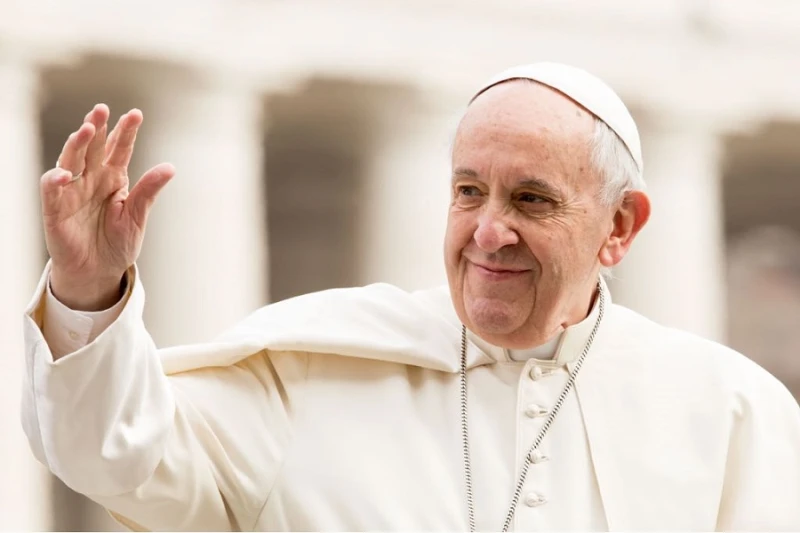
Pope Francis waves to pilgrims during his March 28, 2018 general audience in St. Peter’s Square. / Daniel Ibáñez/CNA.
CNA Staff, May 5, 2021 / 06:20 am (CNA).
Pope Francis will issue an apostolic letter next week on the ministry of catechist.
The Holy See press office said May 5 that the papal letter, issued motu proprio (“on his own impulse”), would be presented at a press conference on May 11.
It described the apostolic letter, Antiquum ministerium, as the means “by which the ministry of catechist is instituted.”
The Italian section of the Vatican News website said: “The motu proprio therefore will formally establish the ministry of catechist, developing that evangelizing dimension of the laity called for by Vatican II.”
It noted that in a 2018 video message, Pope Francis said that the vocation of catechists “demands to be recognized as a true and genuine ministry of the Church, which we particularly need.”
Further details will be unveiled at the news conference, which will take place at the Vatican. Archbishop Rino Fisichella, president of the Pontifical Council for Promoting the New Evangelization, and Bishop Franz-Peter Tebartz-van Elst, the Pontifical Council’s delegate for catechesis, will speak at the event.
The Code of Canon Law (Can. 785) defines catechists as “lay members of the Christian faithful, duly instructed and outstanding in Christian life, who devote themselves to setting forth the teaching of the gospel and to organizing liturgies and works of charity under the direction of a missionary.”
“Catechists are to be formed in schools designated for this purpose or, where such schools are lacking, under the direction of missionaries,” it says.
In his 1990 encyclicalRedemptoris missio, Pope John Paul II described catechists as “irreplaceable evangelizers.”
He wrote: “It is with good reason that the older and established churches, committed to a new evangelization, have increased the numbers of their catechists and intensified catechetical activity. But ‘the term “catechists” belongs above all to the catechists in mission lands … Churches that are flourishing today would not have been built up without them.’”
“Even with the extension of the services rendered by lay people both within and outside the Church, there is always need for the ministry of catechists, a ministry with its own characteristics.”
He continued: “Catechists are specialists, direct witnesses and irreplaceable evangelizers who, as I have often stated and experienced during my missionary journeys, represent the basic strength of Christian communities, especially in the young churches.”
A 1993 guide for catechists, issued by the Vatican Congregation for the Evangelization of Peoples, said: “Through religious instruction, preparation for the sacraments, animation of prayer and other works of charity, they help the baptized to grow in the fervor of the Christian life.”
“Where there is a shortage of priests, the catechists are also entrusted with the pastoral guidance of the little community separated from the center. Often, they are called to witness to their faith by harsh trials and painful privations.”
“The history of evangelization past and present attests to their constancy even to the giving of life itself. Catechists are truly the pride of the missionary Church!”
In his 2020 post-synodal apostolic exhortationQuerida Amazonia, Pope Francis said that there was a need to strengthen lay leadership in the Amazon region.
He wrote: “A Church of Amazonian features requires the stable presence of mature and lay leaders endowed with authority and familiar with the languages, cultures, spiritual experience and communal way of life in the different places, but also open to the multiplicity of gifts that the Holy Spirit bestows on every one. For wherever there is a particular need, he has already poured out the charisms that can meet it.”
“This requires the Church to be open to the Spirit’s boldness, to trust in, and concretely to permit, the growth of a specific ecclesial culture that is distinctively lay. The challenges in the Amazon region demand of the Church a special effort to be present at every level, and this can only be possible through the vigorous, broad and active involvement of the laity.”
In January this year, the pope issued a motu proprio, Spiritus Domini, changing canon law to allow women to serve as lectors and acolytes.
Lector and acolyte are publicly recognized ministries instituted by the Church. The roles were once considered “minor orders” in the tradition of the Church and were changed to ministries by Pope Paul VI.
If you value the news and views Catholic World Report provides, please consider donating to support our efforts. Your contribution will help us continue to make CWR available to all readers worldwide for free, without a subscription. Thank you for your generosity!
Click here for more information on donating to CWR. Click here to sign up for our newsletter.
Members of the Sts’ailes First Nation at Holy Rosary Cathedral last year for the first Mass to integrate a First Nation language. A Cardus report presents the voices of Indigenous Canadians speaking about their faith and distinguishing it from the traditional spirituality they’re often associated with. / Photo courtesy Nicholas Elbers, 2022
Vancouver, Canada, May 17, 2023 / 14:15 pm (CNA).
A groundbreaking report published by the Ottawa-based Cardus Institute has given voice to Indigenous Canadians who are frustrated by secular society’s unawareness of — or unwillingness to accept — the fact that almost half of them are Christian.
“I find that insulting to Indigenous people’s intelligence and freedom,” Catholic priest Father Cristino Bouvette said of the prejudice he regularly encounters.
Bouvette, who has mixed Cree-Métis and Italian heritage and now serves as vicar for vocations and Young Adults in the Diocese of Calgary, was one of 12 individuals interviewed by Cardus for the report “Indigenous Voices of Faith.”
Father Deacon Andrew Bennett, left, leads a post-production discussion by Indigenous Voices of Faith participants. Photo courtesy of Cardus
Prejudice against Indigenous Christians has become so strong, even inside some Indigenous communities, “that Indigenous Christians in this country right now are living in the time of new martyrdom,” Bouvette said.
Although that martyrdom may not cost them their lives, “they are ostracized and humiliated sometimes within their own communities if they openly express their Christian or Catholic faith.”
Statistics Canada reported last year that the 2021 census found that 850,000, or 47%, of Canada’s 1.8-million Indigenous people identify as Christian and that more than a quarter of the total report they are Catholic. Only 73,000, or 4%, of Indigenous people said they adhere to traditional Indigenous spiritual beliefs.
In a new report, Cardus wants to “amplify the voices of Indigenous Canadians speaking for themselves about their religious commitments, which sometimes clash with the typical public presentation of Indigenous spirituality.” Photo courtesy of Cardus
Ukrainian Catholic Deacon Andrew Bennett, program director for Cardus Faith Communities, conducted the interviews for the think tank last fall. He published his report in March at a time when Canadian mainstream media and many political leaders continued to stir division and prejudice through misleading commentary about abandoned cemeteries at Indian Residential Schools.
The purpose of the report, he writes, “is to affirm and to shed light on the religious freedom of Indigenous peoples to hold the beliefs and engage in the practices that they choose and to contextualize their faith within their own cultures.”
Too often, however, “the public narrative implies, or boldly declares, that there’s a fundamental incompatibility between Indigenous Canadians and Christianity or other faiths,” Bennett said. “[M]any Indigenous Canadians strongly disagree with those narratives.”
Father Bouvette is clearly one of those.
“We did not have Christian faith imposed upon us because of [my Indigenous grandmother’s] time in the residential school or her father’s time in the trade school that he was sent to,” Bouvette said. “No, it was because our family freely chose to receive the saving message of Jesus Christ and lived it and had continued to pass it down.”
Bouvette said his “grandmother was not tricked into becoming something that she didn’t want to be, and then tricked into staying that way for 99 years and 11 months of her life. She was a Christian from the day of her birth, and she remained a Christian until the day of her death. And so that was not by the consequence of some imposition.”
Nevertheless, Canadians continue to labor under a prejudice holding the opposite view. “I do believe that probably the majority of Canadians at this time, out of some mistaken notion of guilt for whatever their cultural or ethnic background is, think they are somehow responsible for Indigenous people having had something thrust upon them that they didn’t want,” Bouvette said.
“We did not have Christian faith imposed upon us,” Father Cristino Bouvette says in a Cardus report on Indigenous faith. Photo courtesy of Cardus
“But I would say, give us a little more credit than that and assume that if there is an Indigenous person who continues to persevere in the Christian faith it is because they want to, because they understand why they have chosen to in the first place, and they remain committed to it. We should be respectful of that.”
The executive director of the Catholic Civil Rights League, Christian Elia, agrees and says society should grant Indigenous Catholics the respect and personal agency that is due all Canadians.
“Firstly, I am not an Indigenous person, so I cannot speak for our Indigenous brothers and sisters, but neither can non-Indigenous secularists who choose to ignore that Indigenous people in Canada continue to self-identify as Christian, the majority of these Catholic,” Elia said in an interview with The B.C. Catholic.
He said his organization has heard from many Indigenous Catholics who are “growing weary of the ongoing assumption that somehow they have been coerced into the faith, that it is inconceivable that they wish to be Catholic. This condescending attitude must stop.”
Deacon Rennie Nahanee, who serves at St. Paul’s Indian Church in North Vancouver, was another of the 12 whom Bennett interviewed. A cradle Catholic and member of the Squamish First Nation, Deacon Nahanee said there is nothing incompatible with being both an authentic Indigenous person and a Catholic.
“I’m pretty sure we had a belief in the Creator even before the missionaries came to British Columbia,” he said. “And our feelings, our thoughts about creation, the way that we lived and carried out our everyday lives, and the way that we helped to preserve the land and the animals that we used for food, our spirituality and our culture, were similar to the spirituality of the Catholic Church.”
“I believe that’s why our people accepted it. I don’t think anybody can separate themselves from God, even though they say so.”
Interviewed later by The B.C. Catholic, Nahanee said he is not bothered by the sort of prejudice outlined by Bouvette. “People are going to say or do what they want,” he said.
Voices of Indigenous Christianity
Bennett, program director of Cardus Faith Communities, interviewed 12 Indigenous Canadians, most of them Christian, about their religious commitments, “which often clash with the typical public presentation of Indigenous spirituality.” Here is a selection of some of their comments:
Tal James of the Penelakut First Nation in Nanaimo spoke about the relationship between Indigenous culture and his Christian faith:
Tal James and wife Christina. Photo courtesy of Project 620 – James Ministry
“I think … that our [Indigenous] cultures were complete, and in Jesus they’re more complete. I think that’s a big thing and a big step for a lot of us. You’re going to have a lot of non-Indigenous people look at you and question your actions based on your Aboriginal heritage. Don’t take that to heart. They’re the ignorant ones who don’t want you to flourish. Those of you who are Christians, First Nations Christians, you come to the table with the same gifting that non-Aboriginal people have. For them to say, ‘We want to make room for you at the table,’ correct them. You are already at the table, and encourage them to step back and allow your gifts to flourish. Because it’s one in the same spirit.”
Rose-Alma McDonald, a Mohawk from Akwesasne, which borders New York, Ontario, and Quebec, talked about re-embracing her Catholic faith:
Rose-Alma McDonald. Photo courtesy of Cardus
“I surprised everybody, including myself, in terms of embracing Catholicism after 20 years away. So I’ve had a few epiphanies in the sense that this is why my mother made me do so much in the church growing up. When I’m working, volunteering, and doing stuff in the church, I remember that. I keep remembering I’m Catholic and I’m still Catholic. I will stay Catholic because of the way I was raised.”
Jeff Decontie, a Mohawk from the Algonquin First Nations who lives in Ottawa, talked about being a person of faith in a secular world:
Jeff Decontie. Photo courtesy of Cardus
“Secular worldviews can sort of eat up everything around them and accept a whole wide range of beliefs at the same time. For example, you have the prevailing scientific thinking alongside New Age believers, and people in society just accept this, saying, ‘Oh, whatever it is you believe in, all religions lead to the same thing.’ No one questions it. How can these contradictions coexist? … Then we ask an [Indigenous] elder to lead prayer? Any other religion would be a no-no, but you can ask for an elder who’s going to pray a generic prayer to some generic Creator, and it’s not going to ruffle any feathers. I think that’s the danger of secular thought creeping into Canada: It goes unnoticed, it’s perceived as neutral, but at the same time it’s welcoming a whole wide range of beliefs. And it doesn’t just influence Indigenous thought. It’s influencing Christianity.”
Rosella Kinoshameg, a member of the Wikwemikong Reserve on Manitoulin Island in Ontario, spoke about being Indigenous and Catholic:
Rosella Kinoshameg. Photo courtesy of the Catholic Register
“Well, I can’t change being Indigenous. That’s something that is me. I can’t change that. But to believe in the things that I was taught, the traditional things, the way of life and the meanings of these things, and then in a church, well, those things help one another and they make me feel stronger.”
This article was originally published May 10, 2023, in The B.C. Catholic, a weekly publication serving the Catholic community in British Columbia, Canada, and is reprinted here on CNA with permission.
Vatican City, Jun 15, 2017 / 11:02 am (CNA/EWTN News).- Pope Francis, in a foreword to a work by Cardinal Peter Turkson, has said corruption infects the world like a cancer, and the Church must combat it by working together with society, infusing it with mercy.
“We must all work together, Christians, non-Christians, people of all faiths and non-believers, to combat this form of blasphemy, this cancer that weighs our lives,” the Pope wrote.
“It is urgent to take notice of it, and this is why we need education and a merciful culture, we need cooperation on the part of everyone according to their own possibilities, their talents, their creativity.”
Hi words on corruption were written in a foreword for Corrosion, a book-length interview of Cardinal Peter Turkson, prefect of the Dicastery for Promoting Integral Human Development, published June 15.
The interview was conducted by Vittorio V. Alberti, a member of the Cardinal Turkson’s dicastery.
The book was presented at the Vatican during an “International Debate on Corruption.” Italian daily Corriere della Sera published the Pope’s foreword June 14, just ahead of the book’s release.
Corruption, Francis wrote, in its Italian etymological root, means “a tear, break, decomposition, and disintegration.”
The life of a human being can be understood in the context of his many relationships: with God, with his neighbor, with creation, the Pope said.
“This threefold relationship – in which man’s self-reflection also falls – gives context and sense to his actions and, in general, to his life,” but these are destroyed by corruption.
When we respect these relationships we are honest, responsible, and work for the common good. But when corruption enters in, they become torn. “Thus, corruption expresses the general form of disordered life of the decayed man,” he said.
And this has an effect on all of society.
What, for example, he asked, is at the root of exploitation, degradation, human trafficking, trafficking of weapons and drugs, social injustice, lack of service for people? What is the origin of slavery, unemployment, carelessness for cities, common goods, and nature?
Corruption “is a profound cultural question that needs to be addressed.”
But in order to address it, we must understand the different forms of corruption, besides merely the political, like those that infect even the average person.
For example, Francis said, our corruption can be a “spiritual worldliness, tepidness, hypocrisy, triumphalism, to make prevail only the spirit of the world in our lives, a sense of indifference.”
In the book, Cardinal Turkson explains the ramifications of these different forms of corruption, he continued, focusing in particular on the origins of corruption: which, “in fact, sprouts in the heart of man and can sprout in the heart of all men.”
“We are, in fact, all very exposed to the temptation of corruption: even when we think it has been defeated, it can be present again,” he said.
Cardinal Turkson explores the different types of corruption, including spiritual, cultural, political, and criminal, as well as the various ways in which they come about and insinuate themselves into our lives. Putting these together, he shows what the Church must do, the Pope said.
“The Church must listen, raise herself and bend herself on the sorrows and hopes of people according to mercy, and must do so without fear of purifying herself, assiduously seeking a way to improve.”
“Henri de Lubac wrote that the greatest danger for the Church is spiritual worldliness – therefore corruption – which is more disastrous than the infamous leprosy.”
“And it is with this awareness that we, men and women of the Church, can accompany ourselves and the suffering humanity, especially those most oppressed by the criminal consequences and degradation created by corruption.”
To fight the many ways we may allow corruption into our lives, we must join together, Francis said. On our own we are like individual pieces of snow, both Christians and non-Christians. But united, we can become like an avalanche, he explained: “a strong and constructive movement.”
“Here is the new humanism, this renaissance, this re-creation against corruption that we can accomplish with prophetic audacity.”
Writing from inside the Vatican, Francis reflected on the ways beauty can transcend sin and corruption.
“This beauty is not a cosmetic accessory, but something that puts the human person in the center so that it can lift the head against all injustices,” he said.
“This beauty should marry with justice. Thus we must speak about corruption, denounce evils, understand it, and show the will to affirm mercy for grief, curiosity and creativity for resigned fatigue, beauty for nothing.”
Dr. Christina Francis, incoming CEO of the American Association of Pro-Life Obstetricians (AAPLOG), says she suspects they were denied an exhibit booth because of their opposition to abortion. / AAPLOG
Leave a Reply
