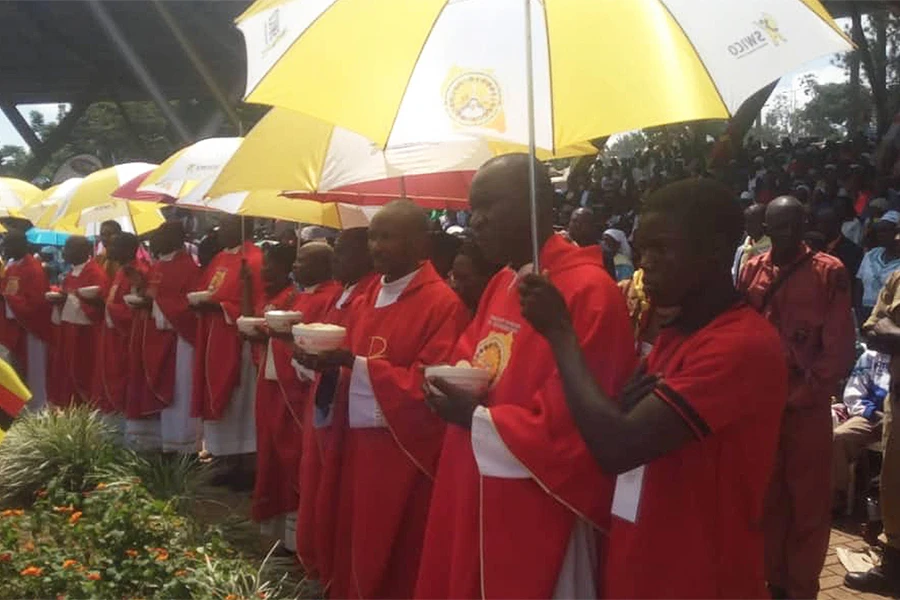
Kampala, Uganda, Jun 17, 2018 / 05:00 am (CNA/EWTN News).- A new sex-education program created by the government of Uganda will be rejected by Christian schools unless considerable revisions are made, the Catholic bishops of the country have said.
While a team of Catholic experts was consulted while the program was being created, their suggestions were “substantially ignored” in the final document, the bishops noted.
Among the shortcomings of the new program are that it ignores “the vital role of the family, especially in the early ages” and that it exposes children ages 3-5 years to “content and life skills which are not appropriate for their age.”
Furthermore, the bishops said, the information and life skills provided for upper level students are “open to interpretation and practices which may contrary to moral Christian values.” They also added that the program provides “no provisions or guaranties that school teachers are prepared and able to teach in a balanced and proper way such delicate and emotionally charged topics.”
“As it stands now, the National Sexual Education Framework, though containing some valid ideas and guidelines, fails to answer some crucial questions and address in an adequate manner some important issues,” the Uganda Episcopal Conference said in a statement issued after their plenary assembly earlier this month.
According to 2014 Census data, Roman Catholics constitute the largest religious denomination in Uganda, with nearly 40 percent of the population identifying as Catholic. Another 32 percent are Anglican, while Muslims make up about 14 percent of the population.
The Ugandan bishops emphasized that “contrary to what many people think, the Church is in favor of a positive, age appropriate, culturally and religious (sic) sensitive sex education which upholds moral and Christian values.” “This is the task and shared responsibility of the family, the Church and the state throughout the schools,” they added.
The document is now undergoing a final evaluation by Catholic experts who are compiling suggested amendments to the program, the bishops said.
However, should the document remain unchanged, the Catholic Church in Uganda together with the Orthodox Church have decided “that we shall not be able in conscience to have it introduced and taught in our Christian-founded schools.”
If you value the news and views Catholic World Report provides, please consider donating to support our efforts. Your contribution will help us continue to make CWR available to all readers worldwide for free, without a subscription. Thank you for your generosity!
Click here for more information on donating to CWR. Click here to sign up for our newsletter.

A photo of Deborah Emmanuel’s photo on her Facebook page. Emmanuel, a Christian student in Nigeria, was killed by an Islamic mob on her college campus on May 12, 2022. / CNA
Washington, D.C. Newsroom, Jun 23, 2022 / 14:01 pm (CNA).
Deborah Emmanuel, the Nigerian Christian student who was murdered by a Muslim mob last month, spent her final hours with a close friend who has shared exclusive details of the brutal killing with CNA.
CNA is using the pseudonym “Mary” for the woman’s protection. A Christian herself, she nearly was killed by the same mob.
Significantly, Mary’s account contradicts the claim of authorities that they attempted to rescue Emmanuel from the mob but were “overwhelmed.”
On the contrary, the police “could have stopped the murder if they had really tried,” Mary told CNA.
Emmanuel’s so-called “blasphemy murder” took place on May 12 on the campus of Shehu Shagari College of Education in Sokoto, Sokoto State, a major city located in the northwest corner of Nigeria. The city is home to the Muslim Sultan who serves as the top religious authority for Nigeria’s 100 million Muslim believers.
Prior to the attack, Emmanuel, a home economics major who attended Evangelical Church Winning All, was bullied by fanatical Muslim students at the teacher’s college for audio statements she made on WhatsApp, a messaging platform. She credited Jesus Christ for her success on a recent exam, and when threatened and told to apologize she refused, invoking the Holy Spirit, saying “Holy Ghost fire! Nothing will happen to me,” according to WhatsApp messages reviewed by CNA.
In the aftermath of these heated exchanges, a Muslim mob attacked Emmanuel on the college’s campus. After an hours’ long siege, the mob beat and stoned her to death, then set her body on fire with burning tires, according to graphic video footage posted online. The rioters also rampaged in a Catholic Church compound in Sokoto, according to reports. The riots spread to other Christian-owned properties over two days.
A relative of Emmanuel’s, who said he was standing approximately 60 feet from the mob, also told CNA he believes the police could have saved her. He, too, asked that his identity be withheld for his safety.
Unarmed campus security personnel made a futile attempt to rescue Emmanuel, according to a campus security report shared with CNA. But Emmanuel’s relative said there were dozens of armed police officers on the scene who didn’t fire their weapons.
The commissioner of police in the state also said officers did not fire their weapons. However, he maintained that only 15 of his officers were at the scene, according to a report in The Epoch Times.
Bishop Matthew Hassan Kukah of the Diocese of Sokoto has strongly condemned the attack and called on Emmanuel’s killers to be brought to justice..
“This matter must be treated as a criminal act,” he said. You can read his full statement here.
A plea for help
On the day of Emmanuel’s death, Mary received a frantic phone call from her around 9 a.m, asking for help. By that time, women who lived in her dormitory had begun slapping Emmanuel, Mary told CNA.
Mary arrived at the campus to see her friend surrounded by a mob and being led by a campus staffer to a gatehouse building for her protection. The Muslim students had bloodied her face and head with blows from rods and were joined by male students who believed their duty was to execute a blasphemer on the spot, Mary said.
“Allahu Akbar!” meaning “God is Great” was bellowed for hours, she said.
Mary initially stayed outside the building and tried to intercede for her friend, but she said it wasn’t long before the mob turned on her, too. Within moments Mary was trying to ward off punches and blows from sticks as she backed away from the gatehouse and toward the gate of the college 40 feet away.
Mary said a college lecturer rescued her and brought her to join Emmanuel inside the gatehouse by 10 a.m.
At 10:25 a.m., the relative said, six officers of the Department of State Security (DSS) — the equivalent to the FBI in the U.S. — arrived, firing their rifles in the air but with no effect. Five minutes later, he said, a group of Sokoto police came on the scene and fired tear gas, temporarily scattering the mob.
The above map is based on eyewitness accounts of the murder of Nigerian Christian student Deborah Emmanuel on her college’s campus on May 12, 2022. Graphic by Alexander Hunter
For about 10 minutes police had an opportunity to disperse the mob and force their way to the gatehouse to extract Mary and Emmanuel, Emmanuel’s relative believes. But that did not happen.
By 11 a.m., the mob had returned to the building, holding cloths against their faces to ward off the tear gas. The mob tried hurling stones at Mary through the windows of the locked gatehouse, but Mary barricaded herself behind a table.
The mob then threw gasoline on the women through the front windows and attempted to burn them alive, Mary said.
“Deborah was soaked with gasoline, but when lighted plastic was pitched in through the windows, I quickly stamped the flames out,” Mary said.
No escape
All of this transpired as police and DSS officers watched from a safe distance, according to Emmanuel’s relative.
The traumatized women said little to each other, but Emmanuel was still hoping to do her examination that day, Mary said. At one point, she recalled, Emmanuel asked, “What time is it? I have an examination at noon.” Mary said she looked at her cell phone and told her it was 1 p.m.
After another excruciating hour of siege, the mob pushed down a single Sokoto policeman guarding the door, broke the padlock on the door, and rushed in to find Mary and Emmanuel hiding behind furniture, Mary and the relative related. Two rioters placed a chain around Mary’s neck and pulled it hard, trying to strangle her, she recounted.
“Let this girl go! She is not an offender,” Mary recalled one of the rioters shouting. But as they released her, a young man in the mob grabbed Emmanuel and took her to the front steps of the gatehouse. There she was bludgeoned with steel pipes and wooden rods and stoned, the relative said.
Two DSS officers attempted to rescue Emmanuel but were hit by stones and pushed aside, the relative said. The police officers remained in position and did not come to her aid, he alleged.
Mary collapsed inside the gatehouse gasping from the strangulation. Approximately 40 minutes later, she said, she was roused by one of the mob to leave the building, which was on fire.
As she walked through the smoke, Mary saw the gatehouse burning and Emmanuel’s lifeless body in flames.
The face of Christian persecution
In the aftermath of Emmanuel’s murder, human rights advocates and others have leveled sharp criticism at Nigeria’s government leaders for not doing enough to stem the rising tide of violence directed at Christians and other non-Muslims.
Relatives of Deborah Emmanuel at her burial in Niger State, Nigeria. Courtesy of the Emmanuel family
Anti-Christian hatred was evident in days of rioting in Sokoto following the arrest of two suspects in Emmanuel’s murder. The rioters reportedly were incensed that there were any arrests at all.
“Deborah Emmanuel, like kidnapping victim Leah Sharibu (who was enslaved by Boko Haram insurgents in 2019), has become the face of Christian persecution in Nigeria,” said Kyle Abts, executive director of the International Committee on Nigeria (ICON). “There has not been an official report from the security forces on the lynching of Ms. Emmanuel. Her killing and subsequent riots show clear government complicity and coverup.”
Tina Ramirez, founder of the international nonprofit Hardwired Global, also believes the Nigerian government has been unwilling to take a strong stand against blasphemy killings.
“The recent attacks on students are reminiscent of the attacks at Nigerian colleges two decades ago that were the precursor to the growth of extremist groups across Nigeria’s North and Middle Belt,” Ramirez wrote in a text to CNA.
People look on as an excavator helps search for people trapped under debris after a landfill collapsed in Kampala, Uganda, on Aug. 10, 2024. Eight people including two children were killed when mountains of garbage collapsed at a landfill, the c… […]
Khartoum, Sudan, Aug 1, 2017 / 06:01 am (CNA).- Dust and mud brick houses everywhere – as far as the eye can see. The houses are indistinguishable in color from the ground on which they stand. Trees are few and far between.
The road leading northwards from the Sudanese capital of Khartoum shimmers in the burning heat. The temperature tops 110 degrees. At a certain point the car turns off into an unpaved road with deep potholes, entering a residential suburb.
“Welcome to the St. Kizito School of Dar es Salaam,” says our host, Father Daniele, as we stand in the courtyard of the school, which is named after the youngest of the Ugandan martyrs. This Italian priest is a member of the clergy of the Archdiocese of Khartoum. His fluent Arabic enables him to communicate with the people of his parish in their own language.
“I belong to the Neo-Catechumenal Way and I studied at our seminary in Beirut. I’ve been living in Sudan now for more than 10 years” – a move he has never regretted, he tells his visitor from international Catholic charity Aid to the Church in Need (ACN).
“But it is an extremely difficult pastoral challenge for priests here,” he adds. This has to do more than anything with the life circumstances of his parishioners.
Fr. Daniele explains: “They are totally uprooted people. The parishioners here are for the most part come from the Nuba mountains in the south of Sudan. Their lives there were marked by the customs and traditions of their villages. But here, far from their homeland, they are completely lost.”
Many of the people many years ago came to the Khartoum area, in search of work or in order to escape the fighting in their homeland. But most of them can only survive as day laborers, and this eats away at the men‘s sense of self-worth.
“Many of them simply drift around idly when they don‘t have any work,” says Fr. Daniele, and many have no work at all. “In their traditional view of themselves, they are herders and warriors. But since there is no fighting no herding to be done here, all the work falls on the shoulders of the women.”
Unlike 90 percent of the Sudanese people, who are Sunni Muslims, the people of the Nuba mountains are Christians. There are often syncretic tendencies, with belief in magic rubbing shoulders with the Christian faith. For this reason Fr. Daniele attaches great importance to helping people grow in their faith. He says: “I want to show people above all that, despite their poverty, God loves them – and each of them individually.”
This is not always easy to understand for people imbued with a tribal way of thinking, he explains. But at least he has no concerns about church attendance. “The people come in large numbers to church. On Sundays our church is full,” he tells us.
“It is extremely important that the church be a beautiful and worthy place,” Fr. Daniele stresses, “as it is undoubtedly the most beautiful place in the lives of these people, who otherwise know only their own poverty-stricken huts and homes.“
Fr. Daniele has a particular concern for the children, and the parish school is his most important resource in this respect.
“Many of the children would spend the whole day roaming around the streets if they didn‘t come to us in school,” he explained. “Their parents show little concern for them. Attention, and even tenderness, is something most of them have never experienced, and above all not from their fathers.”
Fr. Daniele works hard to convey to the children a sense of their own self-worth. He says: “We want to show them that they are respected, precious people, loved by God. We do so by listening to each one of them and showing them respect.”
Precisely because the circumstances of the children are so difficult and their families so large and so poor – eight children or more is by no means unusual – the priest places great hope in the schools, saying that “however modest our means are here, without education the children will have no chance of a better life.”
Indeed, the Catholic school system is one of the pillars of the small Church in Sudan. For one Church official, who requested that his name not be used, the Church educational system is crucially important.
The official explains: “Our schools gain us acceptance among the majority Muslim community, and above all with the state. The state is strongly Islamic, but – because of the rapid population growth, the number of people moving into cities and limited public resources – its budget is overstretched and insufficient to provide enough schools. Hence, the government is happy to see the Church involved. As a Church we maintain almost 20 public schools in the city of Khartoum alone, and permission to build schools, unlike permission to construct churches, is something that is always granted to us.”
The schools are attended both by Christians and by Muslims. The Church official acknowledges that the quality of the schools is not the best. He says: “after all, we hardly have money for teachers and books, and nor do our students.”
But no pupil is refused admittance, even if he or she cannot afford the school fees. “For the children of the poorest families the school is the only possibility of bringing a little order into their lives,” the official stresses.
ACN is committed to support the Catholic schools in Sudan.
“The Church in Sudan has asked us for help,” says Christine du Coudray-Wiehe, who oversees ACN-funded projects in Sudan.
“It is an urgent necessity to respond, as the majority of the pupils are from Catholic families from southern Sudan,” she added. “It is vital for these families that are children be able to attend a Christian school – for this is the only way we can prevent them from being Catholics at home and Muslims at school.”
I am a bit confused… you say “The document is now undergoing a final evaluation by Catholic experts who are compiling suggested amendments to the program, the bishops said”. This statement reveals that Catholic “experts” are not being ignored.
The Catholic experts are compiling the suggested amendments, but it doesn’t say that the people who wrote the document asked them for comments or will look at the suggested amendments or edit the program. So far they have been ignored; doesn’t sound hopeful that they will be listened to now.
International Planned Parenthood and its supporters have had Uganda in its sights for some time. Soros, Buffett, Gates and company continue to funnel funds to flip those countries that resist progressive sex ‘education.’
Ireland has been one of those continuing “success” projects. The
Of course the Catholic bishops are being ignored or given lip service. Take a look at the government budgets that are available as well as the documents regarding these meetings.
I am a bit confused… you say “The document is now undergoing a final evaluation by Catholic experts who are compiling suggested amendments to the program, the bishops said”. This statement reveals that Catholic “experts” are not being ignored.
The Catholic experts are compiling the suggested amendments, but it doesn’t say that the people who wrote the document asked them for comments or will look at the suggested amendments or edit the program. So far they have been ignored; doesn’t sound hopeful that they will be listened to now.
International Planned Parenthood and its supporters have had Uganda in its sights for some time. Soros, Buffett, Gates and company continue to funnel funds to flip those countries that resist progressive sex ‘education.’
Ireland has been one of those continuing “success” projects. The
Of course the Catholic bishops are being ignored or given lip service. Take a look at the government budgets that are available as well as the documents regarding these meetings.