Kampala, Uganda, Jun 17, 2018 / 05:00 am (CNA/EWTN News).- A new sex-education program created by the government of Uganda will be rejected by Christian schools unless considerable revisions are made, the Catholic bishops of the country have said.
While a team of Catholic experts was consulted while the program was being created, their suggestions were “substantially ignored” in the final document, the bishops noted.
Among the shortcomings of the new program are that it ignores “the vital role of the family, especially in the early ages” and that it exposes children ages 3-5 years to “content and life skills which are not appropriate for their age.”
Furthermore, the bishops said, the information and life skills provided for upper level students are “open to interpretation and practices which may contrary to moral Christian values.” They also added that the program provides “no provisions or guaranties that school teachers are prepared and able to teach in a balanced and proper way such delicate and emotionally charged topics.”
“As it stands now, the National Sexual Education Framework, though containing some valid ideas and guidelines, fails to answer some crucial questions and address in an adequate manner some important issues,” the Uganda Episcopal Conference said in a statement issued after their plenary assembly earlier this month.
According to 2014 Census data, Roman Catholics constitute the largest religious denomination in Uganda, with nearly 40 percent of the population identifying as Catholic. Another 32 percent are Anglican, while Muslims make up about 14 percent of the population.
The Ugandan bishops emphasized that “contrary to what many people think, the Church is in favor of a positive, age appropriate, culturally and religious (sic) sensitive sex education which upholds moral and Christian values.” “This is the task and shared responsibility of the family, the Church and the state throughout the schools,” they added.
The document is now undergoing a final evaluation by Catholic experts who are compiling suggested amendments to the program, the bishops said.
However, should the document remain unchanged, the Catholic Church in Uganda together with the Orthodox Church have decided “that we shall not be able in conscience to have it introduced and taught in our Christian-founded schools.”
If you value the news and views Catholic World Report provides, please consider donating to support our efforts. Your contribution will help us continue to make CWR available to all readers worldwide for free, without a subscription. Thank you for your generosity!
Click here for more information on donating to CWR. Click here to sign up for our newsletter.
At the end of the Mass of consecration on Nov. 1, 2023, María Ruiz Rodríguez shows the ring symbolizing her membership in the Ordo Virginum. That’s the only outward sign of her consecration. / Credit: Latin Patriarchate of Jerusalem
Jerusalem, Nov 12, 2023 / 07:00 am (CNA).
On the 25th day of the ongoing conflict between Israel and Hamas, the Church in Jerusalem welcomed a new consecrated member into its fold. María Ruiz Rodríguez made her consecration in the Ordo Virginum on Nov. 1, permanently rooting herself in the local ecclesiastical community.
“A thought crossed my mind, a temptation: ‘What purpose does this step serve in the midst of current events? Doesn’t the Church have more urgent matters to attend to than to stop and celebrate the consecration of a humble woman like me?’” Ruiz shared with CNA a few days later. But she said she was immediately aware of something else.
“I told myself: I cannot delay this commitment… In fact, uniting my life with the Church in a time of suffering is even more meaningful,” she said.
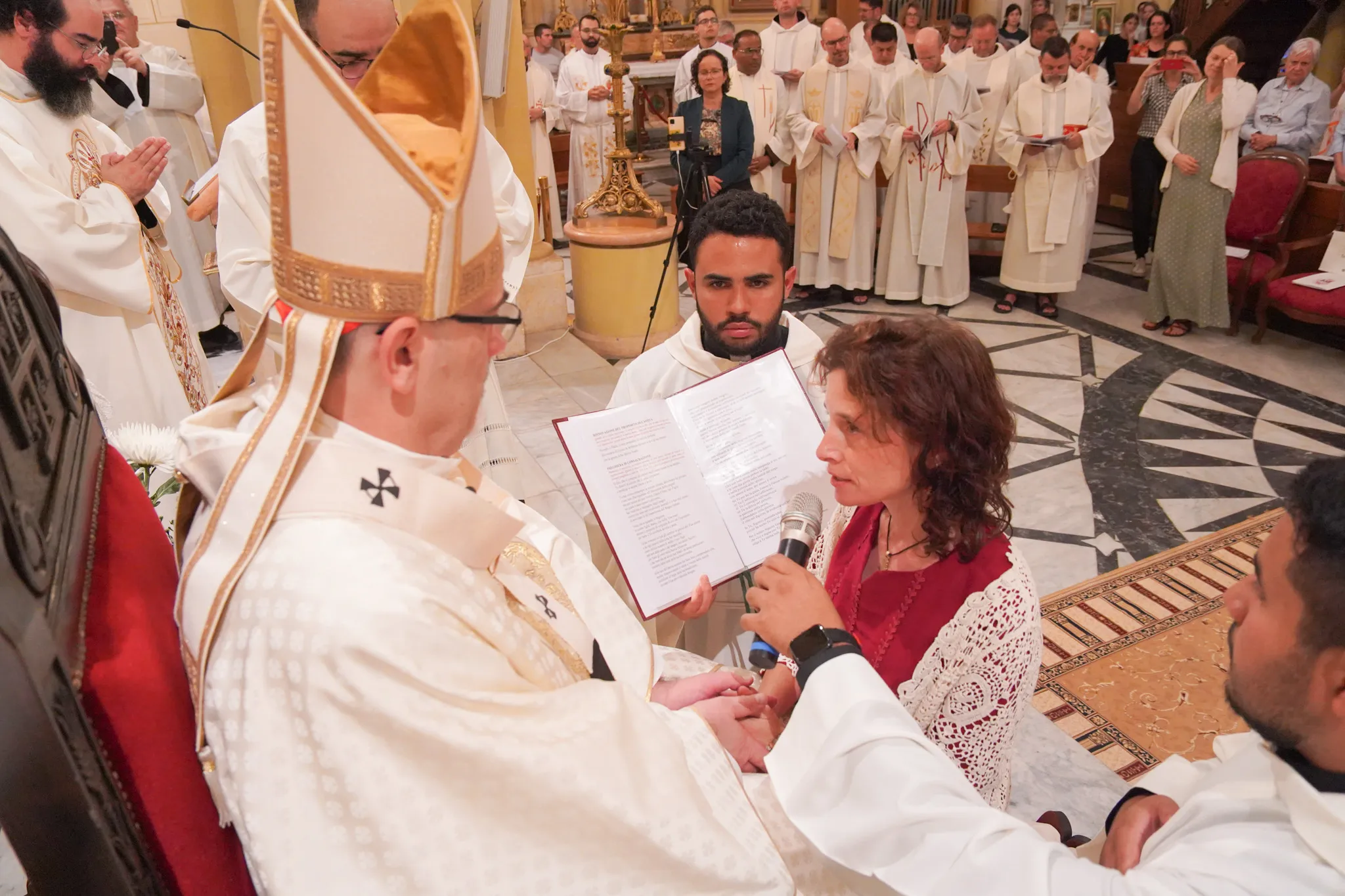
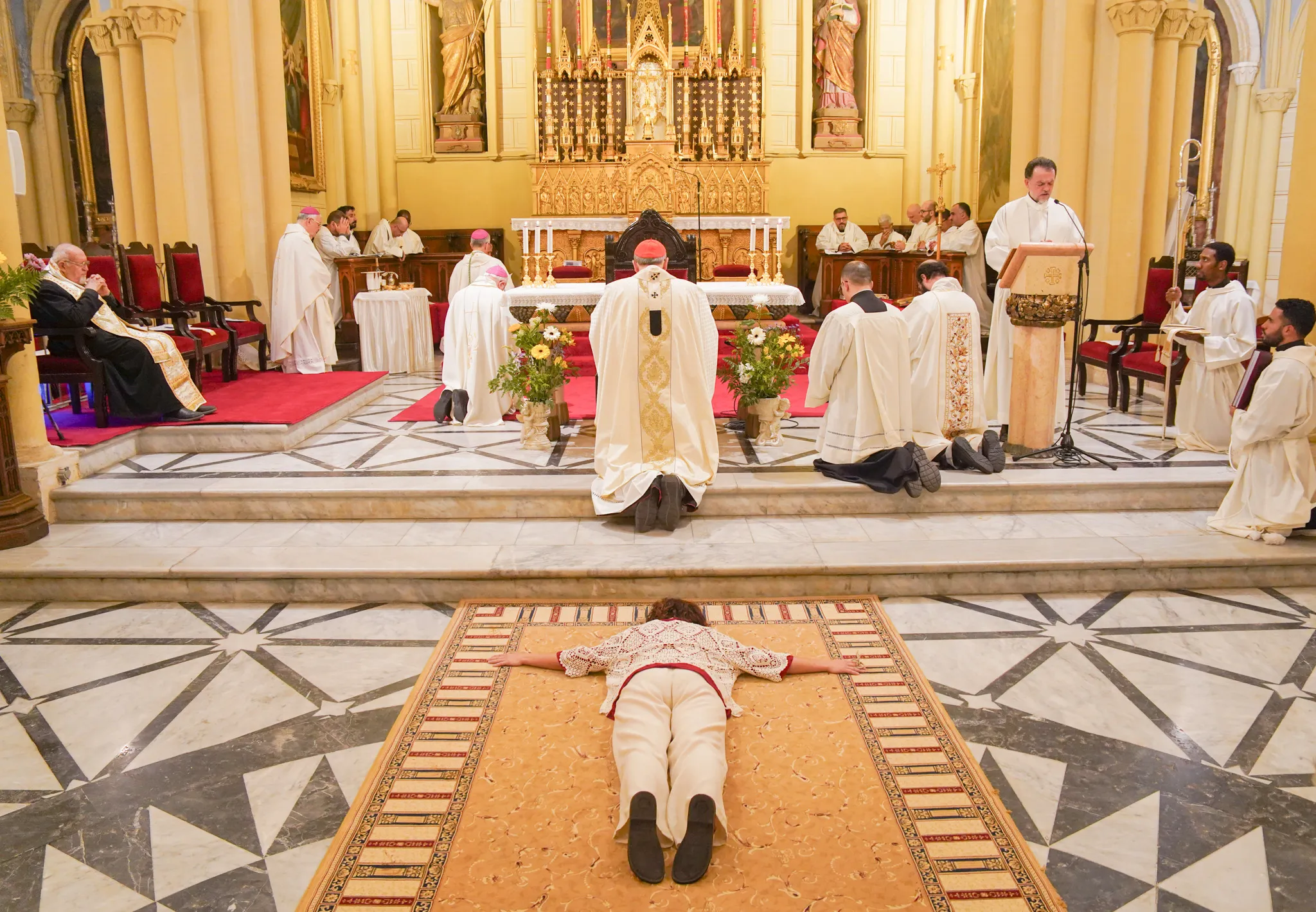
Cardinal Pierbattista Pizzaballa, Latin patriarch of Jerusalem, presided over the consecration of María Ruiz Rodríguez in the Ordo Virginum on Nov. 1, 2023, in the Church of the Latin Patriarchate of Jerusalem. With this consecration, Ruiz permanently rooted herself in the local Church. Credit: Marinella Bandini
Ruiz, now 42, is originally from Spain and arrived in Jerusalem in 2018 for a period of discernment. At that time, she was a member of the “Monastic Family of Bethlehem, the Assumption of the Virgin Mary and St. Bruno,” an institute of consecrated life established in France in 1950.
It was Ruiz’s first time in the Holy Land, even though the desire to visit the sacred places in the Holy Land had long been a dream in her heart.
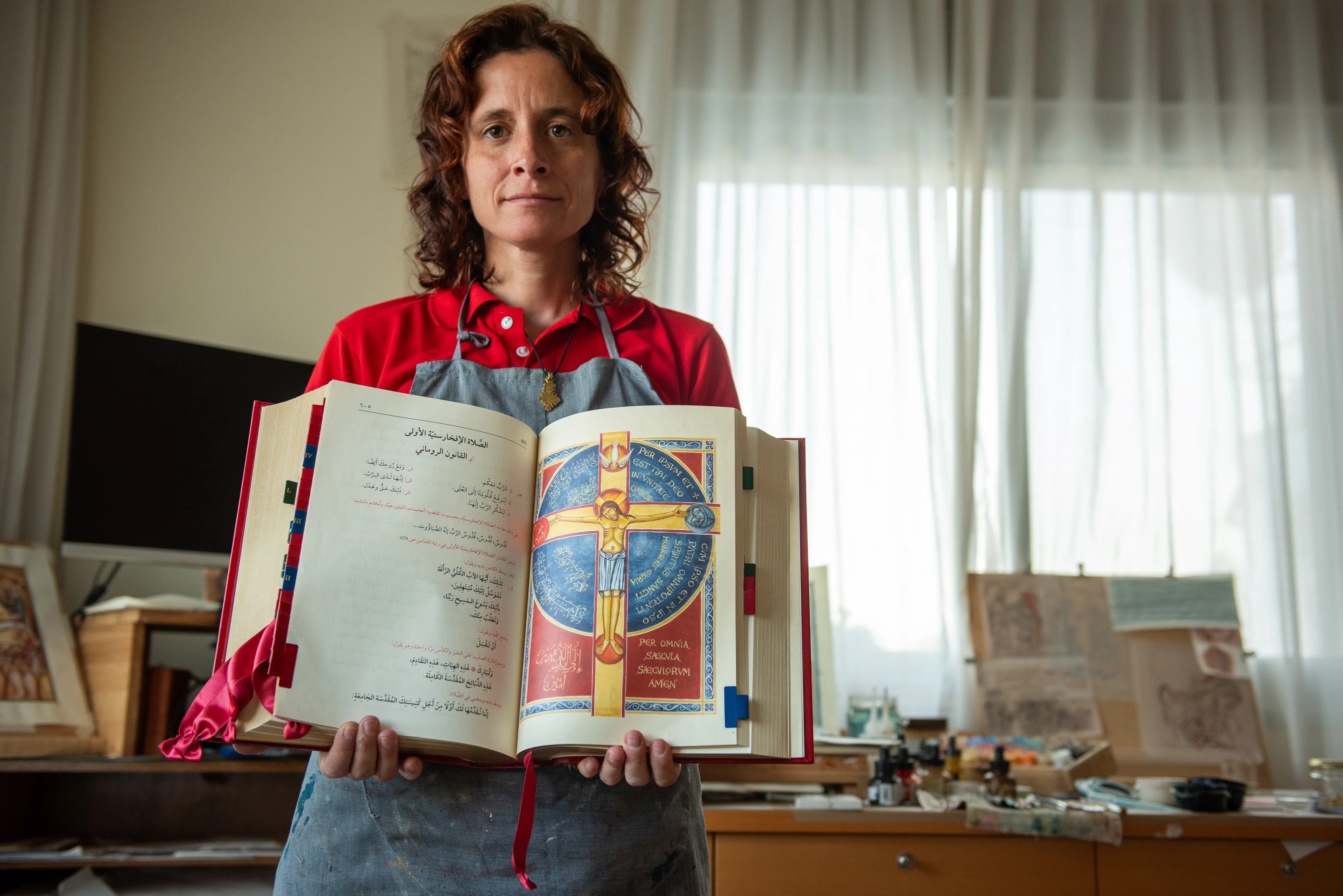
Iconographer María Ruiz Rodríguez with the new Roman Missal in Arabic. The book is open on the page where she depicted the Crucifixion of Jesus. Credit: Marinella Bandini
“For two years, I set aside my savings to make a pilgrimage in 2000, the year of the Great Jubilee. However, in that very year, I entered the convent, so I gave up. I felt that Jesus was saying to me: ‘I am your Holy Land.’ In a way, I had already arrived in Jerusalem,” Ruiz said.
It was in the Holy Land that Ruiz first came into contact with some consecrated women of the Ordo Virginum.
“I was looking for my place and I felt called,” she said.
The Ordo Virginum, Ruiz continued, “is the oldest form of consecration in the Church”. Abandoned over the centuries in favor of the religious life, it was rediscovered with the Second Vatican Council as a form of life that, “in a radically transformed historical context” possesses “a surprising force of attraction” and is “capable of responding not only to the desires of many women to dedicate themselves totally to the Lord and to their neighbors, but also to the concurrent rediscovery by the particular Church of its own identity in communion with the one Body of Christ” (cf. Instruction “Ecclesiae Sponsae Imago” on the “Ordo Virginum”).
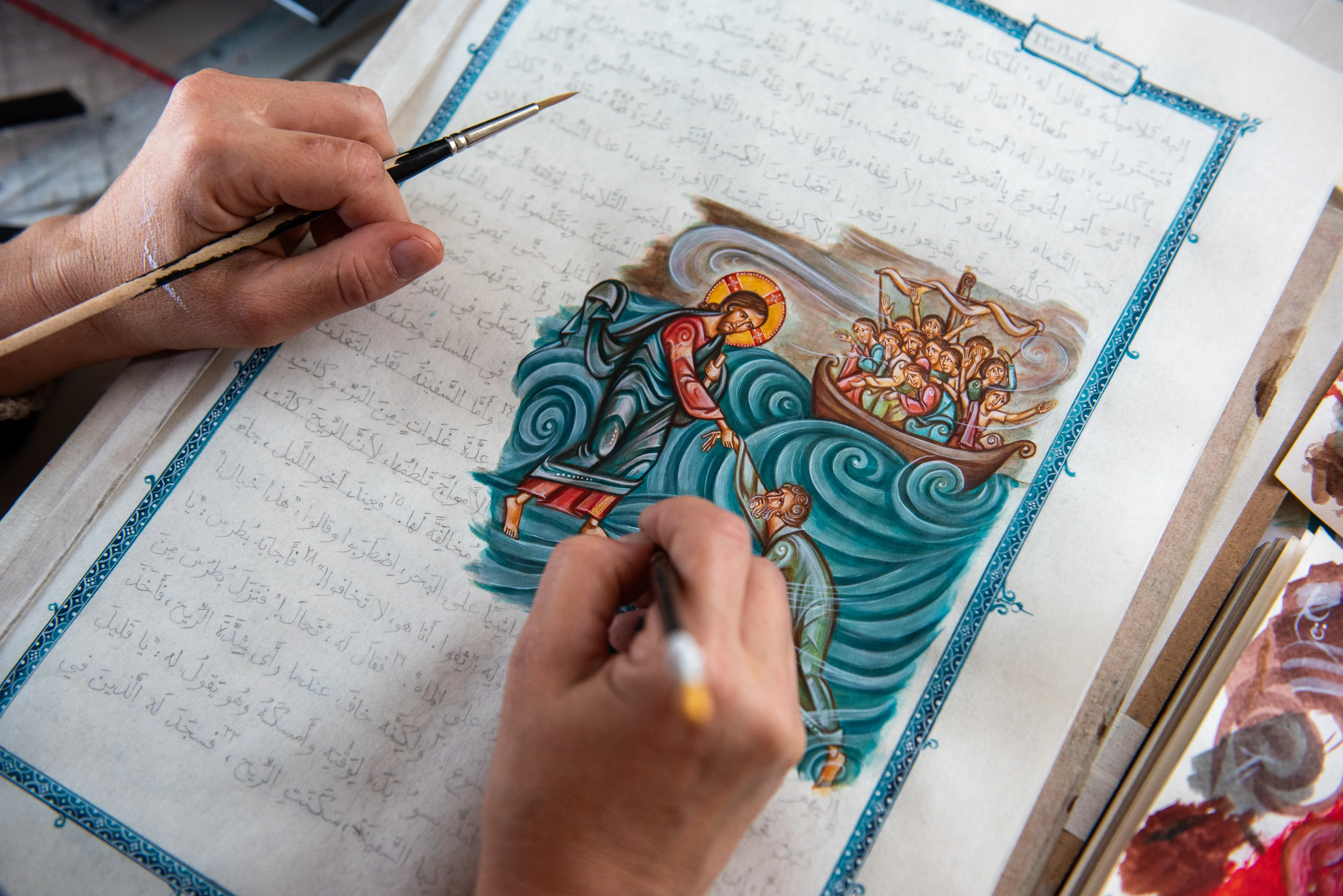
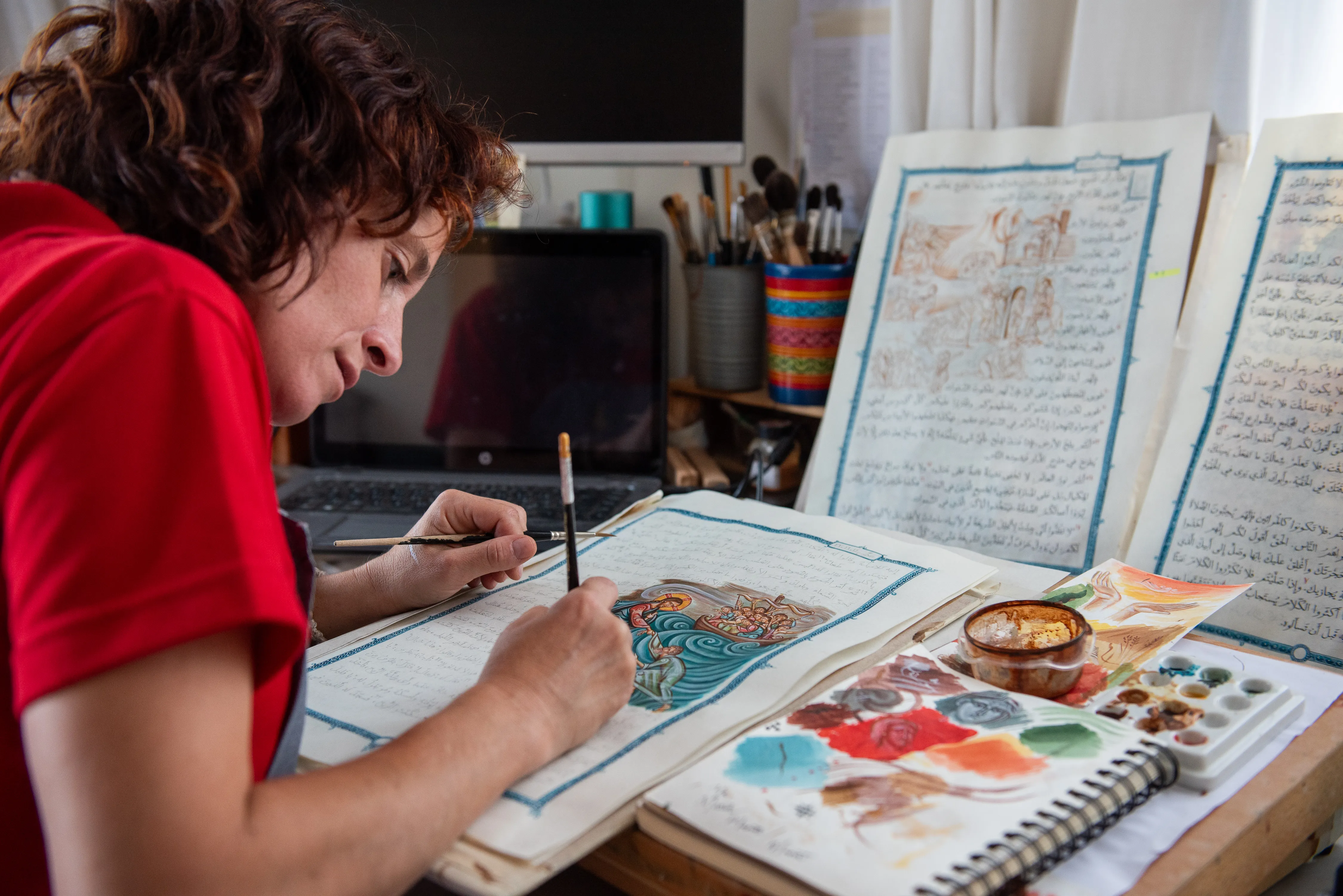
Iconographer María Ruiz Rodríguez at work in her studio. The image depicts Jesus walking on water and taking St. Peter’s sinking hand (Mt 14:22-33). Credit: Marinella Bandini
Consecrated women in the Ordo Virginum choose to live a life of virginity “for the sake of the kingdom of heaven” in a lay form of life. They do not wear religious habits, do not live in communities, have no common statutes or rules, or even superiors. Instead, they maintain a personal reference to the local bishop — in this case, Cardinal Pierbattista Pizzaballa — who acts as guarantor of their journey of discernment and presides over their consecration.
The sole commitment these consecrated women make is the “resolution of chastity,” which they express during the Rite of Consecration. The only symbol they wear is a ring, emphasizing the spousal character of this vocation, which reflects the mystery of the Church as “Bride of Christ.” Engraved in Ruiz’s ring is an inscription in Hebrew meaning “O my life,” referring to Christ, and the date of her consecration.
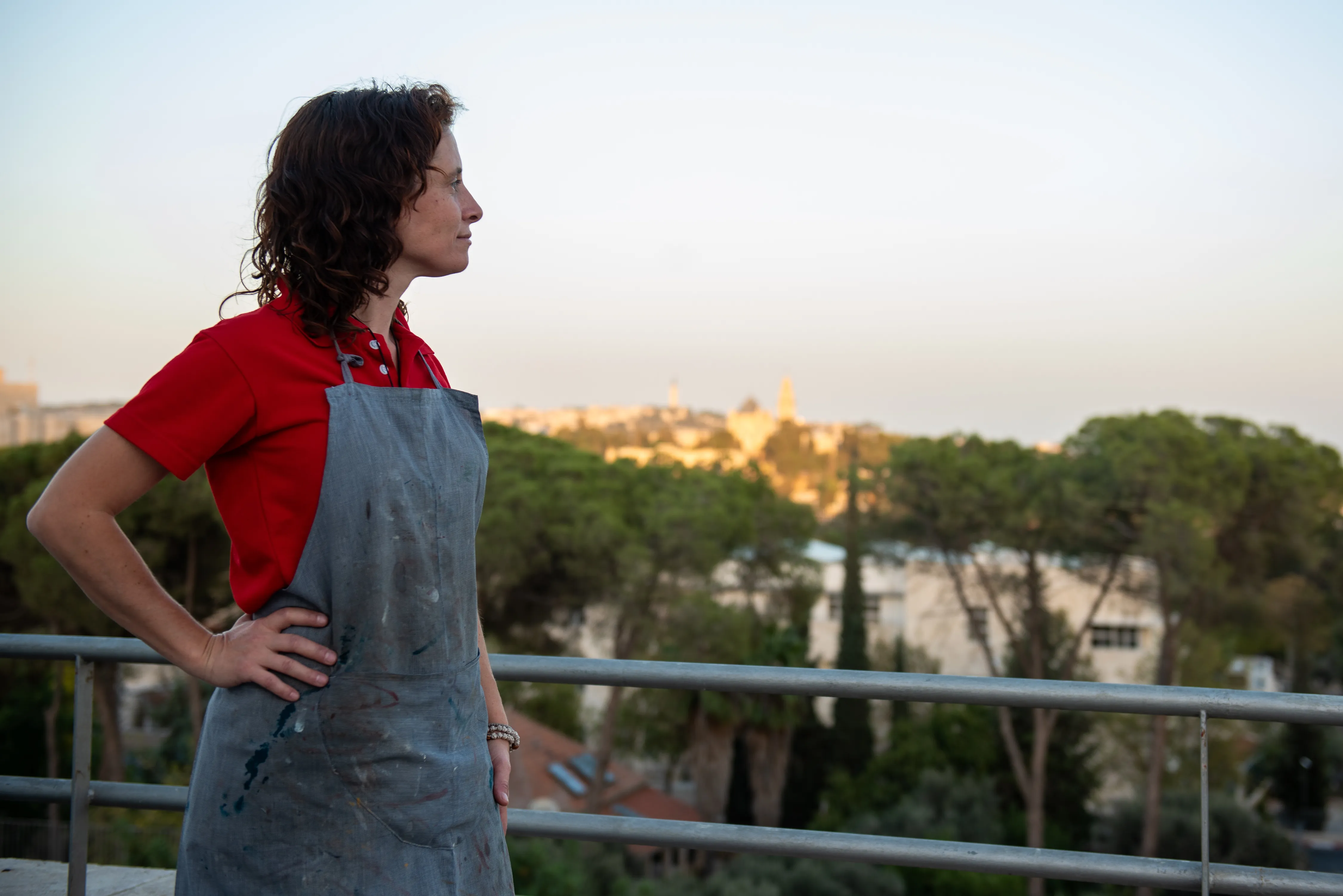
Iconographer María Ruiz Rodríguez on her terrace looking at the horizon. In the background are the walls of Jerusalem and the outline of the Basilica of the Dormition, November 2023. Credit: Marinella Bandini
Women who consecrate themselves in the Ordo Virginum support themselves through their jobs. Ruiz is an iconographer and has been working for the Latin Patriarchate of Jerusalem for about four years. She was drawn into a project aimed at renewing liturgical books — the Missal and the Evangeliary — with her artwork.
“I first approached iconographic art when I was a nun. It was first of all a spiritual journey, a path of prayer. More than an artistic expression, an icon is a profession of faith. Before beginning the work, I invoke the Holy Spirit and ask for forgiveness for my own sins and for those who will venerate these images. I was interested in this dimension of relationship,” Ruiz shared. She spent a year researching the style and colors.
“The patriarch asked me to create something that would speak to local Christians, who are Latin by tradition but Eastern by culture. A style that was uniquely mine yet rich in the entire iconographic tradition of the Church of Jerusalem. The art of Armenian manuscripts certainly had a significant influence on me.”
Iconographer María Ruiz Rodríguez at work in her studio. Currently, Ruíz is in the process of creating the images for the Gospels of Matthew and Mark. Credit: Marinella Bandini
The patriarch takes a personal interest in overseeing Ruiz’s work. “We read the Gospel together and choose which scenes to represent, taking into account the particularity of each evangelist. He particularly enjoys highlighting passages that are less frequently represented in the artistic tradition. This is a project close to his heart,” she told CNA.
Currently, Ruíz is in the process of creating images for the Gospels of Matthew and Mark.
“The process is very laborious and involves multiple stages for each page: the pencil lettering, the crafting of the icons, then the ink lettering and finally the gilding.” The plan is for a volume of about 200 pages with 250 images.
“Making this work in Jerusalem has a special value: I can visit the places where that Gospel was lived” but also “immerse myself in Jewish culture,” she said. “This has opened my eyes to the richness that Judaism brings to Christianity. There is a perfect continuity and at the same time an unprecedented newness in the person of Christ.”
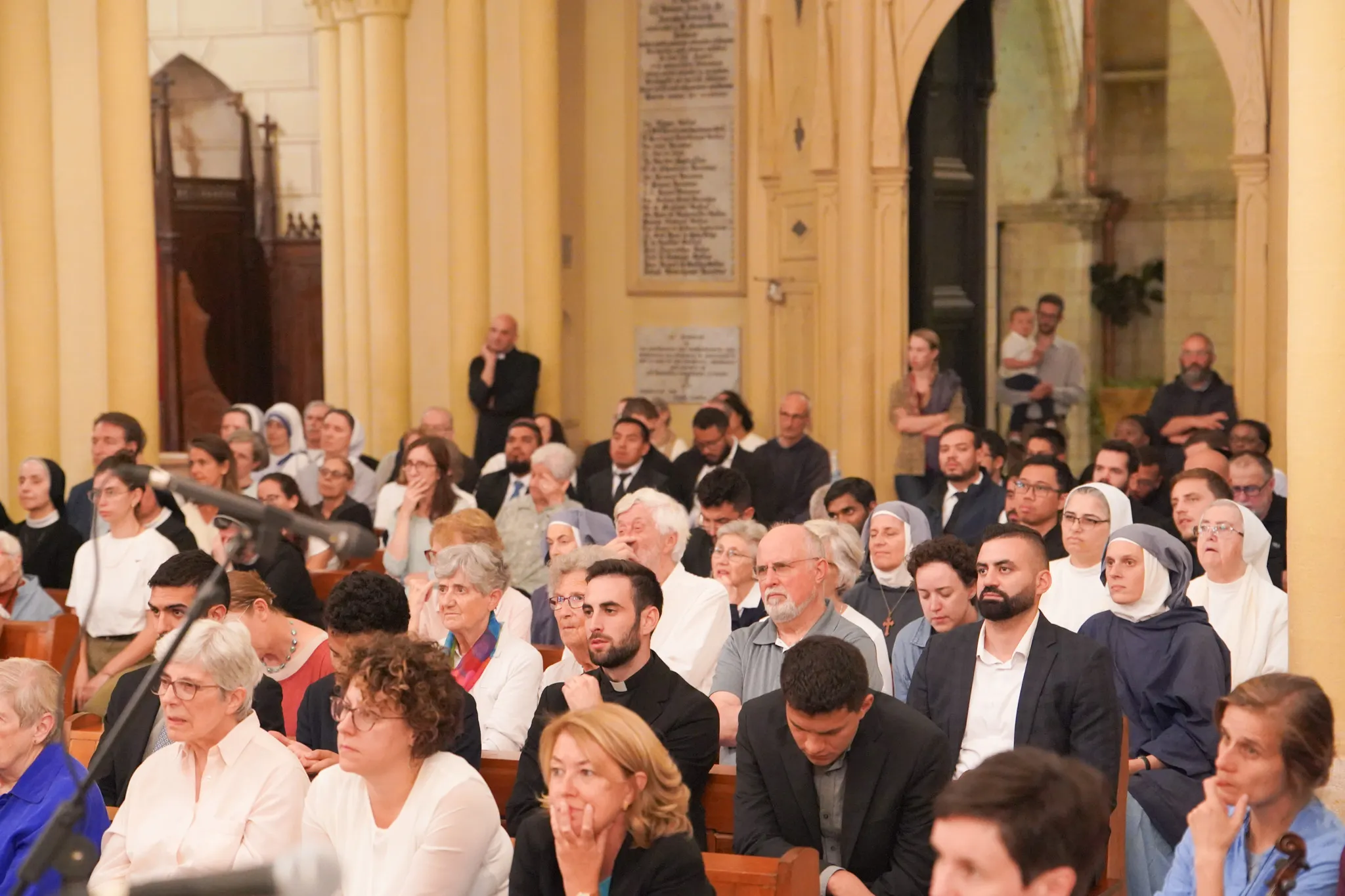
The Church of the Latin Patriarchate of Jerusalem full of people on Nov. 1, 2023, for the Mass of consecration of María Ruiz Rodríguez in the Ordo Virginum. Credit: Latin Patriarchate of Jerusalem
Ruiz learned the local languages — Arabic and Hebrew. The Mass of her consecration brought together within one place all the diverse “souls” of the Jerusalem Church: priests, friars, religious, and laity, Arab Christians and Hebrew-speaking Christians, each hearing the word of God in their own language. There were migrants, foreigners, Jews, and Christians of various denominations.
The culminating moment of María Ruiz Rodríguez’s consecration in the Ordo Virginum. The celebration took place on Nov. 1, 2023, in the Church of the Latin Patriarchate of Jerusalem. Credit: Latin Patriarchate of Jerusalem
“I believe my being a foreigner is a blessing for this Church,” Ruiz said. “Why were there such different people in the church that day? Because I am neither Arab nor Jewish, and this allows me to bring both of these peoples into my heart together. In the praise of God we were one people, transcending the divisions that usually separate us. The Church in Jerusalem also needs this, to remember its universal vocation.”
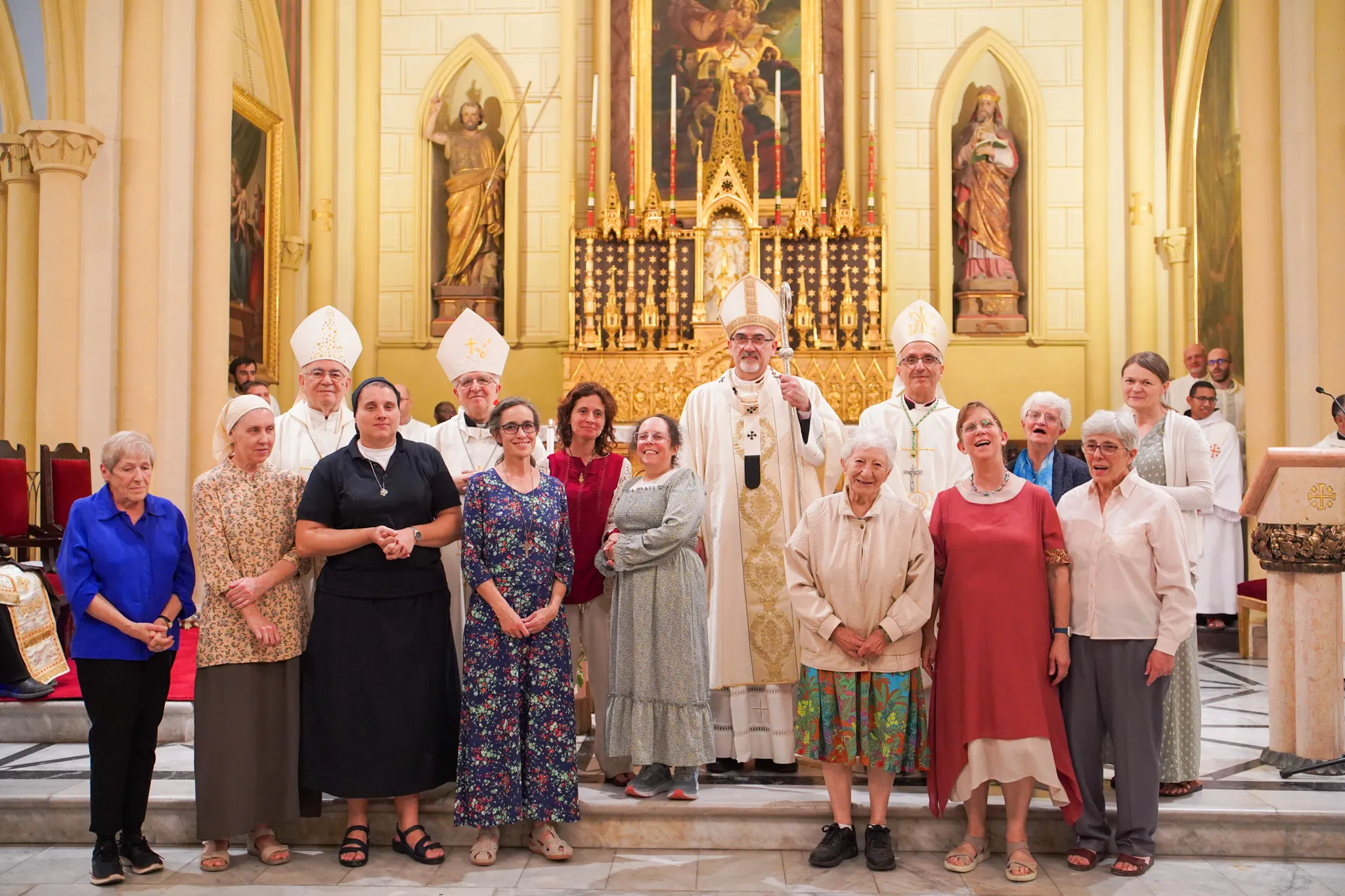
Group photo at the end of the Mass of consecration of María Ruiz Rodríguez in the Ordo Virginum. With her (in the middle, with red shirt) there are other members of the Ordo Virginum, and the bishops of the Latin patriarchate of Jerusalem (from left to right: Giacinto-Boulos Marcuzzo, bishop emeritus; Monsignor William Shomali, general vicar and patriarchal vicar for Jerusalem and Palestine; Cardinal Pierbattista Pizzaballa, Latin patriarch of Jerusalem; Monsignor Rafic Nahra, patriarcal vicar for Israel). Credit: Latin Patriarchate of Jerusalem
With her consecration, Ruiz embarks on her new journey as a “living stone” of the Jerusalem Church: “I am certain that I am finally in the right place. It is not an act of heroism. I am simply where God wants me to be.”
Beirut, Lebanon, Dec 25, 2018 / 08:00 am (CNA).- On the evening before Christmas, the city of Beirut was decked with lights and trees and nativity scenes. A festive glow covered everything as people made their way to the various Catholic and Christian … […]
Ouahigouya, Burkina Faso, Dec 5, 2019 / 12:09 am (CNA).- Following the death of more than a dozen Christians in a church shooting over the weekend, a Burkina Faso bishop said Western governments have a responsibility to stop the flow of weapons to militants in the region.
“The Western powers should stop those who are committing these crimes, instead of selling them the weapons that they are using to kill the Christians,” Bishop Justin Kientega of Ouahigouya told Aid to the Church in Need.
On Sunday, gunmen in the eastern Burkina Faso town of Hantoukoura attacked a protestant church service, killing 14 people, including several children.
“I condemn the barbaric attack against the Protestant Church of Hantoukoura in the department of Foutouri, which left 14 dead and several wounded. I offer my deepest condolences to the bereaved families and wish a speedy recovery to the wounded,” President Roch Marc Kaboré tweeted late Sunday.
Bishop Kientega said the attack is part of an attempt by radical Islamists to “provoke a conflict between the religions in a country where Christians and Muslims have always lived peaceably side by side.”
According to the Washington Post, militants with connections to al-Qaeda and ISIS regularly attack soldiers and civilians in the region.
“No-one has claimed responsibility for the attack, just as no-one claimed responsibility for the previous ones. So we don’t know whether it is one group or several groups that are involved,” Kientega said.
Escalating violence among armed militant groups in Burkina Faso has drawn international concern, with the United Nations warning earlier this year of an “unprecedented humanitarian emergency” in the country. Nearly half a million people have been forced to flee their homes in the last five years. More than 60 Christians have been murdered in the country this year, Aid to the Church in Need reports.
Last month, Pope Francis called for prayers and urged interreligous dialogue amid ongoing violence by jihadist groups.
Kientega argued that the Western world has been ignoring the plight of Christians in West Africa. He suggested some Western powers “have an interest in seeing the violence continue” in the region.
“There is an ongoing persecution of Christians. For months, we bishops have been denouncing what is happening in Burkina Faso, but nobody is listening to us,” he told Aid to the Church in Need. “Evidently, the West are more concerned with protecting their own interests.”
I am a bit confused… you say “The document is now undergoing a final evaluation by Catholic experts who are compiling suggested amendments to the program, the bishops said”. This statement reveals that Catholic “experts” are not being ignored.
The Catholic experts are compiling the suggested amendments, but it doesn’t say that the people who wrote the document asked them for comments or will look at the suggested amendments or edit the program. So far they have been ignored; doesn’t sound hopeful that they will be listened to now.
International Planned Parenthood and its supporters have had Uganda in its sights for some time. Soros, Buffett, Gates and company continue to funnel funds to flip those countries that resist progressive sex ‘education.’
Ireland has been one of those continuing “success” projects. The
Of course the Catholic bishops are being ignored or given lip service. Take a look at the government budgets that are available as well as the documents regarding these meetings.





I am a bit confused… you say “The document is now undergoing a final evaluation by Catholic experts who are compiling suggested amendments to the program, the bishops said”. This statement reveals that Catholic “experts” are not being ignored.
The Catholic experts are compiling the suggested amendments, but it doesn’t say that the people who wrote the document asked them for comments or will look at the suggested amendments or edit the program. So far they have been ignored; doesn’t sound hopeful that they will be listened to now.
International Planned Parenthood and its supporters have had Uganda in its sights for some time. Soros, Buffett, Gates and company continue to funnel funds to flip those countries that resist progressive sex ‘education.’
Ireland has been one of those continuing “success” projects. The
Of course the Catholic bishops are being ignored or given lip service. Take a look at the government budgets that are available as well as the documents regarding these meetings.