


Commentator M. Stanton Evans once quipped that Democrats want to drive off the cliff at 100 miles per hour, while Republicans want to stay within the speed limit. The ghastly $40 trillion national debt illustrates that maxim. Both parties have become the parties of Santa Claus.
Recent Republican legislation providing scholarship funds to needy families is the latest example. The tax break has religious authorities scrambling to claim their piece of the national debt.
The Federal Scholarship Tax Credit takes effect in 2027. It represents another creative federal benefit, subject to state participation, designed to appeal to a new constituency for federal tax advantages: private schools, including Catholic schools. The basic idea is simple. Taxpayers may contribute to a qualified scholarship-granting organization and receive a dollar-for-dollar federal tax credit of up to $1,700 ($3,400 for married couples filing jointly).
The scholarship-granting organization awards scholarships to eligible students. Regulations allow them to use a portion of the proceeds to support administrative costs. When the taxpayer files an annual federal tax return, the credit reduces federal income-tax liability dollar for dollar, up to the applicable limit.
Everyone wins. Except future taxpayers.
The mechanism is familiar. Rather than relying solely on direct government spending, we increasingly use the tax code to engineer cultural change through the “magic” of tax incentives. Does the magician hold the quarter in his left hand or his right? Or is it hidden behind the observer’s ear?
Republicans, like Democrats before them, have learned to manipulate the tax code for their preferred purposes—in this case, financial support for religious education. They can at long last say they are catching up to the decades of Democrat (or “liberal”) social engineering.
At least on the margins, the tax credit may encourage some families to move their children from public to private schools, potentially reducing public-school costs for states and counties.
But will the savings materialize? And will private schools receiving government-facilitated benefits become more susceptible to government manipulation and compromise?
Some may offer a sigh of satisfaction: “It’s about time the government funds culturally conservative causes.” But the program continues the trajectory of uncontrolled big-government spending that threatens to impoverish the nation, either now or in generations to come.
Let’s put the debt into perspective. The national debt is approximately $40 trillion, while U.S. GDP in 2025 was approximately $31 trillion. The accumulated federal debt now exceeds a year’s economic output. Persistent deficits—when federal spending exceeds revenue—continue to increase the debt.
A national debt of $40 trillion (as of October 2026) is $117,000 per person and $310,000 per household. That is a lot of money on the nation’s hidden credit card, with future generations paying the tab.
The Congressional Budget Office (and common sense) explains that large, persistent deficits drive debt upward. Debt held by the public is the measure most useful for examining the government’s effects on financial markets and private investment.
Overcoming the national debt is like paying off a bloated credit card, but only to a point.
The options include: 1) drastically reducing deficit spending; 2) increasing productivity, as with the computer revolution, to enlarge the tax base while controlling spending; 3) increasing taxes while minimizing disincentives to productivity; 4) allowing (likely rampant) inflation to erode the real value of existing fixed-rate debt, at the cost of the dollar’s purchasing power; 5) suffering economic collapse and starting anew; or 6) enduring a solar flare that disables the nation’s electrical grid, takes down the internet, and sends us back to an agrarian society.
Pick your poison.
Federal programs that reduce revenue or increase spending without corresponding offsets add pressure on the national debt. The Federal Scholarship Tax Credit is no exception. Instead of focusing on the economic forces that have led to the crushing national debt, various constituencies—including religious entities—are preoccupied with “getting their fair share” of tax benefits. This entitlement frenzy deflects attention from dysfunctional fiscal policies that make tuition increasingly difficult to afford.
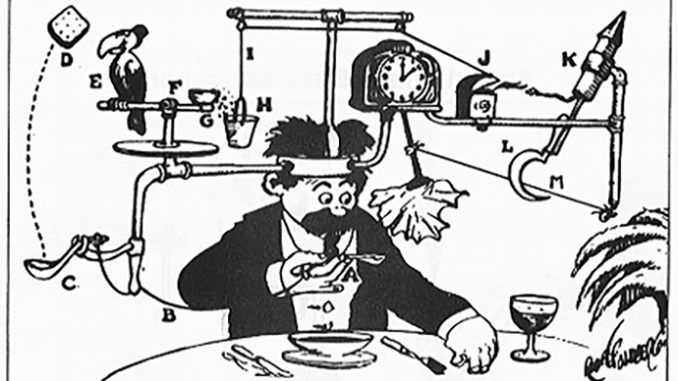
The Rube Goldberg cartoons of yesteryear come to mind. His famous cartoons portrayed absurdly complicated machines that use an elaborate chain of unlikely contraptions to accomplish simple, everyday tasks.
The Federal Scholarship Tax Credit is another Rube Goldberg mechanism: an elaborate tax-code contraption that directs money toward a worthy purpose while leaving the larger fiscal disorder unresolved.
If priests find themselves feeding at the trough of federal programs, perhaps another priest might come to the rescue. There are precedents.
In 1823, Father Gabriel Richard, a French Catholic priest, was elected to represent the Michigan Territory in the U.S. House of Representatives. He served as a nonvoting delegate from 1823 to 1825. Father Robert Drinan, a Jesuit elected to Congress in 1970, left office in 1981 after Pope John Paul II directed priests not to hold elected political office.
Canon law generally forbids priests from assuming public office. Nevertheless, imagine a priest running for president on these promises: “I promise, if elected, I will balance the federal budget and reduce the national debt. I will cut social spending, including Social Security, Medicare, and Medicaid. I will eliminate the Department of Education and many executive-branch agencies. I will cut military spending as necessary and eliminate foreign aid. I will also try to secure the nation’s electrical grid and protect it against solar flares.”
Alas, the priest might receive one vote. And a disciplinary phone call from the Catholic chancery.
Returning to the contemporary scene, perhaps religious institutions have little choice but to take the money and run. A scholarship credit is certainly not a major cause of the national debt. No single raindrop believes it is to blame for the flood.
But a worthy benefit can encourage its beneficiaries to defend a fiscal system without adequately considering its overall costs.
Future generations will pay for our fiscal profligacy. We may eventually realize that we, too, were part of the problem.
If you value the news and views Catholic World Report provides, please consider donating to support our efforts. Your contribution will help us continue to make CWR available to all readers worldwide for free, without a subscription. Thank you for your generosity!
Click here for more information on donating to CWR. Click here to sign up for our newsletter.


Leave a Reply