


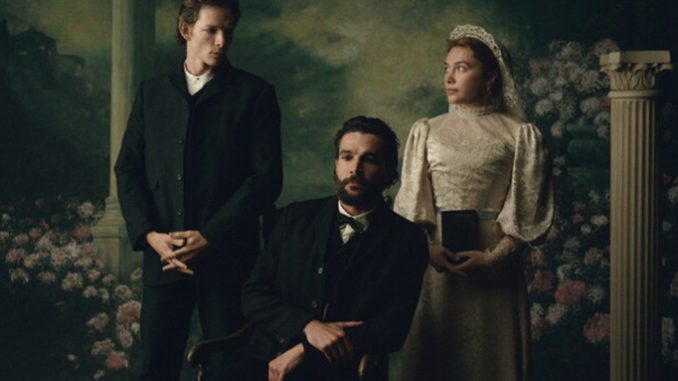
It is clear that John Steinbeck wrote East of Eden to make readers confront biblical evil. Not the softened, therapeutic version that our culture craves and is being portrayed in the new Netflix miniseries, but the ancient Edenic kind of evil that slithers into the garden and corrupts everything it touches.
The primary antagonist in the novel—the beautiful golden-haired Cathy Ames, with the heart-shaped face and the tiny rosebud mouth—is the serpent of the novel. She is a creature whose malice is essential to the story. She is the demonic force that gives the novel’s biblical drama its moral depth. But the miniseries redefines her as a wounded proto-feminist—destroying the biblical force that made the novel so compelling.
Having revisited Steinbeck’s novel several times, most recently this past summer in anticipation of the Netflix miniseries, I have always understood Cathy’s evil as absolute and irredeemable. Early in the novel, Steinbeck even hints that she is something other than human, noting the unusual swelling in the insteps of her tiny feet. By describing her little feet as having “fat insteps almost like little hoofs,” he suggests cloven feet without stating it outright. The image signals that Cathy Ames embodies the corruption that entered Eden on split hooves.
Cathy Ames truly is the demonic force in the garden of Steinbeck’s amazing novel. But while the miniseries is visually beautiful and historically compelling, Netflix has hollowed out the biblical drama at the heart of Steinbeck’s novel—and taken its very soul. By reframing Cathy as having suffered from the patriarchal system of the time (and perhaps some kind of sexual abuse as a child), viewers of the miniseries are invited to try and understand her.
In the novel, however, Cathy was not abused. Her father realizes early that his daughter is not like other children. He is uneasy about it, but the Ames family does not seem to attend church or have any real religious leanings, so he doesn’t seem able to identify what is wrong with his child. Yet he and his wife know there is something wrong with their beautiful daughter—even when she is just ten years old—they know that something in her was bent toward evil.
The father tries to intervene, tries to correct what he senses is fundamentally wrong with her. But in the miniseries, he’s recast as overbearing and punitive, and viewers are led to believe that his severity creates Cathy’s cruelty. The film adaptation replaces Steinbeck’s portrait of a father confronting a child’s innate darkness with a modern therapeutic narrative in which parental harshness explains everything. In doing so, it erases the novel’s central truth that Cathy’s evil was not caused by anything—it was there all the time. Steinbeck obviously understood Original Sin much better than the filmmakers.
But, then again, East of Eden is not, at its core, a book about women. It is a Girardian drama of rivalry—brothers locked in imitation, envy, and the desperate hunger to be chosen by their father. Steinbeck is retelling Genesis, the primal conflict between Cain and Abel, what he once called in a letter to his editor at Viking “perhaps the greatest story of all time.” The novel’s moral structure rests on this rivalry and on the figures who threaten or expose it.
And, in that respect, the miniseries is true to its roots. At the center of the story is Adam Trask, the son of a Connecticut farmer and army veteran, and his half-brother Charles, who tends the farm. In their youth—like Cain and Abel—Charles is envious of the love that their father seems to have for Adam. Complaining that the expensive pocketknife that Charles gives to his father for his birthday is unappreciated, yet the stray puppy that Adam picked up off the farm and gave to the father is his favorite gift of all, reflects the biblical truth that Abel’s gift to our Lord was more pleasing than that of Cain’s. When the father dies and leaves a tidy sum of money to be split evenly by the brothers, Cathy Ames arrives on their doorstep—and Adam is immediately smitten.
The rivalry continues, and we are constantly reminded of Genesis throughout the novel. Charles is even given the “mark of Cain” on his forehead as he suffers an accident while moving a heavy rock with a crowbar. Cathy and Adam move to California, to the Salinas Valley, and try to create their own Eden. But any Christian knows that a true paradise can never be created on this earth—especially when you are bringing your own demon along with you.
Yet neither the novel nor the miniseries leaves us trapped in the cycle of mimetic rivalry. Steinbeck’s invocation of timshel—the Hebrew word for the human capacity to break free from the Cain-and-Abel pattern—remains the hinge of hope. Redemption is possible. The adaptation echoes the truth that violence is not destiny and that imitation can be purified. And, most importantly, grace can interrupt even the oldest scripts of envy.
Some, like Cathy Ames, may not be able to be redeemed because God has given her (and all of us) the free will to choose evil. We all have the power to choose good or evil. Cathy continues to choose darkness, but the other characters begin to move toward the light. As Solzhenitsyn reminds us, “the line dividing good and evil cuts through the heart of every human being.” We all carry both possibilities within ourselves.
East of Eden remains essential reading because it restores the biblical truth of good and evil to its rightful place at the center of human life. It is not likely that Steinbeck would endorse the current cultural need to psychologize sin or try to understand why Cathy Ames was evil. Instead, Steinbeck shows that the Cain and Abel struggle is not an ancient tale but the ongoing condition of every human heart. Steinbeck reminds us that moral choice is always possible—but it always carries a cost.
In a cultural moment that prefers psychologized or therapeutic explanations to spiritual ones, East of Eden brings us back to the truth that we are moral beings who must choose between good and evil every day of our lives.
If you value the news and views Catholic World Report provides, please consider donating to support our efforts. Your contribution will help us continue to make CWR available to all readers worldwide for free, without a subscription. Thank you for your generosity!
Click here for more information on donating to CWR. Click here to sign up for our newsletter.



Thanks, dear Anne Hendershott, for this nicely judged comparison. Hopefully, those who watch the Netflix ‘East of Eden’ series will be encouraged to read John Steinbeck’s novel and so enabled to reconstruct what the pychologizing film-makers have brushed out.
“. . East of Eden brings us back to the truth that we are moral beings who must choose between good and evil every day of our lives.”
‘Ethical Encounter Theology’ argues that our world is arranged not only to cause us to to be in awe of GOD’s beauty, pure brilliance, perfect ethics, & benign power but also so as to facilitate the cumulative enactment of every evil thing. It seems necessary for evil to be exhaustively manifest so it can be justly judged & comprehensively removed. This is on the basis that GOD’s goodness does not judge potential evils.
That may be why Jesus teaches that: “Offences must come” in Mt 18:7 & Lk 17:1.
So much so, that it exceeds our world-entrained cognitive capacity to imagine life where there’s no trace of evil. 1 Corinthians 2:9 helps us here, I think . . .
The accelerating rate at which evil of every sort & extreme is manifesting today encourages one to think GOD’s Judgement can’t be far off. Come soon, dear King Jesus!
I concluded a long time ago that Netflix (i.e. its creators, producers, directors, actors) play a major role in promoting evil (sin) in our culture. Why anyone of faith subscribes eludes me.
The devil runs amok because of the voyeuristic trait of our human heart. And the wicked exploit that to make billions.
GOD’s solution is for us to make a firm resolution not to allow our eyes to rest on images & actions that offend against GOD’s commandments and Christ’s way of life.
It took me decades to come to understand this simple, sanctifying truth.
Wonderful analysis and beautifully presented…
The notion strikes yours truly that the cloven hoof symbolizes a soul—or even a culture—that is content to have things both ways. The divided heart and spiritual vacuity of post-Christian SECULARISM. Recalling Pope Leo’s recent admonition to members of the European Union that if they really want to retain a “rule of law,” then Europe must return to its Christian foundation.
And, recalling another, and substantively pre-Christian, paganism of ISLAM. Islam which imposes an Original Purity onto human history because it denies Original Sin.
“Islam has not wanted to choose between Heaven and Earth. It proposed instead a blending of heaven and earth, sex and mysticism, war and proselytism, conquest and apostolate. In more general terms, Islam proposed a blending of the spiritual and the temporal worlds which neither in Islam nor among the pagans have ever been divided” (Jean Guitton, “Great Heresies and Church Councils,” 1965, p. 116).
SO, ABOUT ASSISI ON OCTOBER 27 of this year, hopeful here that Leo XIV—our Augustinian Pope—might find exactly the right words for mentioning the universality of what St. Augustine discovered about Original Sin within himself and universally within all of humanity.
P.S. In his interreligious writing, Pope St. John Paul II included this:
“…In Islam all the richness of God’s self-revelation, which constitutes the heritage of the Old and New Testaments, has definitely been set aside . . . . Some of the most beautiful names in the human language are given to the God of the Koran, but He is ultimately a God outside of the world, a God who in only Majesty, never Emmanuel, God-with-us. Islam is not a religion of redemption [!]. There is no room for the Cross and the Resurrection [….] For this reason not only the theology but also the anthropology of Islam is very distant from Christianity” (John Paul II, “Crossing the Threshold of Hope,” Alfred Knopf, 1994, pp. 92-3).
Thanks dear Peter D. Beaulieu for your very informative research citations.
You comments benefit us all by their authoritative perspectives on our faith.
Viewers Advisory: According to IMDB.com, the Netflix series has nudity and multiple sex scenes as is typical with many Netflix productions. Be advised!
“If only it were all so simple! If only there were evil people somewhere insidiously committing evil deeds, and it were necessary only to separate them from the rest of us and destroy them. But the line dividing good and evil cuts through the heart of every human being. And who is willing to destroy a piece of his own heart?” -Solzhenitsyn
Dear Deacon Edward Peitler: “And who is willing to destroy a piece of his own heart?” – Solzhenitsyn.
Maybe this gives us an insight into his fraught faith – from Christianity to Marxist Atheism and eventually to Russian Orthodoxy.
If he were here today I’d want to see him read thro’ Paul’s letter to the Galatinas.
e.g. – from yesterday – Saturday’s – Holy Mass first reading:
“Scripture makes no exceptions when it says sin is master everywhere. In this way the promise can only be given through faith in Jesus Christ and can only be given to those who have this faith.”
And then the first reading for tomorrow (Monday of 28th week in ordinary time; yr II) –
“When Christ freed us he meant us to remain free. Stand firm therefore and do not submit again to the yoke of slavery.”
The New Testament repeatedly explains you are IN or you are OUT (no 3rd way!).
You are OUT if your heart is less than 100% owned by King Jesus Christ.
If you are OUT, then repent and call on Christ’s mercy & joyfully become TOTALLY His forever.
Thank you for this. As an English/American lit major in college, I read much Steinbeck. Reading East of Eden as a young high-schooler, a cradle Catholic, I understood the title, the sons, the “Eve” type mother, and the “Adam” father clearly stood as symbols for Biblical characters.
I will not view the miniseries; I didn’t know one was planned, but typically films substitute flatly and poorly for the depth of the novel on which they’re based.
Evidently at the time of its release in 1952, “Eden’s” Biblical underpinnings were difficult for Steinbeck’s critics to approve. Even then some critics criticized its Biblical allusions. Critics also cast Steinbeck as an atheist or humanist despite his Episcopalian/Anglican upbringing and belief (though he did not always practice his faith, marrying numerous times, ?drinking to excess?, etc.).
The name Catherine in Greek derives from Katharos, meaning “pure” (irony); Cathy attempted abortion on the pregnancy of the twins. Kate calls to mind “K” ate (as did Eve). Cathy re-makes herself three times, re-naming herself differently with each new identity…but she is only a trifecta of the original same bad first one.
Samuel, Aaron, Caleb are also names of significant Biblical figures. The letters in the name Caleb contain the same letters (plus one) as the name Abel.
Steinbeck considered East of Eden to be his magnum opus with all other books preparing him to write this, considering that he and many authors wrote only “one book.” He wrote it as a gift to his sons. He left a great inheritance for all of us.
P.S.: For those too weak to stomach Biblical underpinnings, perhaps Steinbeck’s work on migrants would fulfill…Grapes of Wrath, Of Mice and Men, The Red Pony. For the naturalist, a short story about a turtle crossing the road will fill your bill.
Oops. The Red Pony is not about migrants. It is about death.
As a believer, I sorely wish that Steinbeck had been one too, but he stated repeatedly his lack of faith in a traditional God. He believed strongly in right and wrong, as evidenced in his work, yet was a non-teleological science-based thinker. In 1964 he wrote thusly to his personal physician about feeling at peace with his eventual death: “Now finally, I am not religious so that I have no apprehension of a hereafter, either a hope of reward or a fear of punishment. It is not a matter of belief. It is what I feel to be true from my experience, observation, and simple tissue feeling.” (from Steinbeck: A Life In Letters)
You might enjoy the Netflix series – you will see things there that others might miss. You seem to know the novel so well. Steinbeck once wrote to his editor at Viking that “The brilliant may find things in my book I didn’t know were there.” I really enjoyed your post – I learned a lot – things that I missed. Steinbeck’s published letters are a window into a man who is so much more than an “atheist” – he was raised as a devout episcopalian but claimed to become an atheist. But I just do not believe that book was written by an atheist.
Thank you. Your kind understanding and words humble me.
I too do not believe he was authentically an atheist. I doubt that an atheist would ever mention The Name, which Steinbeck does sometimes in his letters.
Also, he and his third and final wife Elaine apparently attended Episcopal Mass on occasion. He asked that his funeral (Mass) be held in the Episcopal church. He did so, apparently, at the behest of his wife. So he was not insensitive to acts of justice or mercy.
Thank you, for your kind words and understanding have truly humbled and blessed me.
I too do not believe that Steinbeck was an authentic atheist. He mentions The Name a number of times in his Letters. I tend to think an atheist would choose rather not to do that.
Also, he occasionally attended Episcopal Mass with his third (and final) wife, Elaine, and he agreed to his funeral Mass in the Episcopal Church, apparently at her request. In one of his final acts, then, he appeared not to be blind to Justice and Mercy.
An excellent summary of the fatal flaw embedded in Netflix’s remake. As the author probably knows, Steinbeck was a lifelong atheist but had a deep appreciation and respect for the mysticism and understanding of human nature at the heart of his family’s Episcopal faith (during childhood he was an altar boy and choir member at Saint Paul’s Episcopal Church in Salinas). I’m convinced he would be appalled at the removal of much of his work’s biblical basis. Thank you again for the thoughtful commentary.
East of Eden was an attempt to turn a work of realist fiction into a Biblical allegory. But the hallmark of realist fiction is psychological realism. Allegory and psychological realism don’t mix well. Allegory is peopled by archetypes, not psychologically realistic human beings. The result is a ponderous novel better loved by those who crave biblical allegory than by those who love a good story.
But if it is hard to combine these things on the page, I think it must be harder still to combine them on the screen. It must be particularly hard for one actor playing a human being to play off another actor playing an archetype. It is no surprise to me, therefore, if Netflix chose to take the path of psychological realism over biblical allegory. East of Eden might have been better if Steinbeck had made the same choice.
If what you ask from fiction is to have the dichotomy of good and evil affirmed, any fairy tale or cheap fantasy novel will do that. Snow White will do the job nicely, complete with a fatal apple and a redemptive eucatastrophe.
But I’m left unsure what is meant by “Biblical Evil.” There seems to be a tendency to react against moral relativism by asserting a kind of moral dualism, a yin and yang in balance. But that is not the Biblical picture of evil, which is simply a corruption of the proper order of love. No human being is on the side of evil. But we are all corrupt in our vision and our aspirations to the good. And that is something a good novel could much more profitably remind us of than any heavy handed allegory.
Dear Mark Baker: “But I’m left unsure what is meant by ‘Biblical Evil’.”
Dear Mark, a bit more research might illuminate. For example, ‘Stong’s Exhaustive Concordance’ lists over 450 biblical verses dealing with EVIL; about a third of those are in *The New Testament*.
Strikingly: Jesus teaches (Luke 11:13) that the natural state of humanity is evil.
Also over 600 biblical verses refer to GOOD; with about a third of those in *The New Testament*.
As for your: “. the Biblical picture of evil, which is simply a corruption of the proper order of love. No human being is on the side of evil.”
That anti-Apostolic heresy is what Freemasons promulgate all the time. It’s their attempt to cover the obdurate exercise of deliberate evil. Like the chequered floor in masonic temples – evil is taught to be a natural part of life, free to be exploited. The higher degrees actually worship it, in the form of the fallen star, Lucifer!
Occult powers are very real & can be developed to a high degree of sophistication. They are routinely applied by millions of freemasons, witches, satanists, pagans, spiritists, and other occultists, all around the world. Deliberate gross offences against GOD’s commandments & morality are used to access favor with the powers of Satan – the prince of this world – and his hordes of fallen angels.
These lovers of evil and their demons ruthlessly target Catholics & other committed Christians, with never-ending attempts to undermine all the good that *The Body of Christ* on Earth is striving for. Ungodly evil things ceaselessly mock at the godly.
It’s no small thing that King Jesus Christ taught us to pray (Matthew 6:13), as we do in every Holy Mass: “Save us from the evil one.”
We don’t need any psychologising to understand that those many millions who oppose GOD’s offer of Life in Jesus Christ and who call on the powers of satanic evil for help, will go to eternal Hell as slaves of the demons who they have called upon to be their servants in this life.
Ever seeking to lovingly obey King Jesus Christ; prayers & blessings from marty
Back to the start of this salutary CWR article:
As Anne Hendershott wrote –
“It is clear that John Steinbeck wrote East of Eden to make readers confront biblical evil. Not the softened, therapeutic version that our culture craves and is being portrayed in the new Netflix miniseries, but the ancient Edenic kind of evil that slithers into the garden and *corrupts everything it touches*.”
A vital lesson from Genesis & ‘East of Eden’ is that EVIL IS HIGHLY ADHESIVE.
Despite demonic protestations, evil can never be employed on a casual basis!
Surely we don’t need an accountant to show us that a few decades of worldly advantages (no matter how attractive) engineered for us by occult servants is a very poor return for our resultant bondage to them, in their eternal Hell?
May GOD’s Holy Spirit help us become wise enough to apprehend that it’s single-hearted allegiance to & total dependence on Sweet Jesus Christ that saves us.
My predominant impression of Steinbeck is that he is a literary artist playing out themes and effects from the Calvinist sense of things like absolute predestination. And as a possibility, that he could be doing that as if to represent Christianity across all its members, or as if to allow it to have that feel.